SHOWTIME AND THE ‘LIVE’ WITNESS
Daniel Sack
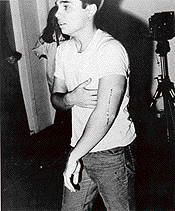
 Chris
Burden referred to those who had watched his performance of Shoot in 1971 not as spectators, but as witnesses. Tim Etchells writes in Certain
Fragments of the profound impact the term
made on the work of Forced Entertainment:
“It’s a distinction I come back to again and again and one which
contemporary performance dwells on endlessly because to witness an event is to
be present at it in some fundamentally ethical way, to feel the weight of
things and one’s own place in them, even if that place is simply, for the
moment, as an onlooker.” (Etchells, Certain Fragments17)
Chris
Burden referred to those who had watched his performance of Shoot in 1971 not as spectators, but as witnesses. Tim Etchells writes in Certain
Fragments of the profound impact the term
made on the work of Forced Entertainment:
“It’s a distinction I come back to again and again and one which
contemporary performance dwells on endlessly because to witness an event is to
be present at it in some fundamentally ethical way, to feel the weight of
things and one’s own place in them, even if that place is simply, for the
moment, as an onlooker.” (Etchells, Certain Fragments17)
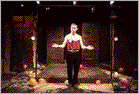 Showtime
opens with a fifteen-minute direct address
to the audience while it waits for a performance that doesn’t ever really begin
or keeps taking its costume off midway through. Lots of storms approach at the
same time. And in the beginning it is amusing, until the constant threat of
something lurking around the bend gathers enough force to impress itself on the
spectator. This kind of
accumulation is specific to the theatre, the thickening of an atmosphere, but,
watching a video of the performance some ten years later, the television screen
contains it, like a window keeping the outside out.
Showtime
opens with a fifteen-minute direct address
to the audience while it waits for a performance that doesn’t ever really begin
or keeps taking its costume off midway through. Lots of storms approach at the
same time. And in the beginning it is amusing, until the constant threat of
something lurking around the bend gathers enough force to impress itself on the
spectator. This kind of
accumulation is specific to the theatre, the thickening of an atmosphere, but,
watching a video of the performance some ten years later, the television screen
contains it, like a window keeping the outside out.
Somehow the witnessing falls apart
in the aftermath of reproduction. Philip Auslander wants to restrict the
discussion of a phenomenological experience of the live to its specifics
articulation, refusing it an ontological character different from that of the
mediated. This is not the place to
engage in a discussion with the short-comings of Auslander’s argument as a
whole, but I do want propose that the character of Showtime (and much of Forced Entertainment’s work)
instantiates a place for the ‘live’that the ‘mediated’ (or ‘mediatized’
depending on which part of Auslander’s argument one is trying to follow) cannot
quite capture. A large part of
this has to do with the fact that a body is in front of me, the tree is
screaming “Fuck off,” “Close your eyes,” telling me to leave the room.
Possibility exists here, anything could happen, not the least of which is the
realization someone could see me stifling my laugh. On the simplest level, I will be held responsible if I fall
asleep, if I avoid someone’s stare-I will be seen.
This is not to deny my specific
experience watching “Showtime” on video, feeling my own particular discomfort,
watching my present disappear in the slowly skipping decay of the video footage
on its vertical roll. But I do not
feel that I witnessed the performance and do not feel responsible for what
happened. I may feel responsible that
it did happen, just as I feel somewhat
responsible for the countless mediated events expanding across time and place
day after day, but I cannot play witness to those events. I do not offer testimony for those who
cannot speak. When the tree
gesticulates wildly, screaming obscenities against this voyeuristic craving, I
can smirk comfortably, smile at the grotesquerie of the scene. No one will see.
Tim Etchells wants the witness to
carry an image (be it visual, aural, or physical) with her out into the
streets, into the days that follow, into years, letting it form its own
calcified atmosphere about like a meaning. One should witness the event that happened and act as its
mediation with a world that can no longer have it. To have a televisual mediation fill that unique position
defeats the witness’ place as a site that stands in for, and speaks in place
of, another that cannot speak.
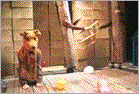 I
imagine myself in the theatre and that the dog is looking at me. In Showtime everything turns towards us and confronts us with
its cavernous cut-out eyes saying “I see you.” There may be moments of
seductive identification or empathy that draw one in to a private narrative
(the bathtub suicide, for example) but the tree interrupts us at the moment of
consummation and it tells us to stay where we are or, better yet, to
leave. In this sense, I see Showtime as a clear argument against the Baudrillardian
simulacra/obscene I discussed in an earlier writing assignment. There is not room for the witness in a
spectacular and post-spectacular world, because everything is splayed out open
for the spectator’s access, expansion, and use. Baudrillard’s ecstasy
of communication with its invitation toward
all experience and information oversteps the role of the witness as mediator to
a silent body. Here Forced
Entertainment diverges from the pure surface of their ancestors, the Wooster
Group, to present a hidden landscape behind the visible. The trees and the dog are inhabited,
live, and it is this other thing, this obscured reference, which haunts an
audience after the event. More
often than not, it is the presence of the human made inhuman on the
surface. Here we find Forced
Entertainment connecting with a tradition of performance art—the ordeal art of
Chris Burden, Gina Pane, and Linda Montano, among others—by pointedly placing
the spectator as witness in their midst.
If the earlier performance work presented the artist in pain (Burden’s Shoot), pleasure (Vito Acconci’s Seed Bed) or any number of other phenomenological situations,
does Forced Entertainment’s imperceptible straddling of the presentation and
representation of such intimacies alter the position of the witness? A question
for further consideration….
I
imagine myself in the theatre and that the dog is looking at me. In Showtime everything turns towards us and confronts us with
its cavernous cut-out eyes saying “I see you.” There may be moments of
seductive identification or empathy that draw one in to a private narrative
(the bathtub suicide, for example) but the tree interrupts us at the moment of
consummation and it tells us to stay where we are or, better yet, to
leave. In this sense, I see Showtime as a clear argument against the Baudrillardian
simulacra/obscene I discussed in an earlier writing assignment. There is not room for the witness in a
spectacular and post-spectacular world, because everything is splayed out open
for the spectator’s access, expansion, and use. Baudrillard’s ecstasy
of communication with its invitation toward
all experience and information oversteps the role of the witness as mediator to
a silent body. Here Forced
Entertainment diverges from the pure surface of their ancestors, the Wooster
Group, to present a hidden landscape behind the visible. The trees and the dog are inhabited,
live, and it is this other thing, this obscured reference, which haunts an
audience after the event. More
often than not, it is the presence of the human made inhuman on the
surface. Here we find Forced
Entertainment connecting with a tradition of performance art—the ordeal art of
Chris Burden, Gina Pane, and Linda Montano, among others—by pointedly placing
the spectator as witness in their midst.
If the earlier performance work presented the artist in pain (Burden’s Shoot), pleasure (Vito Acconci’s Seed Bed) or any number of other phenomenological situations,
does Forced Entertainment’s imperceptible straddling of the presentation and
representation of such intimacies alter the position of the witness? A question
for further consideration….