...some critics mean by post-modernism what others call avant-gardism or even neo-avant-gardism, while still others would call the same phenomenon simply modernism. This can make for inspired debates.
(Hassan, 87, hyphen in post-modernism may be due to a line break in the text)
One can very easily point at postmodernism in architecture, for instance, both synchronically as a style and diachronically as a period. The emergence of quotation and nostalgia in PoMo buildings stands in stark contrast to the abstract form of the modernist "International Style" buildings. For example:
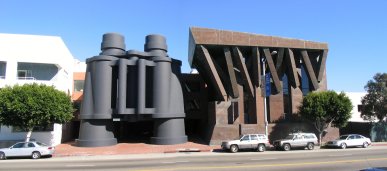 |
VS. | 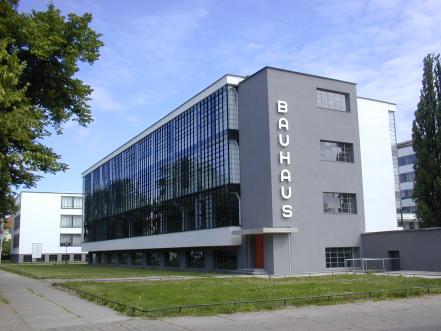 |
| Frank Gehry (w/ Claes Oldenberg) | Walter Gropius | |
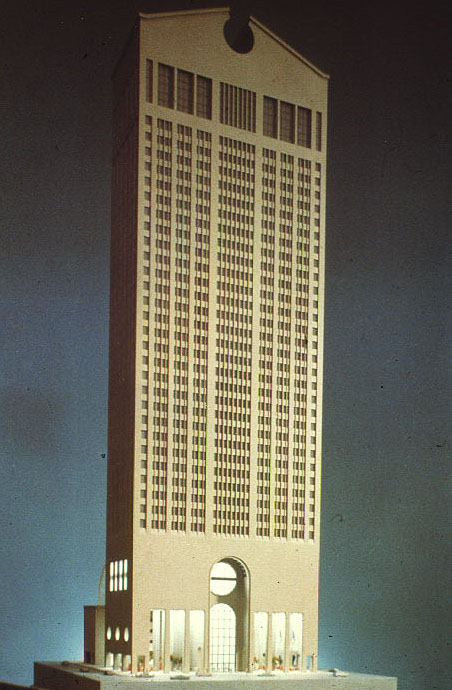 |
 |
|
| (later) Phillip Johnson | Ludwig Mies van der Rohe |
I know almost nothing about the theory and practice of architecture, but I find it quite simple to "point out" a building (or characteristics of a building) that are either modernist or post-modernist. The categories easily emerge from observing the phenomena with only a little bit of context.
In the theater, on the other hand, I have a harder time employing the term "postmodernism" for critical effect or even pointing at what is or isn't postmodern. Much of this difficulty is historical and stems from the lack of a unified sense of modernism in the theater. Post-modernism implies a reaction to, a superceding of, modernism. Part of the difficulty in finding postmodernism is the plurality of modernisms and reactions to them in the Theater. The modernisms of Stanislavski and Brecht, for instance, resonate in and of that they both seek to do away with Romantic nonsence and find a theater true to the realities of psychology and the proletariat (respectively.) Historically, however, Brecht's modernism constitutes a pretty clear and direct reaction against bourgeois modernist theaters like Stanislavski's. I don't think, however, that anyone would contend that this makes Brecht's theater post-modernist. One would probably find similar difficulties in placing the various works of Grotowski, Wedekind, Tennessee Williams, or even later Ibsen, Strindberg, and O'Neil. I have a hard time seeing any coherent, unifying Theatrical Modernism akin to the International Style of architecture that dominates so many city skylines. The grain of reaction and counter-reaction in various modes of theatricality from the mid-nineteenth through the mid-twentieth centuries makes it difficult to find any sort of sensical diacricical definition of postmodernist theater.
Of course, why should we need modernism to be a giant monolith in order to effectively define postmodernism? Because theater as a medium often works as a synthesis of other media, perhaps the theater experienced modernism and postmodernism in multiple waves as other media crossed "Great Divides." We can find postmodern architecture, for instance, in the stagings of Robert Wilson (i.e. the giant chairs in The Black Rider) One can find and point to tropes like immanence, indeterminacy, pastiche, schizophrenia, and breaking down the distinctions between high and low and try to locate PoMo that way. I have reservations about this sort of approach, however. First of all, in works like Hassan's, postmodernism is located across fields, media, and genres as diverse as architecture, literary theory, psychoanalysis, the novel, philosophy, poetry, dance, and theater (Interestingly, Hassan never puts theater on his list, but he does list a number of playwrights and Robert Wilson under writers.) This is fascinating in terms of trying to locate some sort of large-scale cultural shift taking place sometime in the first half of the 20th century—postmodernity—but what interests me more are the actual tropes that Hassan tries to mobilize to outline his idea of postmodernism. He describes a number of really fascinating trends that are much more useful to artists and audiences on their own than in trying to outline an -ism. Theatrical postmodernism doesn't constitute a school of thought in the same way that Fauvism, the Intenational Style, or even Surrealism does. If I may nitpick for a moment, perhaps sometimes "theater in postmodernity" should be substituted for "postmodern theater" because it communicates a sense of historical period without implying direct thematic or ideological links between works. Describing a work as postmodernist (or modernist, or avant-garde) invites all sorts of not terribly useful assumtions about it, yet to describe it as a schizophrenic pastiche collage of x, y, and z communicates something more, both in terms of the work itself, and in terms it's art-historical relation to other works.