JUST LIKE (HE SAYS) HE
WHAT'S
UNDERGROUND ABOUT MARSHMALLOWS?
RON VAWTER PERFORMS JACK SMITH
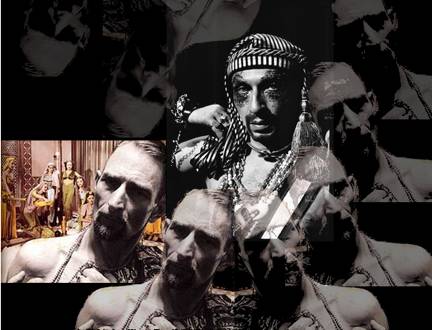
"A
lot of people say that Jack only had about twelve ideas, but that they were the
most important 12 ideas of the last 25 years. "
Ron Vawter
Ron Vawter has 12 or more important ideas, just like (he
says) Jack Smith had.
Ron Vawter takes his time. He does not mind slow pacing
and lack of tension. He does not care if something urgent is happening on the stage or not.
He is actually convinced that nothing urgent should at any time be happening on
the stage. Just like (we are supposed to believe) Jack Smith was fascinated
with unstable texts and flexible film screenings, with the desultory and the
provisional.
Ron Vawter faces a number of mishaps and delays. He fumbles and rummages and makes minor adjustments in the
composition of the set. He pays ritualistic attention to details, just like (he says) Jack
Smith did when he dressed in a fastidious way or when he handled unused
objects, refuse and junk as if they were a center of emotional and intellectual
activity.
Ron Vawter forgets his lines or reads them from a tattered script, just like (we should assume) Jack
Smith used the script as a prop, as a found object, as a part of the set.
Ron Vawter treats his stage assistant as a found object.
He interrupts the action in order to correct her or discuss with her the
placement of a prop or a light, just like (he says) Jack Smith mixed public
performances with rehearsals.
Ron Vawter fades into and out of the spectacle. He
substitutes performance for himself just like (he says) Jack Smith did by outrageously
drawing attention to his theatrical devices and the nature of his artifice.
Indeed, Ron Vawter does quite a thing just like Jack Smith
once did.
Is his project RECONSTRUCTION, REPLICA or REMAKE of Jack
Smith's performance?
If it's a reconstruction, it is an unreliable one, since
being based only on an audio recording and Vawter's own memories of Jack Smith.
If it's a replica, it is an illusionary one, like
every imaginable replica in live performing arts is.
If it's a remake, it's an underground one, since
it eschews the standard remake strategy that demands the remake to transcend
its origins by revision and reinterpretation.
Ron Vawter did not want his audience to be clear about
what kind of "re-doing" they were dealing with. Therefore, no matter
how doomed from the start his project of recreating Smith was, it is in this
ambiguous overlapping of ambition and frustration layers that lie its
integrity, strength, beauty and, paradoxically, accomplishment.
Vawter's stage appearance can never be as unmotivated and
arbitrary as Smith's. His project is not exactly Smith's project. It cannot
quite be (anti-)art redeeming the debris of everyday life because it is already
art restoring previous art. Vawter can neither reproduce the effect Smith's
stage and real life persona had on Smith's contemporaries nor escape the burden
of Smith's place in underground-turned-pop culture history. Vawter does not
offer a perverse example of Baudrillard's notion of the simulacrum, of
obsessive Warholian artistic acquisition gone horribly awry. His piece is not a
consummate postmodernist artifact a la Robert
Wilson, nor one of those high-concept commentaries on the illusion of
authorship a la Wooster
Group.
But, even if it's an unreliable reconstruction, it is
evocative. Even if it's an illusionary replica, it is nostalgic. Even if it's an
underground remake, it is respectful. This is rather an homage for "the
archive", a genuine and unusual one.
Gus Van Sant said that with his remake of Psycho (1998) he simply wanted to update
the art direction and some details to bring the picture to a generation that
was otherwise unlikely to see it. Similar motives may have incited Ron Vawter
to recreate Smith's work and persona. The only difference is that the
boundaries dividing ambitions and frustrations of reconstructing, replicating
and remaking are much more decisively intertwined in Vawter's case. His homage
contained from the start considerable self-referential additions for "the
archive".
By being ambiguously self-referential and auto-ironic,
Vawter succeeds – alas, posthumously – to neutralize and question
Arlene Croce's argument about the imperviousness of the so-called "victim
art".
Ljubi Matic
January
31, 2005
Revised: March 22, 2005