THE BLACK RIDER
Directed by Robert Wilson
Thalia Theater, Hamburg (1991)
American Conservatory Theatre, San Francisco (2004)
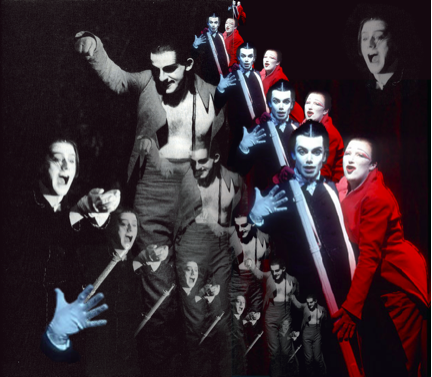
Bearing in mind the profusion of theatrical strategies
that Robert Wilson indebted XX century theatre with (language of silence, rhetoric
of movement, disjunction, discontinuity, simultaneity, dreamwork, landscape
structure) it sounds as more than a common place to say that he is one of the
world's foremost theatre innovators. However, after having seen two versions of
The Black Rider he directed, I can hardly suppress a certain, somewhat
disappointing feeling of deja vu. Is Robert Wilson's San Francisco ACT
production of The Black Rider a reconstruction , a replica or a remake of the production he
directed 13 years ago in Hamburg's Thalia Theater?
This was not the first time that Wilson directed the
same play several times in a relatively short span of time. From 1989 to 1996
he directed three versions of Virginia Woolf's Orlando (with Jutta Lampe in the
German, Isabelle Huppert in the French, and Miranda Richardson in the English
version). This time, though, he had been the initiator of the world premiere of a new dramatic,
music and scenic work. After the play had been successfully produced in a
number of diverse (mostly German) versions during the nineties, he made a redo
with a conspicuously similar approach to the characters, blocking (how
inappropriate this word sounds when used in Wilson's context) and visuals.
It is not strange that high-scale productions of some
musicals – like Cats, Les Miserables or The Phantom of the Opera – are nowadays put on
stage around the world in an increasingly similar manner. Although I do not
contend that Wilson's work is immune to this kind of clonization on the global
level, I do not intend to reiterate here discussions about the pros and cons of
the "Disneyization of theatre". On the other hand, the case of The
Black Rider
does not either belong to those postmodernist strategies that subvert the
necessity of formal innovation.
I suggest that one of the reasons why Robert Wilson's productions
are exemplary 21st-century pieces is that they postulate a social and spiritual
existence which is both rigidly controlled and uncontrollable: a quintessential
21st-century condition.
Is it the grandeur of Wilson's simplicity
("minimalism"), his disassociation of theatrical codes or the
mathematical, "control freak" precision which Wilson impregnates his
work with that makes two versions of The Black Rider seem more or less identical?
Is The Black Rider a clone, the aggregate of the "asexually" produced and
increasingly controllable progeny of an individual? Is Wilson really an
autotrophic replicator, a self-sufficient directing star who, as often claimed,
is not interested in the work of an individual actor or a particular text
itself?
Repetition is, to start with, nothing new or strange to
Wilson's work. A whole repertoire of recognizable jerks, twitches, spinnings
and other gestual foibles recur in his productions, no matter how different
they may be. Treated like objects or physical actions in his theatre, words,
syllables or even sounds are often extracted from their original contexts and
repeated ad nauseam. Oversized animal and human figures are multiplied and
Wilson often returns to the motive of the double.
So, since the replication of a whole play emphasizes
repetitive composition processes that Wilson cherishes – modulation,
imperceptible accretion, phase difference (time delay or advance of two signals
of the same frequency) – Wilson's replication strategies may simply be
seen as a prolongation of his trademark repetitive technique on a higher level.
The dynamics of simplicity, disjunction and precision do not cause but are
sustained in the parallel processes of repetition and replication.
By definition, repetition says nothing more, but this
"nothing more" is however said in different ways and it is this
difference that is snatched away from the pitfall of redundancy. So, far from
intensifying precedent occurrences, repetition actually resists them and avoids
any attempt of petrifying them into essences. It succeeds in this by
engendering perceptual resistance.
A replicated play changes, at least in the perception
of the spectator, because the spectator becomes increasingly conscious of the
utilized procedure. Either s/he perceives that a same thing is different (even
if it is not), or s/he perceives that a same thing stays the same (even if it
does not). Anyhow, s/he becomes aware of the ways in which it was transferred
from its original form of presentation. In that sense, repetition produces an
interference that makes perception, meaning and time decenter and vacillate in
doubt.
What differentiates Wilson from other theatre artists
prone to repetition and replication is that he uses the repetition to reduce
the role of spectator's anticipation and suspense. Repetition produces a
perceptual echo (and if repetitions are replicated then an echo of that echo,
and so on) to the degree of the dilution of the meaning by fracturing the
relation between the signifier and the signified.
Wilson seems intent on creating a feeling of
vacillation in his spectator who discovers a scene to be different in the very
moment when s/he thinks having rediscovered it the same. Repetition therefore
sharpens perception. If one pursues this kind of logic, one realizes soon that
those seemingly simplest scenes are hardest to rediscover in a different light
and are thus potentially most enjoyable and stimulating since requiring both
masterful memory and astute perception.
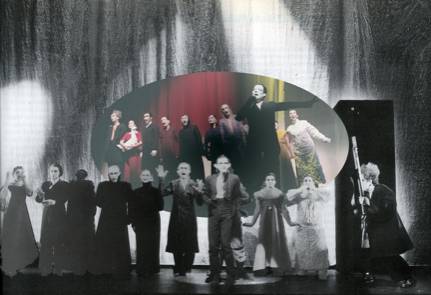 No wonder that Wilson's
prologue – where the entire company come out and just stand in a line
– turns out to be a real tour de force. Abrupt figures resembling
mechanical dolls and dissociated both from each others and from themselves,
refresh our memory about what it means to simply stand on stage. Who can detect
a needle in a haystack and at the same time surpass the gap between
spectatorial expectation and memory? A few of us, if anybody, since Wilson
would like to control what we, his spectators (or, for that matter, he
himself), cannot even perceive.
No wonder that Wilson's
prologue – where the entire company come out and just stand in a line
– turns out to be a real tour de force. Abrupt figures resembling
mechanical dolls and dissociated both from each others and from themselves,
refresh our memory about what it means to simply stand on stage. Who can detect
a needle in a haystack and at the same time surpass the gap between
spectatorial expectation and memory? A few of us, if anybody, since Wilson
would like to control what we, his spectators (or, for that matter, he
himself), cannot even perceive.
If Wilson ever makes his third version of The Black
Rider, we
may find worth focusing our spectatorial energy on fluctuations between what The
Black Rider
once was and what The Black Rider still will be. Even looking for the Black Rider in other Wilson's works may
eventually turn out to be gratifying (he just did Ibsen's Peer Gynt in Oslo).
How many times should Robert Wilson direct The Black
Rider in
order that we learn to give up from paying attention to the meaning and
"essence" of the signified object?
Ljubi
Matic
April 9, 2005