SCENIC KALEIDOSCOPE
HOUSE/LIGHTS
The Wooster Group
Dir. Elizabeth LeCompte
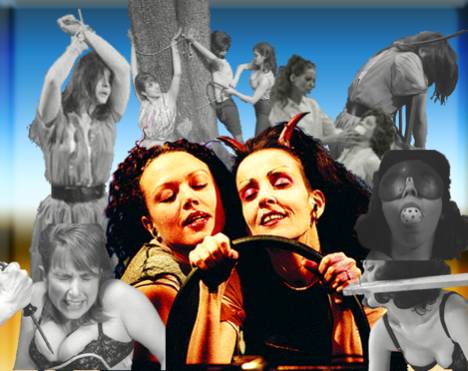
The Wooster Group’s House/Lights seems to be a "shot-by-shot" theatre
replica of the B-film classic Olga’s House of Shame (1964). Nevertheless, it cannot at
all be considered this film’s scenic remake. The Wooster Group revises the
black-and-white movie in order to look over and study it again but without any
intention to improve, correct, amend or reinterpret it nor to give its
up-to-date version. They do not at all proceed from the intention of simply
adjusting it to the taste of today’s audience nor of setting it in a new,
modernized context. What they actually do with this notoriously disreputable
movie is exactly the opposite: they juxtapose it or, to put it more precisely,
merge it with an even older textual source: Gertrude Stein’s play Doctor
Faustus Lights the Lights (1938).
This company’s long-lasting focus on contemporary
technological disembodiment uses indeed a motion picture here, but for a
completely different purpose: to displace and derange live (and very physical
at that) action.
The principle of synchronization – which is considered to be the order of the
day in the psychology-driven realistic drama and theatre – is eschewed
here. Each character represented with an agency has its own tempo of operating.
The Wooster Group’s live performers deliver their speeches behind the screen,
which, however, as they speak, shows images of asynchronous faces and voices.
We cannot determine whether we are witnessing a time-delay or visual
reverberation system, or whether we are watching a leg shot and a face shot
recorded in their entirety on another occasion. Be that as it may, stage events
start looking like the narration of a clumsily edited film with too many
missing frames projected at too rapid a speed.
The whole principle of the choreography of the piece
reproducing that of Olga’s House of Shame is all about a certain kind of specifically filmic
synchronization. However, it is asynchronization established between live and
prerecorded performance that – through alterations, deformations, and
transformations – completely effaces standard theatre syntax and
semantics and signals the spectator’s attention to the surface of the visuals
at the expense of everything else.
But House/Lights displays in addition a surprising variety of modes of
representation: live audio (on-stage and off-stage), live visual, live motoric,
prerecorded audio, prerecorded video, prerecorded motion. With the constant
vacillation about which mode is operating at any single moment, this production
gives us not so much meaning as a field that evokes the referential and
differential processes of signification.
A basic prerequisite to such an end was to blur the
borders of authorial identity. And, indeed, one of the spectatorial pleasures
on offer in this production is the process of osmosis by which different authorships
pass through thin membranes of performers’ voices and movements. The Wooster
Group does not want just to leave it to their spectators to decide whether it
will be the authorial voice of Goethe, Gertrude Stein, Joseph Mawra, Elizabeth
LeCompte, Audrey Campbell, Kate Walk, Suzy Roach or someone else from the cast
that will lead them trough the performance. The Wooster Group’s aim is more
radical. They would like to make the spectators be able to do without such a
decision.
After all, one of the overall goals of this show, which
both plays down the universality of Goethe’s epic masterwork and questions the
triviality of a trashy movie, is to conceal the authors’ “deepest feelings”.
The Wooster Group does not conceal feelings for the sake of their expulsion
from the world of the play, but in order to renounce the deceptive notion of a
“deepest feeling” that shelters the concepts of essentialism and authoritarian
authorship. This renouncement is achieved by, again, drawing excessive
attention to the surface, but this time of the text.
That’s why this theatrical sensory orgy enforces an
awareness not just of the materiality of images, but also of the primary
physical denotation of words, their sonic quality. The dazzling and dizzying
words of Stein’s play seem as if not at all to happen in the way we are used to
and have the effect of both compelling and dispelling the audience.
The Wooster Group’s emphasis on what we usually consider
to be external and material appearance and not on what we usually consider to
be its underlying reality can easily justify the seemingly random coupling of a
vocally expressive play originally written for an opera and a pornographic
movie conceived and exploited within an overbearing scopic regime.
The most fascinating outcome of House/Lights is thus a scenic kaleidoscope
emerging when the sheer materiality of voices (“borrowed” from Stein) and the
sheer materiality of images (“borrowed” from Mawra), like loose bits of colored
material put together to be amplified, echoed, fractured, replicated,
accelerated and decelerated, are eventually reflected in an endless variety of
patterns, each however independent of any perceptual regime or of any authorial
agency.
Ljubi Matic
April 9, 2005