observance
of silence and listening
in Forced
Entertainment's Showtime
 If
you observe a person or thing, you see, notice or watch them carefully. “Observe”: that's what a theatre audience
usually and quite naturally does. On the other hand, if you observe a law or custom,
you obey and follow them. A theatre audience does that also. Before, while and
after watching a show, they observe – consciously or inadvertently
– a myriad of written and unwritten laws and customs. A minute of silence
can often be seen in theatre as a part of a staged action. Seldom, though, do
theatre spectators witness a minute of silence that is supposed to be observed
“for real” on both sides of the “fourth wall.”
If
you observe a person or thing, you see, notice or watch them carefully. “Observe”: that's what a theatre audience
usually and quite naturally does. On the other hand, if you observe a law or custom,
you obey and follow them. A theatre audience does that also. Before, while and
after watching a show, they observe – consciously or inadvertently
– a myriad of written and unwritten laws and customs. A minute of silence
can often be seen in theatre as a part of a staged action. Seldom, though, do
theatre spectators witness a minute of silence that is supposed to be observed
“for real” on both sides of the “fourth wall.”
Yet, it is
precisely the observance of one minute of silence that is imposed on the
audience as a community and on each spectator separately that occurs at the
beginning of Forced Entertainment's Showtime. One minute of
not much to be seen, nor heard on stage. One minute of nothing but an
actor-cum-administrator (of this strange paratheatrical ritual) just standing
and looking at the ground in a pseudo-contrite way. Haven't they taught you,
you forced-action entertainers, that one minute of stage time spent in vain can
cost you dear?
All right, I
agree. One minute, it's not a big deal. (Are they sure it's gonna be only one?)
"So,
a minute… silence," says the guy. All right. But what am I
to do? Observe? What exactly? I could just sit pretending to do what everybody
else does (what, as a matter of fact, does everybody else do?). I could
probably think about somebody who's important or dear to me (that's what's
being suggested, but I really don't think that anyone in the audience is right
now offering their thoughts to their loved ones). I could hold a minute of
silence in respect for the victims of a tragedy or catastrophe (but I somehow
doubt that it is as a community in prayer for the strength to heal and recover
that we spectators unite in this particular moment). I could use this minute of
silence to think about the things I did today or about those I am to do after
the show or tomorrow (I am too lazy for that, I came to see the show precisely
in order to avoid my quotidian preoccupations). I could meditate (if only I
knew how to do that). I suppose this solemn moment is the perfect time to say a
prayer or two (if only I felt the slightest impulse to do that). I've got it! I
could watch other spectators and spy on them indulging in their little passions
for pity and terror. That's what I usually do when I'm bored in theatre. Except
this time, I am stuck since forced by decorum not to move my head – not even
my eyes – during
one minute full of humbleness and self-effacement. Oh, this minute seems to
curiously bother me more than numerous hours of boredom that I have so far
endured in theatre! But look, this minute of silence is dissolving right now
into laughter!
Soon I am to discover
that this rather motionless minute, with or without laughter, continues
throughout the evening. Too often I start watching a person (or the dog) who is
delivering a stage speech only to become aware that my attention is immediately
being drawn to another person (or the dog) who carefully, respectfully –
and silently – listens to the former. I can look at either of the two (I
am persuaded that I am able to choose which one to focus my gaze on), I can
look at both of them consecutively, I don't have to decide (we're not at the
movies, I don't have to observe dogmatic laws of shot-countershot sequence),
but I am somehow constantly forced to watch the listener, to observe listening itself, rather
than to watch or, for that matter, listen to the speaker. I become so deeply
absorbed by this seemingly modest sight of listening that I keep losing track
of what's being said. And finally I give up. After all, do I really care about
what's being said? As long as I can see – as long as I can observe – that
somebody else is there listening and arguably hearing.
It seems that in Showtime
the
usually coordinated and complementary stage actions of speaking and listening
interfere with and obstruct one another. Their relation is one of constant
compromise and supersession. Listening is here by no means caused by nor
subjected to speaking. It often starts before any word is pronounced at all.
The listener seldom looks at the speaker. The speaker’s text is governed not so
much by a coherent meaning, but rather by the visual composition of
conversation (loud or silent) and particularly of listening. And while one
might say that by emphasizing on-stage listening one impedes the effects of
theatrical imagery, it is much more the speech itself (i.e., the logos bearing
the meaning) that is desemanticized and deconstructed by the visually striking
listening. Although the speaker's answers to the questions (sometimes posed by
the listener) seem fairly logical, it is the questions that are posed without
recognizable motives and coherence in the first place. Taken together,
questions and answers paradoxically appear not to belong to this universe of
listening. And since the speech competes with the scenic action of listening,
which is often paired with the questioning, there is no end to questions. The
more insatiable the listening, the more resistant the speaking (and not vice
versa as we are used to).
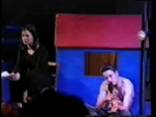 It is by a palpable fusion of the observance of silence and observance of listening that Showtime succeeds in
finding a space where to escape from the domination of scenic speech, deemed
since the birth of theatre to be of the highest rank in the hierarchy of theatre
constituents. As we can see, respectful observance can sometimes lead even to
resistance.
It is by a palpable fusion of the observance of silence and observance of listening that Showtime succeeds in
finding a space where to escape from the domination of scenic speech, deemed
since the birth of theatre to be of the highest rank in the hierarchy of theatre
constituents. As we can see, respectful observance can sometimes lead even to
resistance.
Ljubi
Matic
April 9, 2005