bent
figures
in theatre works of Goat Island
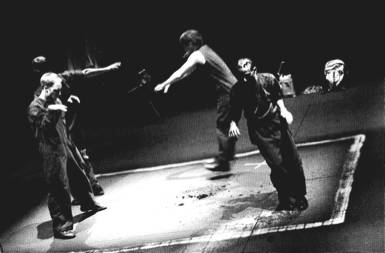
Goat Island: The Sea & Poison
One might generally say that
the dramatic theatre tends to privilege a central (or centralized) position. As
Hans-Thies Lehmann argues, extremely intimate as well as enormous scenic spaces
become potentially dangerous for the drama because the structure of dramatic
mirroring – whereby the scope of the stage functions as a mirror
that permits the beholder to recognize his own homogeneous world in the no less
self-consistent world of the drama – is endangered in both cases. “In
order this equalization and mirroring – however illusionary or
ideological they may be – to occur, mutual confinement, wholeness and
self-identification of both the worlds are needed. Only that can enable the
safety – necessary for the identification process – of the border
between the emission and the reception of the signs which a self-identified
sender exchanges with a self-identified recipient.”[1]
The theatre of Goat Island is a
theatre in which perception is not dominated by the transmission of connotative
signs and signals but by what Jerzy Grotowski called "proximity of live
organisms."
If one diminishes the distance
between performers and spectators to a degree where physical and physiological
proximities (with a heightened consciousness of breath, sweat, breathlessness,
muscle movements, twitches and gazes) overlap with and even overshadow a
certain mental meaning to be conveyed, a space of centripetal dynamics will
emerge in which the theatre itself becomes a moment rather of shared energies
than of communicated signs. Performers are then seen in close-ups, i.e., from
such a perplexing proximity that spectators cannot help but become aware of
their own corporeal presence and voyeuristic gaze, which makes them find
themselves in the sphere of physiological empathy.
However, the centripetal space of extreme intimacy is undermined in
Goat Island's production of It's An Earthquake in My Heart by the specific centrifugal
positions the four performers take throughout the show when they are supposed
to deliver the monologues oozing with the tension of their intimate confessions
and childhood memories ("I do deteriorate from the center like rotten
cabbage").
The bent postures they
take in those moments (while just standing, crawling or walking in a kind of
procession of the crooked) become the space that simply prevails over the
perception of all the other scenic elements of the production. The microphones that help them deliver their speeches
– just as the chairs they use – are barely lifted from the
ground, so that, in order to be heard, they are paradoxically forced to address
not the audience but the ground. The audience is thus usually not allowed to
see the faces of the speakers during their speeches. And the fact that they use
microphones for speaking to the audience situated barely a dozen of inches away
from them only underlines the centrifugal
forces they seem to be
inclined to. They even sing in this curved and most likely unpleasant position.
The imagery of crookedness, usually associated with ageing and infirm people,
is juxtaposed here not just with Goat Island's frantic and hectic jumps and
falls (which make the audience feel the pain in their own knee caps!), but also
with the rectilinear movement patterns and rigidly geometrical scenic space
form.
Centrifugal and centripetal
forces are, as Lehmann notes, constant threats faced by the dramatic theatre.
It is in this constant interweaving
of centripetal and cetrifugal dynamics that
Goat Island creates a postdramatic narrative of their own (if such a syntagm is
even conceivable, let alone feasible in performing arts practice).
Ljubi
Matic
April 9, 2005