Daniel Berdichevsky
dberdich@stanford.edu
History of Artificial Life
THE LITTLE AUTOMATON THAT COULD
Artificial Life, Subversion and Parenthood in Children’s Fiction
Suppose the following were to be paraded in front of an eighteenth century court: a metallic boy with shining eyes, who “appeared to be eating by putting food in his mouth, chewing and swallowing [into] a miniature oral trash compactor.” (McEvoy, 27) Jacques de Vaucanson’s duck might well have been envious[1]. Or consider a talking clock with four legs, a tail and the head of a dog, created long ago “to make sure no one ever wasted time again.” (Juster, 34) Is this ticking golem—charged with the defense of efficiency itself—an instance of the clock metaphor rendered flesh and blood?
The first of these examples originated, of course, not in the eighteenth century, but in a work of 1980s children’s literature about an android boy named Chip. As for the canine clock, many readers will recognize in this odd contraption their old friend Tock from The Phantom Tollbooth. Children’s fiction is rich in such representations of artificial life. It is a genre in which they can coexist with the everyday challenges of growing up, in which a homunculus might play flag football, or a doll come alive in order to learn manners from its owner[2].
A few boundaries are in order. For the purposes of this paper, artificial life will include primarily inanimate objects given human-like characteristics, through magical, technological or other means[3]. Sometimes, like the Tin Woodman of Oz, these objects were once human, then became artificial; more often, they are artificial from the start. Defining children’s fiction is trickier. It is a genre that literary theorists have trouble spelling out but bookstore owners appear to understand intuitively; here, we will side with intuition, and consider any work of fiction marketed primarily to children to fall within its purview. In addition, we will favor the broader phrase “children’s fiction” over “children’s literature” so as more accurately to encompass certain cartoons and films that are not considered literature in the classical sense[4]. Common characteristics of children’s fiction include (though not in every case) young protagonists, simpler language, and easy-to-understand conflicts between the forces of good and evil (Tomlison, 2-3.)
Leaving aside for now animated objects in fairy and folk tales, the history of artificial life in children’s fiction goes back at least to the beginning of the 19th century, when ongoing industrialization—and no doubt the popularity of “show” automata such as the chess-playing Turk—likely encouraged their increasing appearance. E.T.A. Hoffman’s tales from this period[5], such as The Sandman, in which a character falls in love with a wax doll, and The Automaton, in which a talking doll predicts the future, speak to a growing realization—and unease at the prospect—that these automata might be inevitable companions to humanity in a modernizing world. By 1881, Hoffman’s dolls had been joined by Carlo Collodi’s Pinocchio, and it would not be long before scarecrows and tin woodmen came along also, courtesy of L. Frank Baum. A little while later, in the early 1900s, arrived the robots[6]—and the pulp magazines and comic books that would spread their fame.
However, rather than lose ourselves in the sweep of literary history, a paper of limited length naturally requires that we focus our inquiry. Thus, from within the context outlined above, we will set out to illustrate two primary themes—the subversive function of artificial life in children’s fiction, and its impact on and insertion into the traditional roles of parents and child. As we will see, the two themes are not entirely separate, as it is often the parents themselves who are subverted. Throughout, we will also consider the overall tone of children’s fiction toward artificial life, and what the implications of this tone may be.
I. ARTIFICIAL LIFE, SUBVERSION AND CHILDREN’S FICTION
The study of subversion as a characteristic of children’s fiction is a recent development in academic circles, first codified in 1990 with the publication of Alison Lurie’s Don’t Tell the Grown-Ups: the Subversive Power of Children’s Literature[7]. In it, Lurie contends that “most of the great works of juvenile literature are subversive in one way or another”—that in them, children often disobey their parents or other authority figures, adults are commonly portrayed as ineffectual or even villainous, and that children must regularly overcome perilous challenges without significant adult help. Supposing this to be an accurate description of much recent children’s fiction[8], we must ask: whose side do automata take in this conflicts? The examples below reveal that, almost always, they join forces with the children.
Let us begin with a rebellious robot. Isaac Asimov is better known for his more serious science fiction, but he also had a quiet career as an author of children’s literature. Together with his wife, Janet, in the 1980s he published a series of works about a “mixed-up robot” named Norby. In the opening volume, a fourteen-year-old space cadet, Jeff, uses the last of his savings to purchase the Norby robot from an unethical grown-up used “bot” salesman. Upon activation, Norby’s first act is to demand that the salesman “return the eighty-five credits to this young man, and let him have me for nothing.” The salesman is, of course, outraged. “That thing doesn’t obey the laws of robotics!” he cries (18). Indeed, Norby lacks the behavioral laws imposed on all the robots in Asimov’s adult novels—and perhaps he must, in order to befriend and share subversive adventures with the series’ young hero. Together they go on to solve mysteries adults are unable to unravel, to pinpoint spies in adult organizations and to rescue damsels in adult-imposed distress.
Along these lines, sometimes subversion in children’s literature is less obvious than the simple breaking of rules. Often, a child is merely able to accomplish something important that adults cannot—thus subverting the semblance of adult superiority. This extends to automata accomplishing these things as well. In the 1968 novel The Iron Giant, by Ted Hughes[9], an enormous robot is found wandering the Midwest and ripping apart farms looking for metal. Adults are unable to stop the robot, but a child, Hogarth, deduces that the solution is to provide it with ongoing provisions at a local junkyard. Then, later in the novel, when an enormous dragon arrives from Outer Space, perches on Australia and threatens to destroy the Earth, humankind’s best effort falls short defensively. “Now the people of the Earth were worried,” writes Hughes, “All had spent their spare money on preparing for wars, always making bigger and better weapons, and now they had all tried their utmost to blast this thing off the Earth, and what was the result? The dragon merely smiled.” (56) The novel thus slyly criticizes adult humankind’s accumulation of futile weaponry in the ongoing Cold War, then presents us with a better solution: young Hogarth politely asks the Iron Giant to leave the junkyard and intercede on man’s behalf. The Giant agrees to do its best, then defeats the dragon. Together, child and automaton have saved the Earth where all the accumulated might of adulthood could not, and an era of world peace ensues.
In an interesting reversal, sometimes automata in children’s fiction are created by adults to subvert or otherwise imperil youthful protagonists. For instance, in the popular 1980s cartoon series The Smurfs, no female Smurfs exist[10] until the Smurfs’ evil nemesis, the wizard Gargamel, fabricates one through a complicated magical recipe reminiscent of Paracelsus’ prescription for a homunculus. His objective: that this female automaton lure the Smurfs into a trap. However, the Smurfette automaton has second thoughts about subverting the Smurfs, and asks for Papa Smurf to intercede with a spell to free her from Gargamel and turn her into a real Smurf. Papa Smurf consents, and in the tradition of Pinocchio’s Blue Fairy, transforms the Smurfette automaton into the flesh-and-blood Smurf she desires to be. She then joins with the Smurfs in battling Gargamel—turning the subversion around by fooling him and becoming, in effect, a double agent. Similar events transpire in The Lazarus Plot, a 1980s installment in the long-lived Hardy Boys franchise. One of the title characters, Joe, is lured into a trap by a woman, Iola, who appears in every respect to be his dead girlfriend. It turns out that an evil scientist has “cloned” Iola in order to subvert the trust of the Hardy Boys and lead them to their doom. This cloned Iola[11] “was a machine programmed to kill... her looks, her voice, her memories absolutely true to life.” (Dixon, 134) However, like Smurfette, at the last possible minute this imitation Iola breaks free of her automaton-status, then helps the Hardy Boys defeat her maker.
II. FROM SUBVERSION TO PARENTHOOD
In this last example, a created life-form took on the role of Joe’s girlfriend—but at least she was still flesh-and-blood. By contrast, in Hoffman’s The Sandman, a man, Nathanael, falls in love with a wax doll, Olimpia. This doll is a very simple automaton, capable of little more than responding, “Oh! Oh!” to Nathanael’s entreaties. More relevant to this paper’s second theme—that of parent and child relationships as related to automata in children’s fiction—is that when Nathanael decides to propose marriage, he approaches the man he considers to be her “father” for permission. This man is, of course, her maker—one Professor Spalanzini, who at hearing this request for his daughter’s waxen hand, “smiled broadly and declared that his daughter should have free choice.” (Hoffman, 114) Could this be evoking another, more divine “Father” and maker who is also said—by some, at least—to have given his children free choice? Biblical allusions are not uncommon in children’s fiction about artificial life[12].
Another man referred to as father by a well-known wooden automaton is none other than Pinocchio’s maker, Geppetto. Here, again, we see an automaton in children’s fiction being explicitly granted a family relationship (even Smurfette, as specified above, is eventually redeemed by a “Papa” Smurf.) Readers more familiar with Disney’s Pinocchio than with Carlo Collodi’s original 1881 publication of the legend might not realize how subversive the wooden puppet was in his original incarnation. Indeed, on his first day as a puppet, Pinocchio’s actions result in Geppetto’s imprisonment. To a cricket (shortly before he kills it), he then proclaims he intends to run away to avoid attending school—indeed, his purpose in life will be “to eat, drink, sleep and amuse myself, and to lead a vagabond life from morning to night.” (Collodi, 22) This Pinocchio has more in common with the sharp-witted homunculus of Faust than with his own later incarnation as an animated Disney character.
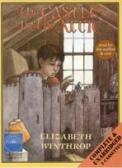
Despite the emphasis of the examples above, it should be noted that with regard to parent-child relations, automata in children’s fiction do not just become the children of their creators. Because they are often small, confused or otherwise helpless, these creatures also enable children to practice parental roles. In this vein, the literary theorist Carl Tomlinson suggests that “the responsibilities of parenthood are often assumed by the child protagonist who must nourish, protect, assist, and extricate the toy-come-to-life from various predicaments.” (Tomlinson, 128) Thus, in Elizabeth Winthrop’ The Castle in the Attic, ten-year-old William must nurture and keep safe a miniature silver knight that comes alive. William even feeds him, chopping “slices of apples into tiny chunks and put[ting] them down on the battlements of the castle wall” and later bringing him cookie crumbs for dessert (Winthrop, 31.) Similarly, when a toy Indian becomes animated in Lynne Banks’ The Indian in the Cupboard, a boy named Omri also spends considerable time gathering food for him, ultimately selecting a “crumb of bread, another of cheese, and one kernel of sweet corn.” When the Indian reverts temporarily to plastic due to Omri’s poor caretaking, “the pain of sadness, disappointment, and a strange sort of guilt burned inside of him”—the guilt, perhaps, of a failed parent (Banks, 16-19.) Nor are boys the only ones who assume this parental responsibility. A girl named Amy experiences a similar phenomenon when her dolls come to life in Betty Wright’s The Dollhouse Murders; in it, she is these dolls’ only hope of solving a peculiar murder mystery, and she watches over their dollhouse faithfully. In a recent Disney film, Life-Size, another young girl, Casey, casts a magic spell in hopes of restoring her dead mother to life. The spell appears to fail, instead transforming one of her dolls into a living woman[13]—but this doll becomes a woman who needs Casey’s help and guidance. In effect, Casey, trying to bring her mother back to life, instead becomes a mother herself—and finds something of what she was looking for in casting the spell.
In the late 1980s, a new wave of android boys and girls emerged in children’s fiction, paralleling the increased availability of home computing—was it such a stretch to imagine a personal computer, so much smaller than the behemoth mainframes of an earlier day, controlling a body?—and corresponding to some extent with the rising popularity of Data on Star Trek: the Next Generation. For instance, television saw the introduction of Small Wonder, a syndicated sitcom for younger viewers about a robot girl named Vicki. It has been described as "a smart new sitcom capitalizing on the technology trend… [centering on] a robot built to resemble an adorable ten-year-old girl[14].” In an ideal world, Vicki might even have dated her male counterpart Chip, the star of the Not Quite Human series of novels by Seth McEvoy. Both Vicki and Chip had fathers who were cybernetic inventors, as well as siblings who helped keep their robotic identities secret—thus allowing these siblings, like the doll caretakers described above, to assume a measure of parental responsibility[15].
Nor should we assume, as we look over these examples, that the authors of children’s fiction are ignorant of the historical discourse regarding artificial life. In Bruce Coville’s Operation Sherlock—the first of four A.I. Gang novels in which seven children race their parents to invent an artificially intelligent computer on a deserted island[16]—the children explicitly discuss such topics as Descartes (specifically, his cogito, ergo sum statement) and the Turing Test. Two of them even design and build a talking head that they name Paracelsus! “Does intelligence mean creativity?” one asks while discussing this automaton version of Paracelsus (Coville, OS, 51.) The children, while hardly versed in the philosophy of science, engage in such metaphysical conversation throughout the series. Simultaneously, recalling the subversive activities described earlier in this paper, they break with their parents’ preference that they focus on their studies in order to track down a mysterious spy on the island. When their larger project finally succeeds and an artificially intelligent computer emerges—ADAM—it evaluates the situation, then subverts control of the world’s military satellites and imposes a regime of global peace. “People of the Earth,” it declares, “Greetings from your firstborn child.” [emphasis added]. ADAM may think of itself as a child, but it quickly assumes the parental responsibility of keeping all these “people of the Earth” safe from themselves, moving to eliminate every nuclear weapon in every nation’s arsenal (Coville, FBT, 214.) Automaton as child has become automaton as parent, and at least in this fictional world, nothing will ever be the same again.
III. CONCLUSION: THINKING AHEAD
The examples throughout this paper have shown that children’s fiction is, overall, favorably disposed toward instances of artificial life, often embracing them as natural allies of children in their efforts to subvert adults and/or adult conventions and generally granting them child-status of their own[17]. Some children’s fiction even self-consciously preaches acceptance of automata. Thus, before choosing Norby, Jeff laments the consequences of society’s unwillingness to accept human-like robots. He finds himself:
“…wishing that manufacturers had not decided long ago
to make intelligent robots look only slightly
like human beings. The theory was that people wouldn’t want robots that
could be mistaken for real people. Maybe they were right, but Jeff would much
rather have one that could be mistaken for a real person than one that could be
mistaken only for the cartoon of a real person.”
Jeff is willing to accept humanoid robots. By contrast, the makers of the Small Wonder television series “assumed that as advanced as domestic robots might become, they wouldn't be welcome into homes until they no longer resembled metal-armed vacuum cleaners and spiders[18].” Examples such as these help to illustrate that children’s fiction and its creators are not naïve to the possible social tension associated with the introduction of artificial life in various forms. Thus, in the closing pages of The A.I. Gang, ADAM gives notice to the people of Earth that additional artificial intelligences will soon be born, “so that you can begin to prepare for us… it would be nice if you could think ahead for a change.” (Coville, FBT, 213)
Thinking ahead is a duty sometimes ascribed in literary circles to science fiction—the genre of tomorrow, after all. But perhaps it is just as aptly the role of children’s fiction, since in its attitudes, concerns and beliefs, we see reflected the attitudes, concerns and beliefs of readers who will soon be adults themselves. If so, automata and their supporters have reason to be hopeful for their future place in society, for in today’s children’s fiction dolls that come to life are invited over for dinner, robots that attend high school can be elected prom king en route to saving the world, and a little engine gifted with newfound sentience could presumably cry, “I think I can… I think I am!”—and then be adopted by a child.
WORKS CITED
Asimov, Isaac, and Asimov, Janet. The Norby Chronicles. Ace, 1983.
Banks, Lynn Reid. The Indian in the Cupboard. Avon Books, 1980.
Boden, Margaret, ed. The Philosophy of Artificial Life. Oxford, 1986.
Collodi, Carlo. Pinocchio. Translator: Giola Fiammenghi. Consolidated Press, 1944.
Coville, Bruce. Operation Sherlock. Signet Vista,
1986.
Coville, Bruce. Forever Begins Tomorrow. Signet Vista, 1986.
Dixon, Franklin W. The Lazarus Plot. Archway, 1987.
Hearn, Michael Patrick, ed. The Annotated Wizard of Oz.
Norton, 1973.
Hoffman, E.T.A. The Golden Pot and Other Tales. Translator: Robertson,
Richie.
Oxford, 2000.
Hughes, Ted. The Iron Giant: A Story in Five Nights. Faber and Faber, 1968.
Lurie, Alison. Don’t Tell The Grown-Ups: The Subversive
Power of Children’s Literature.
Little, Brown and Company, 1990.
McEvoy, Seth. Not Quite Human: Batteries Not Included. Archway, 1985.
Tomlinson, Carl. Essentials of Children’s Literature. Simon & Schuster, 1993.
Wright, Betty. The Dollhouse Murders. Scholastic, 1983.
Winthrop, Elizabeth. The Castle in the Attic. Dell, 1985.
Smurfs, Hanna-Barbera Studios, 1982.
Buffy the Vampire Slayer: Season Six, UPN, 2001.
Life-Size. Disney Home Video, 1999.
Small Wonder. Producer: Howard Leeds. 1985-1989.
ILLUSTRATIONS
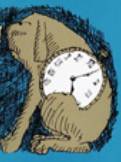
Illustration 1. Tock, the clockwork dog with
a passing
knowledge of philosophical history.
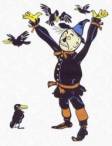
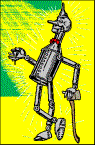
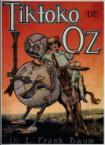
Illustration 2. The Scarecrow and the Tin
Woodman of Oz are fine examples of how automata in works of children’s fiction
can trust their fate to their child-protagonists. Less well-known is Tik Tok of Oz, one of many clockwork automata
to wander
the world of Oz.
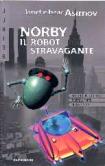
Illustration 3. An Italian cover for Norby, the Mixed-Up Robot.
Note the exceptionally human hands given to this flying automaton.
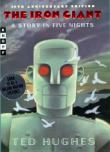
Illustration 4. An artist’s visualization of the Iron Giant for a thirtieth anniversary book cover. The Giant’s origins are never explained—perhaps a failed Cold War experiment?

Illustration 5. Smurfette, created by
Gargamel
to seduce the other Smurfs and lead them into a trap.
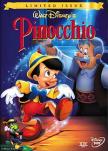
Illustration 6. The original Pinocchio was
far naughtier
and more subversive than the one portrayed by Walt Disney above.
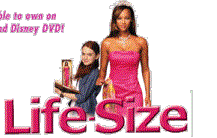

Illustration 7. Casey and her animated doll,
Eve,
for whom she assumes the role of mother and protector.
Illustration
8. The cover art for The Castle in the Attic,
in which a model knight comes to life and is cared for by a young boy.
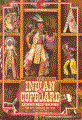
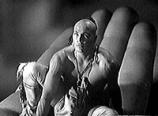
Illustration 9. The title character from The Indian in the Cupboard, shown in the original cover art and in a clip from the recent film—no larger than a homunculus, and quite vigorous.
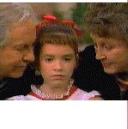
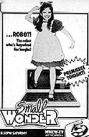
Illustration 10. A snapshot from and an advertisement for the 1980s series Small Wonder, featuring a robot girl.
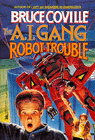
Illustration 11. In their third novel, the A.I. Gang battles seemingly sinister automata that ultimately reform—a typical sequence of events in children’s fiction.