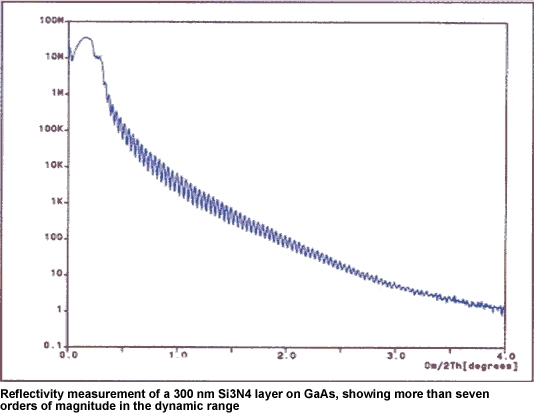
Reflectivity
Simulating Reflectivity Curves
This simulation program makes use of the Parrat formalism for reflectivity [1]. The approach used is detailed in [2,3].
The key parameters in the equations are those that define the refractive index and linear absorption as a function of depth (materials parameters), and those that define the incident beam characteristics (instrumental parameters). For each angle of incidence the relative reflected intensity is calculated following a recursive formula that combines the reflected and transmitted amplitudes layer-by-layer throughout the whole sample depth.
Automatic Fitting of Reflectivity Curves
The principle behind automatic fitting is as follows:
The simulated and measured data are compared.
The differences between the intensities of each measured and simulated point are summed over all points, to give a “fit value” (also called a “Chi” value).
One of the input parameters is then changed and a new fit value is obtained, if the new fit value is better than before, the new input parameter value is adopted. If the new fit value is worse, the original parameter value is maintained.
A new parameter change is tried and on the basis of the fit, is adopted or rejected.
The whole process is repeated for all possible parameter values until the best fit is obtained.
In automated fitting, the sample structure properties (layer density, thickness and roughness) and the instrumental details (background, divergence and intensity) can all be changed, but the materials data remain fixed as they are in the materials database.
References:
X'Pert Reflectivity Quick
Start Guide.
1. L.G. Parratt, Phys. Rev. 95, 372 (1954).
2. P.F. Fewster, X-ray Scattering from Semiconductors
(Imperial College Press, London, 2000).
3. P.F Fewster, Rep. Prog. Phys. 59, 1339 (1996).