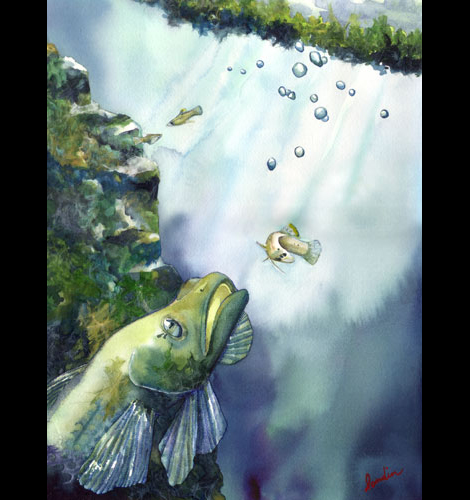
Bahamian “blue holes” are vertical caves that filled with water during the last 15,000 years. During this time, a few species of fish colonized them. Some blue holes support only the endemic Bahamas Mosquitofish; some contain mosquitofish and a larger predatory fish, the Bigmouth Sleeper.
Dr. Brian Langerhans studies mosquitofish evolution in these habitats. Without predators, their populations are dense, and they’ve evolved a sleek, streamlined body shape, an energy-efficient form for foraging.
However, in habitats with predators, mosquitofish evolved a robust body shape which enables them to quickly flit away from the sleeper.
keywords: adaptive radiation, insular populations, fishes
Original Caption: Bahamian “blue holes” are vertical caves that filled with water during the last 15,000 years. During this time, a few species of fish colonized these blue holes. Some blue holes support only the endemic Bahamas mosquitofish (Gambusia hubbsi); some contain mosquitofish and a larger predatory fish, the bigmouth sleeper (Gobiomorus dormitor).
Dr. Brian Langerhans studies mosquitofish evolution in these habitats. Without predators,
mosquitofish populations are dense, and they’ve evolved a sleek, streamlined body shape, an energy-efficient form for foraging.
However, in habitats with predators, mosquitofish evolved a robust body shape which enables them to quickly flit away from the sleeper. |