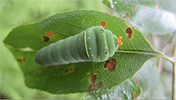
Appendix 1. Twenty-five Examples of Larva/Adult Resemblances
A yellow and black outline highlights the resemblance in the “Resemblance Outlined ” column. The “Adult Caption” column notes the resemblance. The “Larva Caption” column provides available instar and foodplant information.
This material is from Darryl Wheye and Paul R. Ehrlich's 2015 article, Are there caterpillars on butterfly wings? (News of the Lepidopterists' Society, Winter, Vol. 57(4) pp. 182-193). It is presented here so you can click on the photos of the adults and larvae for larger images. |
| # |
|
|
Adult Resemblance Outlined |
Adult Caption |
Larva |
Larva Caption |
| Papilionidae (3) |
1 |
♀ |
Heraclides anchisiades idaeus
Ruby-spotted Swallowtail
|

© 2007 Andrew Warren |
|
The pink and black dorsal hindwing larval band resembles early instar larvae, which are gregarious.
|
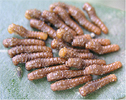
© 2007 Dan Hardy |
The instar is not noted on the photograph. Later instars are darker. |
|
2 |
♀ |
Papilio glaucous
Eastern Tiger swallowtail |
© 2008 Kim Davis, Mike Stangeland, and Andrew Warren |
|
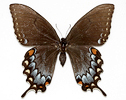
This example is from our text. The lower end of the pale blue
green dorsal hindwing larval band has an orange spot that
resembles the partially ever-ted orange osmiteria that lar-
vae display defensively. When alive, forewings cover the upper hindwing orange spot and complete the larval resemblance. |
© Michael Singer |
This photo is from a study of herbivore diet breadth vs. bird
predation. Read more at: http://phys.org/news/2014-07-eaters-eaten.html#j. The instar is not noted on the photograph. |
|
3 |
♀ |
Parides photinus
Pink-spotted Cattleheart |
© 2008 David Robacker |
|
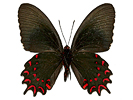
This example is from our text. The pink marks on the ventral hindwing larval band and white marks on the wing edge resemble, to a degree, the pink and white larval spines. |
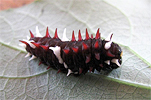
© 2009 Luc Legal, Jerome Labre & Oscar Dorado |
The foodplant is Aristolochia splendens. The instar is not noted on the photograph. |
|
| Pieridae (1) |
4 |
♀ |
Anthocharis sara thoosa
Sara Orangetip |
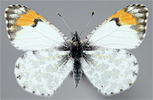
© 2009 Jim P. Brock |
|
The pale orange “tip” of the dorsal forewing and the black mark on the discal cell edge seems to parallel pairing of the orange larva and its black eyes. |
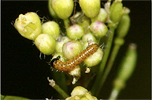
© 2010 Jim P. Brock |
First instar is orange with a few bristles. |
|
| Lycaenidae (4) |
5 |
♂ |
Theritas mavors
Deep-green Hairstreak |
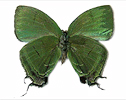
© 2010 D.H. Janzen and W. Hallwachs voucher code 09-SRNP-71199, http://
janzen.bio.upenn.edu/
caterpillars/database.lasso |
|
There is a fairly strong resemblance between the color and shape of the larva and the ventral hindwing “larval band.” |
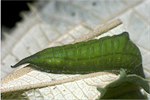
© 2010 D.H. Janzen and W. Hallwachs
voucher code 04-SRNP-41639, http://
janzen.bio.upenn.edu/caterpillars/
database.lasso |
Last Instar. The food-plant is Conostegia xalapensis. |
|
6 |
♀ |
Callophrys mcfarlandi
Sandia Hairstreak |

© 2009 Jim P. Brock |
|
The pale yellowish-greenish ventral hindwing “larval band” resembles a larva. |
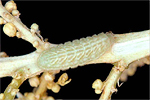
© 2010 Jim P. Brock |
The instar is not noted on the photograph. Coloration might be influenced by camera and available light (note the black background). |
|
7 |
♀ |
Euphilotes ellisii ellisii
Ellis' Blue |
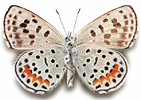
© 2008 Kim Davis, Mike Stangeland
and Andrew Warren |
|
The orange-pink ventral hindwing “larval band” resembles the larva, but
some photos the larvae are very pale. |

© 2011 Nicky Davis |
The larva is on Eriogonum corymbosum. The instar is not noted on the photograph. |
|
8 |
♀ |
Euphilotes spaldingi spaldingi
Spalding's Blue Euphilo |
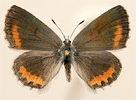
© 2008 Todd Stout |
|
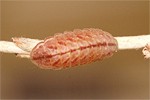
The orange ventral hindwing “larval band” resembles, to a degree, prediapause a 4th instar larva. |
© 2008 Todd Stout |
The 4th instar, prediapause larva is pale orangish-pinkish-reddish with darker marks. |
|
| Riodinidae (5) |
9 |
♂ |
Euselasia pellonia pellonia
Red-rimmed Euselasia |
© 2014 Jim P. Brock |
|
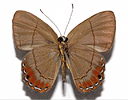
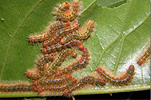
The aposematic orange-red ventral hindwing “larval band” with black spots and white marks resembles, to a degree, a black-spotted, greenish-orange larva. |
© 2010D.H. Janzen and W. Hallwachs
voucher code 04-SRNP-2598, http://
janzen.bio.upenn.edu/caterpillars/
database.lasso |
This instar is greenish-orange with black spots and pale bristles. The foodplant is Vochysia guatemalensis. |
|
10 |
♂ |
Hades noctula
White-rayed Metalmark |

© 2010 D.H. Janzen and W. Hallwachs voucher code 01-SRNP-2576.03, http://janzen.bio.upenn.edu/ caterpillars/database.lasso |
|
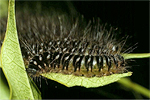
The outer half of the black and white “ray” patterned ventral hindwing resembles, to a degree, a last instar larva. This pattern seems consistent with Nijout’s “intervenous stripe system”. |
© 2010 D.H. Janzen and W. Hallwachs
voucher code 01-SRNP-2576, http://
janzen.bio.upenn.edu/caterpillars/
database.lasso |
The last instar has long bristles and black/whitish-greenish “rays”. The foodplant is Tapirira mexicana. |
|
11 |
♂ |
Esthemopsis pherephatte pherephatte
Godart's Metalmark |
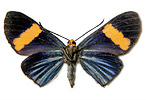
© 2010 D.H. Janzen and W. Hallwachs voucher code 01-SRNP-2685, http://
janzen.bio.upenn.edu/ caterpillars/database.lasso
|
|
The aposematic yellow patch on the blackish blue ventral forewing resembles a last instar larva, minus the black dots. |
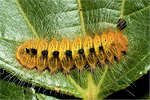
© 2010 D.H. Janzen and W. Hallwachs
voucher code 01-SRNP-2685, http://
janzen.bio.upenn.edu/caterpillars/
database.lasso |
Last instar larvae are
yellow with black bris-
tles (that look like dots from above) and long pale bristles along the edge. The foodplant is Trichospermum grewiifolium. |
|
12 |
♂ |
Pirascca tyriotes
Golden-banded Metalmark |
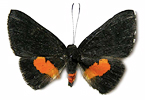
© 2010 D.H. Janzen and W. Hallwachs voucher code 08-SRNP-72467, http://janzen.bio.upenn.edu/ caterpillars/database.lasso |
|
The aposematic orange patch on the black dorsal hindwing resembles a penultimate instar larva. |
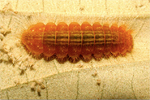
© 2011 D.H. Janzen and W. Hallwachs
voucher code 08-SRNP-72573, http://
janzen.bio.upenn.edu/caterpillars/
database.lasso |
The penultimate instar is orange with long pale bristles along the edge. The foodplant is Miconia argentea. |
|
13 |
♂ |
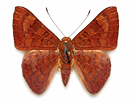
Emesis mandana
Variable emesis |
© 2010 Kim Davis, Mike Stangeland and Andrew Warren |
|
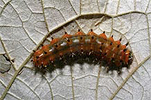
This example is from our text. The resemblance is seen along both dorsal wing margins. |
© Daniel Janzen and W. Hallwachs,
voucher code 05-SRNP-63174, http://
janzen.bio.upenn.edu/caterpillars/
database.lasso |
Penultimate instar is greenish orange with irritating bristles growing from short black spines that resemble the black dots on the wing margins. The foodplant is Croton yucatanensis. |
|
| Nymphalidae (9) |
14 |
♀ |
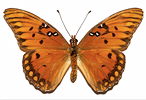
Agraulis vanillae incarnata
Gulf Fritillary |
© 2009 Jim P. Brock |
|
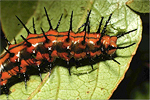
The orange and dark brown dorsal hindwing “larval band” resembles, to a degree, a last instar larva. |
© 2010 D.H. Janzen and W. Hallwachs
voucher code 00-SRNP-16240, http://
janzen.bio.upenn.edu/caterpillars/
database.lasso |
The last instar of this orange and black larva has long black spines with black bristles. The foodplant is Passiflora foetida. |
|
|
|
|
|
|
|
|
15 |
|
Dione juno huascuma
Juno Longwing |
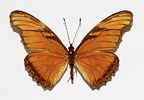
© 2005 Kim Davis and Mike Stangeland kimandmikeontheroad.com
|
|
The orange and black dorsal hindwing “larval band” resembles, to a degree, a last instar larva. This is more evident in some photographs than in others. |
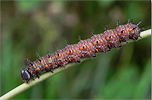
© 2011 Kenji Nishida |
The last instar is orange and purplish-brown with black spines and bristles. The larva is on Passiflora edulis. |
|
|
|
|
|
|
|
|
16 |
♀ |
Heliconius sara theudela
Sara Longwing |
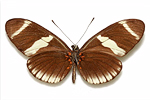
© 2009 Kim Davis, Mike Stangeland
and Andrew Warren |
|
The brown ventral hindwing has red dots near the body. The dark segmentation lines on the white “larval band” resembles, to a degree, the segmentation pattern and might even call to mind the long black spines of a third instar larva. |
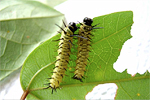
© 2011 Rudy Dodero |
Third instar larvae are whitish with black spines. |
|
17 |
|
Adelpha tracta
Tracta Sister |
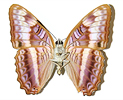
© 2011 D.H. Janzen and W. Hallwachs voucher code 05-SRNP-35693, http://janzen.bio.upenn.edu/ caterpillars/
database.lasso
|
|
The rusty pinkish-mauve patterned ventral hindwing “larval band” resembles a penultimate instar larva. |
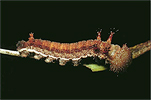
© 2010 D.H. Janzen and W. Hallwachs |
The penultimate instar matches the adult relatively well. The foodplant is Viburnum venustum. |
|
18 |
♀ |
Hamadryas guatemalena marmarice
Guatamalan Cracker |
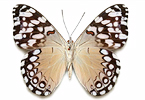
© 2011 Andrew D. Warren
|
|
The black and white patterned ventral hindwing margin is probably aposematic and, to a degree, resembles the larva. |

© 2010 Jim P. Brock |
This white, black and yellow -- and presuma-bly aposematic -- larva
has black spines and black bristles. The instar is not noted on the photograph. It was photographed on Dalechampia. |
|
19 |
♀ |
Vanessa annabella
West Coast Lady |

© 2009 Andrew Warren
|
 |
The complex beige, bright and pale orange, pale blue, black, light and dark brown pattern on the ventral hindwing “larval band” resembles, to a degree, the complex pattern of the larva. |
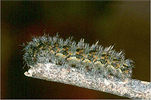
© 2009 Jim P. Brock |
The instar of this bright and pale orange and black larva with grey bristles is not noted on the photograph. |
|
20 |
♀ |
Chlosyne fulvia coronado
Fulvia Checkerspot |

© 2009 Jim P. Brock |
|
The dark brown, orange, pale orange, and white dorsal hindwing “larval band” resembles the larva. |

© 2009 Kim Davis and Mike Stangeland |
This blackish-brown, pale orange and white larva has black-spines and black-bristles. The instar is not noted on the photograph. |
|
21 |
♂ |
Poladryas minuta minuta
Dotted Checkerspot |

© 2010 Andrew D. Warren |
|
The basically orange ventral hindwing “larval band” has some dark dots and resembles the black-dotted, black-spined larva. |

© 2011 Jim P. Brock |
The instar is not noted on the photograph. |
|
22 |
♂ |
Calisto muripetens
Muripetens Calisto |
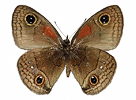
© 2014 Rayner Nuñez |
|
Except for the rust-ringed false eye, the pale brown ventral hindwing “larval band” with black, cream, and beige marks resemble, to a degree, the brown-patterned larva. |
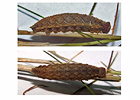
© 2014 Rayner Nuñez |
The instar is not noted on the photograph. |
|
| Hesperiidae (3) |
23 |
♀ |
Aguna asander asander
Gold-spotted Aguna |

© 2009 Kim Davis, Mike Stangeland, and Andrew Warren |
|
The light mauve, rust, white, cream and beige ventral hindwing “larval band” is bordered on one end by a rust-colored triangle and resembles, to a degree, a last instar larva. |
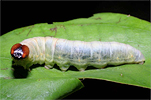
© 2011 D.H. Janzen and W. Hallwachs |
The last instar larva has rust-colored eyes and a cream-colored body. It was photographed on Bauhinia ungulata. |
|
24 |
♂ |
Zestusa dorus
Short-tailed Skipper (Northern Zestusa) |
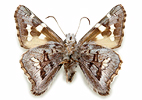
© 2009 Andrew D. Warren |
|
The light grey and creamy-grey ventral hindwing “larval band” resembles a penultimate instar larva. |
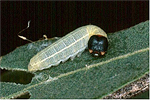
© 2010 Jim P. Brock |
The penultimate instar is creamy-grey with pale yellow stripes. A greenish cast—the color of the leaf--seems to show through the skin. |
|
25 |
♂ |
Eantis papinianus
Cuban Sicklewing |
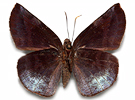
© 2009 Kim Davis, Mike Stangeland,
and Andrew Warren |
|
The whitish pale bluish ventral hindwing “larval band” resembles the fifth instar larva. |
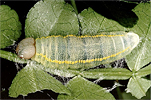
© 2010 Andrei Sourakov |
The fifth instar has a pale bluish-green cast showing through the skin. The pale yellow stripes and cream-colored head seem similar to the pale patch on the ventral hindwing. First instar larvae have a dark head. Larva photographed on Citrus. |
|