Archive for the ‘New Resources’ Category

IUPAC Glossary of Terms Used in Biomolecular Screening

Friday, June 5th, 2009

Glossary of Terms Used in Biomolecular Screening

Provisional Recommendations
Comments by 30 September 2009

Biomolecular Screening is now a crucial component of the drug discovery process and this Glossary of Terms will be of use to practitioners in the field of screening and to those who interact with the screening community. The glossary contains definitions related to various aspects of the screening process such as assay types, data handling and relevant technologies. Many of the terms used in this discipline are not covered by existing glossaries, and in the cases they are, the definitions are often not appropriate for this field. This document provides new or modified definitions to better reflect the new context. The field of Biomolecular Screening is multidisciplinary in nature and this glossary containing authoritative definitions will be useful not only for regular practitioners, but also for those who make use of the data generated during the screening process.

Download full text of the Provisional Recommendations (pdf file — 281KB)

(more…)

Publishers Allow More Than Authors Think

Friday, June 5th, 2009

“Publishers’ agreements are more liberal than journal authors think, but do not allow self-archiving of the published PDF.

The Publishing Research Consortium has published another in its series of reports: Journal Authors’ Rights: perception and reality (Summary Paper 5).

Using re-analysis of the recently published ALPSP report Scholarly Publishing Practice 3 (which looks at the practice of 181 publishers, representing 75% of all articles), and a new survey of 1163 authors, the report compares what publishers actually allow authors to do with the different versions of their manuscript, and what they want to do and believe they are permitted to do.

(more…)

Strengthening High School Chemistry Education

Friday, June 5th, 2009

Strengthening High School Chemistry Education Through Teacher Outreach Programs: A Workshop Summary to the Chemical Sciences Roundtable

strengthening_hs_chem

Authors:
Steve Olson, Rapporteur; Chemical Sciences Roundtable; National Research Council

Publisher’s Description:
A strong chemical workforce in the United States will be essential to the ability to address many issues of societal concern in the future, including demand for renewable energy, more advanced materials, and more sophisticated pharmaceuticals. High school chemistry teachers have a critical role to play in engaging and supporting the chemical workforce of the future, but they must be sufficiently knowledgeable and skilled to produce the levels of scientific literacy that students need to succeed.

(more…)

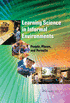
Learning Science in Informal Environments

Friday, June 5th, 2009

Learning Science in Informal Environments: People, Places, and Pursuits

learning_science

Authors:
Philip Bell, Bruce Lewenstein, Andrew W. Shouse, and Michael A. Feder, Editors, Committee on Learning Science in Informal Environments, National Research Council

Publisher’s Description:
Informal science is a burgeoning field that operates across a broad range of venues and envisages learning outcomes for individuals, schools, families, and society. The evidence base that describes informal science, its promise, and effects is informed by a range of disciplines and perspectives, including field-based research, visitor studies, and psychological and anthropological studies of learning.

(more…)

Gender Differences at Critical Transitions

Friday, June 5th, 2009

Gender Differences at Critical Transitions in the Careers of Science, Engineering and Mathematics Faculty

gender_differences

Authors:
Committee on Gender Differences in the Careers of Science, Engineering, and Mathematics Faculty; Committee on Women in Science, Engineering, and Medicine; National Research Council

Publisher’s Description:
Gender Differences in the Careers of Science, Engineering, and Mathematics Faculty presents new and surprising findings about career differences between female and male full-time, tenure-track, and tenured faculty in science, engineering, and mathematics at the nation’s top research universities. Much of this congressionally mandated book is based on two unique surveys of faculty and departments at major U.S. research universities in six fields: biology, chemistry, civil engineering, electrical engineering, mathematics, and physics. A departmental survey collected information on departmental policies, recent tenure and promotion cases, and recent hires in almost 500 departments. A faculty survey gathered information from a stratified, random sample of about 1,800 faculty on demographic characteristics, employment experiences, the allocation of institutional resources such as laboratory space, professional activities, and scholarly productivity.

(more…)

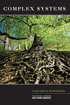
Complex Systems

Friday, June 5th, 2009

The National Academies Keck Futures Initiative: Complex Systems: Task Group Summaries

complex_systems

Authors:
The National Academies Keck Futures Initiatives

Publisher’s Description:
The National Academies Keck Futures Initiative was launched in 2003 to stimulate new modes of scientific inquiry and break down the conceptual and institutional barriers to interdisciplinary research. At the Conference on Complex Systems, participants were divided into twelve interdisciplinary working groups. The groups spent nine hours over two days exploring diverse challenges at the interface of science, engineering, and medicine.

(more…)

Frontiers of Engineering

Friday, June 5th, 2009

Frontiers of Engineering: Reports on Leading-Edge Engineering from the 2008 Symposium

frontiers_engineering

Authors:
National Academy of Engineering

Publisher’s Description:
Every year at the U.S. Frontiers of Engineering Symposium, 100 of this country’s best and brightest engineers, ages 30 to 45, have an opportunity to learn from their peers about pioneering work being done in many areas of engineering. The symposium gives early career engineers working in academia, industry, and government in many different engineering disciplines an opportunity to make contacts with and learn from individuals they would not meet in the usual round of professional meetings. This networking may lead to collaborative work and facilitate the transfer of new techniques and approaches. It is hoped that the exchange of information on current developments in many fields of engineering will lead to insights that may be applicable in specific disciplines and thereby build U.S. innovative capacity. Different topics are covered each year, and, with a few exceptions, different individuals participate.

(more…)

Catalysis for Energy

Friday, June 5th, 2009

Catalysis for Energy: Fundamental Science and Long-Term Impacts of the U.S. Department of Energy Basic Energy Science Catalysis Science Program

catalysis_energy

Authors:
Committee on the Review of the Basic Energy Sciences, Catalysis Science Program, National Research Council

Publisher’s Description:
This book presents an in-depth analysis of the investment in catalysis basic research by the U.S. Department of Energy (DOE) Office of Basic Energy Sciences (BES) Catalysis Science Program. Catalysis is essential to our ability to control chemical reactions, including those involved in energy transformations. Catalysis is therefore integral to current and future energy solutions, such as the environmentally benign use of hydrocarbons and new energy sources (such as biomass and solar energy) and new efficient energy systems (such as fuel cells).

(more…)

New Edition of “On Being a Scientist”

Friday, June 5th, 2009

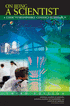
On Being a Scientist: Third Edition

being_scientist

Authors:
Committee on Science, Engineering, and Public Policy, National Academy of Sciences, National Academy of Engineering, and Institute of Medicine

Publisher’s Description:
The scientific research enterprise is built on a foundation of trust. Scientists trust that the results reported by others are valid. Society trusts that the results of research reflect an honest attempt by scientists to describe the world accurately and without bias. But this trust will endure only if the scientific community devotes itself to exemplifying and transmitting the values associated with ethical scientific conduct.

(more…)

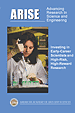
ARISE: Advancing Research in Science and Engineering

Friday, June 5th, 2009

Investing in Early-Career Scientists and High-Risk, High-Reward Research

arise

The American Academy of Arts and Sciences is pleased to release ARISE: Advancing Research in Science and Engineering, a white paper from the Academy’s Initiative for Science, Engineering, and Technology.

The ARISE report addresses two issues central to the vitality of America’s research enterprise: 1) the support of early-career investigators; and 2) the encouragement of high-risk, high-reward research. Such support and encouragement will foster a new generation of scientists and stimulate the daring investigations that will generate competitive advantage in a global economy.

Publication Year: 2008
Size: 69 Pages, 8.5 x 11
ISBN: 0-87724-071-X