An evolutionarily "old pathogen," Bornavirus is uncommonly
genetically stable and contains highly conserved sequences. A
member of the order Mononegavirales, it is most closely
related to Paramyxoviridae and Rhabdoviridae. Although
bornavirus has long been thought to be a classical animal virus, it has
been shown to also be linked to human psychiatric disorders, including
schizophrenia, paranoid psychosis and major depression. In animals,
bornavirus is known to persist in the limbic system, a subarea of the
central nervous system. The limbic system is known to affect mood,
behavior, and memory. Hence, bornavirus was dubbed "sad horse disease"
before it was known to have a large animal reservoir. Bornavirus is
presently thought to be able to infect all mammals, including humans.
As of yet, the virus has not been found in any other type of animals, such
as birds, reptiles, or amphibians.
Neurons,
where Borna persists
Pathogenesis
The clinical disease is still uncommon so that its pathophysiology
is only partially understood. BDV is unusual in that it can exhibit
lifelong
persistence with short periods of activation and long periods of latency.
For horses and sheep, its period of incubation is estimated to be
approximately four weeks. The virus is thought to be spread by direct
contact and exposure to the virus via saliva and nasal secretions. The
olfactory route of transmission was proposed because intranasal infection
is efficient and the olfactory bulbs of naturally infected horses show
inflammation early in the disease. Experimentally, bornavirus can be
induced by intracerebral injection or nasal innoculation. In
experimentally infected animals, viral gene products are found in the
saliva, urine and feces. Once in the body, bornavirus is capable of
infecting all cell lines, but is primarily neurotropic. The agent enters
the axons of peripheral nerves and spreads throughout the central nervous
system. The way bornavirus effects the moods of its hosts is by
targeting the limbic and hypothalamic regions. Although the exact
neural mechanisms are unknown, bornavirus has been shown to cause changes
in dopamine transmission. Although most bornavirus infections are
subclinical, some infected horses and sheep are characterized by agitated
aggressive behavior, which lasts for weeks, and progresses to paralysis
and inanition. Although it is fatal in sheep and horses, borna disease
virus is
non-fatal in rats. Infected rats exhibit hyperactivity and exaggerated
startle responses during the inflammation period. After several weeks,
the virus persists and the animals begin to show stereotyped motor
behavior, dyskinesias, and dystonias. After infection of the central
nervous system, borna has been shown to progress to ganglia and the
peripheral nerves.
Treatment and Prevention
Treatment
for Borna is currently unknown although a recent study found that
ribavirin inhibits borna replication, in the transcription step, at
concentrations of 1-10 micrograms/ml in persistently infected
cells. Conventional immunization with inactivated virus or purified
virus-specific antigen does not provide immunity to clinical disease.
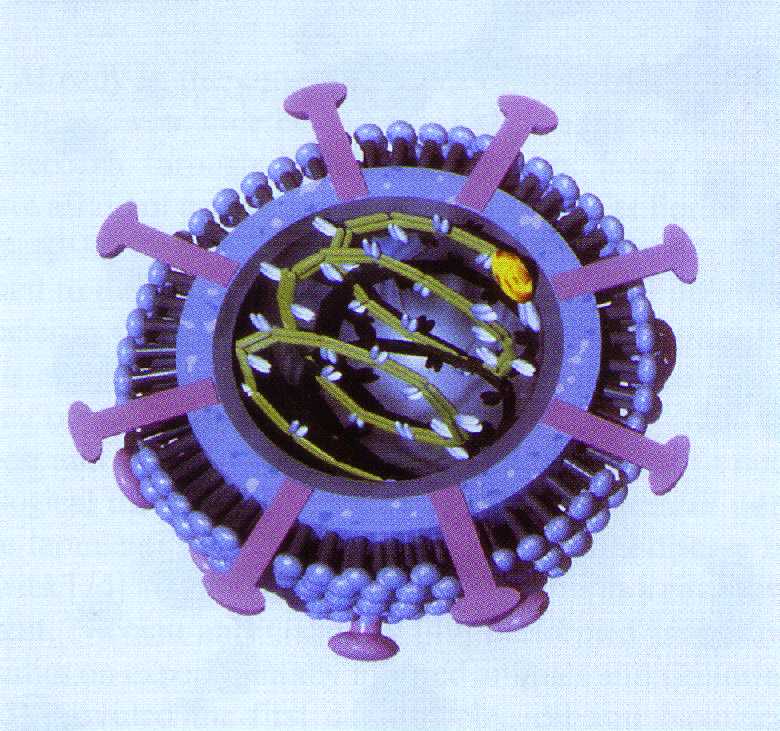
Structure and Morphology
Particles spherical, enveloped and 130 nm in
diameter.
Spikes 7 nm in
length.
Thin
Nucleocapsid 4 nm in width.
Classification
Monopartite
Helical Capsid Morphology
Negative-stranded, single stranded 8.9 kbRNA
Enveloped
Spherical
Nuclear localization for replication and transcri ption
Posttranslational modification of subgenomic RNAs
Non-lytic
Non-cytopathogenic
Neurotropic
Computer-Generated Model of
Bornavirus:
*taken from:Ludwig and Bode, Intervirology 1997;40:188.