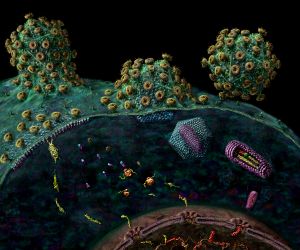
RETROVIRUSES
INTRODUCTION
The Retroviruses are a unique
RNA virus family, known most famously for their penchant for violating the
Central Dogma of Biology by not only synthesizing DNA from their RNA genomes,
but also by replicating their RNA genomes. The unique lifestyle of the retrovirus
involves two life forms, a DNA provirus and an RNA-containing infectious
virion. The nucleocapsid has a helical morphology; however, it isn’t
strictly helical since one end of the helix is wider than the other. These
particles are spherical since they’re enveloped and they bud from the
host cell surface. Many heavily glycosylated envelope proteins can be found
on the virus surface, and these proteins play an important role in recognizing
and binding cellular receptors for fusion and entry Retroviruses are typically
100nm in diameter and contain two single strands of RNA, which permits recombination
between the two strands. The typical genome is 10 kilobases and has three
major genes, namely pol, gag and env. Gag encodes structural proteins (matrix
proteins, capsid proteins and nucleocapsid proteins). Pol encodes several
enzymes: reverse transcriptase for turning the message strand into a DNA
copy, integrase to insert the DNA in the host genome, and protease to cleave
the polyproteins made off of the gag, pol and env genes. Lastly env encodes
a surface protein and a transmembrane protein (gp 120 and gp 41 respectively
in HIV).
There are three Retrovirus genera: the genus formerly known as oncoviruses that has now been split into 5 genera; lentiviruses (including HIV-1 and HIV-2; and spumaviruses including the Human Foamy Virus.
click here to view previous student Retrovirus webpages
(these websites include viral profiles of HIV and HTLV)
Image Copyright: Russell Kightley Media, rkm.com.au