
EFS 693B - STANFORD UNIVERSITY
Listening and Communication
Home | Syllabus
| Class Notes | EFS Home Page
EFS 693B
Notes: Week 5
CLASS OBJECTIVES
-
Some key ideas
-
Notes on listening to news
-
Varying the speed in media players
-
Listening to movies--Groundhog Day
-
Introduction of new sites
I. Some key ideas
A. Selecting materials: generally, pick what is interesting
and good for language learning (familiar topic, right level, with
captions and/or transcripts); if this overlaps with something you should
listen to (e.g., class lecture), that's even better.
B. Selecting vocabulary. Draw vocabulary from context, not
word lists: listening materials first, followed by reading materials. Use both the
www.lextutor.ca/vp/eng and
www.lextutor.ca/vp/bnc tools. The
first includes words from the General Service List and University Word List (you
should know all of these). Put your current lists of words into these and
see what the result is.
C. Recognizing vocabulary automatically: you need to know words instantly; know sound as well as spelling; be able to describe them in English (translation is OK too). Important: connect the word to a phrase or sentence that it occurs in.
D. Building objectives into your independent report. Make sure you a listening for a purpose that will help you get better at listening. For example, if you want to "improve comprehension ability", what can you do besides "just listen"?
Improve comprehension (make predictions), improve retention (e.g., note taking, summarizing (oral or written)); improve processing (understand faster speech, understand a specific accent, build accuracy, recognize reduced forms, build capacity…), improve knowledge (e.g., build vocabulary, identify discourse markers, recognize grammatical functions like hypotheticals…)
E. A note on the intensive<-->extensive listening continuum for learning. In general, intensive means working in a concentrated fashion, while extensive means working more broadly over a wider range of time. If you're running, you could think of intensive as running, say, a series of short sprints and extensive is taking a run of several miles (or kilometers). While some teachers define intensive listening as listening for details (the way you would on a TOEFL or IELTS exam) we will make a slightly different distinction. Extensive listening refers to listening to a lot of material but not trying to get all the details and every word--this is what you do when you listen to a live lecture or go to a movie: the goal is primarily listening for meaning (for information or entertainment), with any other development (like new vocabulary) occurring incidentally. That is, during extensive listening, you can still make "mental notes" of new words/phrases or other language points you notice, but that should not interfere with the objective of getting the meaning. Intensive listening involves going over a piece of material multiple times in an attempt to more fully understand it and often mining it for other purposes, such as using dictation to improve processing or examining the transcript to build vocabulary and grammar.
Besides the extensive listening you do for academic purposes or pleasure, when doing activities for this class or for your homework, a combination of semi-intensive and intensive listening is best. In semi-intensive listening, you don't necessarily try to get everything (that is, you don't have to understand and learn every word), but you interact with the material more than you would in real life--this is the great advantage of text-supported audio and video. For example, doing pre-listening, listening once with an occasional pause, and then listening a second time with the captions on, pausing and writing down a few key words of interest (not every new word) would be an example of semi-intensive listening. If you continued listening another time or two and then did a dictation, that would make it intensive. In a medium length clip (e.g., 10-15 minutes), or even a series of related clips as on ecorner, it is quite reasonable to do the majority of them semi-intensively and a small part intensively. In a longer one (e.g., a TV show, full lecture, or movie) different parts might be done extensively (listened to just once), semi-intensively, and intensively. Keep this in mind as you go through your independent material.
II. Go to the Online News Hour: http://www.pbs.org/newshour/. Click on "Videos" or "Recent Programs" at the top to get a list of programs from the last two weeks or so, along with access to the archives. Pay close attention to the material and options for use available on this site.
Today, we'll do http://www.pbs.org/newshour/bb/education/july-dec13/education_10-08.html : (brief preview).
How would you use this to help you with your English proficiency development? In groups, do the following:
1) Choose someone who will take notes and report at the end--the others should be more responsible for the ideas
2) Decide what your objective or objectives are (improve comprehension, improve language knowledge, improve processing)
3) Make a procedure that you think will support the objective/objectives. Be specific.
4) Be prepared to report your decisions
Some options (besides the obvious ones):
-
Think about what you might expect to hear: different accents; supporters and critics
-
Open two windows--one with the video and one with the transcript
-
Download the mp3 for use when the video isn't handy (click on the mp3 link and then right-click once it loads to save it to your computer)
-
Read the script first, put it into www.lextutor.ca/vp/bnc, and pick out key words that you don't know.
-
After viewing, record your comment (speaking practice) and compare your comment with others'.
III. Listening to news: your experience
with
www.pbs.org/newshour.
A. Why? keep track of current events, learn about
developments in areas of interest, get more acquainted with US culture...
B. What?
- Use stories on new or familiar
topics to practice getting meaning (though the procedure will be
different--how?)
- Use stories on familiar
topics for processing practice (dictation, accent practice, etc.) and building
vocabulary
- Note that continuing stories start out new but become familiar
C. How?
- Use the web, TV, or radio for
current breaking news
- Focus on online
resources for study
- Get stories with
transcripts or captions
- Try to link listening and reading of the same stories
- If possible, talk about the news to reinforce your learning and add to motivation
IV. Technical training: controlling speed on the media player. First, download the VLC media player: go to www.videolan.org/vlc/. It's free, though you can donate to them if you wish. They have versions for both Windows and Mac, as well as other operating systems.
-
Load the video into the VLC Player, using the Media menu. It's best to use videos you have already downloaded (ecorner allows this). You can also try to use "Open Network Stream" if you have a URL for it. If you don't have the URL handy, right click on the video screen and select "properties" to find it; alternatively, for Flash videos you may be able to get it by using View > source in your browser and searching for "flv". Sometimes (in fact, increasingly), you just can't find it...
-
Note that the speed control is easy to use (see the red circle below).
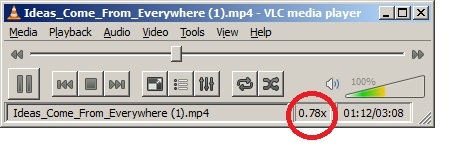
If you are using version 2 or later, you may need to click on "status bar" under the "View" menu to get the control.
Here's a demonstration: http://ecorner.stanford.edu/authorMaterialInfo.html?mid=1528 (download and open with VLC)
V. Instant dictionary option; Firefox browser only. Go to http://www.answers.com/main/firefox_plugins.jsp to load a plug-in that lets you get word and phrase definitions from web pages with a single click.
VI. Introduction to watching movies: Groundhog Day.
VII. Some additional links to explore
- www.ted.com (Technology, Entertainment, Design): This has subtitles and a transcript. most talks are around 18-20 minutes, but some are shorter--for example http://www.ted.com/talks/lang/eng/arthur_benjamin_s_formula_for_changing_math_education.html.
- www.englishbaby.com: an English language learning website with multiple new audio and video lessons each week. The language is relatively authentic and conversational, with a lot of idioms and slang that are defined for you. Join the free version to explore the site. See http://www.englishbaby.com/lessons/4330/eavesdropping/jason_s_lucky_day.
----------------------------------------------------------------------------------------------------------------------------------------------------------------------------------------
Homework: Unless otherwise stated (e.g.,
the independent project) you should complete this material in time to discuss it
in the following class. Be sure to bring notes if requested.
1) Spend at least 45 minutes exploring each of the two sites in IV above
(TED and English, Baby), even if you've been there before. Let me emphasize
"explore": you should look at the range of links and options for the sites, not
just the obvious parts on the first page. Be prepared to describe your experience in class
(take notes and bring them to help you remember!).
you will need to "join" English, Baby by giving them your email
contact, but don't "Go Super" yet (you can do it later if you want--be
sure you understand what's free first).
2) Ecorner with Marissa Mayer (former Google VP, now CEO of Yahoo): trying different speeds. Note, for reference, the Carly Fiorina clip on selective information was at 144 words per minute (wpm).
A. Go to http://ecorner.stanford.edu/authorMaterialInfo.html?mid=1524. [221 wpm] Follow the instructions in VI to activate the play speed control. Prepare for listening by reading Mayer's bio and looking at the description. Follow directions on the ecorner site to download the video. Listen to the clip first at slow speed (~80%) and then again at normal speed. Did slowing it down seem to help your comprehension? Were you able to notice new words, reductions and linking, more easily?
B. Try the next clip http://ecorner.stanford.edu/authorMaterialInfo.html?mid=1525. [216 wpm] For this one, listen first at normal speed and then again at slow speed (~80%). Did you notice a difference in your comprehension?
C. Try the third clip http://ecorner.stanford.edu/authorMaterialInfo.html?mid=1526. [233 wpm] For this one, start at normal speed and then pause and change the speed as needed. Go through two times using this method.
Describe your experience briefly in report. Does the slower speed seem to help or hinder your comprehension? Which of the three options (A, B, or C) do you think would work best for you when listening to fast speech?
3) Continue working on your independent project. Remember to incorporate any suggestions made in the individual meetings. Plan to do some combination of 3-4 sessions for a total of at least two hours (I'm giving you a break due to midterms). Be sure to include your objectives, and try to have a mixture of objectives that include not only comprehension, but also building language knowledge and improving processing. Be sure you are doing something about reviewing your vocabulary in addition to adding new words and phrases. Get the report form here. The report is due Monday, October 28 at 8:00 PM. Please follow the directions and upload it to Coursework.
Be sure you have learned all the words and phrases on your vocabulary lists before our individual meeting this week!