Today: parsing, while loop vs. for loop, parse words out of string patterns, boolean precedence, variables
Here's some fun looking data...
$GPGGA,005328.000,3726.1389,N,12210.2515,W,2,07,1.3,22.5,M,-25.7,M,2.0,0000*70
$GPGSA,M,3,09,23,07,16,30,03,27,,,,,,2.3,1.3,1.9*38
$GPRMC,005328.000,A,3726.1389,N,12210.2515,W,0.00,256.18,221217,,,D*78
$GPGGA,005329.000,3726.1389,N,12210.2515,W,2,07,1.3,22.5,M,-25.7,M,2.0,0000*71
$GPGSA,M,3,09,23,07,16,30,03,27,,,,,,2.3,1.3,1.9*38
$GPRMC,005329.000,A,3726.1389,N,12210.2515,W,0.00,256.18,221217,,,D*79
$GPGGA,005330.000,3726.1389,N,12210.2515,W,2,07,1.3,22.5,M,-25.7,M,3.0,0000*78
$GPGSA,M,3,09,23,07,16,30,03,27,,,,,,2.3,1.3,1.9*38
...
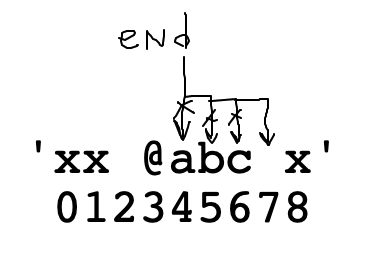
var += 1Start with end = 4. Advance to space char with end += 1 in loop
for i/range vs. whileThe for/i/range form is great for going through numbers which you know ahead of time - a common pattern in real programs. If you need to go through 0..n-1 - use for/i/range, that's exactly what it's for.
for i in range(n):
    # i is 0, 1, 2, .. n-1
while Loop - FlexibleBut we also have the while loop. The "for" is suited for the case where you know the numbers ahead of time. The while is more flexible. The while can test on each iteration, stop at the right spot. Ultimately you need both forms, but here we will switch to using while.
It's possible to write the equivalent of for/i/range as a while loop instead. This is not a good way to go through 0..n-1, but it does show a way to structure a while loop.
Here is the while-equivalent to for i in range(n)
i = 0         # 1. init
while i < n:  # 2. test
    # use i
    i += 1    # 3. update, loop-bottom
              # (easy to forget this line)
> while_double() (in parse1 section)
double_char() written as a while. The for-loops is the correct approach here, so here just showing for-while equivalence.
def while_double(s):
    result = ''
    i = 0
    while i < len(s):
        result += s[i] + s[i]
        i += 1
    return result
i < lengthWith zero based indexing, if we are increasing an index variable i, then i < length is the easy test that i is a valid index; that it is not too big.
Look at our old 'Python' str example
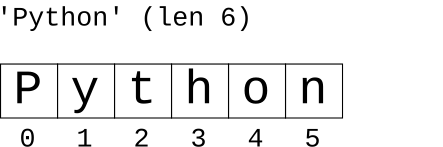
If we are increasing an index number, 5 is the last valid index. When we increase it to 6 it's past the end of the string. The length here is 6, so in effect i < 6 checks that i is valid if we are increasing i.
If we are decreasing i, then i >= 0 is the valid check, since 0 is the first index.
> at_word() (in parse1 section)
'xx @abcd xyz' -> 'abcd'
'x@ab^xyz' -> 'ab'
at_word(s): We'll say an at-word is an '@' followed by zero or more alphabetic chars. Find and return the alphabetic part of the first at-word in s, or the empty string if there is none. So 'xx @abc xyz' returns 'abc'.
First use s.find() to locate the '@'. Then start end pointing to the right of the '@'.
Start of loop:
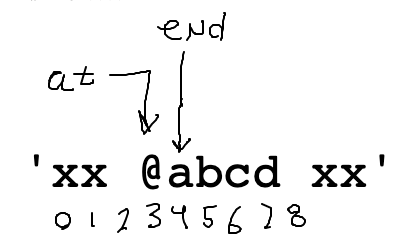
    at = s.find('@')
    if at == -1:
        return ''


    end = at + 1
Use a while loop to advance end over the alphabetic chars. Make a drawing below to sketch out this strategy.
End of loop:
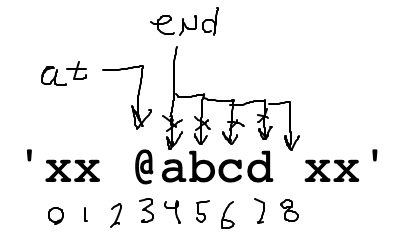
    # Advance end over alpha chars
    while s[end].isalpha():
        end += 1
Once we have at/end computed, pulling out the result word is just a slice.
    word = s[at + 1:end]
    return word
Put those phrases together and it's an excellent first try, and it 90% works. Run it.
def at_word(s):
    at = s.find('@')
    if at == -1:
        return ''

    end = at + 1
    # Advance end over alpha chars
    while s[end].isalpha():
        end += 1

    word = s[at + 1:end]
    return word
That code is pretty good, but there is actually a bug in the while-loop. It has to do with particular form of input case below, where the alphabetic chars go right up to the end of the string. Think about how the loop works when advancing "end" for the case below.
    at = s.find('@')
    end = at + 1
    while s[end].isalpha():
        end += 1
'xx@woot'
 01234567
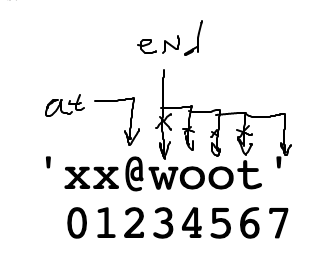
Problem: keep advancing "end" .. past the end of the string, eventually end is 7. Then the while-test s[end].isalpha() throws an error since index 7 is past the end of the string.
The loop above translates to: "advance end so long as s[end] is alphabetic"
To fix the bug, we modify the test to: "advance end so long as end is valid and s[end] alphabetic".
In other words, stop advancing if end reaches the end of the string.
Loop end bug:
end < len(s) Guard TestThis "guard" pattern will be a standard part of looping over something.
We cannot access s[end] when end is too big. Add a "guard" test end < len(s) before the s[end]. This stops the loop when end gets to 7. The slice then works as before. This code is correct.
def at_word(s):
    at = s.find('@')
    if at == -1:
        return ''

    # Advance end over alpha chars
    end = at + 1
    while end < len(s) and s[end].isalpha():
        end += 1

    word = s[at + 1:end]
    return word
The "and" evaluates left to right. As soon as it sees a False it stops. In this way the < len(s) guard checks that "end" is a valid number, before s[end] tries to use it. This a standard pattern: the index-is-valid guard is first, then "and", then s[end] that uses the index. We'll see more examples of this guard pattern.
s[end] vs. s[at + 1:end]>>> s = 'Python' >>> len(s) 6 >>> s[2:5] 'tho' >>> s[2:6] 'thon' >>> s[2:46789] 'thon'
exclamation(s): We'll say an exclamation is zero or more alphabetic chars ending with a '!'. Find and return the first exclamation in s, or the empty string if there is none. So 'xx hi! xx' returns 'hi!'. (Like at_word, but right-to-left).
Will need a guard here, as the loop goes right-to-left. The leftmost valid index is 0, so that will figure in the guard test.
def exclamation(s):
    exclaim = s.find('!')
    if exclaim == -1:
        return ''

    # Your code here
    # Move start left over alpha chars
    # guard: start >= 0
    start = exclaim - 1
    while start >= 0 and s[start].isalpha():
        start -= 1

    # start is on the first *non* alpha
    word = s[start + 1:exclaim + 1]
    return word
See the guide for details Boolean Expression
The code below looks reasonable, but doesn't quite work right
def good_day(age, is_weekend, is_raining):
    if not is_raining and age < 30 or is_weekend:
        print('good day')
Because and is higher precedence than or as written above, the code above acts like the following (the and going before the or):
if (not is_raining and age < 30) or is_weekend:
What is a set of data that this code will evaluate incorrectly? raining=True, age=anything, weekend=True .. the or weekend makes the whole thing True, no matter what the other values are. This does not match the good-day definition above, which requires that it not be raining.
The solution we will spell out is not difficult.
Solution
def good_day(age, is_weekend, is_raining):
    if not is_raining and (age < 30 or is_weekend):
        print('good day')
This is operating at a realistic level for parsing data.
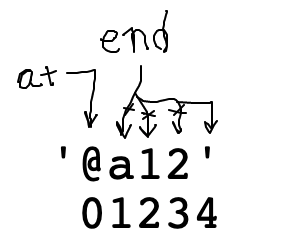
at_word99(): Like at-word, but with digits added. We'll say an at-word is an '@' followed by zero or more alphabetic or digit chars. Find and return the alpha-digit part of the first at-word in s, or the empty string if there is none. So 'xx @ab12 xyz' returns 'ab12'.
Like before, but now a word is made of alpha or digit - many real problems will need this sort of code. This may be our most complicated line of code thus far in the quarter! Fortunately, it's a re-usable pattern for any of these "find end of xxx chars" problems.
The most difficult part is the "end" loop to locate where the word ends. What is the while test here? (Bring up at_word99() in other window to work it out). We want to use "or" to allow alpha or digit.
at = s.find('@')
end = at + 1
while ??????????:
    end += 1
# 1. Still have the < guard
# 2. Use "or" to allow isalpha() or isdigit()
# 3. Need to add parens, since this has and+or
#    combination
while end < len(s) and (s[end].isalpha() or s[end].isdigit()):
    end += 1
def at_word99(s):
    at = s.find('@')
    if at == -1:
        return ''

    # Advance end over alpha or digit chars
    # use "or" + parens
    end = at + 1
    while end < len(s) and (s[end].isalpha() or s[end].isdigit()):
        end += 1

    word = s[at + 1:end]
    return word
If we have time, we'll do this bit.
With the following code, it's clear that the assignment = sets the variable to point to a value.
x = 7
It's less obvious, but the for loop just sets a variable too, once for each iteration. The variable name is the word the programmer chooses right after the word "for", in this example the variable is i which is an idiomatic choice:
for i in range(4):
    # use i
    print(i)

0
1
2
3
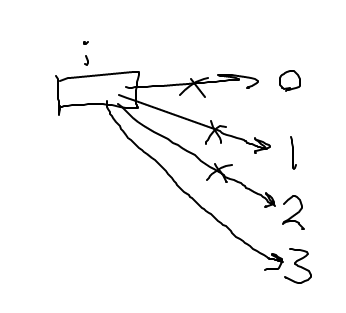
The Sartre of Coding!
The variable name is just the label applied to the box that hold the pointer.
You might get the feeling in CS106A to this point: it will only work if the variable is named "i", but that's not true. We always name it "i" since that's the idiom programmers use for that context, so you cannot be blamed for thinking it was some Python rule.
We try to choose a sensible label to keep our own thoughts organized. However the computer does not care about the word used, so long as the word chosen is used consistently across lines. The variable name i is idiomatic for that sort of loop. But in reality we could use any variable name, and the code would work exactly the same. Say we name the variable meh instead .. same output. All that matters is that the variable on line 1 is the same as on line 2.
for meh in range(4):
    print(meh)

0
1
2
3
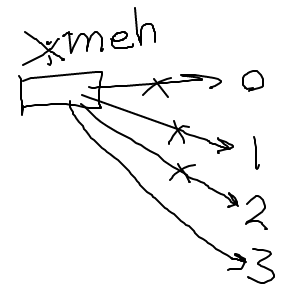
This is a little disturbing. We do try to choose good and/or idiomatic variable names for our own sake. However, the computer does not notice or care about the actual word choice for our variables. The computer does not understand English here; it just recognizes that two words are the same and so must be the same variable.