Today: wordcount -top exercise, modules, urllib example, how the internet works
>>> d = {'a': 'alpha', 'g': 'gamma', 'b': 'beta'}
>>>
>>> d.items()
dict_items([('a', 'alpha'), ('g', 'gamma'), ('b', 'beta')])
>>>
Look at wordcount project, apply custom sorting to the output stage.
>>> items = [('zebra', 1), ('ant', 3), ('elk', 11), ('bear', 4),
('cat', 2)]
>>> sorted(items)
[('ant', 3), ('bear', 4), ('cat', 2), ('elk', 11), ('zebra', 1)]
>>> sorted(items, key=lambda pair: pair[1])   # increasing count
[('zebra', 1), ('cat', 2), ('ant', 3), ('bear', 4), ('elk', 11)]
>>> sorted(items, key=lambda pair: pair[1], reverse=True)  # decreasing
[('elk', 11), ('bear', 4), ('ant', 3), ('cat', 2), ('zebra', 1)]
>>> max(items, key=lambda pair: pair[1])   # max count
('elk', 11)
Here is the WordCount project we had before. This time look at the print_counts() and print_top() functions.
Here is the output of the regular print_counts() function, which prints out in alphabetic order. Output looks like:
$ python3 wordcount.py poem.txt
are 2
blue 2
red 2
roses 1
violets 1
$
This is the standard dict-output sorted loop. The first bit of code uses d.keys(), which is ok. The alternate solution shown uses d.items() which is neat if you want to use it.
def print_counts(counts):
    """
    Given counts dict, print out each word and count
    one per line in alphabetical order, like this
    aardvark 1
    apple 13
    ...
    """
    for word in sorted(counts.keys()):
        print(word, counts[word])

    # Alternately use .items() to access all the key/value
    for key, value in sorted(counts.items()):
        print(key, value)
The print_top(counts, n) function - print the n most common words in decreasing order by count.
$ python3 wordcount-solution.py -top 10 alice-book.txt
the 1639
and 866
to 725
a 631
she 541
it 530
of 511
said 462
i 410
alice 386
How to write the code for that?
def print_top(counts, n):
    """
    Given counts dict and int N, print the N most common words
    in decreasing order of count
    the 1045
    a 672
    ...
    """
    items = counts.items()
    # Could print the items in raw form, just to see data
    # print(items)
    pass
    # Your code - my solution is 3 lines long, but it's dense!
    # Sort the items with a lambda so common words are first.
    # Then print just the first N word,count pairs with slice
Here's the lines - sort by count decreasing order. Then slice to take the top n.
    # 1. Sort largest count first
    items = sorted(items, key=lambda pair: pair[1], reverse=True)
    # 2. Slice to grab first N
    for word, count in items[:n]:
        print(word, count)
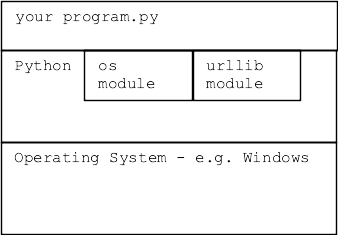
Modules hold code for common problems, ready for your code to use. We say that you build your code "on top of" the libraries. Modern coding is part custom, and part building on top of module code.
import mathmath.sqrt(2)>>> import math >>> math.sqrt(2) # call sqrt() fn 1.4142135623730951 >>> math.sqrt>>> >>> math.log(10) 2.302585092994046 >>> math.pi # constants in module too 3.141592653589793
Quit and restart the interpreter without the import, see common error:
>>> # quit and restart interpreter
>>> math.sqrt(2)  # OOPS forgot the import
Traceback (most recent call last):
NameError: name 'math' is not defined
>>>
>>> import math
>>> math.sqrt(2)  # now it works
1.4142135623730951
Other modules are valuable but they are not a standard part of Python. For code using non-standard module to work, the module must be installed on that computer via the "pip" Python tool. e.g. for homeworks we had you pip-install the "Pillow" module with this command:
$ python3 -m pip install Pillow
..prints stuff...
Successfully installed Pillow-5.4.1
A non-standard module can be great, although the risk is harder to measure. The history thus far is that popular modules continue to be maintained. Sometimes the maintenance is picked up by a different group than the original module author.
When you install a module on your machine from somewhere - you are trusting that code to run on your machine. In very rare cases, bad guys have tampered with modules to include malware in the module. Be more careful if installing a little used module. In contrast, python itself or standard modules like urllib are very safe as so many people use them.
>>> import math
>>> dir(math)
['__doc__', '__file__', '__loader__', '__name__', '__package__', '__spec__', 'acos', 'acosh', 'asin', 'asinh', 'atan', 'atan2', 'atanh', 'ceil', 'copysign', 'cos', 'cosh', 'degrees', 'e', 'erf', 'erfc', 'exp', 'expm1', 'fabs', 'factorial', 'floor', 'fmod', 'frexp', 'fsum', 'gamma', 'gcd', 'hypot', 'inf', 'isclose', 'isfinite', 'isinf', 'isnan', 'ldexp', 'lgamma', 'log', 'log10', 'log1p', 'log2', 'modf', 'nan', 'pi', 'pow', 'radians', 'remainder', 'sin', 'sinh', 'sqrt', 'tan', 'tanh', 'tau', 'trunc']
>>>
>>> help(math.sqrt)
Help on built-in function sqrt in module math:

sqrt(x, /)
    Return the square root of x.
>>>
>>> help(math.cos)
Help on built-in function cos in module math:

cos(x, /)
    Return the cosine of x (measured in radians).
You already have! A regular old foo.py file is a module.
How hard is it to write a module? Not hard at all. A regular Python file we have written works as a module too with whatever defs the foo.py file has.
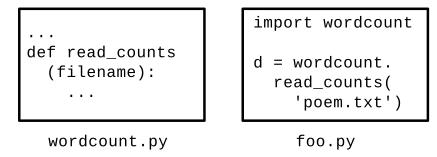
Consider the file wordcount.py in wordcount.zip
Forms a module named wordcount
Try this demo in the wordcount directory
>>> # Run interpreter in wordcount directory
>>> import wordcount
>>>
>>> wordcount.read_counts('test1.txt')
{'a': 2, 'b': 2}
>>> dir(wordcount)
['__builtins__', '__cached__', '__doc__', '__file__', '__loader__', '__name__', '__package__', '__spec__', 'clean', 'main', 'print_counts', 'print_top', 'read_counts', 'sys']
>>>
>>> help(wordcount.read_counts)

Help on function read_counts in module wordcount:

read_counts(filename)
    Given filename, reads its text, splits it into words.
    Returns a "counts" dict where each word
    is the key and its value is the int count
    number of times it appears in the text.
    Converts each word to a "clean", lowercase
    version of that word.
    The Doctests use little files like "test1.txt" in
    this same folder.
...
The text you put in """Pydoc""" per function .. feeds into Python help() (and like systems in PyCharm) automatically. A win!
The code in babygraphics.py iports babynames to call its read_files() function. Here is what the code looks like in babygraphics. This works because the two files are in the same folder.
# 1. In the babygraphics.py file
import babynames

...

    # 2. Call the read_files() function
    names = babynames.read_files(FILENAMES)
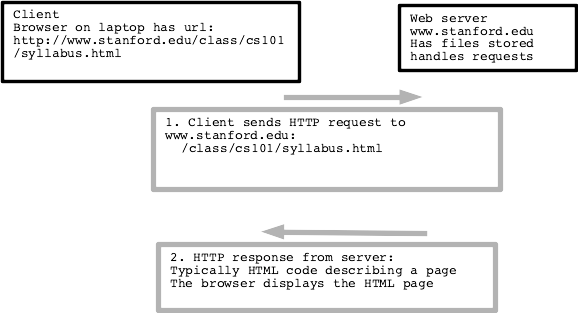
Here is the HTML code for is plain text with a bolded word in it, tags like <b> mark up the text.
This <b>bolded</b> textHTML Experiment - View Source
Go to python.org. Try view-source command on this page (right click on page). Search for a word in the page text, such as "whether" .. to find that text in the HTML code.
Thing of how many web pages you have looked at - this is the code behind those pages. It's a text format! Lines of unicode chars!
>>> import urllib.request
>>> f = urllib.request.urlopen('http://www.python.org/')
>>> text = f.read().decode('utf-8')
>>> text.find('Whether')
26997
>>> text[26997:27100]
"Whether you're new to programming or an experienced developer, it's easy to learn and use Python.\r\n"
# without >>>, for copy/paste
import urllib.request
f = urllib.request.urlopen('http://www.python.org/')
text = f.read().decode('utf-8')
Now does the Internet work? I pulled these slides together I had laying around from another class. Neat to see how something you use every day works.
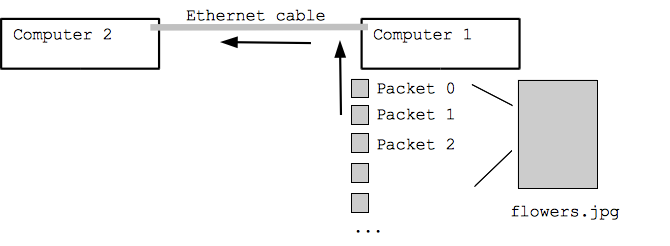
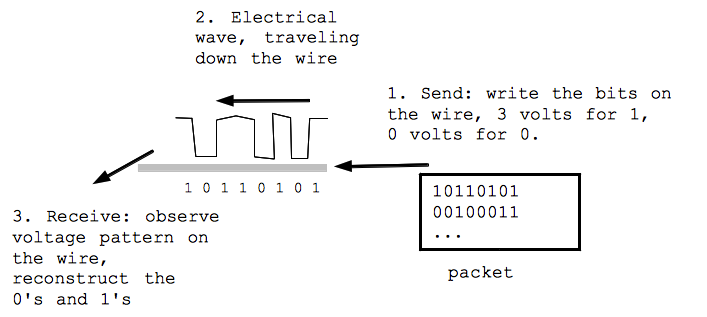
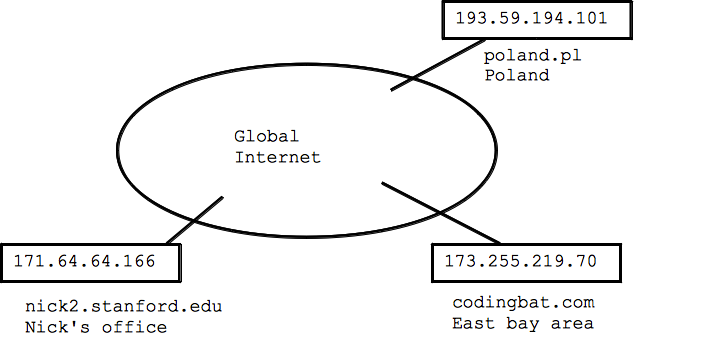
TCP/IP blooper in this video of "The Net"...
Blooper: in the video the IP address is shown as 75.748.86.91 - not a valid IP address! Each number should be 1 byte, 0..255
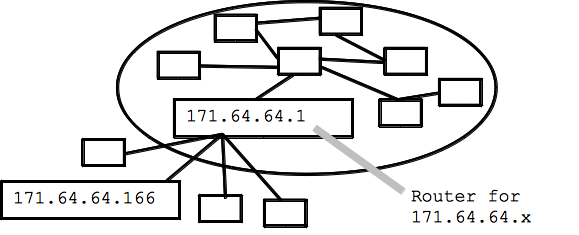
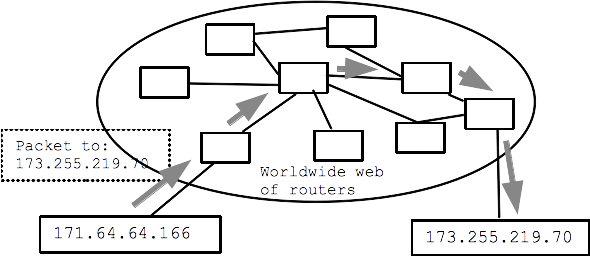
The most common way for a computer to be "on the internet" is to establish a connection with a "router" which is already on the internet. The computer establishes a connection via, say, wifi to communicate packets with the router. The router is "upstream" of the computer, connecting the computer to the whole internet.
The packet is passed from router to router - called a "hop". There might be 10 or 20 hops in a typical internet connection.
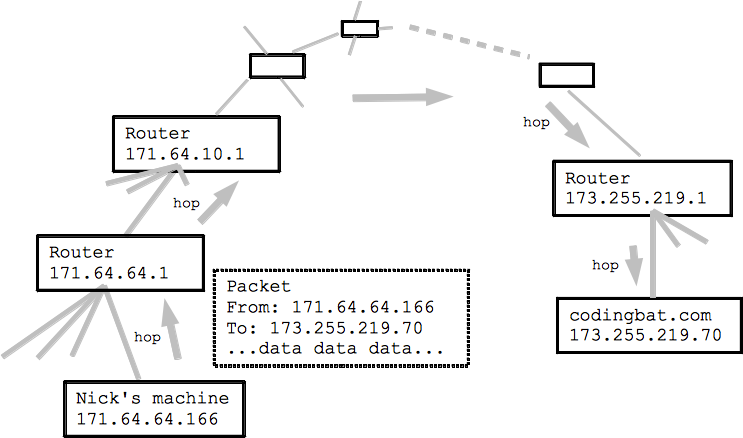
The routing of a packet from your computer is like a capillary/artery system .. your computer is down at the capillary level, your packet gets forwarded up to larger and larger arteries, makes its way over to the right area, and then down to smaller and smaller capillaries again, finally arriving at its destination.
So what does it mean for a computer to be on the internet? Typically it means the computer has established a connection with a router. The commonly used DHCP standard (Dynamic Host Configuration Protocol), facilitates connecting to a router; establishing a temporary connection, and the router gives your computer an IP address to use temporarily. Typically DHCP is used when you connect to a Wi-Fi access point.
Bring up the networking control panel of your computer. It should show what IP address you are currently using and the IP address of your router. You will probably see some text mentioning that DHCP is being used. Your computer will likely have a local IP address, just used while you're in this room.
"Ping" is an old and very simple internet utility. Your computer sends a "ping" packet to any computer on the internet, and the computer responds with a "ping" reply (not all computers respond to ping). In this way, you can check if the other computer is functioning and if the network path between you and it works. As a verb, "ping" is also used in regular English this way .. not sure if that's from the internet or the other way around.
Experiment: Most computers have a ping utility, or you can try "ping" on the command line (works on the Mac, Windows, and Linux). Try pinging www.google.com or pippy.stanford.edu. Not all computers respond to ping. Type ctrl-c to terminate ping.
Milliseconds fraction of a second used for the packet to go and come back. 1 ms = 1/1000 of a second. Different from bandwidth, this "round trip delay".
Here I run the "ping" program for a few addresses, see what it reports
$ ping www.google.com  # I type in a command here
PING www.l.google.com (74.125.224.144): 56 data bytes
64 bytes from 74.125.224.144: icmp_seq=0 ttl=53 time=8.219 ms
64 bytes from 74.125.224.144: icmp_seq=1 ttl=53 time=5.657 ms
64 bytes from 74.125.224.144: icmp_seq=2 ttl=53 time=5.825 ms
^C                            # Type ctrl-C to exit
--- www.l.google.com ping statistics ---
3 packets transmitted, 3 packets received, 0.0% packet loss
round-trip min/avg/max/stddev = 5.657/6.567/8.219/1.170 ms
$ ping pippy.stanford.edu
PING pippy.stanford.edu (171.64.64.28): 56 data bytes
64 bytes from 171.64.64.28: icmp_seq=0 ttl=64 time=0.686 ms
64 bytes from 171.64.64.28: icmp_seq=1 ttl=64 time=0.640 ms
64 bytes from 171.64.64.28: icmp_seq=2 ttl=64 time=0.445 ms
64 bytes from 171.64.64.28: icmp_seq=3 ttl=64 time=0.498 ms
^C
--- pippy.stanford.edu ping statistics ---
4 packets transmitted, 4 packets received, 0.0% packet loss
round-trip min/avg/max/stddev = 0.445/0.567/0.686/0.099 ms
Traceroute is a program that will attempt to identify all the routers in between you and some other computer out on the internet - demonstrating the hop-hop-hop quality of the internet. Most computers have some sort of "traceroute" utility available if you want to try it yourself (not required). On Windows it's called "tracert" in Windows Power Shell, and it does not suppor the "-q 1" option below, but otherwise works fine.
Some routers are visible to traceroute and some not, so it does not provide completely reliable output. However, it is a neat reflection of the hop-hop-hop quality of the internet.
codingbat.com is housed in the east bay - 13 hops we see here. The milliseconds listed is the round-trip delay.
$ traceroute -q 1 codingbat.com
traceroute to codingbat.com (173.255.219.70), 64 hops max, 52 byte packets
 1  rt-ac68u-b3f0 (192.168.1.1)  7.152 ms
 2  96.120.89.177 (96.120.89.177)  9.316 ms
 3  24.124.159.189 (24.124.159.189)  9.638 ms
 4  be-232-rar01.santaclara.ca.sfba.comcast.net (162.151.78.253)  9.775 ms
 5  be-39931-cs03.sunnyvale.ca.ibone.comcast.net (96.110.41.121)  31.753 ms
 6  be-3202-pe02.529bryant.ca.ibone.comcast.net (96.110.41.214)  10.273 ms
 7  ix-xe-0-1-1-0.tcore1.pdi-paloalto.as6453.net (66.198.127.33)  10.570 ms
 8  if-ae-2-2.tcore2.pdi-paloalto.as6453.net (66.198.127.2)  11.344 ms
 9  if-ae-5-2.tcore2.sqn-sanjose.as6453.net (64.86.21.1)  13.555 ms
10  if-ae-1-2.tcore1.sqn-sanjose.as6453.net (63.243.205.1)  11.583 ms
11  216.6.33.114 (216.6.33.114)  11.938 ms
12  if-2-4.csw6-fnc1.linode.com (173.230.159.87)  14.833 ms
13  li229-70.members.linode.com (173.255.219.70)  11.549 ms
A random Serbian address - 31 hops - the farthest thing I could fine. See the extra delay where the packets go across the Atlantic - I'm guessing hop 16. The names there may refer to Amsterdam and France. Note that the packets are going at a fraction of the speed of light here - a fundamental limit of how quickly you can get a packet across the earth.
$ traceroute -q 1 yujor.fon.bg.ac.rs
traceroute to hostweb.fon.bg.ac.rs (147.91.128.13), 64 hops max, 52 byte packets
 1  rt-ac68u-b3f0 (192.168.1.1)  9.136 ms
 2  96.120.89.177 (96.120.89.177)  9.608 ms
 3  24.124.159.189 (24.124.159.189)  20.184 ms
 4  be-232-rar01.santaclara.ca.sfba.comcast.net (162.151.78.253)  15.058 ms
 5  be-39911-cs01.sunnyvale.ca.ibone.comcast.net (96.110.41.113)  11.050 ms
 6  be-3411-pe11.529bryant.ca.ibone.comcast.net (96.110.33.94)  11.294 ms
 7  be3111.ccr31.sjc04.atlas.cogentco.com (154.54.11.5)  10.420 ms
 8  be2379.ccr21.sfo01.atlas.cogentco.com (154.54.42.157)  20.021 ms
 9  be3110.ccr32.slc01.atlas.cogentco.com (154.54.44.142)  37.200 ms
10  be3037.ccr21.den01.atlas.cogentco.com (154.54.41.146)  36.318 ms
11  be3035.ccr21.mci01.atlas.cogentco.com (154.54.5.90)  49.991 ms
12  be2831.ccr41.ord01.atlas.cogentco.com (154.54.42.166)  66.591 ms
13  be2718.ccr22.cle04.atlas.cogentco.com (154.54.7.130)  67.178 ms
14  be2993.ccr31.yyz02.atlas.cogentco.com (154.54.31.226)  77.369 ms
15  be3260.ccr22.ymq01.atlas.cogentco.com (154.54.42.90)  86.026 ms
16  be3042.ccr21.lpl01.atlas.cogentco.com (154.54.44.161)  152.559 ms
17  be2183.ccr42.ams03.atlas.cogentco.com (154.54.58.70)  161.324 ms
18  be2813.ccr41.fra03.atlas.cogentco.com (130.117.0.122)  164.945 ms
19  be2960.ccr22.muc03.atlas.cogentco.com (154.54.36.254)  172.507 ms
20  be2974.ccr51.vie01.atlas.cogentco.com (154.54.58.6)  197.670 ms
21  be3463.ccr22.bts01.atlas.cogentco.com (154.54.59.186)  181.075 ms
22  be3261.ccr31.bud01.atlas.cogentco.com (130.117.3.138)  184.336 ms
23  be2246.rcr51.b020664-1.bud01.atlas.cogentco.com (130.117.1.14)  189.231 ms
24  149.6.182.114 (149.6.182.114)  182.364 ms
25  amres-ias-amres-gw.bud.hu.geant.net (83.97.88.6)  191.607 ms
26  amres-mpls-core----amres-ip-core-amres-ip.amres.ac.rs (147.91.5.144)  187.181 ms
27  *
28  stanica-134-241.fon.bg.ac.rs (147.91.134.241)  204.945 ms
29  stanica-134-250.fon.bg.ac.rs (147.91.134.250)  192.673 ms
30  stanica-134-250.fon.bg.ac.rs (147.91.134.250)  193.978 ms
31  stanica-134-250.fon.bg.ac.rs (147.91.134.250)  193.032 ms !Z