
Today: new data type dict and the dict-count algorithm
dict - Hash Table - FastFor more details sees the chapter in the Guide: Dict
Suppose you are out ordering dinner at a restaurant, and the order is proceeding in a chaotic way, with the people throwing out their orders out in random order:
Alice: I'd like to start with a cup of gazpacho
Bob:   I like beignets for dessert
Alice: Then a ceaser salad
Zoe:   I'll have lasagna
Bob:   Actually two orders of beignets
Alice: Then I'll have tacos
Bob:   And a hot dog
...
People mention the parts of their order piece by piece in no organized order - fine. However, what is needed for the kitchen is to organize each order by person. In a dict, we choose the person as the key for their order, and organize the data that way.
Once all the data is loaded, organized by key, it looks like this:
Alice: gazpacho, ceasar, tacos
Bob: hot dog, two orders of beignets
...
This is what the dictionary does - data comes in randomly and the dict can organize it by a chosen "key" part of the data, here the name.
x[y] Mean?What does this mean in Python generally...
x[y]
We have an outer thing x. Refer to an inner thing inside it identified by y.
The dict will use square bracket [ ] also, and will follow this outer/inner pattern.
>>> d = {}             # Start with empty dict {}
>>> d['a'] = 'alpha'   # Set key/value
>>> d['g'] = 'gamma'
>>> d['b'] = 'beta'
>>> # Now we have built the picture above
>>> # Python can input/output a dict using
>>> # the literal { .. } syntax.
>>> d
{'a': 'alpha', 'g': 'gamma', 'b': 'beta'}
>>>
>>> s = d['g']         # Get by key
>>> s
'gamma'
>>> d['b']
'beta'
>>> d['a'] = 'apple'   # Overwrite 'a' key
>>> d['a']
'apple'
>>>
>>> # += modify value
>>> d['a'] += '!!!'
>>> d['a']
'apple!!!'
>>>
>>> d
{'a': 'apple!!!', 'g': 'gamma', 'b': 'beta'}
>>>
>>> # Can initialize dict with literal
>>> d = {'a': 'alpha', 'g': 'gamma', 'b': 'beta'}
>>>
>>> val = d['x']         # Key not in -> Error
Error:KeyError('x',)
>>>
>>> 'a' in d             # "in" key tests
True
>>> 'x' in d
False
>>>
>>> # Guard pattern (else ..)
>>> if 'x' in d:
      val = d['x']
>>>
>>> # "in" uses key, not value, so this does not work:
>>> 'alpha' in d
False
>>>
At a high level, the dict is like a memory store - code can store a piece of information at one time, retrieve it later.
Meals problems: use dict to remember what food was eaten under the keys 'breakfast', 'lunch', 'dinner'. For example meals['breakfast'] = 'apple'`
>>> meals = {}
>>> meals['breakfast'] = 'apple'
>>> meals['lunch'] = 'donut'
>>>
>>> # time passes, other lines run
>>>
>>> # what was lunch again?
>>> meals['lunch']
'donut'
>>>
>>> # did I have breakfast and dinner yet?
>>> 'breakfast' in meals
True
>>> 'dinner' in meals
False
>>>
Look at the dict1 "meals" exercises on the experimental server
> dict1 meals exercises
With the "meals" examples, the keys are 'breakfast', 'lunch', 'dinner' and the values are like 'hot dot' and 'bagel'. A key like 'breakfast' may or may not be in the dict, so need to "in" check first.
dict[key]Often pulling up a value by its key
val = d[key]
Think about - is that key always valid? If the key is not in the dict, get a KeyError crash when accessing it. Therefore, have "in" logic to check if key is present before accessing with square brackets
if key in d:
    val = d[key]
bad_start(meals): Given a "meals" dict which contains key/value pairs like 'lunch' -> 'hot dog'. The possible keys are 'breakfast', 'lunch', 'dinner'. Return True if there is no 'breakfast' key in meals, or the value for 'breakfast' is 'candy'. Otherwise return False.
Try running code without the "in" check - see the KeyError.
Question: is the meals['breakfast'] == 'candy' line safe? Yes. The earlier if-statement guards the [ ].
def bad_start(meals):
    if 'breakfast' not in meals:
        return True
    if meals['breakfast'] == 'candy':
        return True
    return False
    # Can be written with "or" / short-circuiting
    # if 'breakfast' not in meals or meals['breakfast'] == 'candy':
> enkale()
enkale(meals): Given a "meals" dict which contains key/value pairs like 'lunch' -> 'hot dog'. The possible keys are 'breakfast', 'lunch', 'dinner'. If the key 'dinner' is in the dict with the value 'candy', change the value to 'kale'. Otherwise leave the dict unchanged. Return the dict in all cases.
Demo: work out the code, see key error
Cannot access meals['dinner'] in the case that dinner is not in the dict, so need logic to avoid that case.
def enkale(meals):
    if 'dinner' in meals and meals['dinner'] == 'candy':
        meals['dinner'] = 'kale'
    return meals
Typical pattern: "in" check guards the meals['dinner'] access, since the short-circuit and only proceeds when the first test is True. Could write it out in this longer form with two if-statements which is ok — works exactly the same as the above and/short-circuit form:
def enkale(meals):
    if 'dinner' in meals:
        if meals['dinner'] == 'candy':
            meals['dinner'] = 'kale'
    return meals
is_boring(meals): Given a "meals" dict. We'll say the meals dict is boring if lunch and dinner are both present and are the same food. Return True if the meals dict is boring, False otherwise.
Idea: could solve without worrying about the KeyError first. Then put in the needed "in" guard checks.
> dict2 Count exercises
Go through these strs strs = ['a', 'b', 'a', 'c', 'b']Sketch out counts dict here:
Counts dict ends up as {'a': 2, 'b': 2, 'c': 1}:
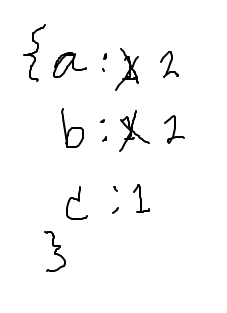
str_count1 demo, canonical dict-count algorithm
def str_count1(strs):
    counts = {}
    for s in strs:
        # s not seen before?
        if s not in counts:
            counts[s] = 1   # first time
        else:
            counts[s] +=1   # every later time
    return counts
def str_count2(strs):
    counts = {}
    for s in strs:
        # fix counts/s if not seen before
        if s not in counts:
            counts[s] = 0
        # Unified: now s is in counts one way or
        # another, so this works for all cases:
        counts[s] += 1
    return counts
Apply the dict-count algorithm to a list of int values, return a counts dict, counting how many times each int value appears in the list.
Apply the dict-count algorithm to chars in a string. Build a counts dict of how many times each char, converted to lowercase, appears in a string so 'Coffee' returns {'c': 1, 'o': 1, 'f': 2, 'e': 2}.