Today: Debugging 1-2-3, debug printing, string upper/lower, string case-sensitive, reversed, movie example, grid, grid testing, demo HW3
Is this course going to get harder and harder each week? Mercifully, no! We're actually going to settle down a little from here on out.
Hang in there! You can spend hours fiddling with some line to get it to work. That's what everybody is doing. You are building up computer-code skills that will be useful for all sorts of things. We do not know a quicker way to do this!
We're going to weave together two things below - show some string algorithms, but also show some debugging techniques.
To write code is to see a lot of bugs. We'll mention the 3 debug techniques here, and do some concrete examples of two of these below.
For more details, see the Python Guide Debugging chapter
Read the exception message and line number. Read the exception text (which can be quite cryptic looking), from the bottom up. Look for the first line of code that is your code and read the error message which can be quite helpful. Go look at the line of your code. Many bugs can be fixed right there, just knowing which line caused the error.
Don't ask "why is this not working?". Ask "why is the code producing this output?".
The code and the output are not moving around - they are static, just sitting there. Look at the first part of the output which is wrong. What line of the code produced that?
This can work well with Doctests. Run the Doctest and you have the code, the input, and the output all to work with. It can also be handy to write a small Doctest.
We talked about writing a simple, obvious test case as a first Doctest. e.g. for the alpha_only() function, an input like '@Ax4**y', looking for output 'Axy'. That's fine. For debugging, sometimes it's nice to add a small test that still shows the bug, maybe '@A' - the loops and everything run so few times, there's less chaos to see through.
Look at the output. Look at the code that produced it, tracing through through the code in your mind. Sometimes "trace through it with your mind" is too hard! In that case try print() below.
Instead of tracking the code in your head, add print() to see the state of the variables. It's nice to just have the computer show the state of the variables in the loop or whatever. This works on the experimental server and in PyCharm - demo below.
Note that return is the formal way for a function to produce a result. The print() function does not change that. Print() is a sort of side-channel of text, alongside the formal result. We'll study this in more detail when we do files.
The experimental server shows the function result first, then the print output below. This can also work in a Doctest. Be sure to remove the print() lines when done - they are temporary scaffolding while building.
'A' vs. 'a'The chars 'A' and 'a' are two different characters.
>>> 'A' == 'a'
False
>>> s = 'red'
>>> s == 'red'   # two equal signs
True
>>> s == 'Red'   # must match exactly
False
Treating upper/lower as different is called "case sensitive". Case-sensitive is the default behavior within computers. If we ask you to write some string code, and don't say anything about upper/lower case, assume it's supposed to be case-sensitive.
s.upper() s.lower() s.isupper() s.islower()>>> 'Kitten123'.upper() # return with all chars in upper form 'KITTEN123' >>> 'Kitten123'.lower() 'kitten123' >>> >>> 'a'.islower() True >>> 'A'.islower() False >>> 'A'.isupper() True >>> '@'.islower() False >>> 'a'.upper() 'A' >>> 'A'.upper() 'A' >>> '@'.upper() '@'
Functions like s.upper() return a new answer string, but the original string is always left unchanged.
>>> s = 'Hello'
>>> s.upper()    # Returns uppercase form of s
'HELLO'
>>>
>>> s            # Original s unchanged
'Hello'
>>>
>>> s + '!!!'    # Returns + form
'Hello!!!'
>>>
>>> s            # Original s unchanged
'Hello'
>>>
x = change(x)This is easy enough to solve. Each time we call a function to compute a changed string, use = to change the variable, say s, to point to the new string.
Say we have a string s, and want to change it to be uppercase and have '!!!' at its end. Here is code that works to change s:
>>> s = 'Kitten'
>>> s = s.upper()  # compute upper, assign back to s
>>> s
'KITTEN'
>>> s = s + '!!!'
>>> s
'KITTEN!!!'
Suppose I want to compute something not case-sensitive.
only_ab(): Given string s. Return a string made of the 'a' and 'b' chars in s. The char comparisons should not be case sensitive, so 'a' and 'A' and 'b' and 'B' all count. Use the string .lower() function.
Strategy: write the code using s[i].lower() to look at the lowercase form of each char in s.
Here is our v1 attempted solution code. Use s[i].lower() to look at the lowercase version of each input char.
def only_ab(s):
    result = ''
    for i in range(len(s)):
        if s[i].lower() == 'a' or s[i].lower() == 'b':
            result += s[i].lower()
    return result
Debug Technique-2 - Look at output/got + code
The got/output is like
only_ab('aABBccc') -> 'aabb'

expected output: 'aABB'
Look at the output.
Key question: Where does the output first go wrong? What line of the code writes that?
Look at that line. Think about how it could produce the observed output.
reversed() FunctionThe Python built-in reversed() function: return reversed form of a sequence such as from range().
Here is how reversed() alters the output of range():
range(5) -> 0, 1, 2, 3, 4
reversed(range(5)) -> 4, 3, 2, 1, 0
This fits into the regular for/i/range idiom to go through the same index numbers but in reverse order:
for i in reversed(range(5)):
    # i in here: 4, 3, 2, 1, 0
For more detail, see the guide Python range()
The reversed() function appears in part of homework-3.
Say we want to compute the reversed form of a string:
'Hello' -> 'olleH'
There are many ways to do this, and we might make a study of it later. For now, see if you can write the reverse2() version of the problem, using the reversed() function.
Plan: e.g. with 'Hello'. Go through the index numbers in reverse order: 4, 3, ... So in the loop, s[i] will be in reverse order: 'o', then the 'l' and so on. Use these to build the solution.
There's actually a whole section of reverse string problems we may play with later - trying out various techniques.
Now we'll show Debug-3 technique: add print() inside the code temporarily to get visibility into what it's doing. This works on the experimental server and in Doctests. The printing will make the Doctests fail, so it should only be in there temporarily.
Here's the reverse2() code with print() added
def reverse2(s):
    result = ''
    for i in reversed(range(len(s))):
        result += s[i]
        print(i, s[i], result)
    return result
Heres's what the output looks like in the experimental server - it shows the formal result first, and the print() output below that. This is kind of beautiful, revealing what's going on inside the loop:
'olleH'

4 o o
3 l ol
2 l oll
1 e olle
0 H olleH
So if you have a bug and the code is not computing what it's supposed to. Well first you just look at the output and try to just see what the bug is. That works sometimes. In your mind, you are thinking about what s[i] is going to be for each loop - a so called thought experiment.
But if you are stuck staring at the code, you could put some print() calls in there and it will just show you exactly what s[i] is for each run of the loop. This can be very clarifying technique if you are not spotting the bug at first. Like instead of using your brain to think what's going on with s[i], just let the computer do it.
This works with Doctests too - the printed output appears in the Doctest window. Unfortunately, the printed output will make the Doctest fail, even if the code is correct.
Remove the print() code when you are done. It's a sort of temporary scaffolding and it will make all Doctests fail.
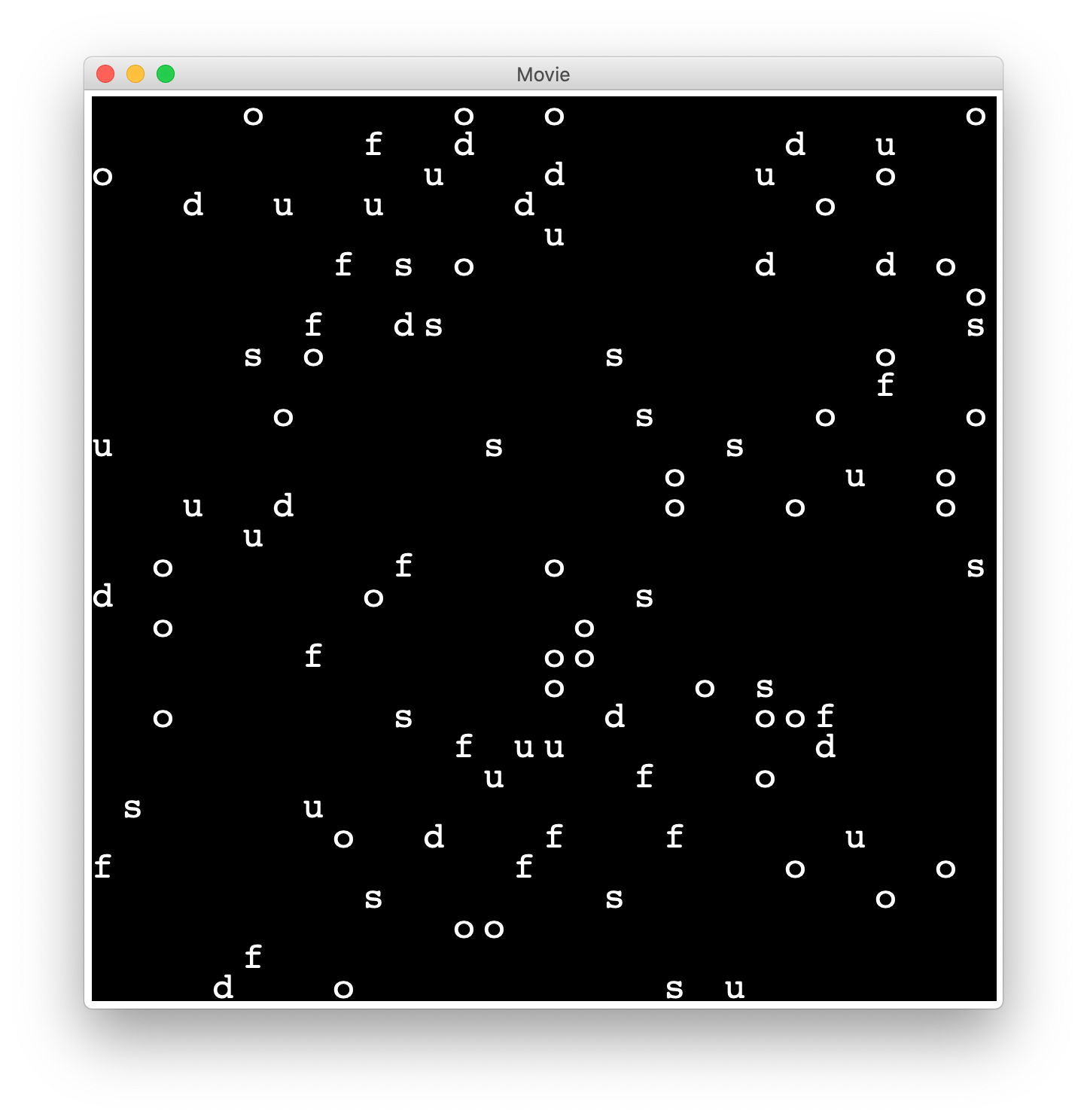
Today we will use this "movie" example and exercise: movie.zip
The movie-starter.py file is the code with bugs, and movie.py is a copy of that to work on, and movie-solution.py has the correct code.
Implement set_edges(), then write Doctests for it. We're not doing this in lecture, but it's an example.
def set_edges(grid):
    """
    Set all the squares along the left edge (x=0) to 'a'.
    Do the same for the right edge.
    Return the changed grid.
    """
    pass
Solution code:
def set_edges(grid):
    """
    Set all the squares along the left edge (x=0) to 'a'.
    Do the same for the right edge.
    Return the changed grid.
    """
    for y in range(grid.height):
        grid.set(0, y, 'a')
        grid.set(grid.width - 1, y, 'a')
    return grid
Q: How can we tell if that code works? With our image examples, at least you could look at the output, although that was not a perfect solution either. Really we want to be able to write test for a small case with visible data.
Here's a visualization - before and after - of grid and how set_edges() modifies it.
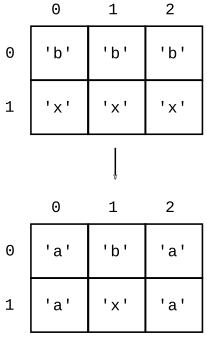
Here are the key 3 lines added to set_edges() that make the Doctest: (1) build a "before" grid, (2) call fn with it, (3) write out the expected result of the function call
    ...
    >>> grid = Grid.build([['b', 'b', 'b'], ['x', 'x', 'x']])
    >>> set_edges(grid)
    [['a', 'b', 'a'], ['a', 'x', 'a']]
    ...
"Anyone who attempts to generate random numbers by deterministic means is, of course, living in a state of sin."
-John von Neumann (early CS giant)
A computer program is "deterministic" - each time you run the lines with the same input, they do exactly the same thing. Creating random numbers with deterministic code and inputs is impossible, so we settle for pseudo random numbers. These are numbers which are statistically random looking, but in fact are generated by a deterministic algorithm producing each "random" number in turn.
Aside: it is possible to create true random numbers by measuring a random physical process - getting the randomness from outside the determinism of the computer.
>>>For more details, see the Python Guide Interpreter chapter
Ways to get an interpreter (apart from the experimental server)
1. With an open PyCharm project, click the "Python Console" button at the bottom .. that's an interpreter.
2. In the command line for your computer, type "python3" ("py" on Windows), and that runs the interpreter directly. Use ctrl-d (ctrl-z on windows) to exit.
Keep in mind that there are two different places where you type commands - your computer command line where you type commands like "date" or "pwd". Then there's the Python interpreter with the >>> prompt where you type python expressions.
Try random module in the "Python Console" tab at the lower-left of your PyCharm window to get an interpreter. This won't work right in the experimental server interpreter, so try Pycharm.
>>> import random   # hw3 starter code has this already
>>>
>>> random.randrange(10)
1
>>> random.randrange(10)
3
>>> random.randrange(10)
9
>>> random.randrange(10)
1
>>> random.randrange(10)
8
>>> random.choice('doofus')
'o'
>>> random.choice('doofus')
'u'
>>> random.choice('doofus')
'o'
>>> random.choice('doofus')
'o'
>>> random.choice('doofus')
's'
>>> random.choice('doofus')
's'
>>> random.choice('doofus')
'o'
>>> random.choice('doofus')
's'
The code for this one is provided to fill in letters at the right edge. Demonstrates some grid code for the movie problem. We're not testing this one - testing random behavior is a pain, although it is possible.
def random_right(grid):
    """
    Set the right edge of the grid to some
    random letters from 'doofus'.
    (provided)
    """
    for y in range(grid.height):
        if random.randrange(10) == 0:
            char = random.choice('doofus')
            grid.set(grid.width - 1, y, char)
    return grid
Think about scroll_left()
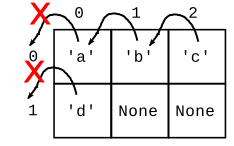
def scroll_left(grid):
    """
    Implement scroll_left as in lecture notes.
    """
    # v1 - has bugs
    for y in range(grid.height):
        for x in range(grid.width):
            # Move letter at x,y leftwards
            val = grid.get(x, y)
            if val != None and grid.in_bounds(x - 1, y):
                grid.set(x - 1, y, val)
    return grid
Need concrete cases to write Doctest. They can be small! An input grid, and the expected output grid. That's what makes one test case - an input and expected. We could also call these "before" and "after" pictures.
Doctest input grid (before)
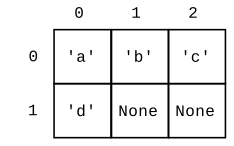
[['a', 'b', 'c'], ['d', None, None]]
Doctest expected grid (after)
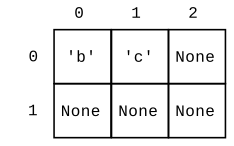
[['b', 'c', None], [None, None, None]]
Run the Doctest to debug the code.
Key: look at the got, and the and code which produced it. Sometimes you can see the problem just looking at these. We'll keep working on the code with this test until it is perfect.
def scroll_left(grid):
    """
    Implement scroll_left as in lecture notes.
    >>> grid = Grid.build([['a', 'b', 'c'], ['d', None, None]])
    >>> scroll_left(grid)
    [['b', 'c', None], [None, None, None]]
    """
How do you debug a function? Run its small, frozen Doctests, look at the got and the code - all of which the Doctest prints out.
Here is the code with bugs fixed and the Doctest now passes.
def scroll_left(grid):
    """
    Implement scroll_left as in lecture notes.
    >>> grid = Grid.build([['a', 'b', 'c'], ['d', None, None]])
    >>> scroll_left(grid)
    [['b', 'c', None], [None, None, None]]
    """
    for y in range(grid.height):
        for x in range(grid.width):
            # Move letter at x,y leftwards
            val = grid.get(x, y)
            if val != None and grid.in_bounds(x - 1, y):
                grid.set(x - 1, y, val)
            grid.set(x, y, None)
    return grid
$ python3 movie.py
$
$ python3 movie.py 80 40  # bigger window