Today: program style: readability and decomposition, bits and bytes, computer hardware CPU, RAM, storage
Ethic: Privacy
- Benjamin Xie - talk about privacy
- Ethic: have some privacy
- Nick editorial...
- Where are you today?
College in the liberal tradition
- College - liberal education
Freedom of thought
Freedom of speech
Privacy can think of as adjacent to these freedoms
- Geo-political angle
- Story of the next 50 years - Democracy vs. Autocracy
- Look at WhatsApp
- WhatsApp is end-to-end encrypted, so messages are private from the government
- USA:
WhatsApp is legal
- China:
WhatsApp is forbidden
Big Picture - The Truth About Software
We'll start a the highest level, seeing the truisms that guide software building. There's software in everything, so you should know the lay of the land.
The Natural Sate of Code = Broken
"Broken" is the natural state of code. It's easy to type in some code, and have it not work. We need a plan to work in this environment. Code can work so nicely, we should keep in mind that even more easily it can fail to work.
Goal #1 - Code That Computes the Correct Answer
The main thing we want from code. Other goals are secondary.
Q: Can You Judge Code By Looking at It?
Can you judge code correctness by looking at it? The surprising answer is - no. To really judge, you need to simulate what the loops and if-statements will with various inputs. In effect, you need to run the code to see what it does.
How To Judge - Run Tests
We need to run the code against a few inputs, checking the output for each case. If the code works against a few cases, suggests it is probably correct. It is not a 100% proof, which is surprisingly difficult or impossible to obtain, but tests are very good in practice.
Corollary: Code Not Run is Probably Buggy
There was a big AT&T Phone outage in 1990. The cause was code in an error-handling section - code to run in the event of a problem. The code had a bug in it, but of course it had run very little. Imagine that error handling code is sitting dormant for years, waiting for a particular situation. But when it does happen .. what are the odds that code is bug free?
Tests help us here too. We can make sure that every line has been run. There are modern "code coverage" tools that make sure that every line has been run in some test or other.
Goal #2 - Clean Code
Clean code with good style. This helps reduce bugs in the first place, and it's easier to fix and add features to code that is already clean. Stanford has always put an emphasis on writing clean code with good style.
Goal #3 - Run Fast
If the code is works correctly and looks good, we might also want to tune it to run fast or use less memory. For some bits of code, speed is crucial. However, the best strategy is generally getting the code working first before messing with it for maximum performance.
Program Design Strategy
Why is code written the way it is? Today we tell the outside, strategic story, driving what forms of code work best.
We'll look over to the Python guide chapters on style readability and decomposition.
Python Guide: PEP8 Tactics
Python Guide: Readable Code
Python Guide: Decomposition
Bits and Bytes
At the smallest scale in the computer, information is stored as bits and bytes. In this section, we'll look at how that works.
Bit
- a "bit", like an atom, the smallest unit of storage
- A bit stores just a 0 or 1
- "In the computer it's all 0's and 1's" ... bits
- Anything with two separate states can store 1 bit
Nick's tennis racket example
- In a chip: electric charge = 0/1
- In a hard drive: spots of North/South magnetism = 0/1
- A bit is too small to be much use
- Group 8 bits together to make 1 byte
Byte
- One byte = grouping of 8 bits
- e.g. 0 1 0 1 1 0 1 0
- One byte can store one roman character, e.g. 'A' or 'x' or '$'
How Many Patterns With N Bits?
How many different patterns can be made with 1, 2, or 3 bits?
| Number of bits | Different Patterns |
|---|
| 1 | 0 1 |
| 2 | 00 01 10 11 |
| 3 | 000 001 010 011
100 101 110 111 |
- Combare 3 bits vs. 2 bits
- Consider just the leftmost bit
- It can only be 0 or 1
- Leftmost bit is 0, then append 2-bit patterns
- Leftmost bit is 1, then append 2-bit patterns again
- Result ... 3-bits has twice as many patterns as 2-bits
- Every row - double the number of patterns of previous row
| Number of bits | Different Patterns |
|---|
| 1 | 0 1 |
| 2 | 00 01 10 11 |
| 3 | 000 001 010 011
100 101 110 111 |
- In general: add 1 bit, double the number of patterns
- 1 bit -> 2 patterns
- 2 bits -> 4 patterns
- 3 bits -> 8 patterns
- n bits -> 2n - 2 to the nth power
- number of patterns is exponential of number of bits
- Few things in life are exponential!
Compound interest (note: try to put something in 401k when young)
Spread of novel pathogen in population
- Exponential growth is so fast, it is unintuitive
| Number of bits | Number of Patterns |
|---|
| 1 | 2 |
| 2 | 4 |
| 3 | 8 |
| 4 | 16 |
| 5 | 32 |
| 6 | 64 |
| 7 | 128 |
| 8 | 256 |
One Byte - 256 Patterns
- 1 byte is a group of 8 bits
- 8 bits can make 256 different patterns
- How to store an int number in 1 byte?
- Each number gets its own pattern
e.g. binary 110 is the int 12, we're not going to worry about the details
- Imagine assigning each number its own pattern, starting with 0:
- 0 = pattern 1
- 1 = pattern 2
- 2 = pattern 3
- ...
- 254 = pattern 255
- 255 = pattern 256
- There are 256 possible patterns, so 255 is the max int stored in one byte
- pixel.red takes in a number 0..255, why?
- The red/green/blue numbers of a pixel are each stored in one byte
- That's why it's 0..255
"HDR" Image
- HDR High Dynamic Range - more than 256 values
- HDR uses 10 bits per color
- How many more colors is that than 8 bits? 258 colors?
- No it's exponential, doubling with each bit
- 8 bits = 256 colors
- 9 bits = 512 colors
- 10 bits = 1024 colors - HDR
- 10 bit HDR is maybe close to the human perceptual limit anyway
- Uses a little more space, looks better
Future Image Format: AVIF
- JPEG is 8 bits per color
- And it's compression is not great for 2022
- Next gen format: AVIF
- Free/open standard, like JPEG
- Compresses much better
- 10, 12 bit HDR supported
- Alternative format: HEIF heavily patented (Apple)
Data formats where you need a license to be permitted to look at it, probably not a good idea
HTML, HTTP, JPEG, PNG ... free/open standards, super successful
We'll do this if we have time.
What is a Computer?
You have one on your person all day. You're debugging code for one.
You see the output of them constantly. What is it and how does it work?
Step 1 - Why is it called Silicon Valley?
- Silicon valley may be here because of Stanford
- Stanford Prof Fred Terman -> Hewlett and Packard (1939) -> Silicon valley
- Orchards and cheap real estate at that time!
- Think silicon chip
- silicon chip
- Tiny transistors are "etched" onto the chip
- PSA: Silicon (chips) and Silicone (rubbery stuff) - two easily confused words
Moore's Law
- Moore's Law: transistors per chip doubles every 2 years
- (Moore's law appears to be slowing from the 2 year cadence at this time)
- i.e. smaller transistors, fit more per chip ... cheaper!
- Since 1965, an incredible run of improvement
- Think about phone 6 years ago (junior high)
6 years = 3 doublings = 8x
- Was 32GB storage .. now 256 GB is the minimum, 8x more
- Moore's law!
Aside: Chip Factories are Expensive
- Recent shortage of chips in the news
- Chip factories now cost around $10 billion
Each step of Moore's requires more expensive equipment
- See:Bloomberg - chips are hard to make
- Talk of building US chip factories for security
Quick Tour of How Computers Work
- Your Python code runs on computer hardware, using CPU, RAM etc.
- Let's look for a minute at how those parts work
- Terminology explained below:
CPU, RAM, storage, operating system, process, core
Computer - CPU, RAM, Storage
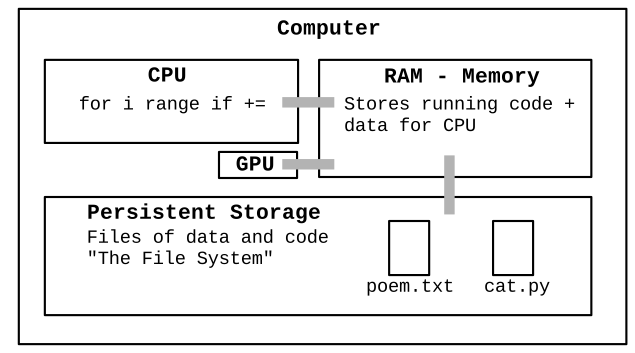
- 3 parts of the computer (or phone)
- 1. CPU
The brains, 2 GHz, simple instructions
CPU does work (RAM stores the work)
e.g. run a line: a = b + c
(Central Processing Unit)
- 2. RAM
Temporary store of bytes for CPU
Stores code and its variables
Not persistent (power-off = erased)
(Random Access Memory)
- 3. Persistent Storage
"storage" in laptop / phone / USB key
Storage in the form of files, folders
Measured in bytes, like RAM, but much cheaper.
Your phone might have 8GB of RAM, but 128GB of storage
"Persistent", keeps state even if powered-off
- 1MB = 1 megabyte = 1 million bytes
- 1GB = 1 gigabyte = 1 billion bytes
Extra: GPU
- Modern computers also have a GPU
- GPU Graphics Processing Unit
- Optimized for pixel processing, games
- Ordinary code runs on the CPU, not the GPU
- The GPU has its own distinct computer language
Used by, say, game developers
Most programmers never write GPU code, it's a specialty
There is a "graphics" specialization in CS department if interested
Want to talk about running a computer program...
Running A Program = Gets own area in RAM
"Process"
- Running program gets its own area in RAM
- Running program is known as a "process"
- The areas in RAM are kept separate from each other
- Multiple processes can run at one time
- When a program exits, its RAM space is reclaimed
- The "Operating Systems" manages the processes
- Your computer has a utility to show the list of running processes (below)
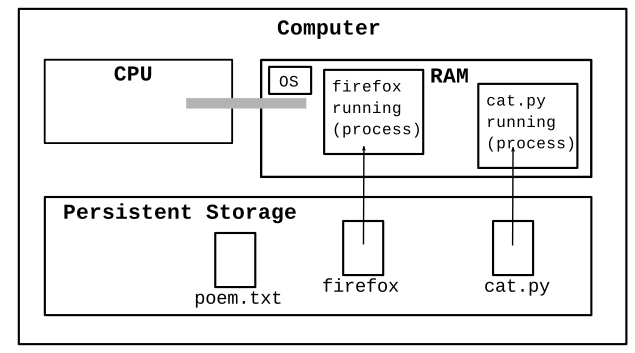
Operating System (OS)
- "Operating System" (OS) manages CPU, RAM etc.
- e.g. Windows, iOS, Android, Mac OS, Linux
Starts and stops programs
Manages memory between programs
Manages files
- When type commands in the "terminal"
You are typing commands to your operating system
Run a program: python3 crazycat.py alice.txt
List files: ls (or old windows "dir")
Show the contents of files: cat poem.txt (or windows "type")
RAM holds code + variables
- The area in RAM for each process stores
The code it is running
The data for its variables
- The CPU runs the code, manipulates the values
- 1 line of Python code expands to about 10 CPU instructions
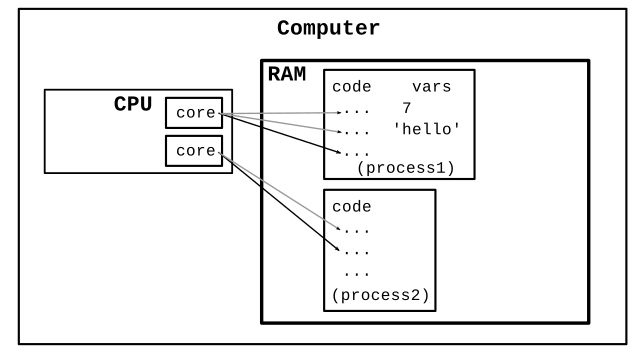
CPU / Cores
- CPU is divided into "cores"
- Each CPU core can run a sequence of code in RAM
- So a 4-core CPU can run 4 things simultaneously
- Often a core is "idle" waiting for something to do
- Cores use more power when running, less when idle
This why the fans spin up to cool the CPU when it is active
crypto.py on a CPU
- Think of crypto.py
- One core is running its code
- The core runs through the code in order, one thing at a time
main() .. encrypt_char() .. print()
- Another core might be running Chrome at the same time
Process Manager
- "Process" = a running program with space in RAM
- A CPU core can run multiple processes
Run process1 for, say, 1 millisecond
Then run process2 for a millisecond
- In this way, your computer "runs" 100 programs simultaneously
- Use an OS utility to see all the processes on your computer:
On the Mac: Applications > Utilities > Activity Monitor
On Windows: Task Manager
- See dozens of processes, mostly idle
- "%CPU" = the percentage of one core used by a process
- Can kill a wayward process from in here BTW
- Note: 16 core machine is not 16x more useful than a 1 core machine
Diminishing returns for a consumer computer, most benefit around 2 cores
Some computations, such as video encoding, can utilize many cores
Browser Tab = Process
- Each process in RAM is isolated from the other processes
- Each tab in your browser is supposed to be isolated from the other tabs
- Modern web browsers implement tabs by running each tab in your browser as its own process
- Most tabs don't do much computation, but advertising / animation heavy tabs can use a lot of CPU
- Look at the processes on your computer, you will likely see processes with names like "Chrome Helper" or "Firefox Web Content". Each of these holds the data and runs the code of one tab
- This shows how a web page in your browser is using your local CPU and RAM to do animations and whatnot
Python Shields us from Hardware Details - Great!
Python shields us from much detail about CPU and RAM, which is great. We're just peeking at the details here to get a little insight about what it means for a program to run, use CPU and RAM.
Hardware Demo Program
Nick's Hardware Squandering Program!
> hardware-demo.zip
Demo: computer is mostly idle to start. Idle CPU is cool. CPU starts running hard, generates heat .. fan spins! This program is an infinite loop, see the code below. It uses 100% of one core. Why is the fan running on my laptop? Use Activity Monitor (Mac), Task Manager (Windows) to see programs that are currently running, see CPU% and MEM%. Run program twice, once in each of 2 terminals - 200%
Core function of -cpu feature:
def use_cpu(n):
    """
    Infinite loop counting a variable 0, 1, 2...
    print a line every n (0 = no printing)
    """
    i = 0
    while True:
        if n != 0 and i % n == 0:
            print(i)
        i = i + 1
Try 1000 first ... yikes! Try 1 million instead. Type ctrl-c in the terminal to kill the process.
$ python3 hardware-demo.py -cpu 1000000
0
1000000
2000000
3000000
4000000
5000000
6000000
7000000
^CTraceback (most recent call last):
  File "hardware-demo.py", line 66, in
    main()
  File "hardware-demo.py", line 56, in main
    use_cpu(n)
  File "hardware-demo.py", line 24, in use_cpu
    i = i + 1
KeyboardInterrupt

(ctrl-c to exit)
Run It Twice
Demo: Nick opens a second terminal. This needs to be done outside of PyCharm - see the Command Line chapter. Run a second copy of hardware-demo.py. Look in the process manager .. now see two programs running at once.
Let's Talk About RAM
When code reads and writes values, those values are stored in RAM. RAM is a big array of bytes, read and written by the CPU.
Say we have this code
n = 10
s = 'Hello'
lst = [1, 2, 3]
lst2 = lst
Every value in use by the program takes up space in RAM.
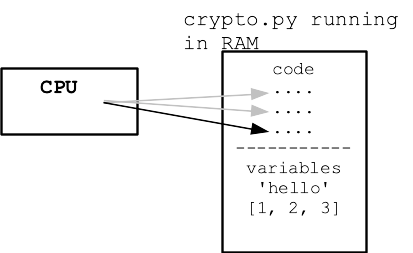
RAM
- RAM - Random Access Memory
"random access" = can access any byte at will
- Each Python value is stored using bytes in RAM
How Many Bytes does a Python Value Use?
- Say each Python value has, approximately, 16 bytes of fixed overhead
- Here's how it works out
- An int value like
2561 takes 8 bytes + 16 overhead = 24 bytes
- The string
'hello' - is 2 bytes per char (10) + 16 = 26 bytes
- If the string were 100 chars long, that would 200 + 16 = 216 bytes
Demo using -mem, Look in activity monitor (task manager), "mem" area, 100 = 100 MB per second. Watch our program use more and more memory of the machine. Program exits .. not in the list any more! Fancy: try killing off the process from inside the process manager window.
$ python3 hardware-demo.py -mem 100
Memory MB: 100
Memory MB: 200
Memory MB: 300
Memory MB: 400
Memory MB: 500
Memory MB: 600
Memory MB: 700
^CTraceback (most recent call last):
...
KeyboardInterrupt
(ctrl-c to exit)