Page 1
 Friday, January 21, 2022
Computer Systems
Winter 2022
Stanford University
Computer Science Department
Reading: Reader: Ch 4,
C Primer,
K&R Ch 1.6, 5.1-
5.5
Lecturer: Chris Gregg
CS 107
Lecture 5: Arrays
and Pointers in C
Page 2
Today's Topics
•
Logistics
•
Assign2 — Due Wednesday at 11:59pm
•
Reading: Reader: C Primer
•
Pointers
•
Arrays in C
•
Pointers to arrays
•
Pointer arithmetic -vs- bracket notation
•
Pointers -vs- arrays
•
When is 1 + 1 ≠ 2 ?
•
Arrays passed by reference
•
memcpy / memmove
•
literal strings
•
dereferencing NULL, bogus address…
Page 3
C Pointers
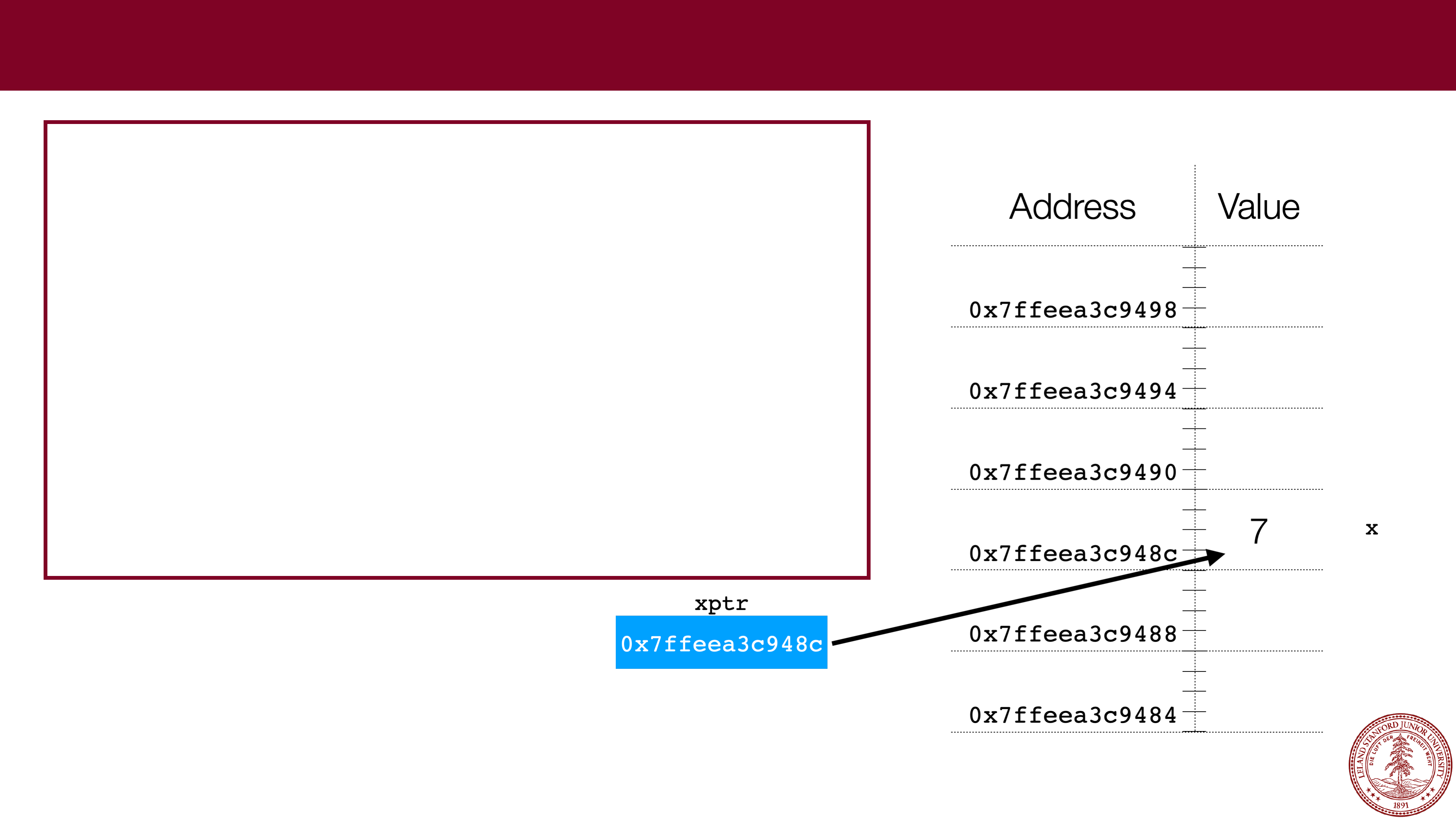
If you took CS 106B (or another C++ based class), you learned about pointers,
which are simply
memory addresses
. A pointer is an integer, and on the myth
machines, all pointers are
64-bits
, or
8 bytes long
.
It is difficult to stress how important understanding that a pointer is
just a memory
address
. Let's look at some examples.
Page 4
 C Pointers
// file: pointer_ex1.c
#include<stdio.h>
#include<stdlib.h>
int main(int argc, char **argv)
{
int x = 7;
int *xptr = &x; // pointer to x
printf("x: %d\n",x);
printf("address of x: %p\n",xptr);
printf("x via dereferencing xptr: %d\n",*xptr);
return 0;
}
$ ./pointer_ex1
x: 7
address of x: 0x7ffeea3c948c
x via dereferencing xptr: 7
Page 5
 C Pointers to Pointers
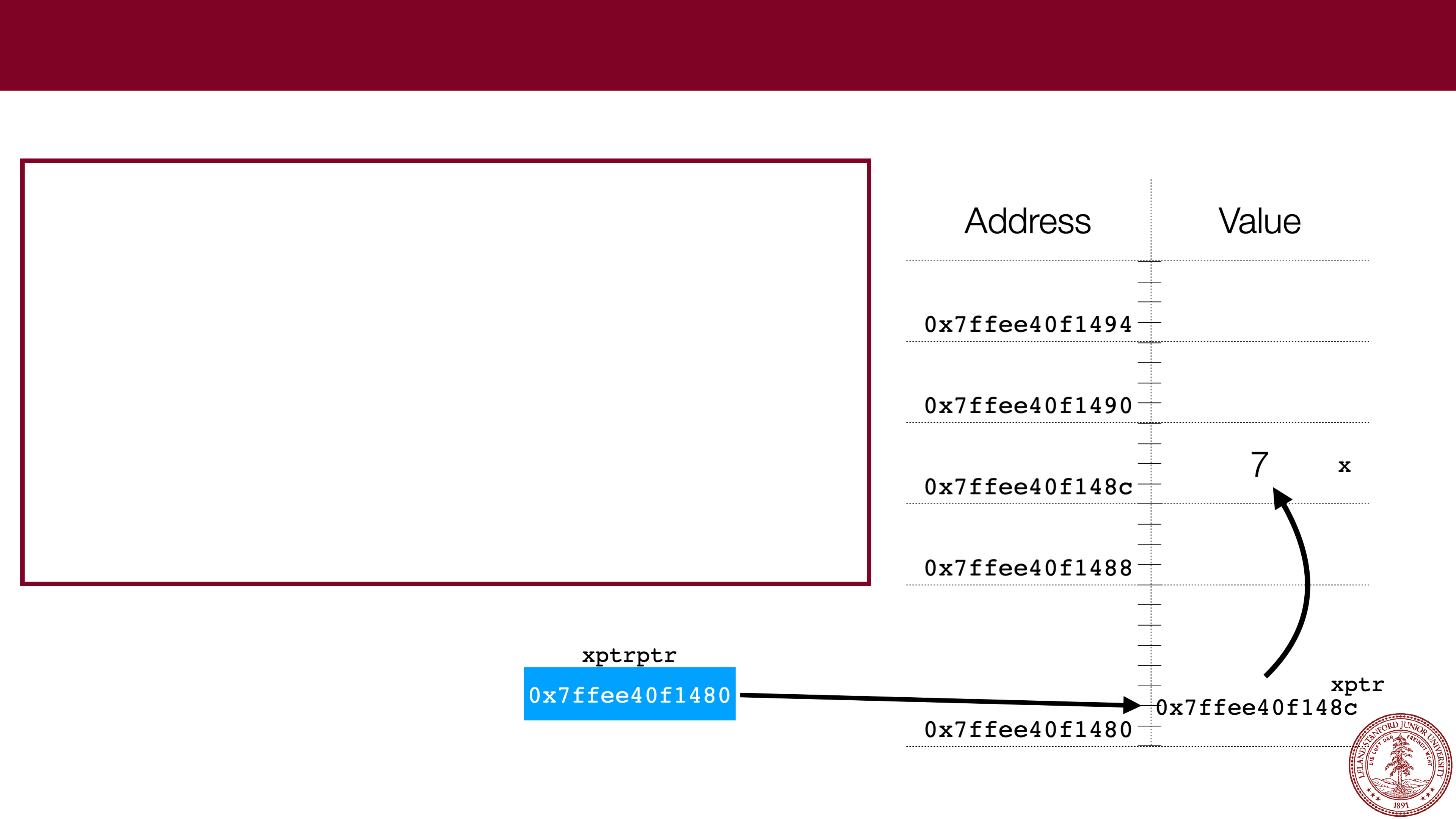
We will often use
pointers to pointers
, which means that we have the address of a
pointer.
// file: ptrptr_ex.c
#include<stdio.h>
#include<stdlib.h>
int main(int argc, char **argv)
{
int x = 7;
int *xptr = &x; // pointer to x
int **xptrptr = &xptr; // pointer to xptr
printf("x: %d
\
n",x);
printf("address of x: %p
\
n",xptr);
printf("address of xptr: %p
\
n",xptrptr);
printf("address of x via dereferencing xptrptr: %p
\
n",*xptrptr);
printf("x via double
-
dereferencing xptrptr: %d
\
n",**xptrptr);
return 0;
}
$ ./ptrptr_ex
x: 7
address of x: 0x7ffee40f148c
address of xptr: 0x7ffee40f1480
address of x via dereferencing xptrptr: 0x7ffee40f148c
x via double
-
dereferencing xptrptr: 7
Page 6
C Pointers to Pointers
Question: what does the following code print out?
// file: ptrptr_mystery.c
#include<stdio.h>
#include<stdlib.h>
int main(int argc, char **argv)
{
char *str = "CS107";
char **strptr = &str;
char mystery = **strptr;
printf("Mystery: %c
\
n",mystery);
return 0;
}
Page 7
C Pointers to Pointers
Question: what does the following code print out?
// file: ptrptr_mystery.c
#include<stdio.h>
#include<stdlib.h>
int main(int argc, char **argv)
{
char *str = "CS107";
char **strptr = &str;
char mystery = **strptr;
printf("Mystery: %c
\
n",mystery);
return 0;
}
Answer: C
A single dereference
*strptr
produces the address of
str
.
If we were to dereference
str
:
*str
this would give us the first character of
str
, or '
C
'.
So, a double-dereference of
strptr
, or
**strptr
produces the character C.
Page 8
Why do we use pointers?
Pointers are used as
references
to values (and for arrays, which we will get to next).
Pointers let us write functions that can modify and use values that are created elsewhere
in the program, without having to make a copy of the values themselves.
Pointers allow us to refer to large data structures in a compact way. One 8
-byte pointer
can refer to any size data structure.
Pointers allow us to reserve new memory during a program (using
malloc
, calloc, and
realloc
, which we will cover later). It is convenient to request memory inside a function
that you do not have details about at compile time (e.g., the length of a potential array).
Pointers to pointers allow us to refer to a particular element in an array generically, without
even knowing about the details of what the array has in it. We will see this next week.
Page 9
 Arrays in C
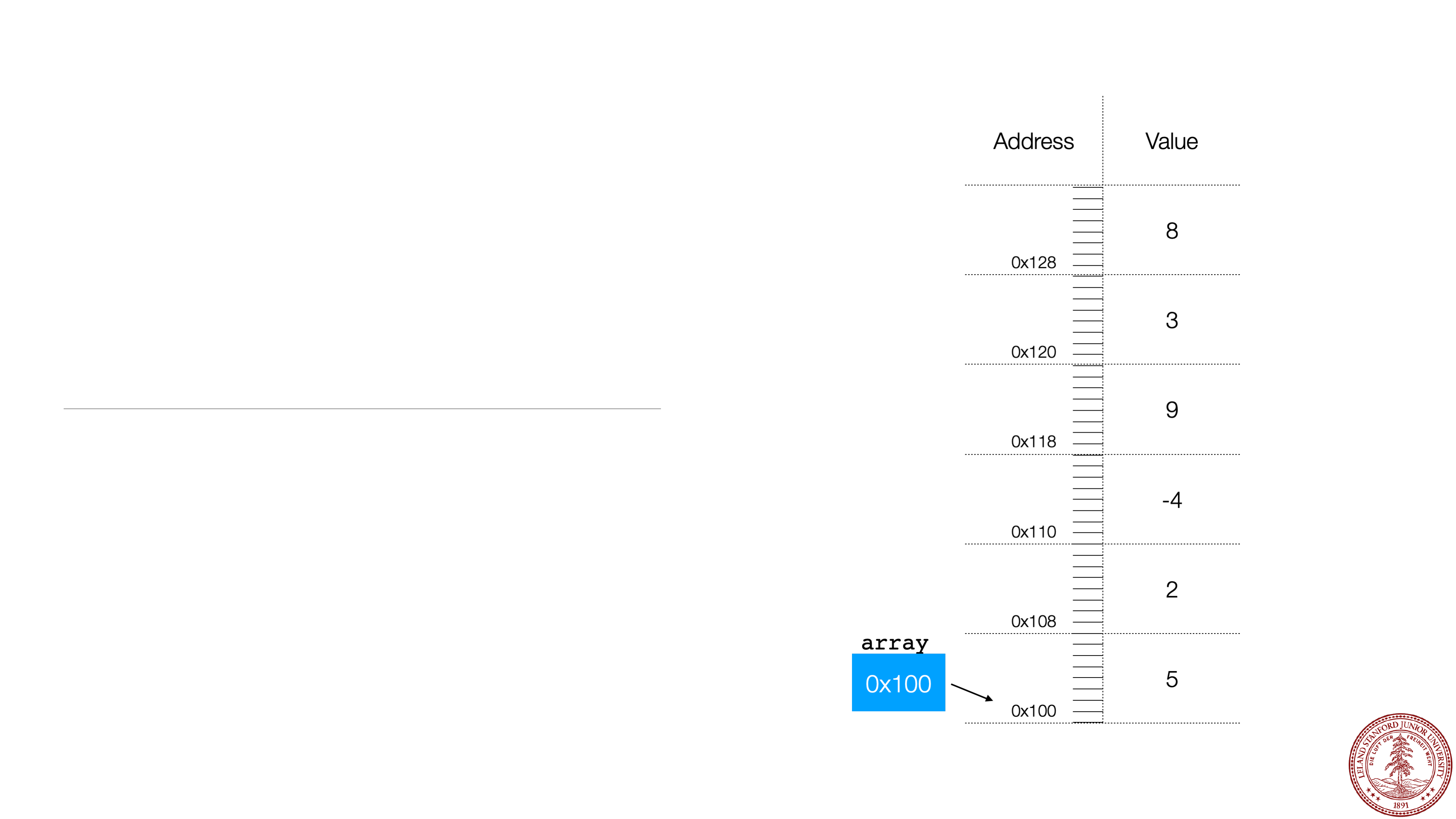
Arrays in C are contiguous blocks of memory
with a fixed length.
A programmer can access elements in an array
using either bracket notation (e.g.,
arr[2]
) or
by dereferencing an offset from the beginning
of the array (e.g.,
*(arr + 2)
, more on this
in a couple of slides).
Although arrays sometimes behave like
pointers, they are distinct and should not be
confused with pointers.
Page 10
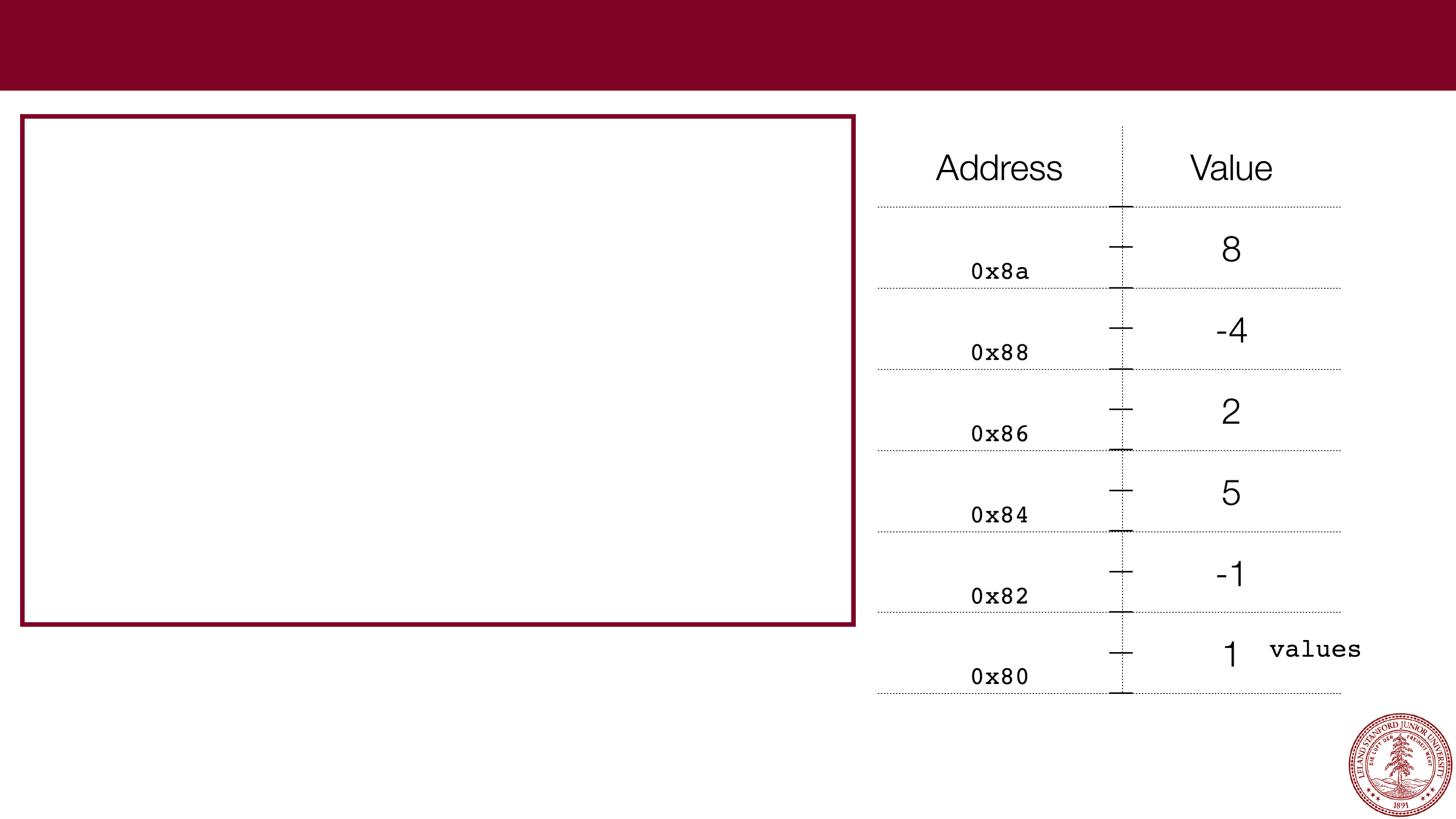 Array Example
// file: array_ex.c
#include<stdio.h>
#include<stdlib.h>
int main(int argc, char **argv)
{
short values[] = {1,
-
1, 5, 2,
-
4, 8};
int nelems = sizeof(values) / sizeof(values[0]);
for (int i=0; i < nelems; i++) {
printf("%d",values[i]);
i == nelems
-
1 ? printf("
\
n") : printf(", ");
}
return 0;
}
$ ./array_ex
1,
-
1, 5, 2,
-
4, 8
The
sizeof
for an array reports the total number of bytes in the array. Not true
for pointers!
Page 11
Arrays are not pointers!
// file: array_sizeof.c
#include<stdio.h>
#include<stdlib.h>
int main(int argc, char **argv)
{
short values[] = {1,
-
1, 5, 2,
-
4, 8};
printf("sizeof(values) = %lu
\
n",sizeof(values));
printf("sizeof(values[0]) = %lu
\
n",sizeof(values[0]));
return 0;
}
$ ./array_sizeof
\
sizeof(values) = 12
sizeof(values[0]) = 2
Arrays can behave like
pointers, but there is no
pointer associated with the
array
values
in the code to
the left.
The compiler keeps track of
where in memory the array is,
and the compiler also knows
how big the array is (which is
why
sizeof(values)
is
12. Each element is 2 bytes
(because it is an array of
short
s, and there are six
elements).
Page 12
Arrays are not pointers!
// file: arrays_not_pointers.c
#include<stdio.h>
#include<stdlib.h>
int main(int argc, char **argv)
{
int arr[3] = {1,2,3};
int a = 4;
arr = &a; // produces compile error
return 0;
}
$ make arrays_not_pointers
gcc
-
g
-
O0
-
std=gnu99
-
Wall $warnflags arrays_not_pointers.c
-
o arrays_not_pointers
arrays_not_pointers.c:9:9: error: array type 'int [3]' is not assignable
arr = &a; // produces compile error
~~~ ^
1 error generated.
make: *** [arrays_not_pointers] Error 1
You cannot assign a different
value to an array, because it
isn't a pointer.
Page 13
You can assign array addresses to pointers
// file: assign_array_to_pointer.c
#include<stdio.h>
#include<stdlib.h>
int main(int argc, char **argv)
{
int arr[3] = {1,2,3};
int *arrptr = arr;
arrptr = &arr[0]; // also works
printf("%p
\
n",arrptr);
printf("%p
\
n",arr);
printf("%p
\
n",&arr[0]);
printf("%p
\
n",&arr); // also works, but try to avoid this
return 0;
}
$ ./assign_array_to_pointer
0x7ffee363d60c
0x7ffee363d60c
0x7ffee363d60c
0x7ffee363d60c
Here,
arr
is
"decaying" into a
pointer when we assign
its value to
arrptr
.
Page 14
 Pointers to arrays
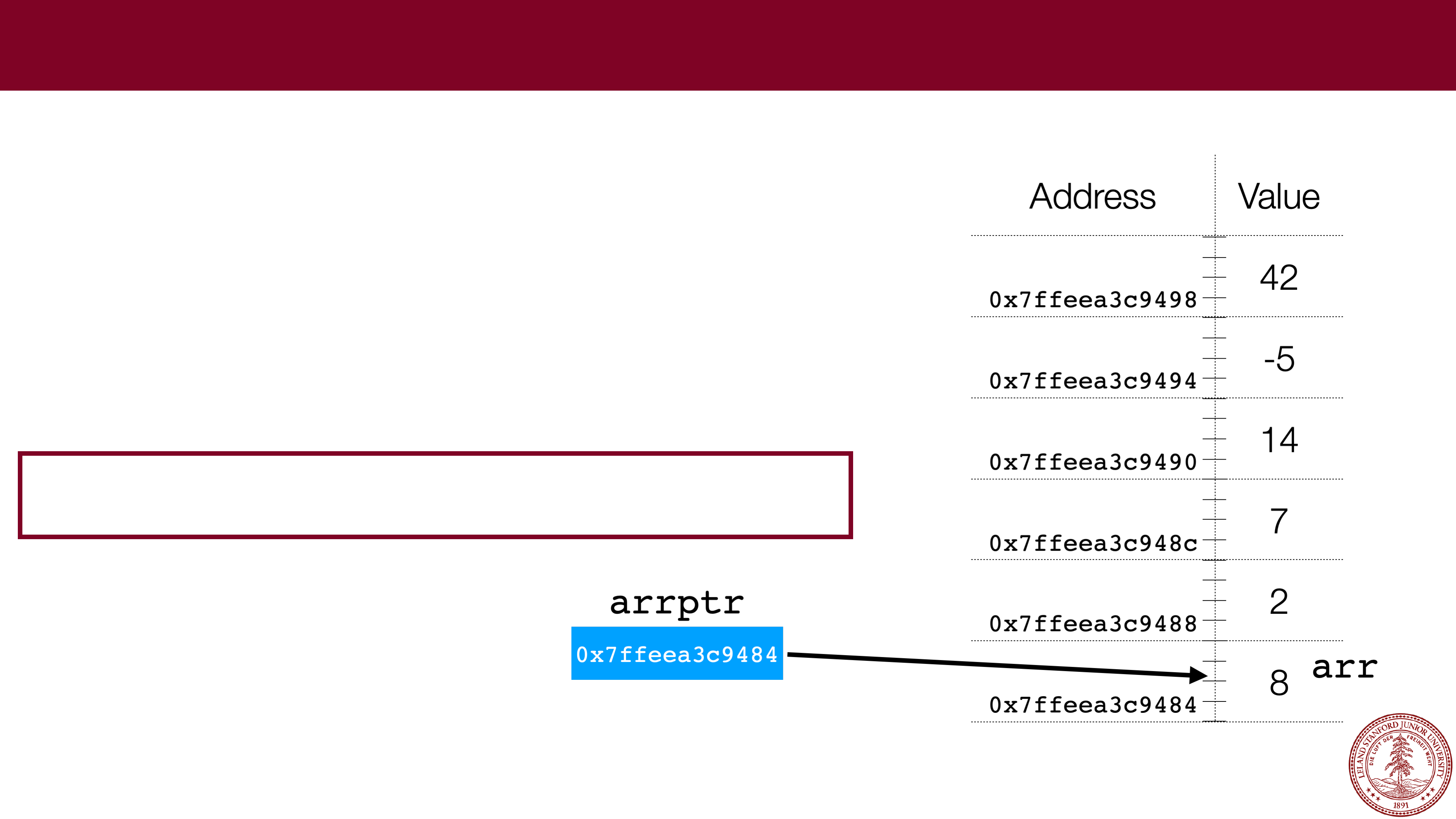
A pointer to an array
points to the first element in the
array.
We can use
pointer arithmetic or bracket notation to
access the elements in the array. If we have a pointer,
we can actually change the value of the pointer to point
to another place in the array.
int arr[] = {8,2,7,14,-5,42};
int *arrptr = arr; // arr now points to the 8
Page 15
 Pointers to arrays
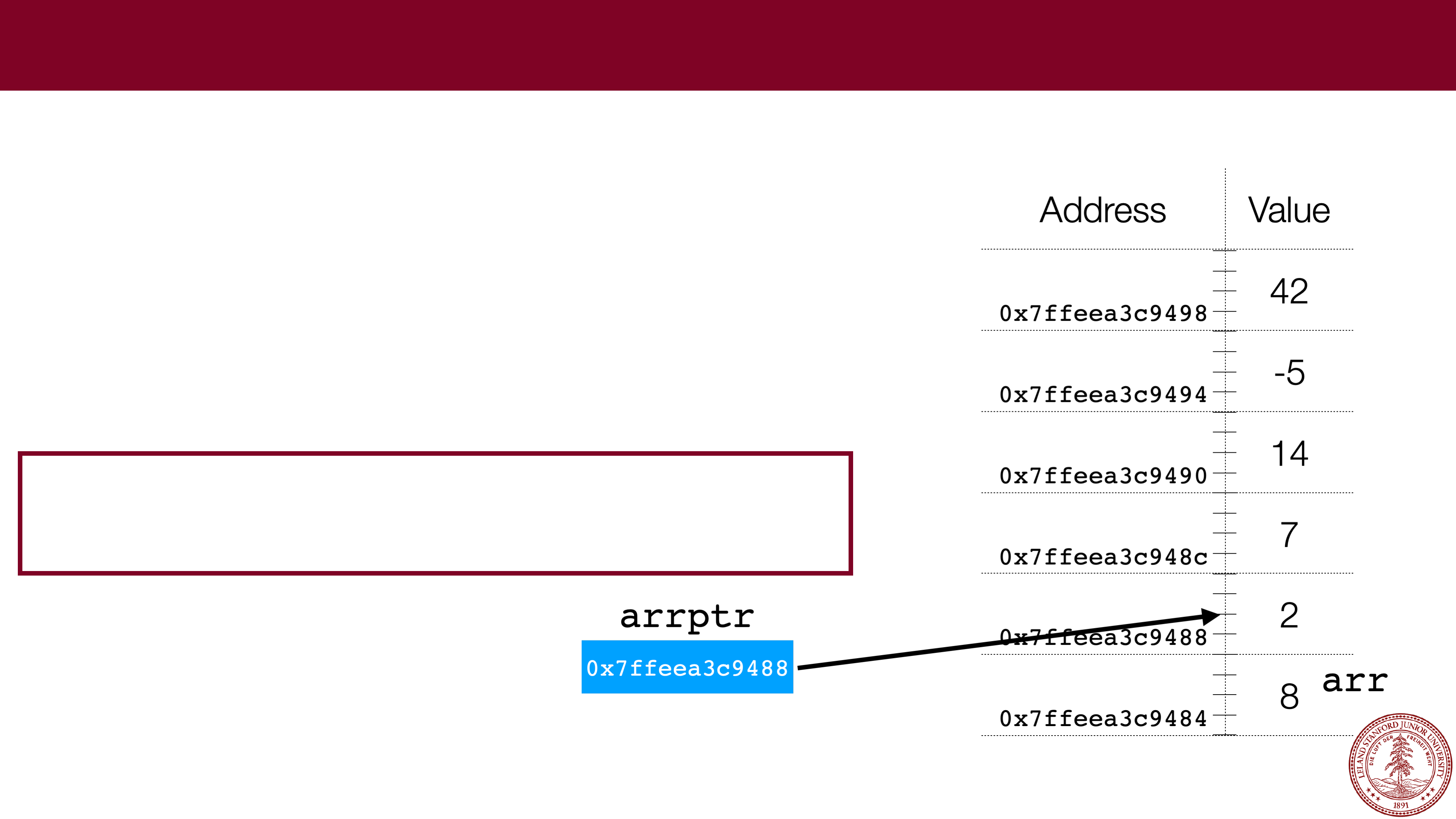
A pointer to an array
points to the first element in the
array.
We can use
pointer arithmetic or bracket notation to
access the elements in the array. If we have a pointer,
we can actually change the value of the pointer to point
to another place in the array.
int arr[] = {8,2,7,14,-5,42};
int *arrptr = arr; // arr now points to the 8
arrptr++; // arrptr now points to the 2
Notice that the expression
arrptr++
incremented
arrptr
by 4! The compiler knows how wide the type is!
Page 16
Pointers to arrays
A very important piece of information was on the bottom of the last slide:
Notice that the expression
arrptr++
incremented
arrptr
by 4! The compiler
knows how wide the type is!
One of the main reasons we have pointer types is so the compiler knows how big
each element in the array is. Continue the printout from the following program:
int main(int argc, char **argv)
{
int arr[] = {1,2,3,4,5,6};
int *arrptr = arr; // arr decays to a pointer
printf("%p
\
n",arrptr);
printf("%p
\
n",arrptr+1);
printf("%p
\
n",arrptr+2);
printf("%p
\
n",arrptr+3);
printf("%p
\
n",arrptr+4);
printf("%p
\
n",arrptr+5);
return 0;
}
./ptr_arith
0x7ffedfe72780
Page 17
Pointers to arrays
A very important piece of information was on the bottom of the last slide:
Notice that the expression
arrptr++
incremented
arrptr
by 4! The compiler
knows how wide the type is!
One of the main reasons we have pointer types is so the compiler knows how big
each element in the array is. Continue the printout from the following program:
int main(int argc, char **argv)
{
int arr[] = {1,2,3,4,5,6};
int *arrptr = arr; // arr decays to a pointer
printf("%p
\
n",arrptr);
printf("%p
\
n",arrptr+1);
printf("%p
\
n",arrptr+2);
printf("%p
\
n",arrptr+3);
printf("%p
\
n",arrptr+4);
printf("%p
\
n",arrptr+5);
return 0;
}
./ptr_arith
0x7ffedfe72780
0x7ffedfe72784
Page 18
Pointers to arrays
A very important piece of information was on the bottom of the last slide:
Notice that the expression
arrptr++
incremented
arrptr
by 4! The compiler
knows how wide the type is!
One of the main reasons we have pointer types is so the compiler knows how big
each element in the array is. Continue the printout from the following program:
int main(int argc, char **argv)
{
int arr[] = {1,2,3,4,5,6};
int *arrptr = arr; // arr decays to a pointer
printf("%p
\
n",arrptr);
printf("%p
\
n",arrptr+1);
printf("%p
\
n",arrptr+2);
printf("%p
\
n",arrptr+3);
printf("%p
\
n",arrptr+4);
printf("%p
\
n",arrptr+5);
return 0;
}
./ptr_arith
0x7ffedfe72780
0x7ffedfe72784
0x7ffedfe72788
0x7ffedfe7278c
0x7ffedfe72790
0x7ffedfe72794
Page 19
Pointers to arrays
Continue the printout from the following program:
int main(int argc, char **argv)
{
long arr[] = {1,2,3,4,5,6};
long *arrptr = arr; // arr decays to a pointer
printf("%p
\
n",arrptr);
printf("%p
\
n",arrptr+1);
printf("%p
\
n",arrptr+2);
printf("%p
\
n",arrptr+3);
printf("%p
\
n",arrptr+4);
printf("%p
\
n",arrptr+5);
return 0;
}
./ptr_arith
0x7ffedfc23770
Page 20
Pointers to arrays
Continue the printout from the following program:
int main(int argc, char **argv)
{
long arr[] = {1,2,3,4,5,6};
long *arrptr = arr; // arr decays to a pointer
printf("%p
\
n",arrptr);
printf("%p
\
n",arrptr+1);
printf("%p
\
n",arrptr+2);
printf("%p
\
n",arrptr+3);
printf("%p
\
n",arrptr+4);
printf("%p
\
n",arrptr+5);
return 0;
}
./ptr_arith
0x7ffedfc23770
0x7ffedfc23778
0x7ffedfc23780
0x7ffedfc23788
0x7ffedfc23790
0x7ffedfc23798
Note that 0x8 + 0x8 = 0x10
Page 21
Pointers to arrays
Continue the printout from the following program:
int main(int argc, char **argv)
{
char arr[] = {1,2,3,4,5,6};
char *arrptr = arr; // arr decays to a pointer
printf("%p
\
n",arrptr);
printf("%p
\
n",arrptr+1);
printf("%p
\
n",arrptr+2);
printf("%p
\
n",arrptr+3);
printf("%p
\
n",arrptr+4);
printf("%p
\
n",arrptr+5);
return 0;
}
./ptr_arith
0x7ffee9fe678b
Page 22
Pointers to arrays
Continue the printout from the following program:
int main(int argc, char **argv)
{
char arr[] = {1,2,3,4,5,6};
char *arrptr = arr; // arr decays to a pointer
printf("%p
\
n",arrptr);
printf("%p
\
n",arrptr+1);
printf("%p
\
n",arrptr+2);
printf("%p
\
n",arrptr+3);
printf("%p
\
n",arrptr+4);
printf("%p
\
n",arrptr+5);
return 0;
}
./ptr_arith
0x7ffee9fe678b
0x7ffee9fe678c
0x7ffee9fe678d
0x7ffee9fe678e
0x7ffee9fe678f
0x7ffee9fe6790
Page 23
3 minute break
Page 24
 Pointers to arrays
// file: pointer_to_array.c
#include<stdio.h>
#include<stdlib.h>
int main(int argc, char **argv)
{
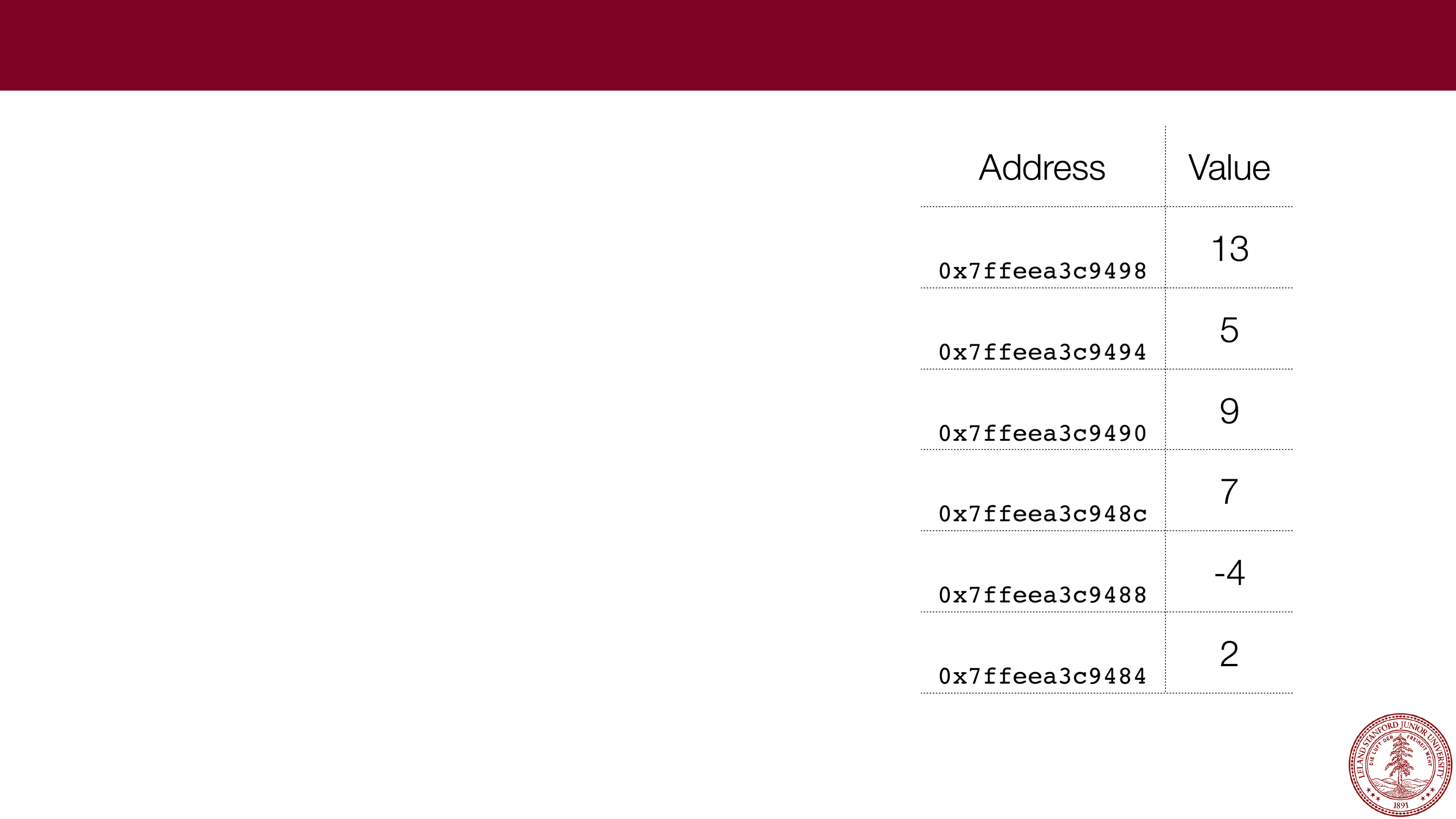
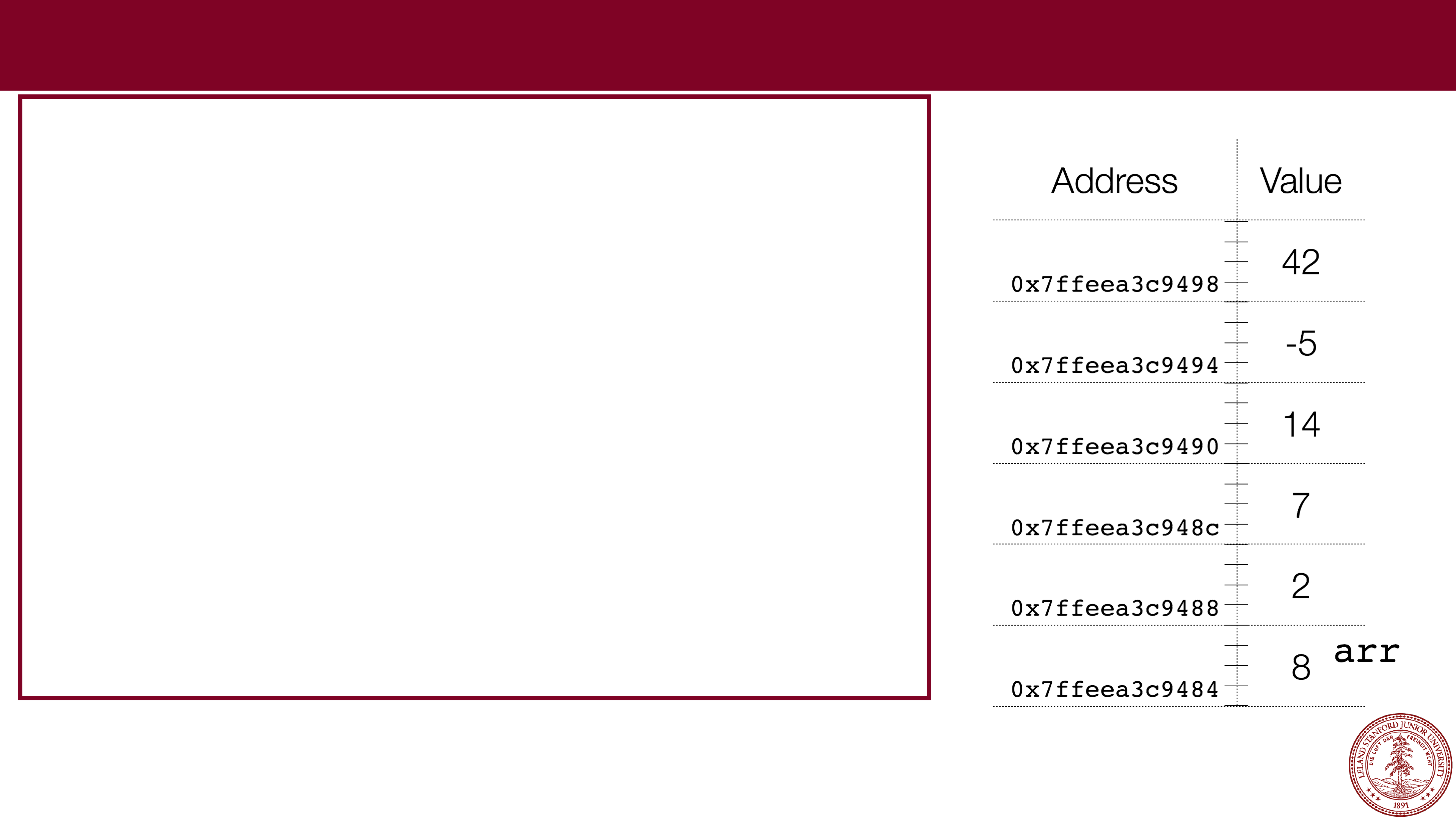
int arr[] = {8,2,7,14,
-
5,42};
int nelems = sizeof(arr) / sizeof(arr[0]);
int *arrptr = arr; // arr now points to the 8
printf("Address of array: %p
\
n",arr);
printf("Address of arrptr: %p
\
n",arrptr);
for (int i=0; i < nelems; i++) {
printf("%d",*arrptr++); // we need to unpack this!
i == nelems
-
1 ? printf("
\
n") : printf(", ");
}
return 0;
}
$ ./pointer_to_array
Address of array: 0x7ffeea3c9484
Address of arrptr: 0x7ffeea3c9484
8, 2, 7, 14,
-
5, 42
Page 25
Pointers to arrays
// file: pointer_to_array.c
#include<stdio.h>
#include<stdlib.h>
int main(int argc, char **argv)
{
int arr[] = {8,2,7,14,
-
5,42};
int nelems = sizeof(arr) / sizeof(arr[0]);
int *arrptr = arr; // arr now points to the 8
printf("Address of array: %p
\
n",arr);
printf("Address of arrptr: %p
\
n",arrptr);
for (int i=0; i < nelems; i++) {
printf("%d",*arrptr++); // we need to unpack this!
i == nelems
-
1 ? printf("
\
n") : printf(", ");
}
return 0;
}
*arrptr++
means:
1.
dereference arrptr
and return the value.
2.
increment the pointer
value
for arrptr.
It does not mean "add
one to the value that
arrptr
points to! To do
would need to write:
(*arrptr)++
Page 26
Pointers to arrays
// file: increment_in_array.c
#include<stdio.h>
#include<stdlib.h>
int main(int argc, char **argv)
{
int arr[] = {8,2,7,14,
-
5,42};
int nelems = sizeof(arr) / sizeof(arr[0]);
int *arrptr = arr; // arr now points to the 8
// increment all values in array
for (int i=0; i < nelems; i++) {
(*arrptr)++;
arrptr++;
}
for (int i=0; i < nelems; i++) {
printf("%d",arr[i]);
i == nelems
-
1 ? printf("
\
n") : printf(", ");
}
return 0;
}
This is not the cleanest code, but you
will see things like this in C quite
often.
You could actually combine the
highlighted line and the next line into
the even more unreadable:
(*arrptr++)++;
Please try to write nice clean code.
(i.e., not this
☝)
BTW, the combined line of code does the following: 1. returns the value
pointed to by
arrptr
, 2. increments both
arrptr
and the value in the array.
Page 27
More examples of arrays decaying to pointers
// file: array.c
#include<stdio.h>
#include<stdlib.h>
void sizeof_test(int arr[]) {
printf("sizeof(arr) in function: %lu
\
n", sizeof(arr));
}
int main()
{
int arr[] = {1,3,4,2,7,9};
printf("%d
\
n",arr[2]); // prints 4
printf("%d
\
n",*(arr+5)); // prints 9
// set the value of the third element
arr[2] = 42;
printf("%d
\
n",arr[2]); // prints 42
printf("sizeof(arr) in main: %lu
\
n",sizeof(arr));
sizeof_test(arr);
return 0;
}
When you pass an array into a
function that expects a pointer, the
array decays into a pointer, and it
loses the ability to determine its size
using
sizeof
.
In the
sizeof_test function, even
though the declaration looks like an
array, it is really an int pointer.
$ ./array
4
9
42
sizeof(arr) in main: 24
sizeof(arr) in function: 8
Page 28
More examples of arrays decaying to pointers
// file: array.c
#include<stdio.h>
#include<stdlib.h>
void sizeof_test(int arr[]) {
printf("sizeof(arr) in function: %lu
\
n", sizeof(arr));
}
int main()
{
int arr[] = {1,3,4,2,7,9};
printf("%d
\
n",arr[2]); // prints 4
printf("%d
\
n",*(arr+5)); // prints 9
// set the value of the third element
arr[2] = 42;
printf("%d
\
n",arr[2]); // prints 42
printf("sizeof(arr) in main: %lu
\
n",sizeof(arr));
sizeof_test(arr);
return 0;
}
Note the use of pointer arithmetic
and bracket notation — either is
fine for an array, because the array
variable decays to a pointer when
used in these circumstances.
Page 29
Arrays are passed by reference
Arrays are passed by
reference when used as
arguments in a function,
because the array variable
decays to a pointer, which is
just an address.
In other words, a function has
access to the array in the
function.
// file: array_pass_by_ref.c
#include<stdio.h>
#include<stdlib.h>
void scale(int array[], int factor, size_t nelems)
{
for (size_t i = 0; i < nelems; i++) {
array[i] *= factor;
}
}
int main(int argc, char **argv)
{
int arr[] = {1,2,3,4,5};
size_t nelems = sizeof(arr) / sizeof(arr[0]);
scale(arr,10,nelems);
for (int i=0; i < nelems; i++) {
printf("%d",*(arr + i));
i == nelems
-
1 ? printf("
\
n") : printf(",");
}
return 0;
}
$ ./array_pass_by_ref
10,20,30,40,50
Page 30
Arrays are passed by reference
If a programmer wants
to indicate that an array
will not be modified, she
passes it as a const
array.
// file: dot_product.c
#include<stdio.h>
#include<stdlib.h>
long dot_prod(const long a[], const long b[], size_t nelems)
{
long result = 0;
for (size_t i=0; i < nelems; i++) {
result += a[i] * b[i];
}
return result;
}
int main(int argc, char **argv)
{
long a[] = {1,2,3};
long b[] = {8,9,10};
size_t nelems = sizeof(a) / sizeof(a[0]);
printf("Dot product of a . b: %lu
\
n",dot_prod(a,b,nelems));
return 0;
}
$ ./dot_product
Dot product of a . b: 56
Page 31
memcpy
In the last lecture, we discussed
strcpy
and
strncpy
, which are used to make
copies of strings into buffers large enough to hold them. A more generic memory
copying function,
memcpy
, is used to copy array data.
void *memcpy(void *dest, const void *src, size_t n);
We haven't yet covered the "
void *
" pointer yet, but for now it is enough to
know that any pointer can be passed into the
memcpy
function. Note that, like
strncpy
,
memcpy
has a parameter for the number of bytes to be copied,
n
.
Unlike
strncpy
, exactly
n
bytes will always be copied.
When using
memcpy
,
src and dest may not overlap
. If you have overlapping
areas, use
memmove
, instead (covered next).
Page 32
memcpy
// file: memcpy_ex.c
#include<stdio.h>
#include<stdlib.h>
#include<string.h>
int main(int argc, char **argv)
{
int src[] = {1,2,3,4,5};
int nelems = sizeof(src) / sizeof(src[0]);
int dest[nelems]; // will set aside enough bytes
memcpy(dest,src,nelems * sizeof(int));
for (int i=0; i < nelems; i++) {
printf("%d",dest[i]);
i == nelems - 1 ? printf("\n") : printf(", ");
}
return 0;
}
$ ./memcpy_ex
1, 2, 3, 4, 5
Note that we passed the
number of bytes. We
often have to use
sizeof(type)
to
determine how wide each
element in the array is.
Page 33
memmove
The
memmove function performs the same operation as memcpy, but it allows
copying from arrays that overlap.
void *memmove(void *dest, const void *src, size_t n);
The reason for using
memcpy
over
memmove
is that sometimes
memcpy
can be
faster, as it does not have to do anything special to determine if there are
overlapping areas.
Page 34
memmove
// file: memmove_ex.c
#include<stdio.h>
#include<stdlib.h>
#include<string.h>
int main(int argc, char **argv)
{
int arr[] = {1,2,3,4,5};
int nelems = sizeof(arr) / sizeof(arr[0]);
memove(arr,arr+2, 3 * sizeof(int));
for (int i=0; i < nelems; i++) {
printf("%d",arr[i]);
i == nelems - 1 ? printf("\n") : printf(", ");
}
return 0;
}
$ ./memmove_ex
3, 4, 5, 4, 5
Note that
memmove
does
not do any "moving" in
the sense that the
elements that it copied
from are still present
where they were
originally, unless they
became written over
because of overlap.
Page 35
declaring strings as arrays or pointers
It is possible to declare a specific string using a
string literal
in two different ways in
C, and you should carefully note the differences:
char s1[] = "string in an array"; // modifiable
char *s2 = "string literal with pointer"; //
not
modifiable
In the first case, the string literal is used to initialize an array that you can modify (and
we have seen examples of this already).
In the second case, there is no array, and there is just a pointer to the string literal.
The following would likely cause your program to crash:
s2[0] = 'S';
Page 36
declaring strings as arrays or pointers
// file: string_literal_crash.c
#include<stdio.h>
#include<stdlib.h>
int main(int argc, char **argv)
{
char *s2 = "string literal with pointer";
s2[0] = 'S'; // crashes here
printf("s2: %s
\
n",s2);
return 0;
}
$ ./string_literal_crash
Segmentation fault (core dumped)
$ gdb string_literal_crash
(gdb) run
Starting program:
/afs/.ir.stanford.edu/users/c/g/cgre
gg/tmp/string_literal_crash
Program received signal SIGSEGV,
Segmentation fault.
0x0000000000400541 in main (argc=1,
argv=0x7fffffffea78) at
string_literal_crash.c:8
8
s2[0] = 'S'; // crashes here
Page 37
be careful dereferencing!
Be careful when dereferencing pointers. NULL pointers or bogus addresses lead to segfaults:
$ ./deref_problems 0x1234
Let's see what int is at address 1234:
Segmentation fault: 11
$ ./deref_problems 0x7ffeea3c948c
Let's see what int is at address 7ffeea3c948c:
Segmentation fault: 11
// file: deref_problems.c
#include<stdio.h>
#include<stdlib.h>
int main(int argc, char **argv)
{
char *err;
size_t address = strtoul(argv[1],&err,0);
printf("Let's see what int is at address %lx:\n",address);
printf("%d\n",*(char *)address);
return 0;
}
Page 38
be careful with your array bounds!
C does
not
check for the end of your array, and it will gladly let you walk right off
the end of the array:
// file: buffer_overflow.c
#include<stdio.h>
#include<stdlib.h>
#define NUMS 10000
int main(int argc, char **argv)
{
int arr[] = {0,1,2,3,4};
for (int i=0; i < NUMS; i++) {
printf("%d",*(arr + i));
i == NUMS ? printf("
\
n") : printf(",");
}
return 0;
}
$ ./buffer_overflow
0,1,2,3,4,32767,
-
1052713984,1018355125,4195936,0,
-
1863256016,32660,0,0,935138104,32767,0,1,419
5734,0,0,0,1702390139,
-
2045811791,4195488,0,935138096,32767,0,0,0,0
,1299736955,2045840459,
-
2039977605,2032550608,0,0,0,0,0,0,1,0,419573
4,0,4196048,0,0,0,0,0,4195488,0,935138096,32
767,0,0,4195529,0,935138088,32767,28,0,1,0,9
35140602,32767,0,0,935140620,32767,935140640
,32767,935140651,32767,935140667,32767,93514
0681,32767,935140714,32767,935140734,32767,9
35140746,32767,935140768,32767,935140938,327
67,935140971,32767,935141005,32767,935141016
,32767,935141033,32767,935141079,32767,93514
1087,32767,935141118,32767,935141134,32767,9
35141149,32767,935141214,32767,935141264,327
67,935141297,32767,935141317,32767,0,0,33,0,
935301120,32767,16,0,
-
1075053569,0,6,0,4096,0,17,0,100,0,3,0,41943
68,0,4,0,56,0,5,0,9,0,7,0,
-
1859416064,32660,8,0,0,0,9,0,4195488,0,11,0,
306920,0,12,0,Segmentation fault (core
dumped)
Page 39
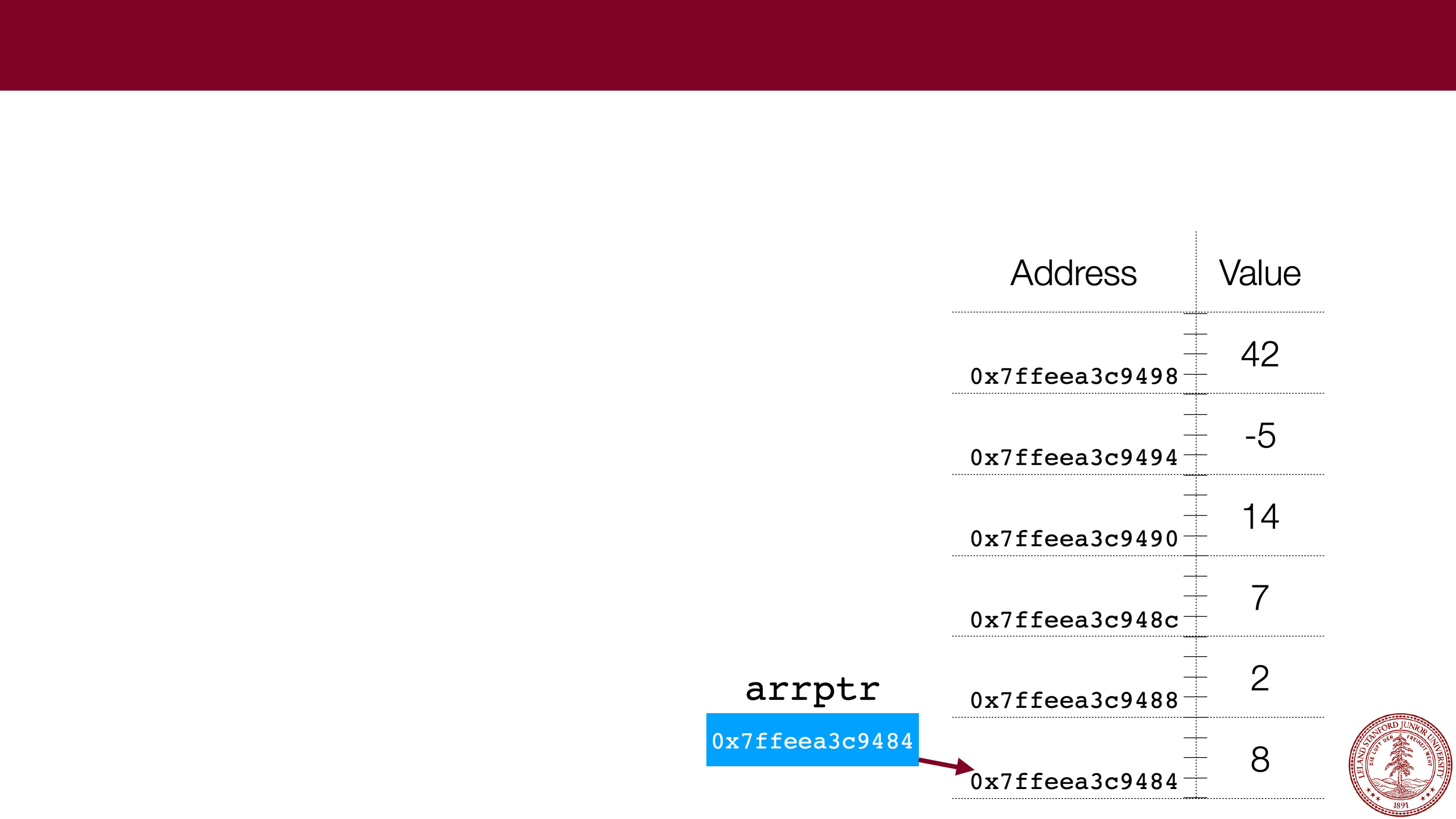 Pointers to Arrays
— Memory Footprint
One tricky part of CS 107 for many students is getting comfortable with what the
memory looks like for pointers to arrays, particularly when the arrays themselves are
filled with pointers. Let's take a look at two examples.
For the first example, let's look at the array defined as
follows:
int arr[] = {8,2,7,14,-5,42};
How many bytes does each
int take up in the array?
Page 40
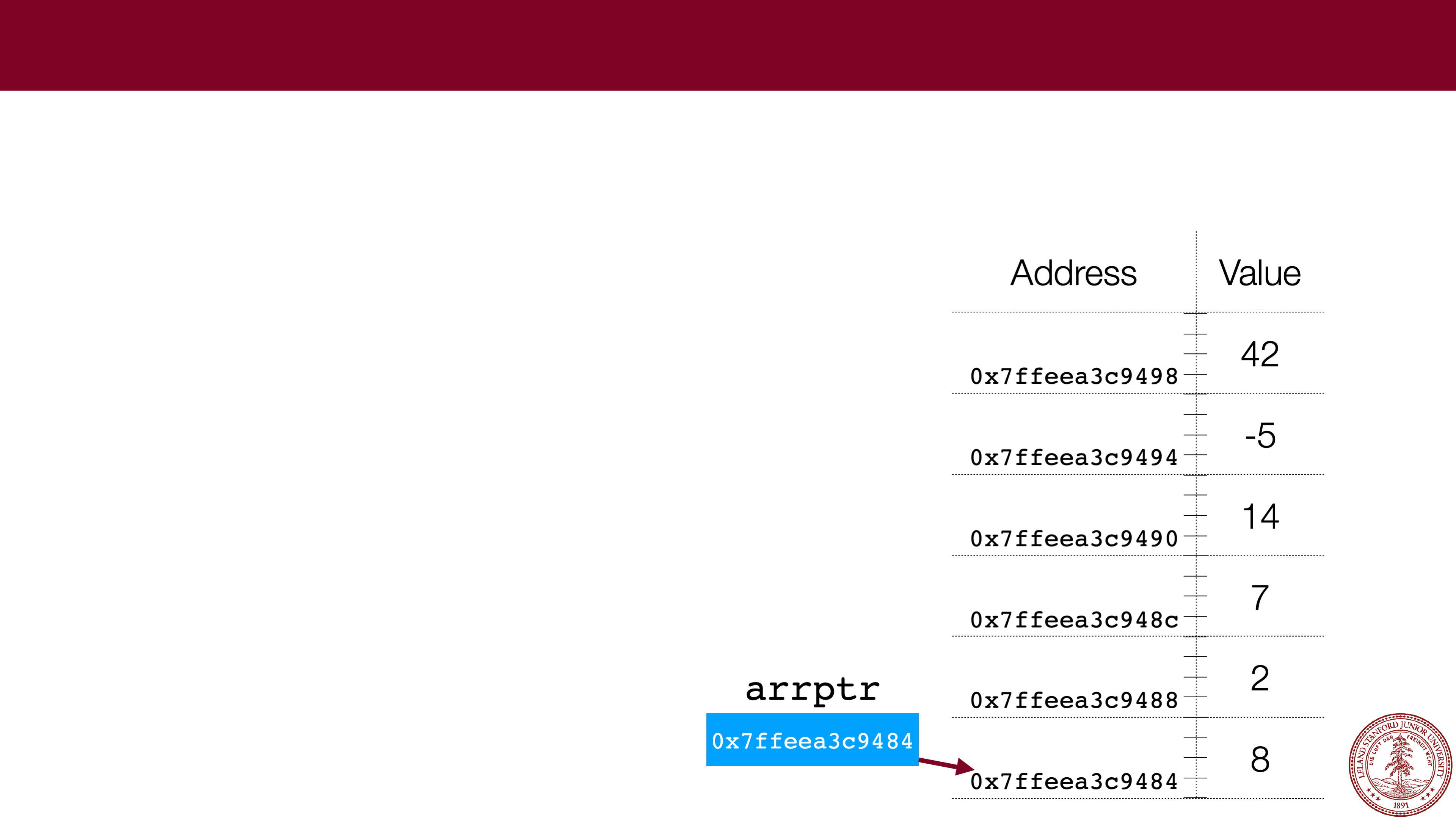 Pointers to Arrays
— Memory Footprint
4
One tricky part of CS 107 for many students is getting comfortable with what the
memory looks like for pointers to arrays, particularly when the arrays themselves are
filled with pointers. Let's take a look at two examples.
For the first example, let's look at the array defined as
follows:
int arr[] = {8,2,7,14,-5,42};
How many bytes does each
int take up in the array?
Page 41
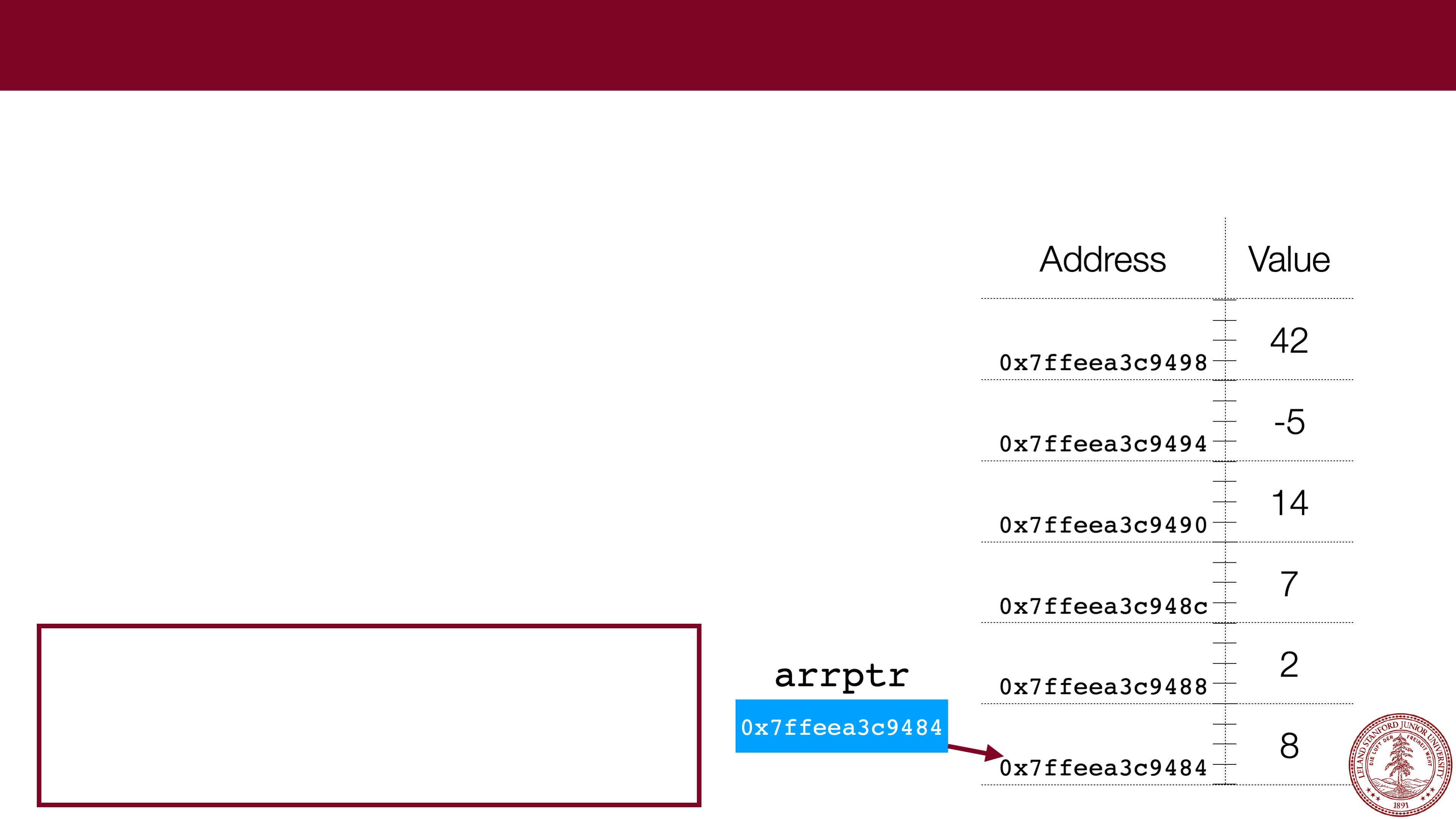 Pointers to Arrays
— Memory Footprint
One tricky part of CS 107 for many students is getting comfortable with what the
memory looks like for pointers to arrays, particularly when the arrays themselves are
filled with pointers. Let's take a look at two examples.
For the first example, let's look at the array defined as
follows:
int arr[] = {8,2,7,14,-5,42};
What if we wanted to write a swap function for the
array (to swap two elements)? We can do it with
regular
int
variables:
void swapA(int *arr, int index_x, int index_y)
{
int tmp = *(arr + index_x);
*(arr + index_x) = *(arr + index_y);
*(arr + index_y) = tmp;
}
Page 42
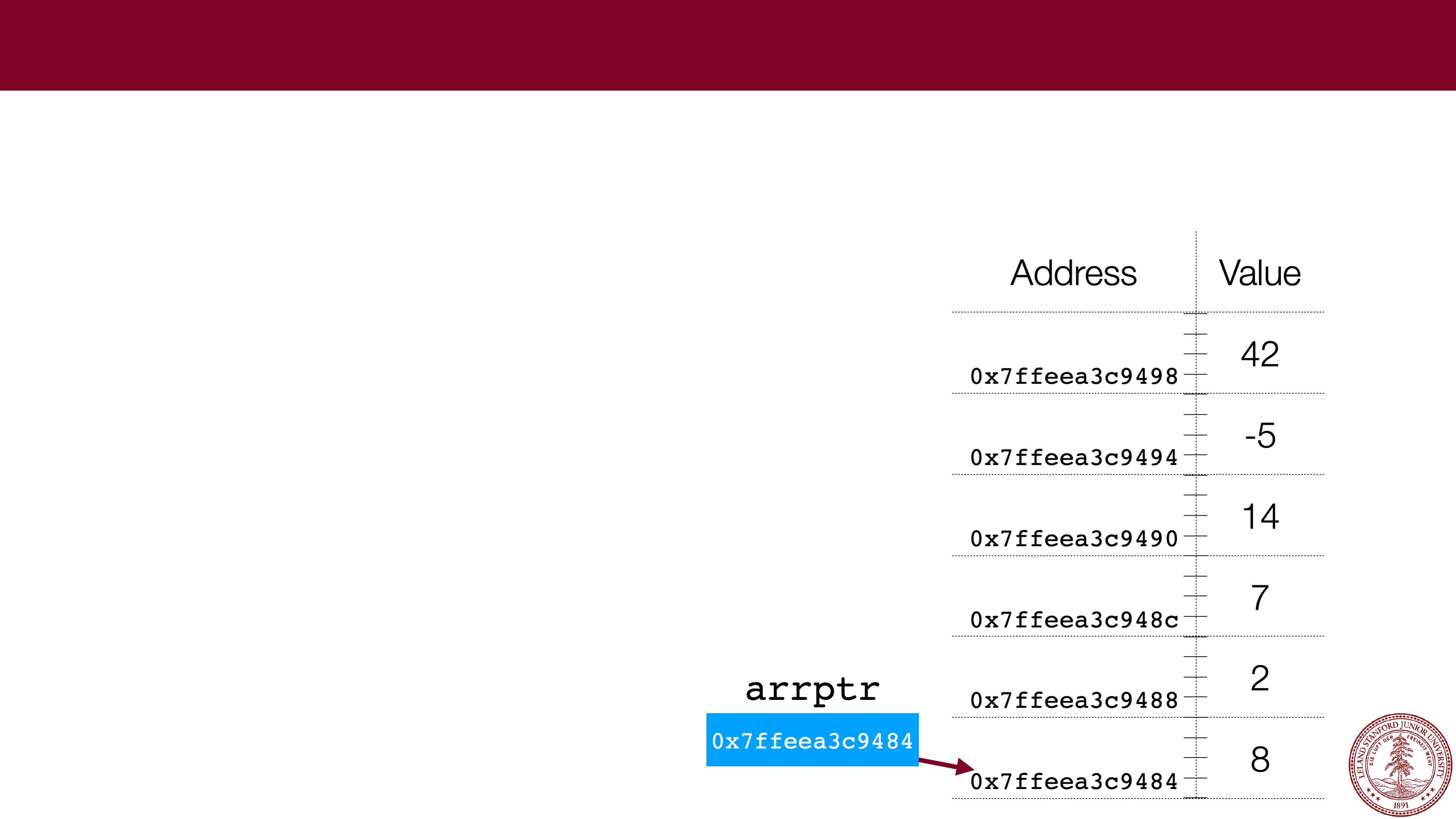 Pointers to Arrays
— Memory Footprint
One tricky part of CS 107 for many students is getting comfortable with what the
memory looks like for pointers to arrays, particularly when the arrays themselves are
filled with pointers. Let's take a look at two examples.
For the first example, let's look at the array defined as
follows:
int arr[] = {8,2,7,14,-5,42};
What if we wanted to write a swap function for the
array (to swap two elements)?
Can we do it with
memmove?
Page 43
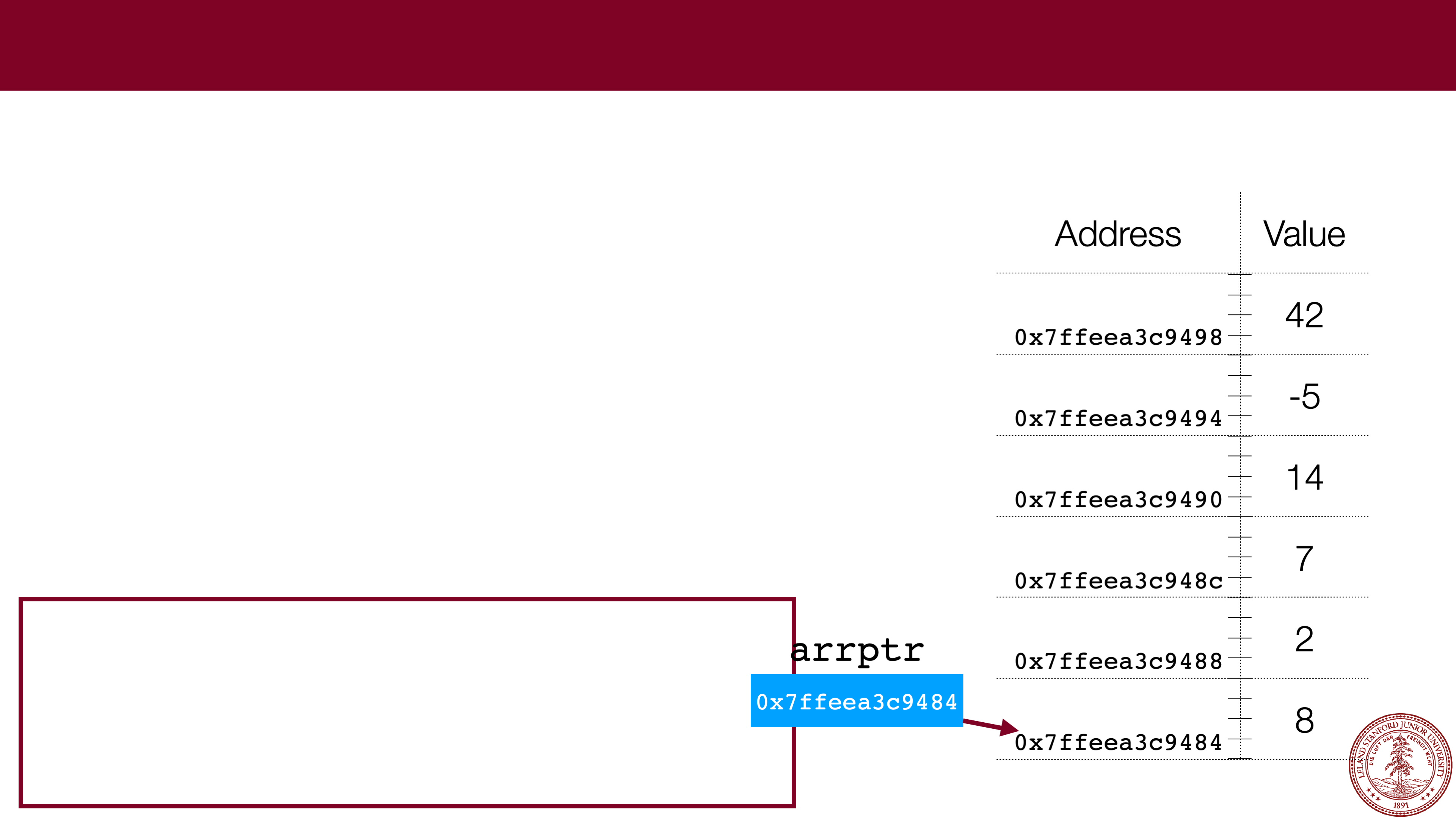 Pointers to Arrays
— Memory Footprint
One tricky part of CS 107 for many students is getting comfortable with what the
memory looks like for pointers to arrays, particularly when the arrays themselves are
filled with pointers. Let's take a look at two examples.
For the first example, let's look at the array defined as
follows:
int arr[] = {8,2,7,14,-5,42};
What if we wanted to write a swap function for the
array (to swap two elements)?
Can we do it with
memmove? Sure:
void swapB(int *arr, int index_x, int index_y)
{
int tmp;
memmove(&tmp, arr + index_x, sizeof(int));
memmove(arr + index_x, arr + index_y,sizeof(int));
memmove(arr + index_y, &tmp,sizeof(int));
}
Page 44
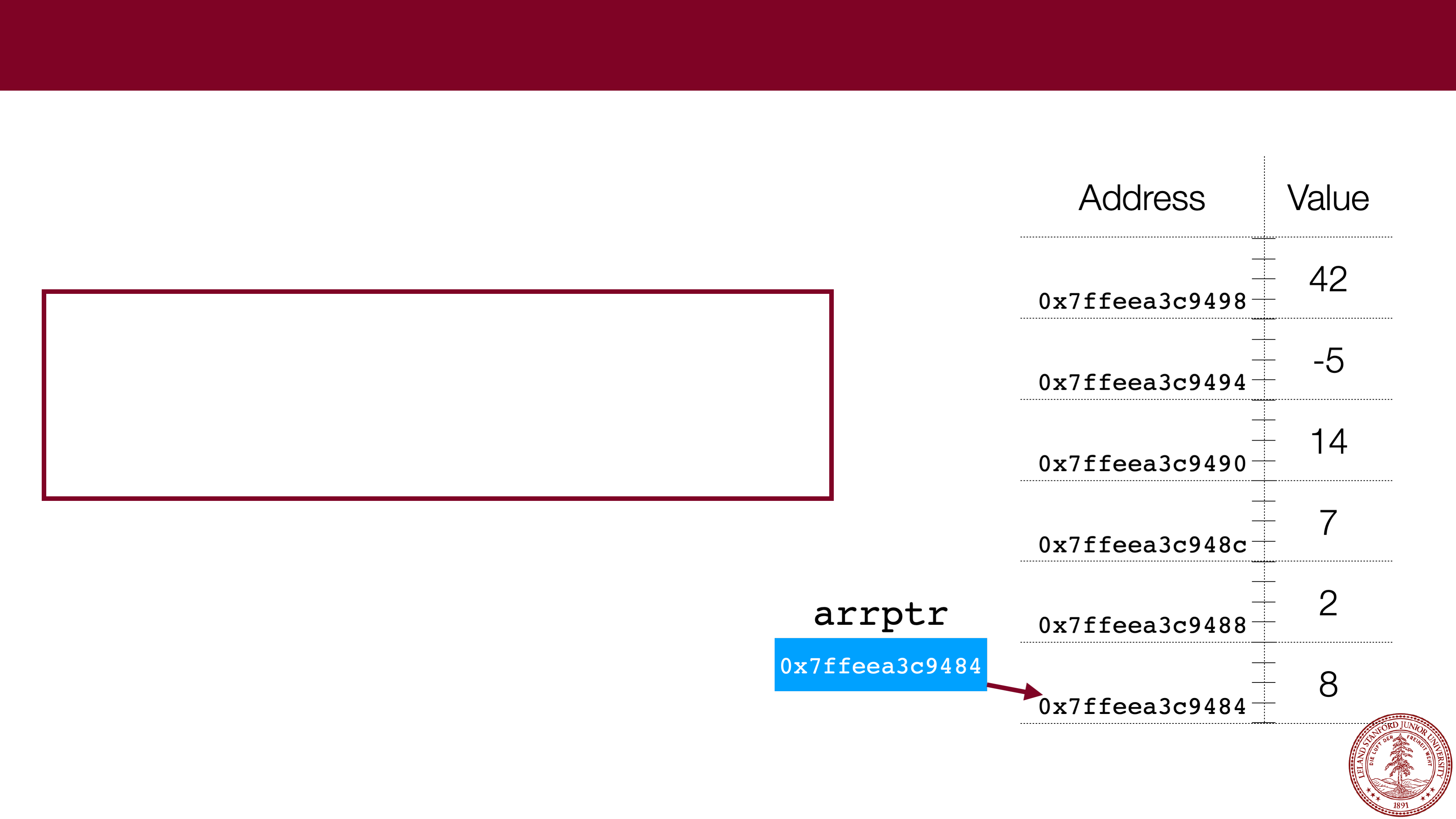 Pointers to Arrays
— Memory Footprint
What if we wanted to write a swap function for the
array (to swap two elements)?
Can we do it with
memove? Sure:
void swapB(int *arr, int index_x, int index_y)
{
int tmp;
memmove(&tmp, arr + index_x, sizeof(int));
memmove(arr + index_x, arr + index_y, sizeof(int));
memmove(arr + index_y, &tmp, sizeof(int));
}
This works because we
know the size of the
elements in the array (they are
int
s)
As long as we know the size of the elements,
we can always swap (or compare, or
whatever) two elements in an array!
Page 45
Pointers to Arrays
— Memory Footprint
Full example:
// file: pointer_to_array1.c
#include<stdio.h>
#include<stdlib.h>
#include<string.h>
void swapA(int *arr, int index_x, int index_y)
{
int tmp = *(arr + index_x);
*(arr + index_x) = *(arr + index_y);
*(arr + index_y) = tmp;
}
void swapB(int *arr, int index_x, int index_y)
{
int tmp;
memmove(&tmp, arr + index_x, sizeof(int));
memmove(arr + index_x, arr + index_y,sizeof(int));
memmove(arr + index_y, &tmp,sizeof(int));
}
int main(int argc, char **argv)
{
int arr[] = {8,2,7,14,
-
5,42};
swapA(arr,0,5); // swaps 8 and 42
swapB(arr,1,2); // swaps 2 and 7
int nelems = sizeof(arr) / sizeof(arr[0]);
for (int i=0; i < nelems; i++) {
printf("%d",arr[i]);
i == nelems
-
1 ? printf("
\
n") : printf(", ");
}
return 0;
}
$ ./pointer_to_array1
42, 7, 2, 14, -5, 8
Page 46
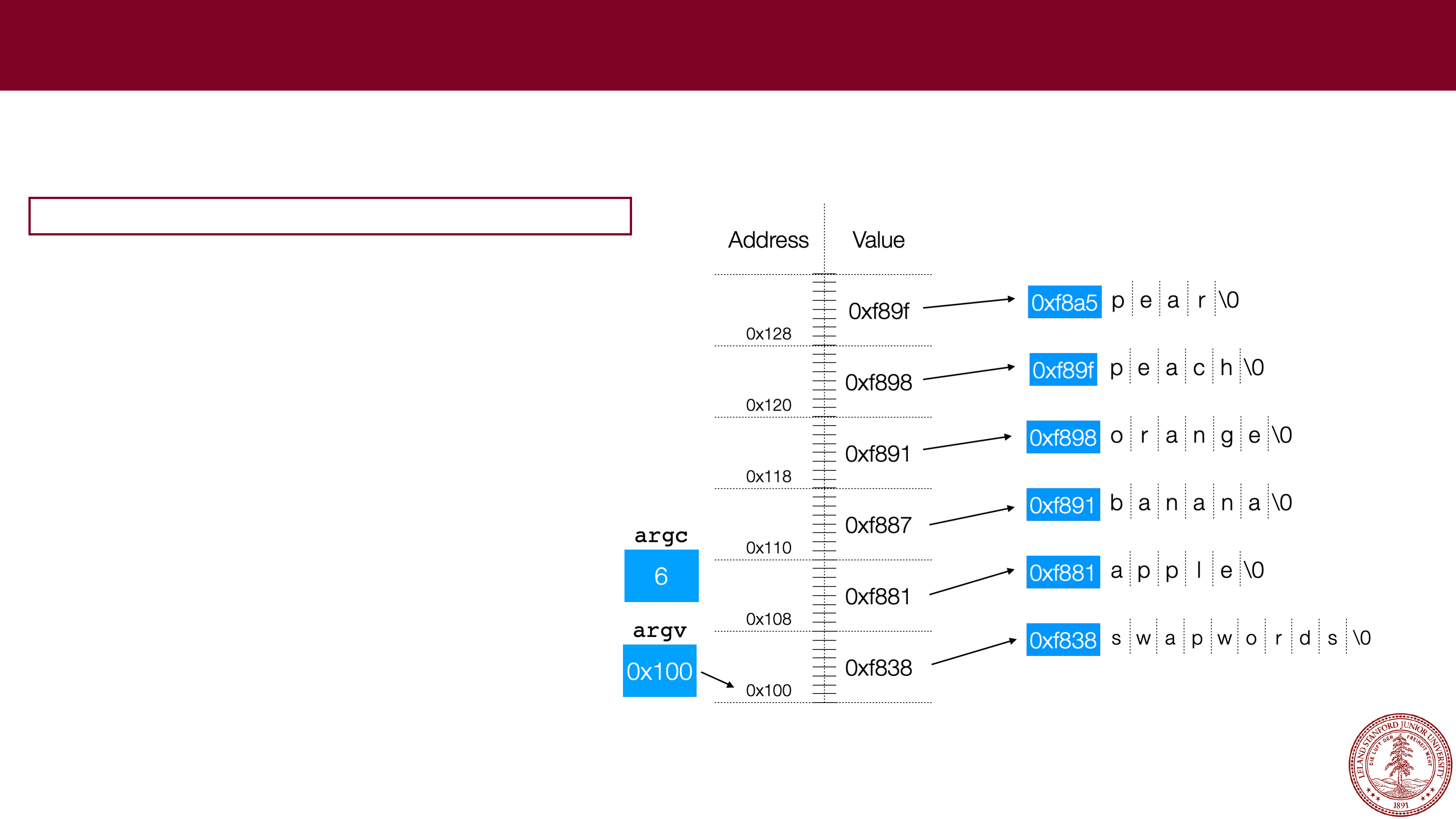 Pointers to Arrays
— Memory Footprint
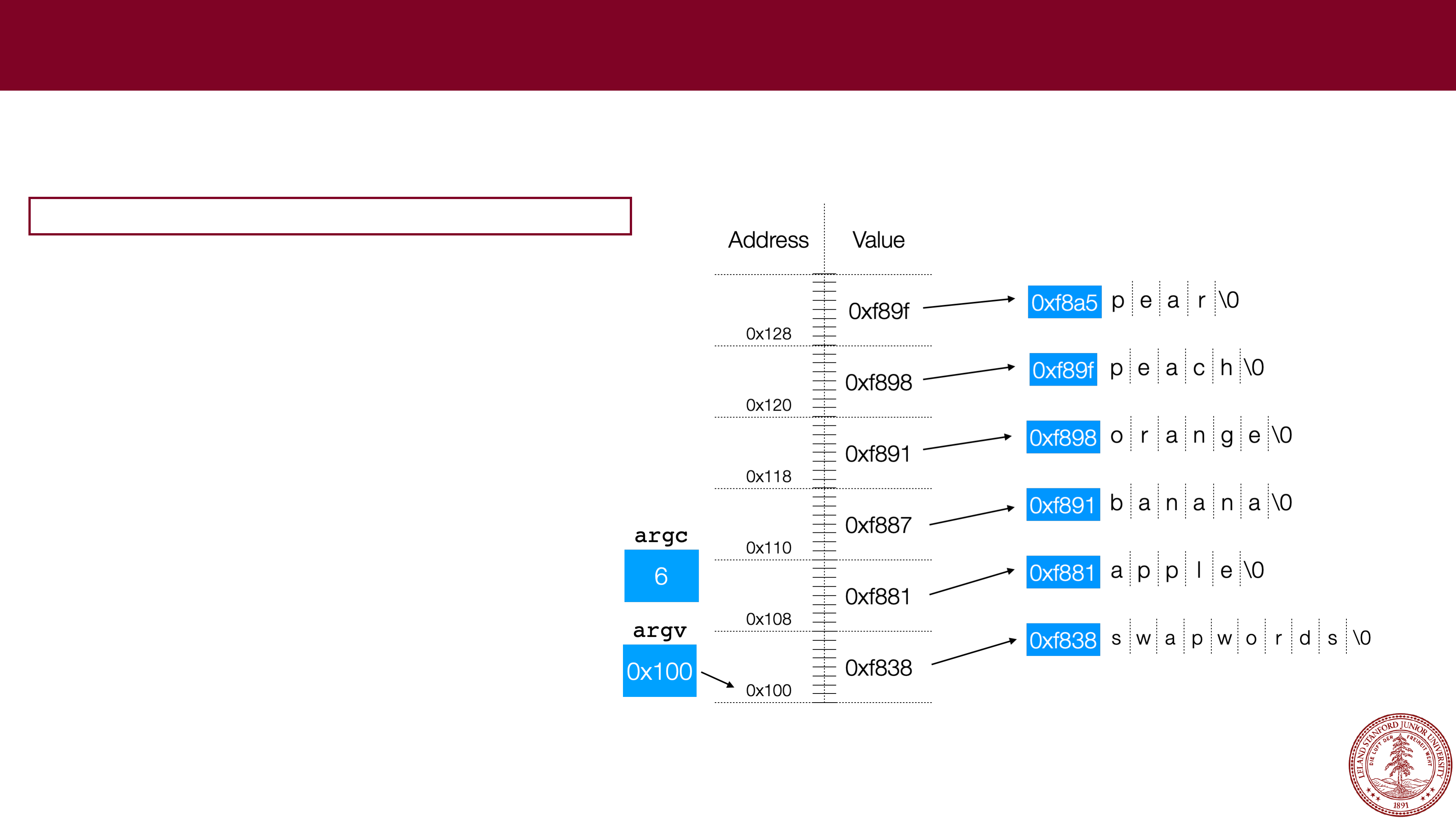
For our second example, let's look at
argv
, which is an array of
char *
pointers:
./swapwords apple banana orange peach pear
Can we write a function to swap two
pointers in the array?
Page 47
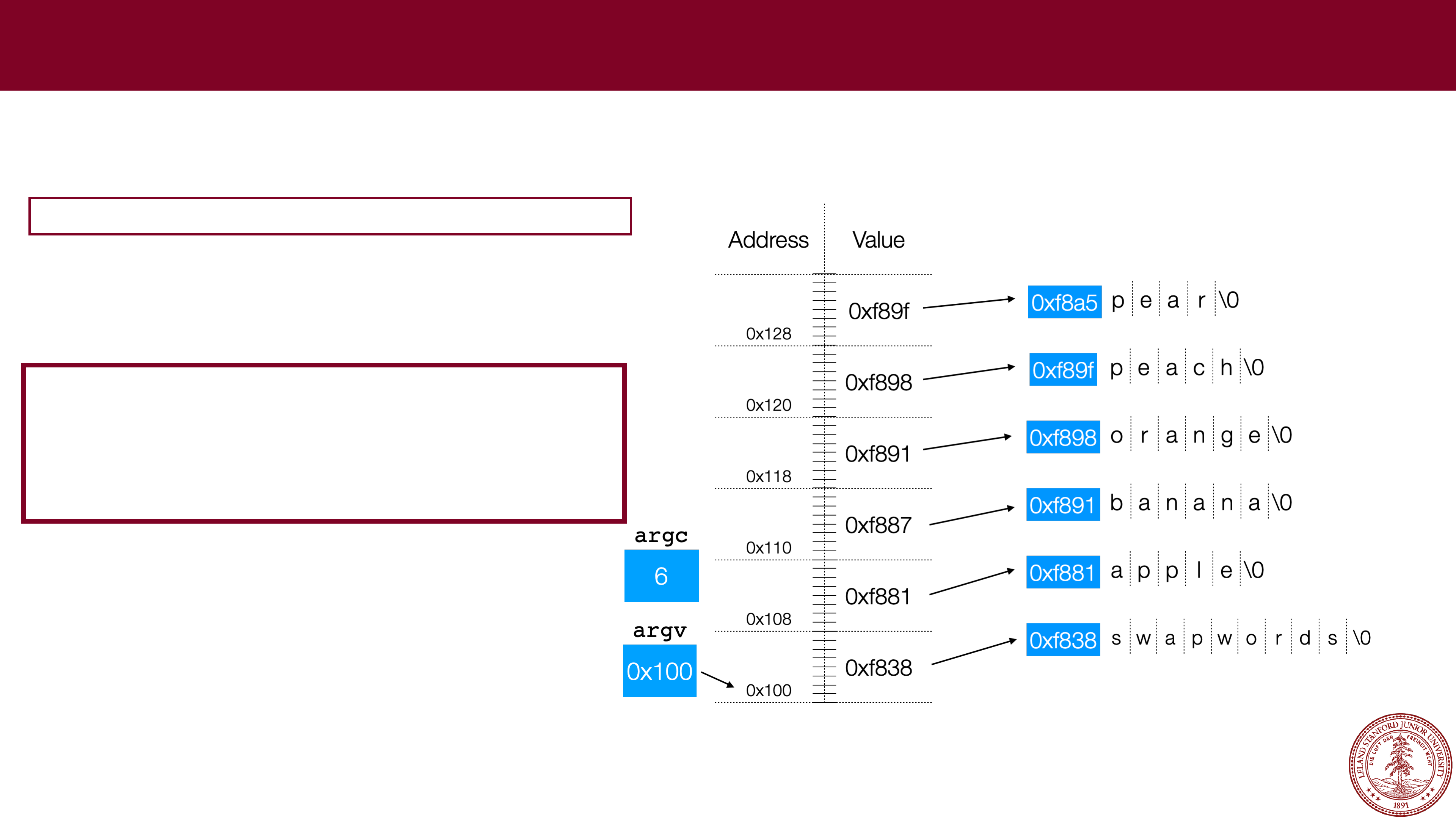 Pointers to Arrays
— Memory Footprint
For our second example, let's look at
argv
, which is an array of
char *
pointers:
./swapwords apple banana orange peach pear
Can we write a function to swap two
pointers in the array? Sure:
void swapA(char **arr, int index_x, int index_y)
{
char *tmp = *(arr + index_x);
*(arr + index_x) = *(arr + index_y);
*(arr + index_y) = tmp;
}
Note (very important!) -- Only the
pointers are getting swapped!
We are
not
copying the text from
each string, at all. For all we
know, the strings might be any
type!
Page 48
 Pointers to Arrays
— Memory Footprint
For our second example, let's look at
argv
, which is an array of
char *
pointers:
./swapwords apple banana orange peach pear
Can we write a function to swap two
pointers in the array
using memove?
Page 49
 Pointers to Arrays
— Memory Footprint
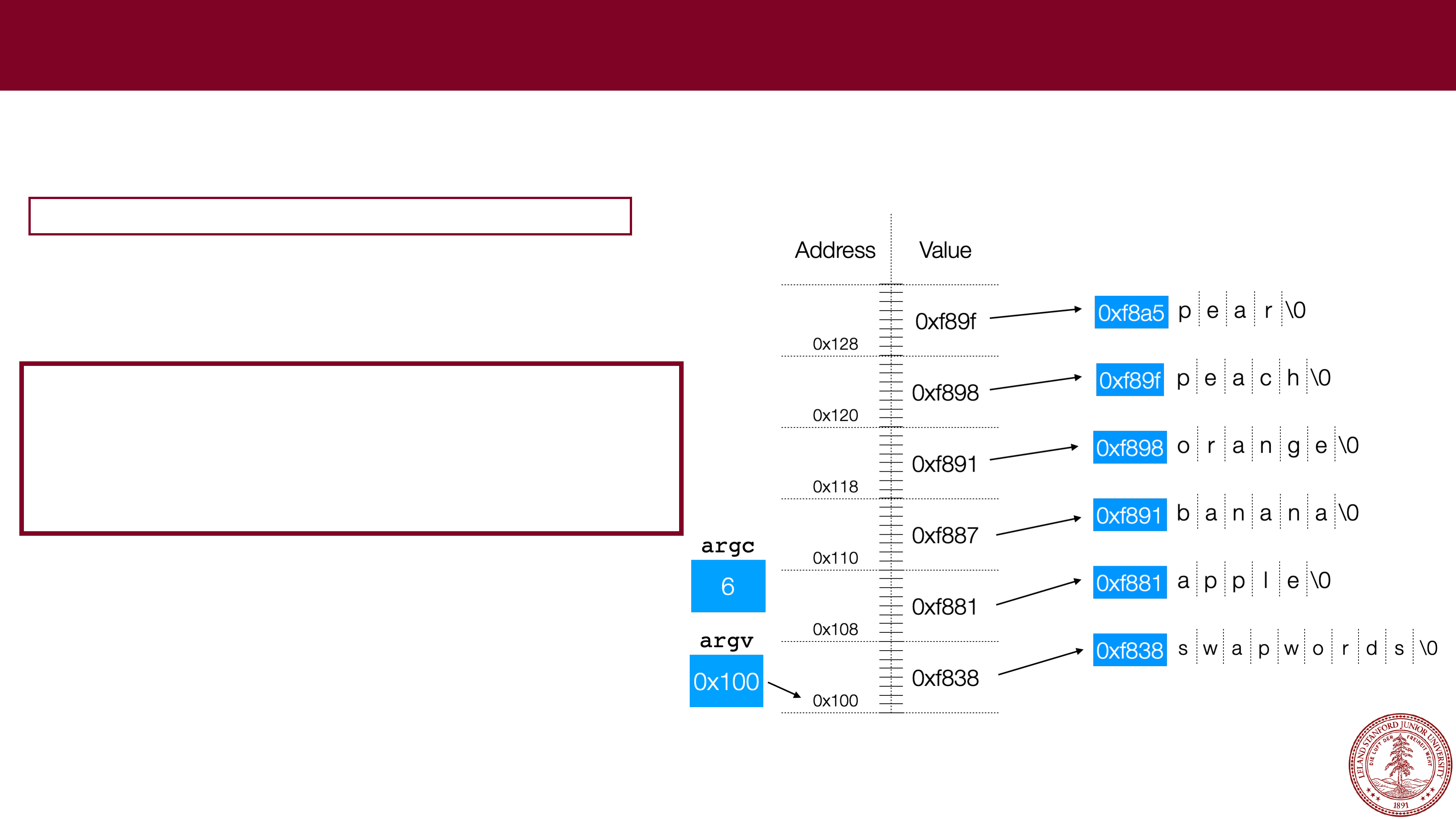
For our second example, let's look at
argv
, which is an array of
char *
pointers:
./swapwords apple banana orange peach pear
Can we write a function to swap two
pointers in the array
using memove?
void swapB(char **arr, int index_x, int index_y)
{
char *tmp;
memmove(&tmp, arr + index_x, sizeof(char *));
memmove(arr + index_x, arr + index_y,sizeof(char *));
memmove(arr + index_y, &tmp,sizeof(char *));
}
In this case, we need to move 8 bytes
at a time, and we conveniently get
that value using
sizeof()
.
Page 50
Pointers to Arrays
— Memory Footprint
Full example:
// file: swapwords.c
#include<stdio.h>
#include<stdlib.h>
#include<string.h>
void swapA(char **arr, int index_x, int index_y)
{
char *tmp = *(arr + index_x);
*(arr + index_x) = *(arr + index_y);
*(arr + index_y) = tmp;
}
void swapB(char **arr, int index_x, int index_y)
{
char *tmp;
memmove(&tmp, arr + index_x, sizeof(char *));
memmove(arr + index_x, arr + index_y, sizeof(char *));
memmove(arr + index_y, &tmp, sizeof(char *));
}
int main(int argc, char **argv)
{
if (argc < 6) {
printf("Usage:
\n\
t%s s1 s2 s3 s4 s5
\
n",argv[0]);
return
-
1;
}
// assume:
// ./swapwords apple banana orange peach pear
swapA(argv,1,5); // swaps apple and pear
swapB(argv,2,3); // swaps banana and orange
for (int i=1; i < argc; i++) { // skip progname
printf("%s",argv[i]);
i == argc
-
1 ? printf("
\
n") : printf(", ");
}
return 0;
}
$ ./swapwords apple banana orange peach pear
pear, orange, banana, peach, apple
Page 51
Pointers to Arrays
— Memory Footprint
You might be asking -- why would we ever want to use the
memmove
function, if
we already know the type?
Ah -- this is a key insight that we will discuss soon! When we get to "
void *
"
pointers, we will find out that there is no way to do this without memmove, and
we will actually need information about the width of the type itself!
Preview:
void swap_generic(void *arr, int index_x, int index_y, int width)
{
char tmp[width];
void *x_loc = (char *)arr + index_x * width;
void *y_loc = (char *)arr + index_y * width;
memmove(tmp, x_loc, width);
memmove(x_loc, y_loc, width);
memmove(y_loc, tmp, width);
}
Page 52
References and Advanced Reading
•
References:
•
K&R C Programming (from our course)
•
Course Reader, C Primer
•Awesome C book:
http://books.goalkicker.com/CBook
•
Advanced Reading:
•
https://www.cs.bu.edu/teaching/cpp/string/array-vs-ptr/
•
https://en.wikibooks.org/wiki/C_Programming/Pointers_and_arrays