Page 1
Friday, January 28, 2022
Computer Systems
Winter 2022
Stanford University
Computer Science Department
Reading: Reader: Ch 8,
Pointers, Generic functions
with void *, and Pointers to Functions,
K&R Ch 1.6,
5.6
-
5.9
Lecturer: Chris Gregg
CS 107
Lecture 7: More
Heap, and Void *
void swap_generic(void *arr, int index_x,
int index_y, int width)
{
char tmp[width];
void *x_loc = (char *)arr + index_x * width;
void *y_loc = (char *)arr + index_y * width;
memmove(tmp, x_loc, width);
memmove(x_loc, y_loc, width);
memmove(y_loc, tmp, width);
}
Page 2
Today's Topics
•
Logistics
•
Assign3 - out
•
Reading: Reader: Ch 8, Pointers, Generic functions with void *, and Pointers
to Functions
•
More on heap allocation: contractual guarantees, undefined behavior
•
Heap allocation, the good, the bad
•
How to choose: stack or heap?
•
Generic pointers, void *
•
Why we use them
•
How to use them
•
Examples
Page 3
Assign3:
You will have to write a function called
read_line
which improves upon the terrible
gets
function, and the better
fgets
function.
You will also write two utilities,
myuniq
and
mytail
, where you will use
read_line
(so make it good!). Let's look at
uniq
and
tail
.
Page 4
More on Heap Allocation
void *malloc(size_t nbytes);
void *calloc(size_t count, size_t size);
void *realloc(void *ptr, size_t nbytes);
void free(void *ptr);
malloc
,
calloc
, and
realloc
guarantee:
•
NULL on failure
•
Memory is contiguous; the number of bytes is >= to the requested amount.
•
They are not recycled unless you call free
•
realloc preserves existing data
•
calloc initializes bytes, malloc and realloc do not
Undefined behavior occurs when:
•
If overflow (i.e., beyond bytes allocated)
•
if use after free, or if free is called twice on a location.
•
realloc/free non-heap address
Page 5
Why do we like heap allocation?
Plentiful
— you can request lots of heap memory if your program needs it.
Allocation and deallocation are under the program's control
— you can
precisely determine the lifetime of a block of memory.
Can resize
— you can use realloc to resize a block.
Page 6
Why don't we like heap allocation?
Only moderately efficient
— The operating system needs to be involved, and it
needs to search for available space, update its records, etc.
Low type safety
— You get back a void * pointer, and that limits the compiler's
ability to provide warnings.
Memory management is tricky
— you have to remember to initialize, you have to
keep track of how many bytes you've requested, you have to remember to
free
but to not
free twice, etc.
Leaks possible
— this is less critical, but causes programs to waste memory.
Page 7
How do you choose between stack and heap allocation?
Use stack if possible, go to heap only when you must
Stack is safer, more efficient, more convenient
When is heap allocation required?
Very large allocation that could blow out stack
Dynamic construction, not known at compile-time what declarations will be needed
Need to control lifetime — memory must persist outside of function call
Need to resize memory after initial allocation
With heap, comes responsibility
Your responsibility for correct allocation at right time and right size
Your responsibility to manage the pointee type and size
Your responsibility for correct deallocation at right time, once and only once
valgrind
is your friend!
Page 8
Generic Pointers
We are now going to go into an area that I like to call "the wild west" of pointers.
We are going to discuss the
void *
pointer, which is a pointer that has an
unspecified pointee type. In other words, it is a pointer, but does not have a width
associated with the underlying data based on some type.
You can pass
void * pointers to and from functions, and you can assign them
values with the
&
operator. E.g.,
int arr[] = {2,4,6,8,10};
void *arr_p1 = arr;
int *arr_p2 = arr_p;
Page 9
Generic Pointers
You
cannot
dereference a void * pointer, nor can you use pointer arithmetic with
it. E.g.,
int arr[] = {2,4,6,8,10};
void *arr_p1 = arr;
arr_p1++; // gives compiler warning about incrementing void *
printf("%d
\
n",arr_p1[0]); // warns, but also causes compiler error
// because you cannot dereference void *
Page 10
Generic Pointers
Why would we ever want a type where we
lose
information?
Sometimes, a function needs to be
generic
so it can deal with any type. We have
seen this with
realloc
and
free
:
void free(void *ptr);
It would not be very nice if we had to have a different
free
function for every type
of pointer!
Page 11
 Generic Pointers
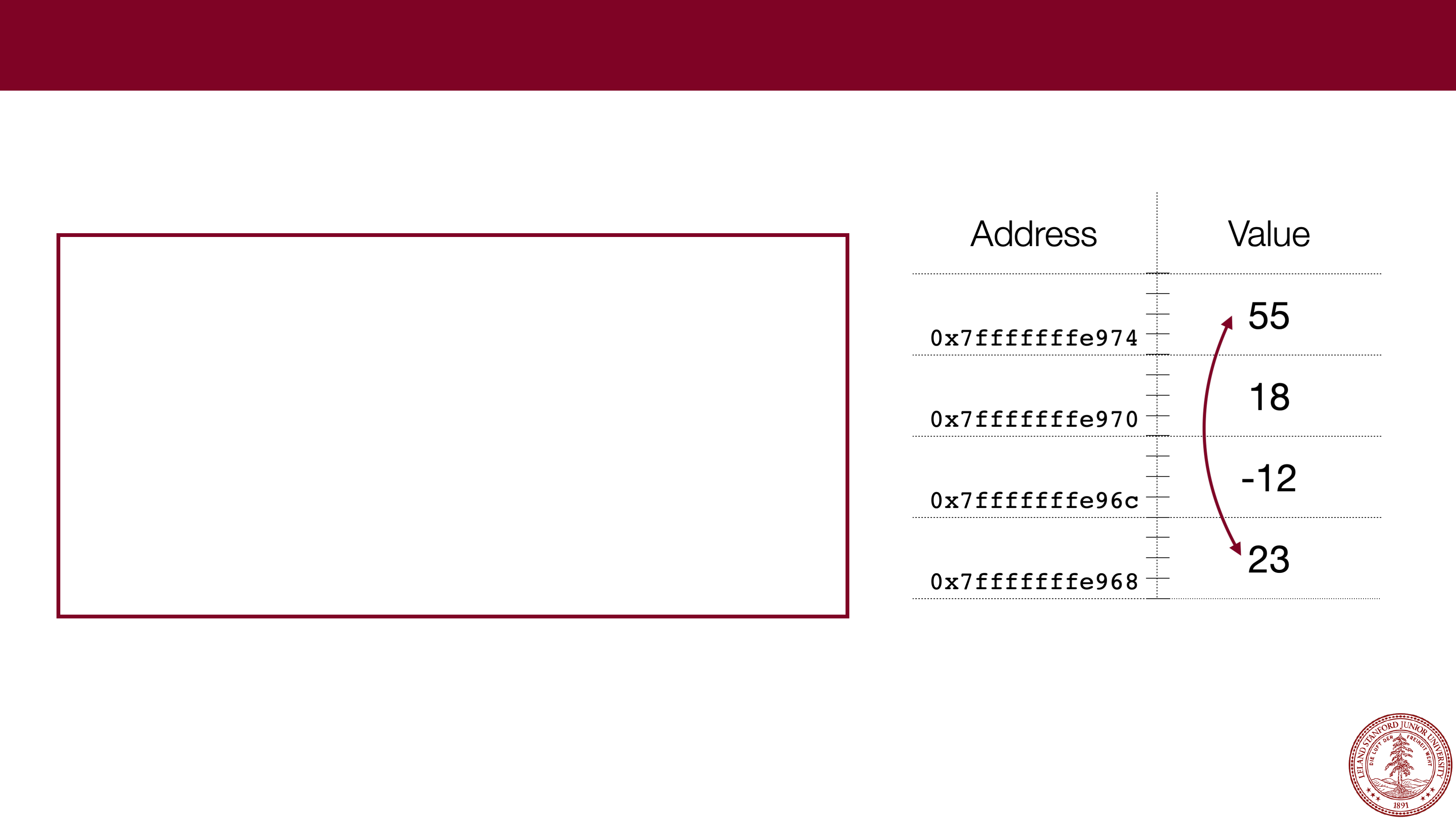
What if you wanted to write a program to swap the first and last element in an
int
array? You might write something like this:
void swap_ends_int(int *arr, size_t nelems)
{
int tmp = *arr;
*arr = *(arr + nelems
-
1);
*(arr + nelems
-
1) = tmp;
}
int main(int argc, char **argv)
{
int i_array[] = {10,40,80,20,
-
30,50};
size_t i_nelems = sizeof(i_array) / sizeof(i_array[0]);
swap_ends_int(i_array,i_nelems);
return 0;
}
Great! But what if you also wanted to swap the first and last element in a
long
array?
Page 12
Generic Pointers
Great! But what if you also wanted to swap the first and last element in a
long
array?
void swap_ends_int(int *arr, size_t nelems)
{
int tmp = *arr;
*arr = *(arr + nelems
-
1);
*(arr + nelems
-
1) = tmp;
}
void swap_ends_long(long *arr, size_t nelems)
{
long tmp = *arr;
*arr = *(arr + nelems
-
1);
*(arr + nelems
-
1) = tmp;
}
int main(int argc, char **argv)
{
int i_array[] = {10,40,80,20,
-
30,50};
size_t i_nelems = sizeof(i_array) / sizeof(i_array[0]);
swap_ends_int(i_array,i_nelems);
long l_array[] = {100,400,800,200,
-
300,500};
size_t l_nelems = sizeof(l_array) / sizeof(l_array[0]);
swap_ends_long(l_array,l_nelems);
return 0;
}
Bummer. We have to write a
function that is virtually identical,
with the only difference being that
we handle the type of the array
elements differently.
In other words, the type system is
getting in the way! We would like
to write a single
swap_ends
function that handles
any
array,
but the type system foils us.
Page 13
Generic Pointers
void *
to the rescue! In this case, the pointer type gives us information about the
size of the elements being pointed to (either 4-bytes for
int
, or 8-bytes for
long
, in
the previous example).
By using void * and
explicitly including the width of the type
, we can write a function
that can take any type as the elements to swap:
void swap_ends(void *arr, size_t nelems, int width)
{
// allocate space for the copy
char tmp[width];
// copy the first element to tmp
memmove(tmp,arr,width);
// copy the last element to the first
memmove(arr,(char *)arr + (nelems
-
1) * width, width);
// copy tmp to the last element
memmove((char *)arr + (nelems
-
1) * width, tmp, width);
}
Remember last time we showed that
we can copy bytes using
memmove
?
We must pass the width of the
elements in the array because the
void *
pointer doesn't carry that
information.
Page 14
Generic Pointers
void swap_ends(void *arr, size_t nelems, int width)
{
// allocate space for the copy
char tmp[width];
// copy the first element to tmp
memmove(tmp, arr, width);
// copy the last element to the first
memmove(arr, (char *)arr + (nelems
-
1) * width, width);
// copy tmp to the last element
memmove((char *)arr + (nelems
-
1) * width, tmp, width);
}
Let's look at this function in more
detail. First, we have a
void *
pointer passed in as the array.
Page 15
Generic Pointers
void swap_ends(void *arr, size_t nelems, int width)
{
// allocate space for the copy
char tmp[width];
// copy the first element to tmp
memmove(tmp, arr, width);
// copy the last element to the first
memmove(arr,(char *)arr + (nelems
-
1) * width, width);
// copy tmp to the last element
memmove((char *)arr + (nelems
-
1) * width, tmp, width);
}
Let's look at this function in more
detail. First, we have a
void *
pointer passed in as the array.
Next, we create a
char
array to hold
the bytes. Remember:
char
is the
only 1-byte type we have, and using
a
char array is how we can create
an array that is exactly the number of bytes we want. We will use this almost every
time we use
void *
pointers, so get used to it!
(we could also use
malloc
if we wanted to, but it isn't really necessary here, as the
array works just fine. Regardless, we would still use a
char *
pointer)
Page 16
Generic Pointers
void swap_ends(void *arr, size_t nelems, int width)
{
// allocate space for the copy
char tmp[width];
// copy the first element to tmp
memmove(tmp, arr, width);
// copy the last element to the first
memmove(arr,(char *)arr + (nelems
-
1) * width, width);
// copy tmp to the last element
memmove((char *)arr + (nelems
-
1) * width, tmp, width);
}
Let's look at this function in more
detail. First, we have a
void *
pointer passed in as the array.
Next, we create a
char
array to hold
the bytes. Remember:
char
is the
only 1-byte type we have, and using
a
char array is how we can create
an array that is exactly the number of bytes we want. We will use this almost every
time we use
void *
pointers, so get used to it!
We copy the bytes with
memmove
.
Page 17
Generic Pointers
void swap_ends(void *arr, size_t nelems, int width)
{
// allocate space for the copy
char tmp[width];
// copy the first element to tmp
memmove(tmp, arr, width);
// copy the last element to the first
memmove(arr,(char *)arr + (nelems
-
1) * width, width);
// copy tmp to the last element
memmove((char *)arr + (nelems
-
1) * width, tmp, width);
}
This part takes some time to get
used to!
Notice that we need a pointer to the
element that we are trying to copy
into. We already said that we cannot
do pointer arithmetic on a
void *
pointer, so we first cast the pointer
to
char *
, and then manually calculate the pointer arithmetic to get us to the correct
location. In this case, because we want the last element in the array, the calculation is:
(char *)arr + (nelems - 1) * width
Page 18
 Generic Pointers
void swap_ends(void *arr, size_t nelems, int width)
{
// allocate space for the copy
char tmp[width];
// copy the first element to tmp
memmove(tmp, arr, width);
// copy the last element to the first
memmove(arr,(char *)arr + (nelems
-
1) * width, width);
// copy tmp to the last element
memmove((char *)arr + (nelems
-
1) * width, tmp, width);
}
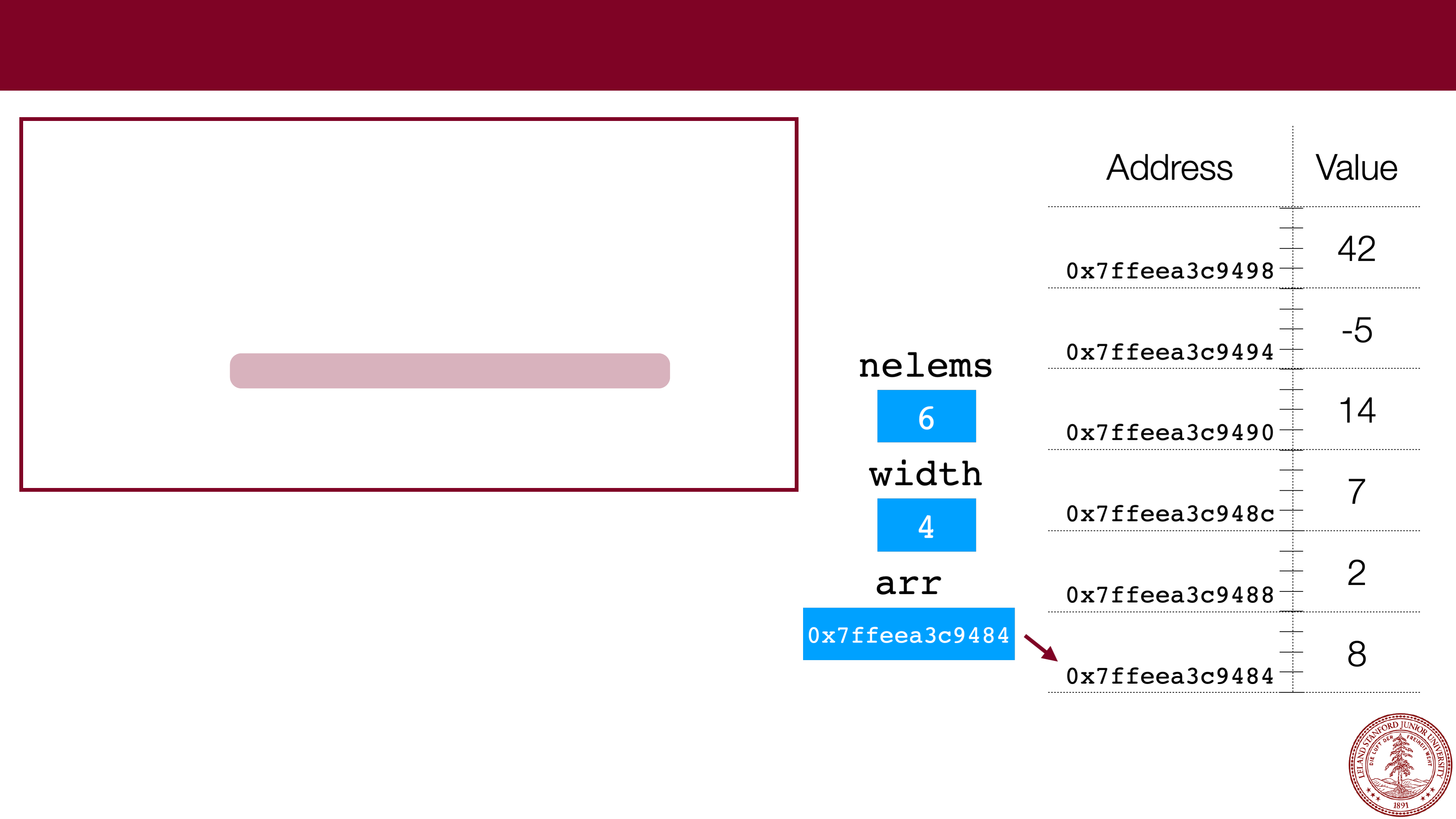
In other words, what is the location of the 42?
(char *)arr + (nelems
-
1) * width
0x7ffeea3c9484 + (5 * 4) == 0x7ffeea3c9498
A key point to understand is that the pointer arithmetic increases by exactly 20
because of the
char *
cast, which means that +1 equals 1 byte.
Page 19
 Generic Pointers
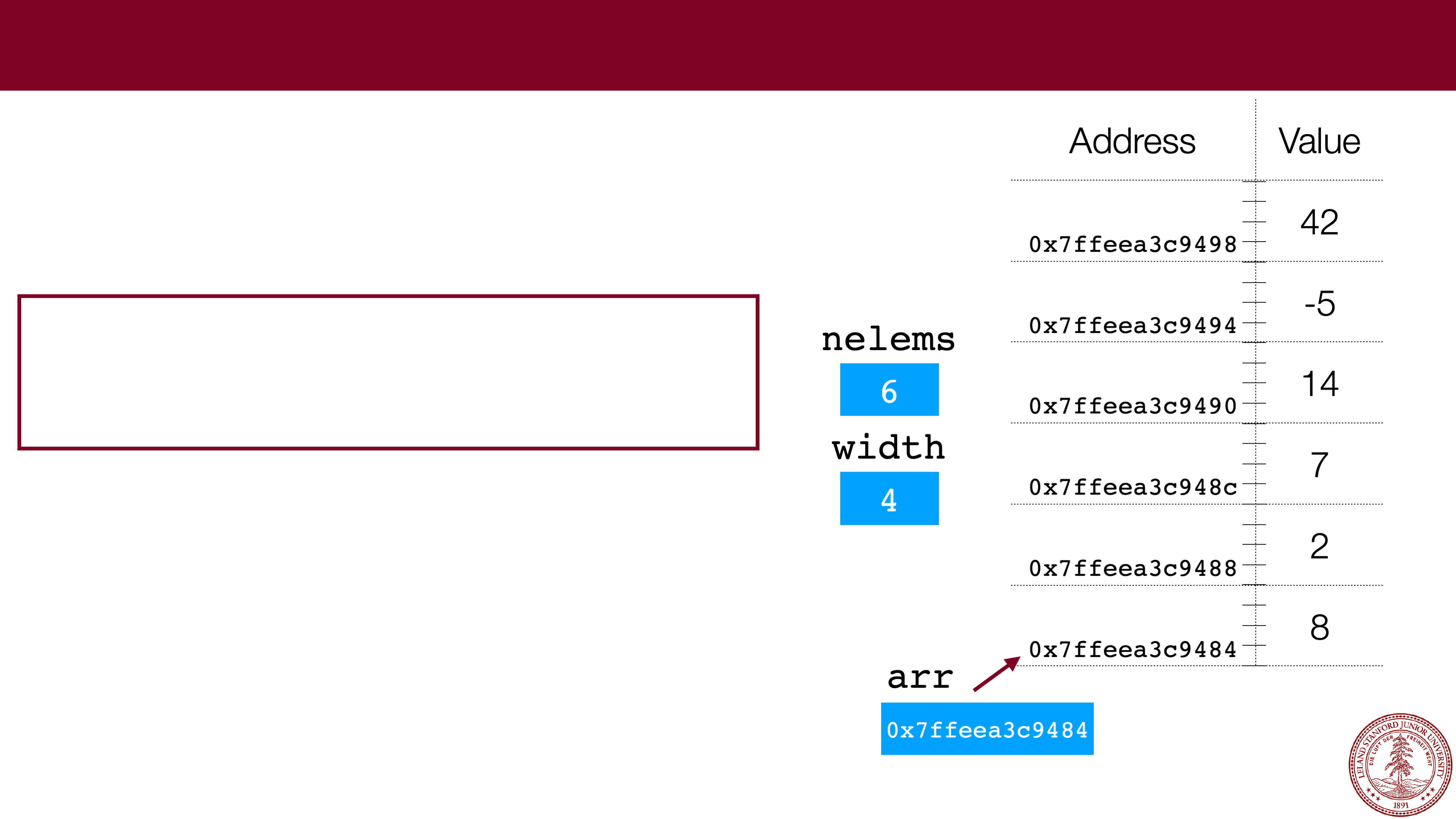
Very often, we will need to find the i
th
element
in an array. You should be
extremely
familiar
with the following idiom:
for (size_t i=0; i < nelems; i++) {
// get ith element
void *ith = (char *)arr + i * width;
}
Page 20
 Generic Pointers
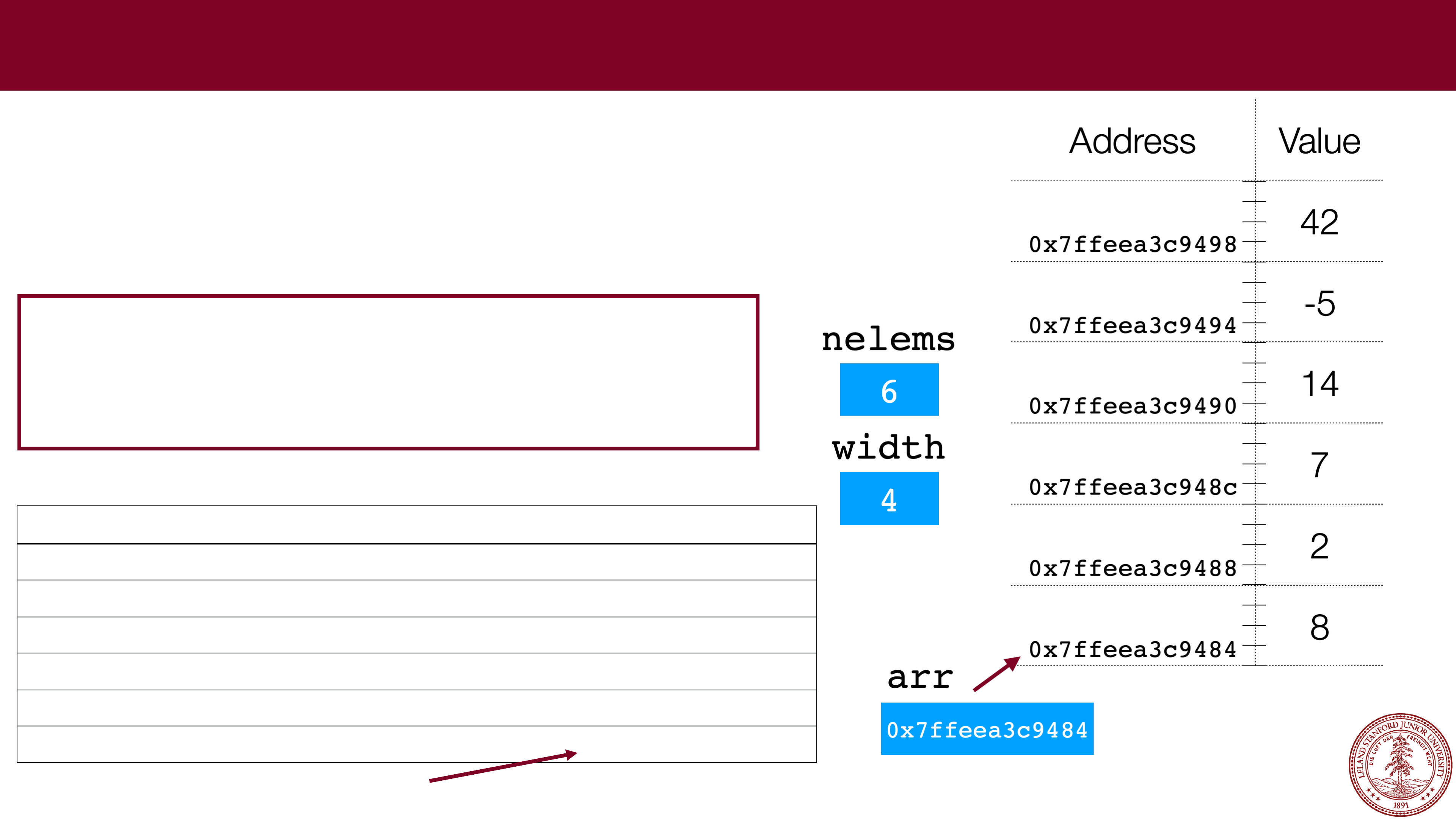
Very often, we will need to find the i
th
element
in an array. You should be
extremely
familiar
with the following idiom:
for (size_t i=0; i < nelems; i++) {
// get ith element
void *ith = (char *)arr + i * width;
}
i
expression
result
0
(char *)0x7ffeea3c9484 + 0 * 4 0x7ffeea3c9484
1
(char *)0x7ffeea3c9484 + 1 * 4 0x7ffeea3c9488
2
(char *)0x7ffeea3c9484 + 2 * 4 0x7ffeea3c948c
3
(char *)0x7ffeea3c9484 + 3 * 4 0x7ffeea3c9490
4
(char *)0x7ffeea3c9484 + 4 * 4 0x7ffeea3c9494
5
(char *)0x7ffeea3c9484 + 5 * 4 0x7ffeea3c9498
Important! These numbers are pointers to the type held in the array!!!!!
Page 21
Generic example with two different arrays
void swap_ends(void *arr, size_t nelems, int width)
{
// allocate space for the copy
char tmp[width];
// copy the first element to tmp
memmove(tmp, arr, width);
// copy the last element to the first
memmove(arr,(char *)arr + (nelems
-
1) * width, width);
// copy tmp to the last element
memmove((char *)arr + (nelems
-
1) * width, tmp, width);
}
int main(int argc, char **argv)
{
int i_array[] = {10, 40, 80, 20,
-
30, 50};
size_t i_nelems = sizeof(i_array) / sizeof(i_array[0]);
long l_array[] = {100, 400, 800, 200,
-
300, 500};
size_t l_nelems = sizeof(l_array) / sizeof(l_array[0]);
swap_ends(i_array, i_nelems, sizeof(i_array[0]));
swap_ends(l_array, l_nelems, sizeof(l_array[0]));
...
Let's walk through this example.
First, we create an
int
array, then
we find its size.
Page 22
Generic example with two different arrays
void swap_ends(void *arr, size_t nelems, int width)
{
// allocate space for the copy
char tmp[width];
// copy the first element to tmp
memmove(tmp, arr, width);
// copy the last element to the first
memmove(arr,(char *)arr + (nelems
-
1) * width, width);
// copy tmp to the last element
memmove((char *)arr + (nelems
-
1) * width, tmp, width);
}
int main(int argc, char **argv)
{
int i_array[] = {10, 40, 80, 20,
-
30, 50};
size_t i_nelems = sizeof(i_array) / sizeof(i_array[0]);
long l_array[] = {100, 400, 800, 200,
-
300, 500};
size_t l_nelems = sizeof(l_array) / sizeof(l_array[0]);
swap_ends(i_array, i_nelems, sizeof(i_array[0]));
swap_ends(l_array, l_nelems, sizeof(l_array[0]));
...
Let's walk through this example.
First, we create an
int
array, then
we find its size.
Next, we create a long array, then
we find its size.
Page 23
Generic example with two different arrays
void swap_ends(void *arr, size_t nelems, int width)
{
// allocate space for the copy
char tmp[width];
// copy the first element to tmp
memmove(tmp, arr, width);
// copy the last element to the first
memmove(arr,(char *)arr + (nelems
-
1) * width, width);
// copy tmp to the last element
memmove((char *)arr + (nelems
-
1) * width, tmp, width);
}
int main(int argc, char **argv)
{
int i_array[] = {10, 40, 80, 20,
-
30, 50};
size_t i_nelems = sizeof(i_array) / sizeof(i_array[0]);
long l_array[] = {100, 400, 800, 200,
-
300, 500};
size_t l_nelems = sizeof(l_array) / sizeof(l_array[0]);
swap_ends(i_array, i_nelems, sizeof(i_array[0]));
swap_ends(l_array, l_nelems, sizeof(l_array[0]));
...
Let's walk through this example.
First, we create an
int
array, then
we find its size.
Next, we create a long array, then
we find its size.
Then, we call swap_ends on the
int
array.
Note that we pass in the width,
which is 4:
sizeof(i_array[0])
Page 24
Generic example with two different arrays
void swap_ends(void *arr, size_t nelems, int width)
{
// allocate space for the copy
char tmp[width];
// copy the first element to tmp
memmove(tmp, arr, width);
// copy the last element to the first
memmove(arr,(char *)arr + (nelems
-
1) * width, width);
// copy tmp to the last element
memmove((char *)arr + (nelems
-
1) * width, tmp, width);
}
int main(int argc, char **argv)
{
int i_array[] = {10, 40, 80, 20,
-
30, 50};
size_t i_nelems = sizeof(i_array) / sizeof(i_array[0]);
long l_array[] = {100, 400, 800, 200,
-
300, 500};
size_t l_nelems = sizeof(l_array) / sizeof(l_array[0]);
swap_ends(i_array, i_nelems, sizeof(i_array[0]));
swap_ends(l_array, l_nelems, sizeof(l_array[0]));
...
Create a char array to hold the width
of the element we want to swap.
At this point, all information about
the int array is gone, so we just have
to rely on the
width
argument.
Page 25
Generic example with two different arrays
void swap_ends(void *arr, size_t nelems, int width)
{
// allocate space for the copy
char tmp[width];
// copy the first element to tmp
memmove(tmp, arr, width);
// copy the last element to the first
memmove(arr,(char *)arr + (nelems
-
1) * width, width);
// copy tmp to the last element
memmove((char *)arr + (nelems
-
1) * width, tmp, width);
}
int main(int argc, char **argv)
{
int i_array[] = {10, 40, 80, 20,
-
30, 50};
size_t i_nelems = sizeof(i_array) / sizeof(i_array[0]);
long l_array[] = {100, 400, 800, 200,
-
300, 500};
size_t l_nelems = sizeof(l_array) / sizeof(l_array[0]);
swap_ends(i_array, i_nelems, sizeof(i_array[0]));
swap_ends(l_array, l_nelems, sizeof(l_array[0]));
...
Create a char array to hold the width
of the element we want to swap.
At this point, all information about
the int array is gone, so we just have
to rely on the
width
argument.
Move 4 bytes from the first element
in the array to
tmp
.
Page 26
Generic example with two different arrays
void swap_ends(void *arr, size_t nelems, int width)
{
// allocate space for the copy
char tmp[width];
// copy the first element to tmp
memmove(tmp, arr, width);
// copy the last element to the first
memmove(arr,(char *)arr + (nelems
-
1) * width, width);
// copy tmp to the last element
memmove((char *)arr + (nelems
-
1) * width, tmp, width);
}
int main(int argc, char **argv)
{
int i_array[] = {10, 40, 80, 20,
-
30, 50};
size_t i_nelems = sizeof(i_array) / sizeof(i_array[0]);
long l_array[] = {100, 400, 800, 200,
-
300, 500};
size_t l_nelems = sizeof(l_array) / sizeof(l_array[0]);
swap_ends(i_array, i_nelems, sizeof(i_array[0]));
swap_ends(l_array, l_nelems, sizeof(l_array[0]));
...
Create a char array to hold the width
of the element we want to swap.
At this point, all information about
the int array is gone, so we just have
to rely on the
width
argument.
Move 4 bytes from the first element
in the array to
tmp
.
Move 4 bytes from the last element
in the array to the first element.
Page 27
Generic example with two different arrays
void swap_ends(void *arr, size_t nelems, int width)
{
// allocate space for the copy
char tmp[width];
// copy the first element to tmp
memmove(tmp, arr, width);
// copy the last element to the first
memmove(arr,(char *)arr + (nelems
-
1) * width, width);
// copy tmp to the last element
memmove((char *)arr + (nelems
-
1) * width, tmp, width);
}
int main(int argc, char **argv)
{
int i_array[] = {10, 40, 80, 20,
-
30, 50};
size_t i_nelems = sizeof(i_array) / sizeof(i_array[0]);
long l_array[] = {100, 400, 800, 200,
-
300, 500};
size_t l_nelems = sizeof(l_array) / sizeof(l_array[0]);
swap_ends(i_array, i_nelems, sizeof(i_array[0]));
swap_ends(l_array, l_nelems, sizeof(l_array[0]));
...
Create a char array to hold the width
of the element we want to swap.
At this point, all information about
the int array is gone, so we just have
to rely on the
width
argument.
Move 4 bytes from the first element
in the array to
tmp
.
Move 4 bytes from the last element
in the array to the first element.
Move 4 bytes from tmp to the
last position in the array.
Page 28
Generic example with two different arrays
void swap_ends(void *arr, size_t nelems, int width)
{
// allocate space for the copy
char tmp[width];
// copy the first element to tmp
memmove(tmp, arr, width);
// copy the last element to the first
memmove(arr,(char *)arr + (nelems
-
1) * width, width);
// copy tmp to the last element
memmove((char *)arr + (nelems
-
1) * width, tmp, width);
}
int main(int argc, char **argv)
{
int i_array[] = {10, 40, 80, 20,
-
30, 50};
size_t i_nelems = sizeof(i_array) / sizeof(i_array[0]);
long l_array[] = {100, 400, 800, 200,
-
300, 500};
size_t l_nelems = sizeof(l_array) / sizeof(l_array[0]);
swap_ends(i_array, i_nelems, sizeof(i_array[0]));
swap_ends(l_array, l_nelems, sizeof(l_array[0]));
...
Repeat the process for the long
array, which will pass in a
width
of
8:
sizeof(l_array[0]);
Page 29
It's really generic
// file: prog_name_to_end.c
#include<stdio.h>
#include<stdlib.h>
#include<string.h>
void swap_ends(void *arr, size_t nelems, int width)
{
// allocate space for the copy
char tmp[width];
// copy the first element to tmp
memmove(tmp, arr, width);
// copy the last element to the first
memmove(arr,(char *)arr + (nelems
-
1) * width, width);
// copy tmp to the last element
memmove((char *)arr + (nelems
-
1) * width, tmp, width);
}
int main(int argc, char **argv)
{
swap_ends(argv, argc, sizeof(argv[0]));
for (int i=0; i < argc; i++) {
printf("%s
\
n",argv[i]);
}
return 0;
}
We've seen that this function works
on elements of an integer type.
The beauty is that it will work on
any
array. What about
char **
arrays,
like
argv
? Sure —
argv
is a pointer
to an array, and we'll be swapping
pointers, not moving string
char
s.
$ gcc -g -O0 -std=gnu99 -Wall
prog_name_to_end.c -o
prog_name_to_end
$ ./prog_name_to_end abc def ghi
ghi
abc
def
./prog_name_to_end
Page 30
It's really generic
// file: prog_name_to_end.c
#include<stdio.h>
#include<stdlib.h>
#include<string.h>
void swap_ends(void *arr, size_t nelems, int width)
{
// allocate space for the copy
char tmp[width];
// copy the first element to tmp
memmove(tmp, arr, width);
// copy the last element to the first
memmove(arr,(char *)arr + (nelems
-
1) * width, width);
// copy tmp to the last element
memmove((char *)arr + (nelems
-
1) * width, tmp, width);
}
int main(int argc, char **argv)
{
swap_ends(argv, argc, sizeof(argv[0]));
for (int i=0; i < argc; i++) {
printf("%s
\
n",argv[i]);
}
return 0;
}
What is the type of
argv[0]
?
Page 31
It's really generic
// file: prog_name_to_end.c
#include<stdio.h>
#include<stdlib.h>
#include<string.h>
void swap_ends(void *arr, size_t nelems, int width)
{
// allocate space for the copy
char tmp[width];
// copy the first element to tmp
memmove(tmp, arr, width);
// copy the last element to the first
memmove(arr,(char *)arr + (nelems
-
1) * width, width);
// copy tmp to the last element
memmove((char *)arr + (nelems
-
1) * width, tmp, width);
}
int main(int argc, char **argv)
{
swap_ends(argv, argc, sizeof(argv[0]));
for (int i=0; i < argc; i++) {
printf("%s
\
n",argv[i]);
}
return 0;
}
What is the type of
argv[0]
?
char *
Page 32
It's really generic
// file: prog_name_to_end.c
#include<stdio.h>
#include<stdlib.h>
#include<string.h>
void swap_ends(void *arr, size_t nelems, int width)
{
// allocate space for the copy
char tmp[width];
// copy the first element to tmp
memmove(tmp, arr, width);
// copy the last element to the first
memmove(arr,(char *)arr + (nelems
-
1) * width, width);
// copy tmp to the last element
memmove((char *)arr + (nelems
-
1) * width, tmp, width);
}
int main(int argc, char **argv)
{
swap_ends(argv, argc, sizeof(argv[0]));
for (int i=0; i < argc; i++) {
printf("%s
\
n",argv[i]);
}
return 0;
}
What is the type of
argv[0]
?
char *
What is
sizeof(argv[0])
?
Page 33
It's really generic
// file: prog_name_to_end.c
#include<stdio.h>
#include<stdlib.h>
#include<string.h>
void swap_ends(void *arr, size_t nelems, int width)
{
// allocate space for the copy
char tmp[width];
// copy the first element to tmp
memmove(tmp, arr, width);
// copy the last element to the first
memmove(arr,(char *)arr + (nelems
-
1) * width, width);
// copy tmp to the last element
memmove((char *)arr + (nelems
-
1) * width, tmp, width);
}
int main(int argc, char **argv)
{
swap_ends(argv, argc, sizeof(argv[0]));
for (int i=0; i < argc; i++) {
printf("%s
\
n",argv[i]);
}
return 0;
}
What is the type of
argv[0]
?
char *
What is
sizeof(argv[0])
?
8
Page 34
It's really generic
// file: prog_name_to_end.c
#include<stdio.h>
#include<stdlib.h>
#include<string.h>
void swap_ends(void *arr, size_t nelems, int width)
{
// allocate space for the copy
char tmp[width];
// copy the first element to tmp
memmove(tmp, arr, width);
// copy the last element to the first
memmove(arr,(char *)arr + (nelems
-
1) * width, width);
// copy tmp to the last element
memmove((char *)arr + (nelems
-
1) * width, tmp, width);
}
int main(int argc, char **argv)
{
swap_ends(argv, argc, sizeof(argv[0]));
for (int i=0; i < argc; i++) {
printf("%s
\
n",argv[i]);
}
return 0;
}
What is the type of
argv[0]
?
char *
What is
sizeof(argv[0])
?
8
What is the type of
argv
?
Page 35
It's really generic
// file: prog_name_to_end.c
#include<stdio.h>
#include<stdlib.h>
#include<string.h>
void swap_ends(void *arr, size_t nelems, int width)
{
// allocate space for the copy
char tmp[width];
// copy the first element to tmp
memmove(tmp, arr, width);
// copy the last element to the first
memmove(arr,(char *)arr + (nelems
-
1) * width, width);
// copy tmp to the last element
memmove((char *)arr + (nelems
-
1) * width, tmp, width);
}
int main(int argc, char **argv)
{
swap_ends(argv, argc, sizeof(argv[0]));
for (int i=0; i < argc; i++) {
printf("%s
\
n",argv[i]);
}
return 0;
}
What is the type of
argv[0]
?
char *
What is
sizeof(argv[0])
?
8
What is the type of
argv
?
char **
Page 36
It's really generic
// file: prog_name_to_end.c
#include<stdio.h>
#include<stdlib.h>
#include<string.h>
void swap_ends(void *arr, size_t nelems, int width)
{
// allocate space for the copy
char tmp[width];
// copy the first element to tmp
memmove(tmp, arr, width);
// copy the last element to the first
memmove(arr,(char *)arr + (nelems
-
1) * width, width);
// copy tmp to the last element
memmove((char *)arr + (nelems
-
1) * width, tmp, width);
}
int main(int argc, char **argv)
{
swap_ends(argv, argc, sizeof(argv[0]));
for (int i=0; i < argc; i++) {
printf("%s
\
n",argv[i]);
}
return 0;
}
What is the type of
argv[0]
?
char *
What is
sizeof(argv[0])
?
8
What is the type of
argv
?
char **
What is the underlying type
(unknown to the function) of
arr
in
swap_ends
?
Page 37
It's really generic
// file: prog_name_to_end.c
#include<stdio.h>
#include<stdlib.h>
#include<string.h>
void swap_ends(void *arr, size_t nelems, int width)
{
// allocate space for the copy
char tmp[width];
// copy the first element to tmp
memmove(tmp, arr, width);
// copy the last element to the first
memmove(arr,(char *)arr + (nelems
-
1) * width, width);
// copy tmp to the last element
memmove((char *)arr + (nelems
-
1) * width, tmp, width);
}
int main(int argc, char **argv)
{
swap_ends(argv, argc, sizeof(argv[0]));
for (int i=0; i < argc; i++) {
printf("%s
\
n",argv[i]);
}
return 0;
}
What is the type of
argv[0]
?
char *
What is
sizeof(argv[0])
?
8
What is the type of
argv
?
char **
What is the underlying type
(unknown to the function) of
arr
in
swap_ends
?
char **
Page 38
 It's really generic
// file: prog_name_to_end.c
#include<stdio.h>
#include<stdlib.h>
#include<string.h>
void swap_ends(void *arr, size_t nelems, int width)
{
// allocate space for the copy
char tmp[width];
// copy the first element to tmp
memmove(tmp, arr, width);
// copy the last element to the first
memmove(arr,(char *)arr + (nelems
-
1) * width, width);
// copy tmp to the last element
memmove((char *)arr + (nelems
-
1) * width, tmp, width);
}
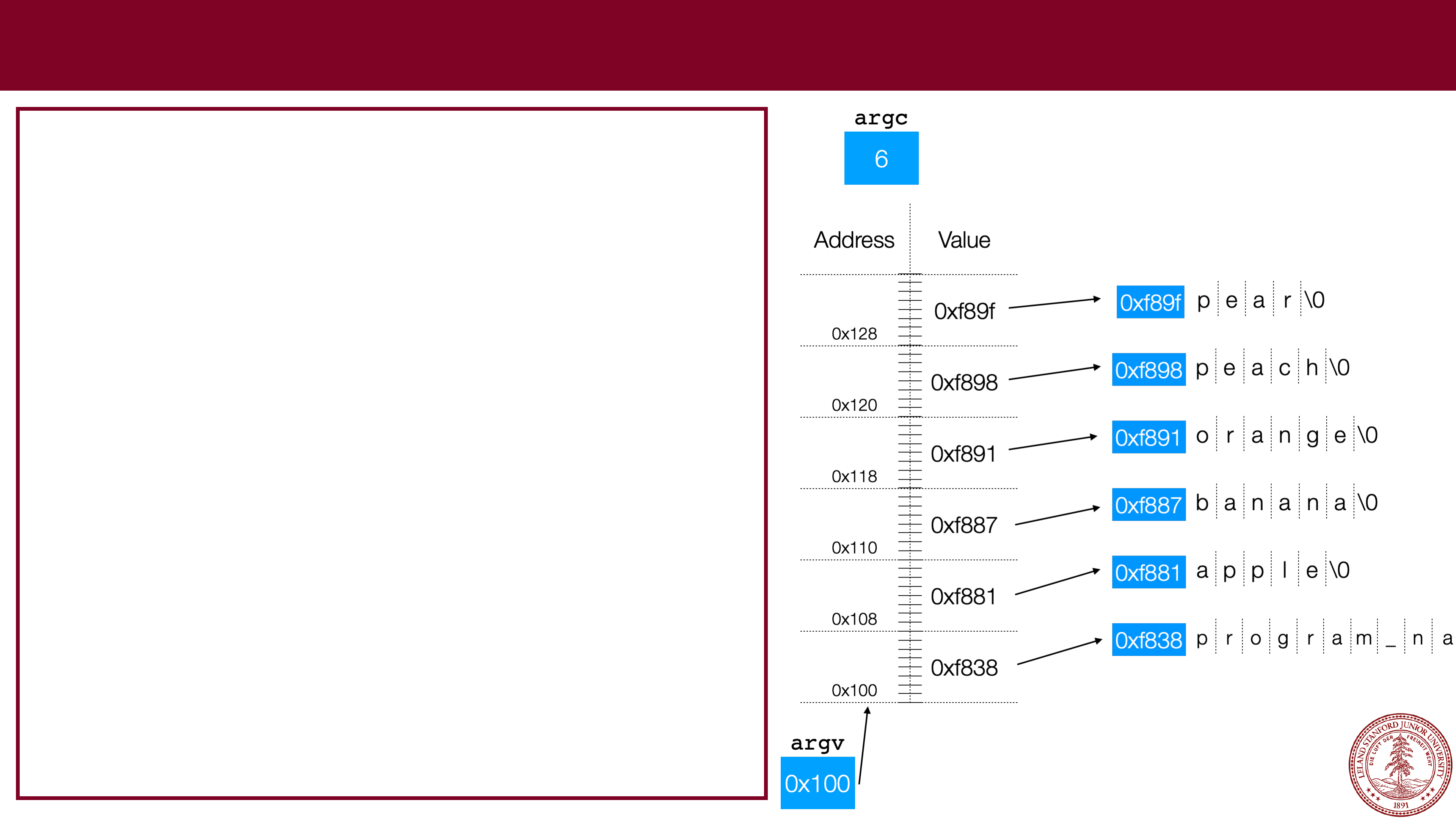
int main(int argc, char **argv)
{
swap_ends(argv, argc, sizeof(argv[0]));
for (int i=0; i < argc; i++) {
printf("%s
\
n",argv[i]);
}
return 0;
}
Page 39
Getting more out of void *
Now it is time to really ramp up the up the generic nature of
void *
pointers.
So far, we've seen how we can manipulate array elements by knowing their width.
But we can't do much else with them — sometimes you really do need to know the
underlying type to be able to work with a piece of data!
For example, what if we wanted to print arrays generically. In other words, we want
a function like this:
void print_array(void *arr, size_t nelems, int width)
We want the function to print the elements. What challenges are there in this case?
Page 40
Getting more out of void *
The challenges are that we have no idea how to print something pointed to by a
void *
!
Let's make a first attempt at our function:
void print_array(void *arr,size_t nelems,int width)
{
for (int i=0; i < nelems; i++) {
void *element = (char *)arr + i * width;
printf("%?",element);
i == nelems
-
1 ? printf("
\
n") : printf(", ");
}
}
Houston, we have a problem.
Page 41
Getting more out of void *
The challenges are that we have no idea how to print something pointed to by a
void *
!
Let's make a first attempt at our function:
void print_array(void *arr,size_t nelems,int width)
{
for (int i=0; i < nelems; i++) {
void *element = (char *)arr + i * width;
printf("%?",element);
i == nelems
-
1 ? printf("
\
n") : printf(", ");
}
}
Houston, we have a problem. What goes in the format string for the
printf
call?
Page 42
Getting more out of void *
The challenges are that we have no idea how to print something pointed to by a
void *
!
Let's make a first attempt at our function:
void print_array(void *arr, size_t nelems, int width)
{
for (int i=0; i < nelems; i++) {
void *element = (char *)arr + i * width;
printf("%?",element);
i == nelems
-
1 ? printf("
\
n") : printf(", ");
}
}
Houston, we have a problem. What goes in the format string for the
printf
call?
We have no idea! Because we don't know
what
the elements in arr are, we have
no hope to print them correctly. They could be
float
s, chars, ints, char *s,
etc…
Page 43
Function pointers
Wouldn't it be nice if we could have the
calling function
tell us how to print the
elements in the array?
Well, we can!
In C, we are allowed to pass
function pointers
as parameters to other functions. A
function pointer tells the other function, "Hey, run this function on the element when
you get to it!" The other function has no idea what type it will work on, but it just
runs the function with the element and gets back the result, which it can use to
perform more work.
In this way, we can write a generic function to do something, but when it works on
each element, it uses the other function to do the work.
Page 44
Function pointers
The function pointer syntax is a bit strange. Here is an example:
void (*myfunc)(int);
This says, there is a function called
myfunc
that takes one
int
parameter and
returns
void
(no return value).
Let's look at a more detailed example:
void *(*myfunc)(int *);
You read this "inside out" — this is a function called
myfunc
that takes an
int *
parameter, and returns a
void *
pointer.
Page 45
Function pointers
You can use the website
cdecl.org
(or the program,
cdecl
on Myth) to get details
about the type if you have trouble figuring it out:
$ cdecl explain "void (*myfunc)(int)"
declare myfunc as pointer to function (int) returning void
$ cdecl explain "void *(*myfunc)(int *)"
declare myfunc as pointer to function (pointer to int)
returning pointer to void
$ cdecl explain "long *(*myfunc)(void *, char, char *)"
declare myfunc as pointer to function (pointer to void,
char, pointer to char) returning pointer to long
Page 46
Function pointers
Let's go back to our print array elements example:
void print_array(void *arr, size_t nelems, int width)
{
for (int i=0; i < nelems; i++) {
void *element = (char *)arr + i * width;
printf("%?",element);
i == nelems
-
1 ? printf("
\
n") : printf(", ");
}
}
Instead of
printf, we want to call a function that knows how to print the data. We
want a function that takes a
void *
element pointer, and then prints it.
Page 47
Function pointers
Something like this:
void print_array(void *arr, size_t nelems, int width, void (*pr_func)(void *))
{
for (int i=0; i < nelems; i++) {
void *element = (char *)arr + i * width;
pr_func(element);
i == nelems
-
1 ? printf("
\
n") : printf(", ");
}
}
In other words, we need to pass in a function (called
pr_func
in this case), that
will do the printing for us.
Page 48
Function pointers
Something like this:
void print_array(void *arr, size_t nelems, int width, void (*pr_func)(void *))
{
for (int i=0; i < nelems; i++) {
void *element = (char *)arr + i * width;
pr_func(element);
i == nelems
-
1 ? printf("
\
n") : printf(", ");
}
}
In other words, we need to pass in a function (called
pr_func
in this case), that
will do the printing for us.
Page 49
Function pointers
Something like this:
void print_array(void *arr, size_t nelems, int width, void (*pr_func)(void *))
{
for (int i=0; i < nelems; i++) {
void *element = (char *)arr + i * width;
pr_func(element);
i == nelems
-
1 ? printf("
\
n") : printf(", ");
}
}
In other words, we need to pass in a function (called
pr_func
in this case), that
will do the printing for us.
The calling function provides the function pointer, and the function pointer is
specific to the type of data stored in the array.
Page 50
Function pointers
Let's write a function pointer that will print
int
elements.
void print_int(void *arr)
{
int i = *(int *)arr;
printf("%d",i);
}
When you have a function like this, it does know the type of the data stored in the
void *
pointer! We created this function specifically to print ints, so it knows
that it has an
int
pointer, and we can cast it to that pointer.
Page 51
Function pointers
Let's write a function pointer that will print
int
elements.
void print_int(void *arr)
{
int i = *(int *)arr;
printf("%d",i);
}
When you have a function like this, it does know the type of the data stored in the
void *
pointer! We created this function specifically to print ints, so it knows
that it has an int pointer, and we can cast it to that pointer.
If we know it is an int pointer, why can't we just have the following function
definition?
void print_int(int *arr)
We can't, because the print_arr function required a generic function.
Page 52
Function pointers
Here is our full example:
#include<stdio.h>
#include<stdlib.h>
void print_array(void *arr, size_t nelems, int
width, void(*pr_func)(void *))
{
for (int i=0; i < nelems; i++) {
void *element = (char *)arr + i * width;
pr_func(element);
i == nelems
-
1 ? printf("
\
n") : printf(", ");
}
}
void print_int(void *arr)
{
int i = *(int *)arr;
printf("%d",i);
}
void print_long(void *arr)
{
long l = *(long *)arr;
printf("%ld",l);
}
int main(int argc, char **argv)
{
int i_array[] = {0, 1, 2, 3, 4, 5};
size_t i_nelems = sizeof(i_array) / sizeof(i_array[0]);
long l_array[] = {0,10,20,30,40,50};
size_t l_nelems = sizeof(l_array) / sizeof(l_array[0]);
print_array(i_array,i_nelems,sizeof(i_array[0]), print_int);
print_array(l_array,l_nelems,sizeof(l_array[0]), print_long);
return 0;
}
Page 53
Function pointers
Here is our full example:
Note that when you pass a function
pointer, you don't need to use "
&
"
because it is implied (though you
can if you want).
#include<stdio.h>
#include<stdlib.h>
void print_array(void *arr, size_t nelems, int
width, void(*pr_func)(void *))
{
for (int i=0; i < nelems; i++) {
void *element = (char *)arr + i * width;
pr_func(element);
i == nelems
-
1 ? printf("
\
n") : printf(", ");
}
}
void print_int(void *arr)
{
int i = *(int *)arr;
printf("%d",i);
}
void print_long(void *arr)
{
long l = *(long *)arr;
printf("%ld",l);
}
int main(int argc, char **argv)
{
int i_array[] = {0, 1, 2, 3, 4, 5};
size_t i_nelems = sizeof(i_array) / sizeof(i_array[0]);
long l_array[] = {0,10,20,30,40,50};
size_t l_nelems = sizeof(l_array) / sizeof(l_array[0]);
print_array(i_array,i_nelems,sizeof(i_array[0]), print_int);
print_array(l_array,l_nelems,sizeof(l_array[0]), print_long);
return 0;
}
Page 54
Function pointers
For our print_array function, we can have the printing do anything we want!
Let's look at the
printf_coordinates.c
file from
/afs/ir/class/cs107/samples/lect7
Also available in the course reader:
http://stanford.edu/~cgregg/107-Reader/107-Reader
Look in
code/Ch8_C_Low_Level
Page 55
C standard library example:
qsort
The C standard library has a number of functions that expect function pointers. The
qsort
function is one of them:
void qsort(void *base, size_t nmemb, size_t size,
int (*compar)(const void *, const void *));
The
base
, nmemb, and size variables are just standard pointer-
to
-array details.
The
compar function is a comparison function that expects two elements from the
array, and will perform a comparison on them. This is a standard comparison with
the following return
int
value possibilities:
negative
: the first element is less than the second element
zero
: the elements are equal
positive
: the first element is greater than the second element
Page 56
C standard library example:
qsort
The C standard library has a number of functions that expect function pointers. The
qsort
function is one of them:
void qsort(void *base, size_t nmemb, size_t size,
int (*compar)(const void *, const void *));
If you want to use the
qsort function, you need to write a compar function
yourself. Sometimes, we just need to build a function that utilizes another built-in
function, like
strcmp
, to do the work:
int compar_str(const void *s1, const void *s2) {
return strcmp(*(char **)s1, *(char **)s2);
}
Page 57
C standard library example:
qsort
The C standard library has a number of functions that expect function pointers. The
qsort
function is one of them:
void qsort(void *base, size_t nmemb, size_t size,
int (*compar)(const void *, const void *));
If you want to use the
qsort function, you need to write a compar function
yourself. Sometimes, we just need to build a function that utilizes another built-in
function, like
strcmp
, to do the work:
int compar_str(const void *s1, const void *s2) {
return strcmp(*(char **)s1, *(char **)s2);
}
Important! Look at the type of
s1
and
s2
in the comparison function! This is a
case where we must draw the situation!
Page 58
 C standard library example:
qsort
full example
// file: qsort_ex.c
#include<stdio.h>
#include<stdlib.h>
#include<string.h>
int compar_str(const void *s1, const void *s2) {
return strcmp(*(char **)s1, *(char **)s2);
}
int main(int argc, char **argv)
{
// ignore program name
argc--
;
argv++;
qsort(argv, argc, sizeof(argv[0]), compar_str);
for (int i=0; i < argc; i++) {
printf("%s",argv[i]);
i == argc
-
1 ? printf("
\
n") : printf(", ");
}
return 0;
}
$ ./qsort_ex dog cat ant duck bear
ant bear cat dog duck
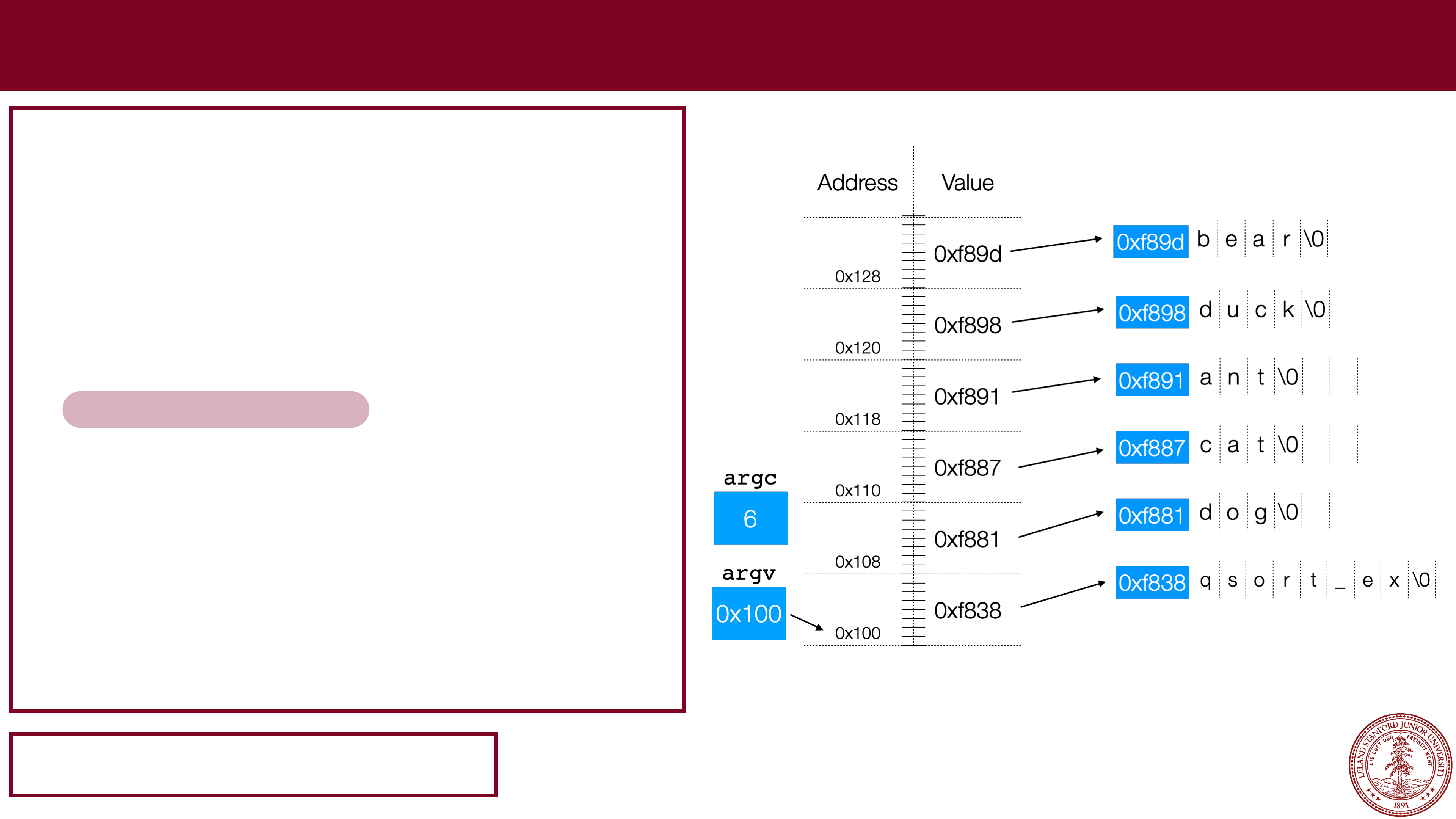
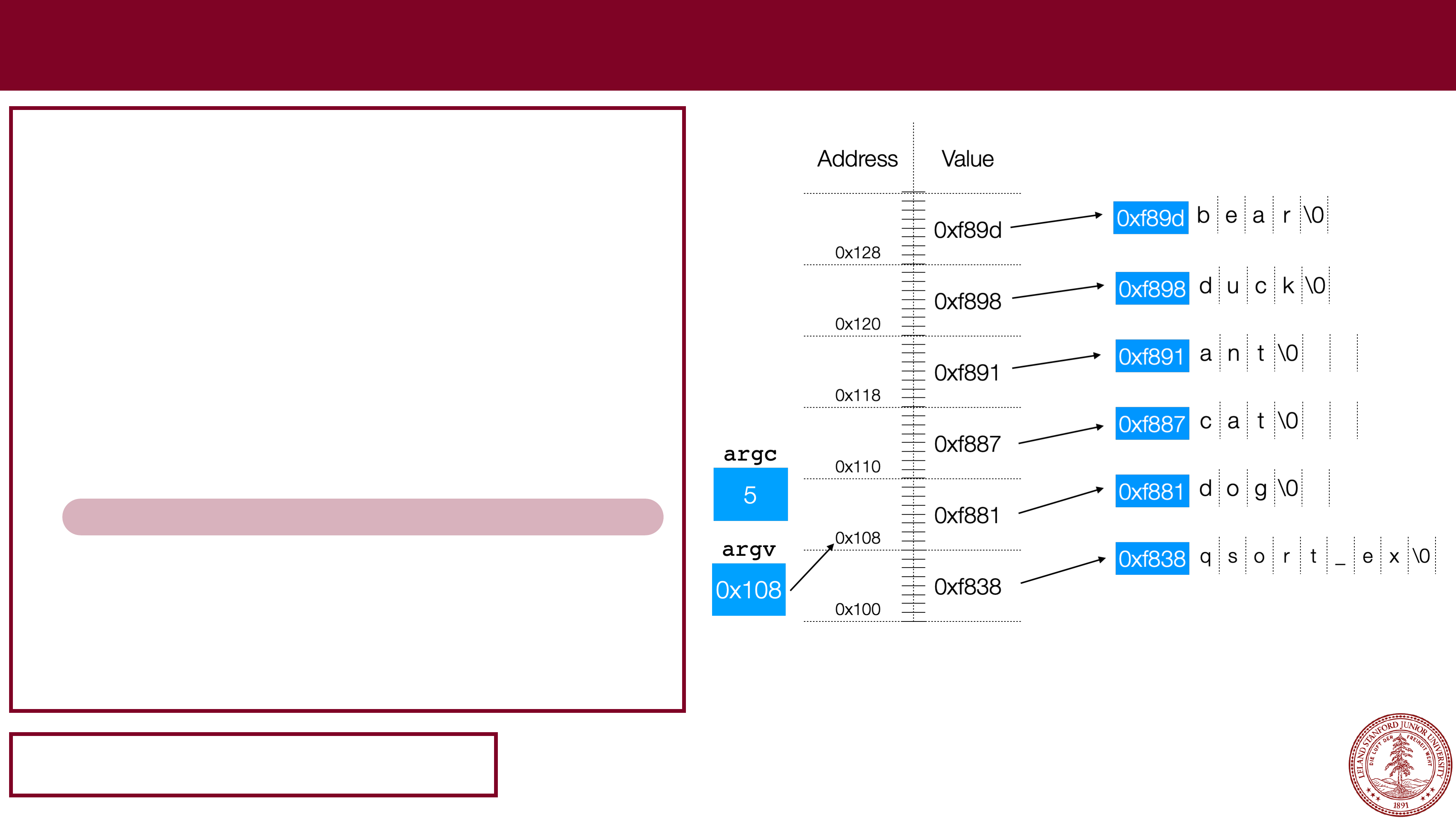
At this point in the program, this is
what the situation looks like.
Page 59
 C standard library example:
qsort
full example
// file: qsort_ex.c
#include<stdio.h>
#include<stdlib.h>
#include<string.h>
int compar_str(const void *s1, const void *s2) {
return strcmp(*(char **)s1, *(char **)s2);
}
int main(int argc, char **argv)
{
// ignore program name
argc--
;
argv++;
qsort(argv, argc, sizeof(argv[0]), compar_str);
for (int i=0; i < argc; i++) {
printf("%s",argv[i]);
i == argc
-
1 ? printf("
\
n") : printf(", ");
}
return 0;
}
$ ./qsort_ex dog cat ant duck bear
ant bear cat dog duck
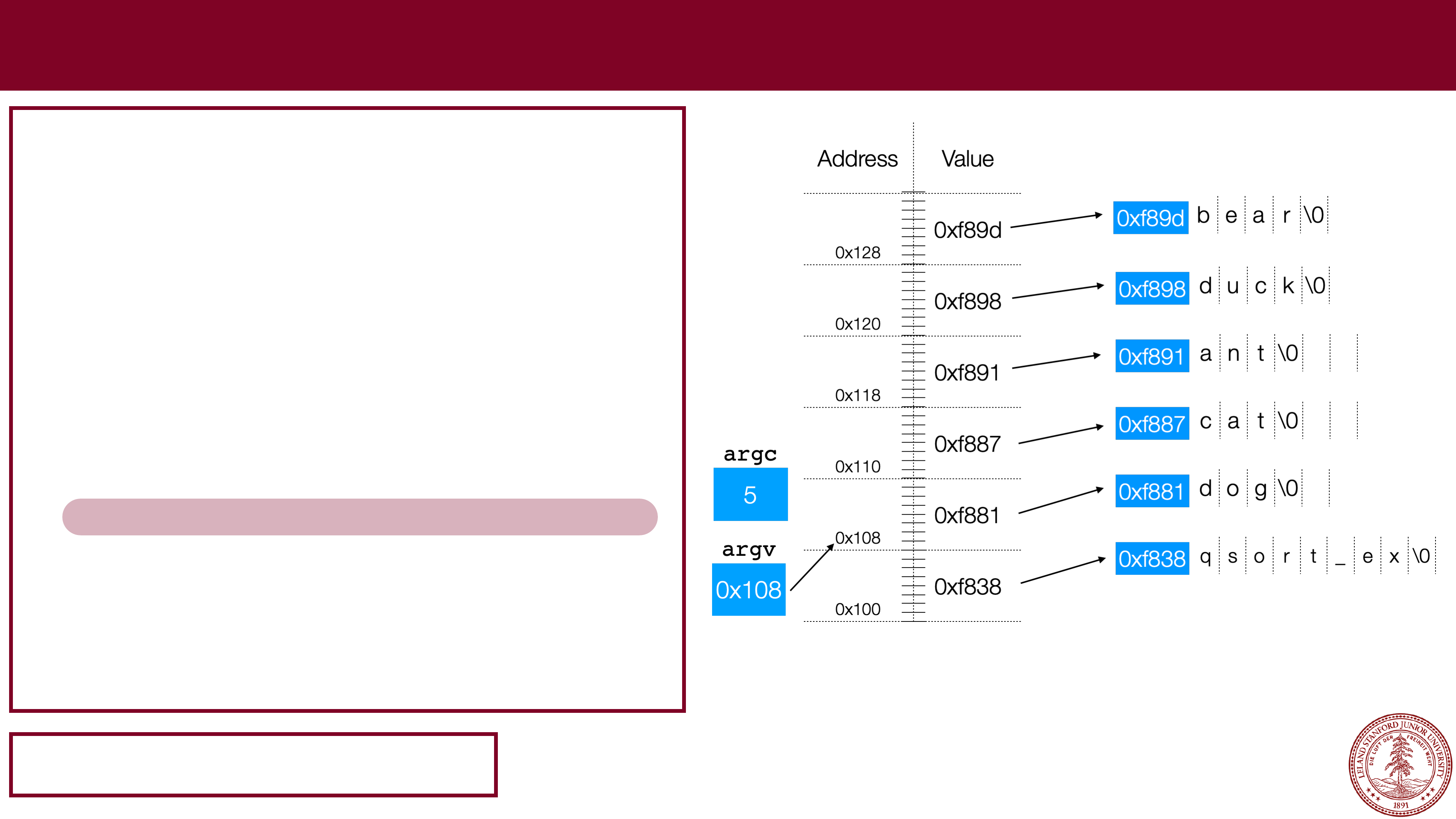
We have updated
argc
and argv
to ignore the program name.
Page 60
 C standard library example:
qsort
full example
// file: qsort_ex.c
#include<stdio.h>
#include<stdlib.h>
#include<string.h>
int compar_str(const void *s1, const void *s2) {
return strcmp(*(char **)s1, *(char **)s2);
}
int main(int argc, char **argv)
{
// ignore program name
argc--
;
argv++;
qsort(argv, argc, sizeof(argv[0]), compar_str);
for (int i=0; i < argc; i++) {
printf("%s",argv[i]);
i == argc
-
1 ? printf("
\
n") : printf(", ");
}
return 0;
}
$ ./qsort_ex dog cat ant duck bear
ant bear cat dog duck
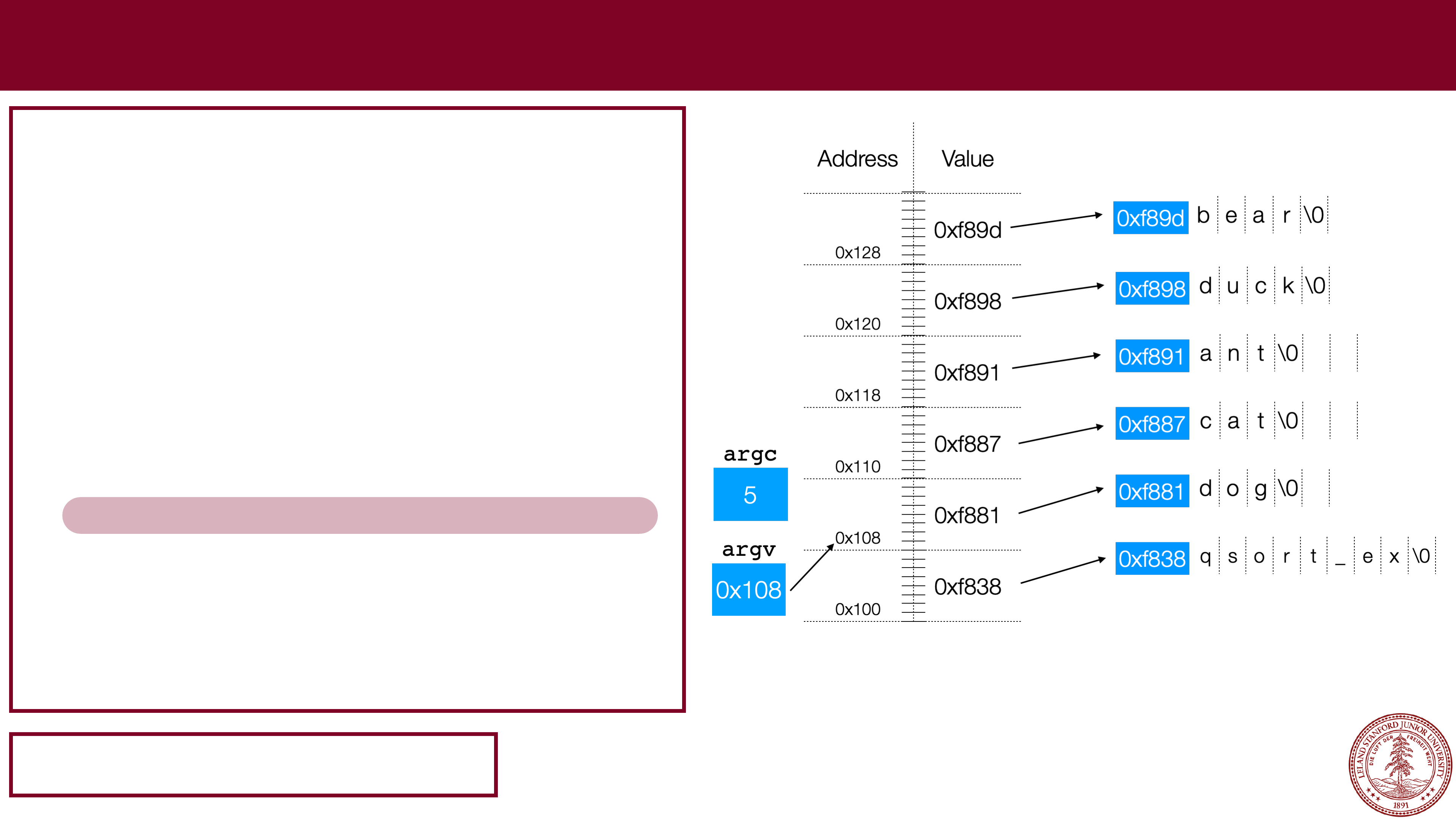
Based on the diagram above, what
number gets passed as the first
argument of
qsort
?
Page 61
 C standard library example:
qsort
full example
// file: qsort_ex.c
#include<stdio.h>
#include<stdlib.h>
#include<string.h>
int compar_str(const void *s1, const void *s2) {
return strcmp(*(char **)s1, *(char **)s2);
}
int main(int argc, char **argv)
{
// ignore program name
argc--
;
argv++;
qsort(argv, argc, sizeof(argv[0]), compar_str);
for (int i=0; i < argc; i++) {
printf("%s",argv[i]);
i == argc
-
1 ? printf("
\
n") : printf(", ");
}
return 0;
}
$ ./qsort_ex dog cat ant duck bear
ant bear cat dog duck
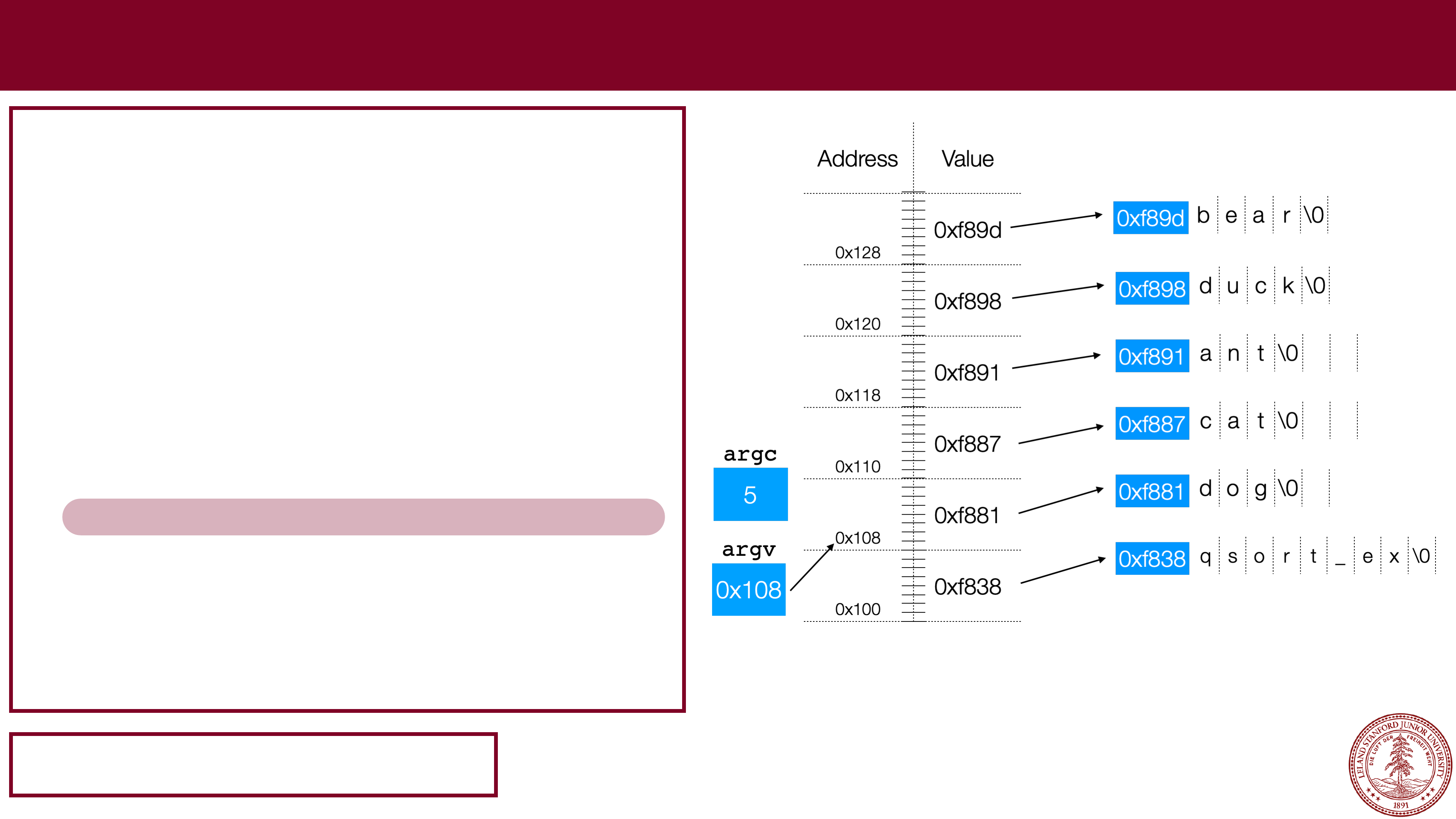
Based on the diagram above, what
number gets passed as the first
argument of
qsort
? 0x108
Page 62
 C standard library example:
qsort
full example
// file: qsort_ex.c
#include<stdio.h>
#include<stdlib.h>
#include<string.h>
int compar_str(const void *s1, const void *s2) {
return strcmp(*(char **)s1, *(char **)s2);
}
int main(int argc, char **argv)
{
// ignore program name
argc--
;
argv++;
qsort(argv, argc, sizeof(argv[0]), compar_str);
for (int i=0; i < argc; i++) {
printf("%s",argv[i]);
i == argc
-
1 ? printf("
\
n") : printf(", ");
}
return 0;
}
$ ./qsort_ex dog cat ant duck bear
ant bear cat dog duck
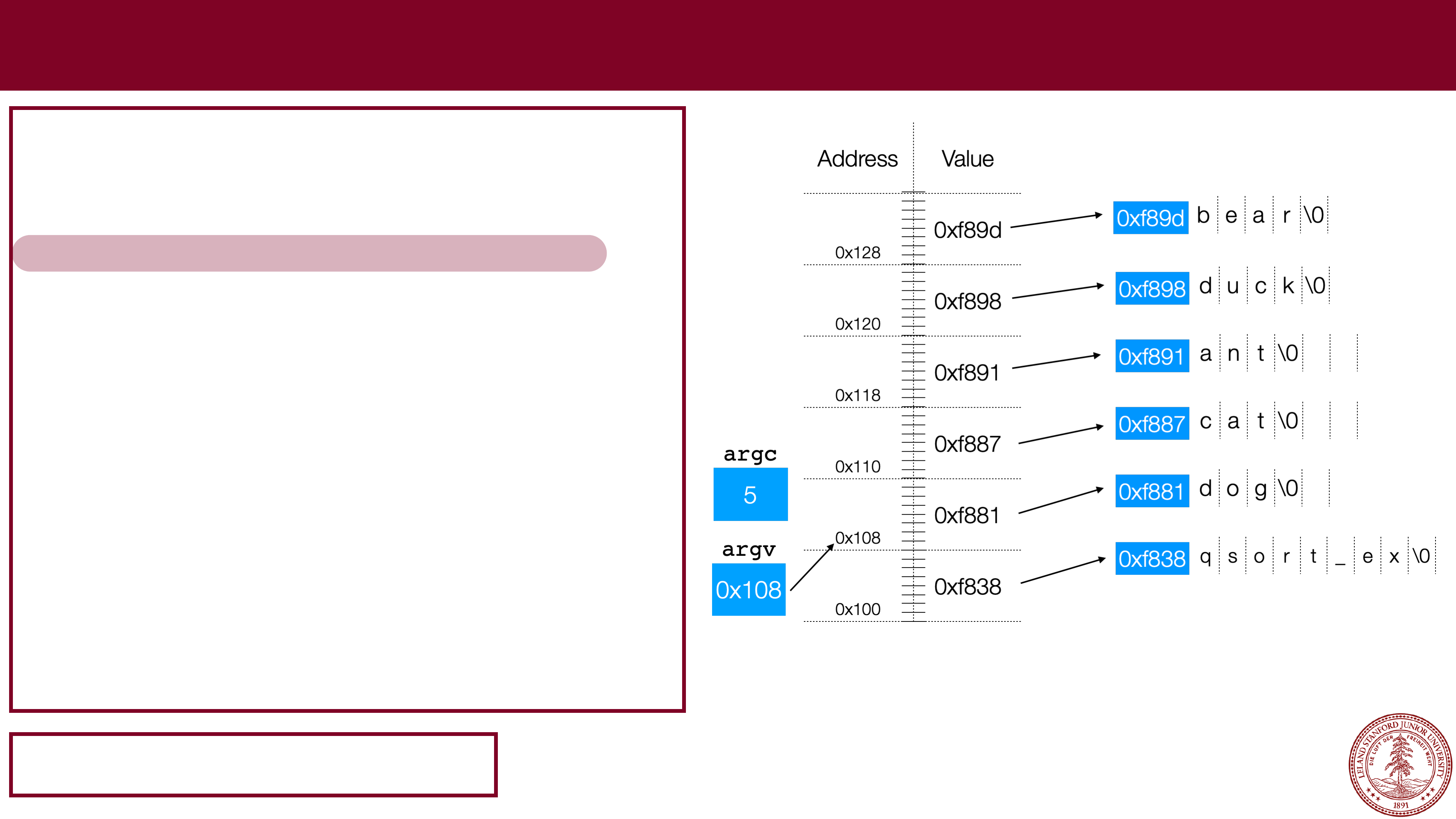
qsort
has no way to dereference
argv
, so it can only pass char **
pointers to sort (e.g.,
0x108
,
0x110
)
Page 63
 C standard library example:
qsort
full example
// file: qsort_ex.c
#include<stdio.h>
#include<stdlib.h>
#include<string.h>
int compar_str(const void *s1, const void *s2) {
return strcmp(*(char **)s1, *(char **)s2);
}
int main(int argc, char **argv)
{
// ignore program name
argc--
;
argv++;
qsort(argv, argc, sizeof(argv[0]), compar_str);
for (int i=0; i < argc; i++) {
printf("%s",argv[i]);
i == argc
-
1 ? printf("
\
n") : printf(", ");
}
return 0;
}
$ ./qsort_ex dog cat ant duck bear
ant bear cat dog duck
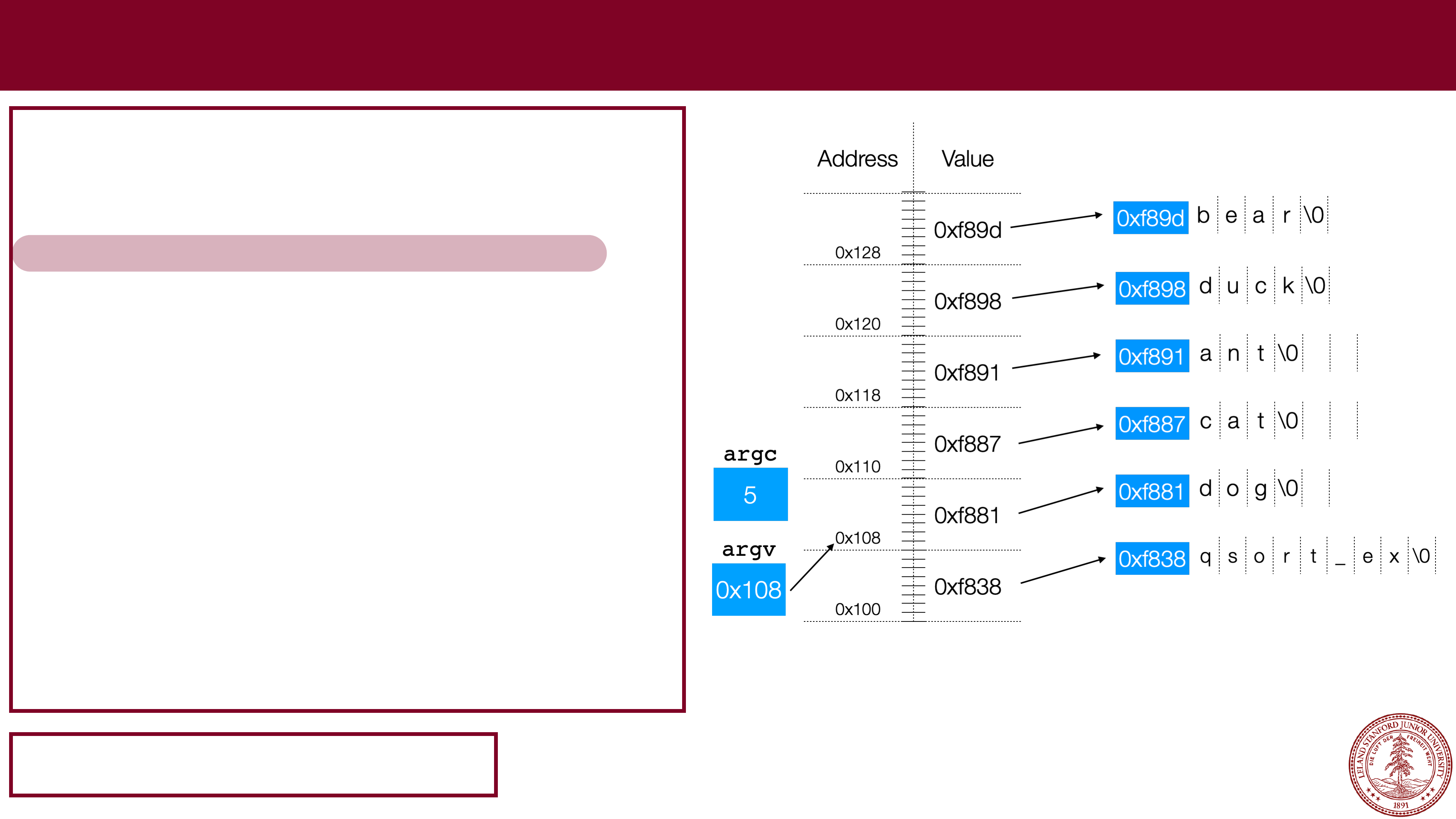
Therefore, the type that gets passed
to
compar_str
must
be char **
pointers. (e.g.,
0x108
,
0x110
)
Page 64
 C standard library example:
qsort
full example
// file: qsort_ex.c
#include<stdio.h>
#include<stdlib.h>
#include<string.h>
int compar_str(const void *s1, const void *s2) {
return strcmp(*(char **)s1, *(char **)s2);
}
int main(int argc, char **argv)
{
// ignore program name
argc--
;
argv++;
qsort(argv, argc, sizeof(argv[0]), compar_str);
for (int i=0; i < argc; i++) {
printf("%s",argv[i]);
i == argc
-
1 ? printf("
\
n") : printf(", ");
}
return 0;
}
$ ./qsort_ex dog cat ant duck bear
ant bear cat dog duck
So, we are correct to cast
s1
and
s2
to
char **, and then dereference to
get
char *
to pass to
strcmp.
Page 65
Function pointers
Function pointer takeaways:
1.
Function pointers allow us to add generic features to our functions, so
that even if the function doesn't know what the underlying type of a
void *
is, it can still do something useful with the data.
2.
The calling function passes in a function that knows how to deal with
the correct type for the elements in the array.
3.
Function pointers have some strange syntax, and you read from "inside
out"
Page 66
References and Advanced Reading
•
References:
•
K&R C Programming (from our course)
•
Course Reader, C Primer
•Awesome C book:
http://books.goalkicker.com/CBook
•
Function Pointer tutorial: https://www.cprogramming.com/tutorial/function-
pointers.html
•
Advanced Reading:
•
virtual memory:
https://en.wikipedia.org/wiki/Virtual_memory
Page 67
Extra Slides