Page 1
 Monday, March 7, 2022
Computer Systems
Winter 2022
Stanford University
Computer Science Department
Reading: Chapter 5, textbook
Lecturer: Chris Gregg
CS 107
Lecture 16:
Optimization
Page 2
Today's Topics
•
Programs from class: /afs/ir/class/cs107/samples/lect16
•
Optimization:
•
What optimizing compilers do and don't do
•
GCC explorer: https://godbolt.org/g/3p91t2
•
Memory Performance
•
How memory is organized
•
Caching
•
Impact of temporal and spatial locality
•
Profiling tools
•
Measuring runtime and memory performance
Page 3
 A few quotes on optimization
“We should forget about small efficiencies, say about 97% of the time: premature
optimization is the root of all evil. ”
—
Donald Knuth
“More computing sins are committed in the name of efficiency (without necessarily
achieving it) than for any other single reason
- including blind stupidity.”
—
W.A. Wulf (University of Virginia)
Page 4
Optimization Considerations
Measure, measure, measure!
Time your code to see if there is even an issue. We
optimize code to make it faster (or smaller) — if there isn't a problem already, don't
optimize. In other words, if it works okay at the scale you care about, don't try and
optimize.
For example, if the code scales well already, it probably doesn't need to be
optimized further.
Use the correct algorithm and design
— optimization won't change Big O or fix
Page 5
Optimization Considerations
Keep it simple!
— Simple code that is easy to understand and debug is generally
best. In this case you are optimizing the programmer's time. This is especially true
for the parts of your code that aren't providing the bottleneck.
Let gcc do its optimizations
— don't pre-optimize, and after you compile with a
high optimization in gcc, look at the assembly code and analyze it to see where you
may be able to optimize.
Optimize explicitly as a last resort
— measure again, and attack the bottlenecks
Page 6
Optimization Blockers
Programmers need to be careful to write code that can be optimized!
Although this isn't always possible, it is a good goal to have.
Let's look at two functions:
void twiddle1(long *xp,
long *yp)
{
*xp += *yp;
*xp += *yp;
void twiddle2(long *xp,
long *yp)
{
*xp += 2 * *yp;
}
The functions perform the same thing, right?
Page 7
Optimization Blockers
Oops
— if the pointer is the same, we have a
problem! Pointers can be
optimization blockers
. gcc
won't optimize twiddle1 to twiddle2, because it
could lead to incorrect code.
$ ./twiddle 2 3
a: 2, b:3
after twiddle1(&a,&b), a = 8
a: 2, b:3
after twiddle2(&a,&b), a = 8
a: 2
after twiddle1(&a,&a), a = 8
void twiddle1(long *xp,
long *yp)
{
*xp += *yp;
*xp += *yp;
}
void twiddle2(long *xp,
long *yp)
{
*xp += 2 * *yp;
Page 8
Optimization Examples: Constant Folding
GCC explorer:
https://gcc.godbolt.org/z/vbfTjehPa
-
O0
-
O2
The compiler doesn't need to do as
many real-time calculations, and
folds
the constants into two calculations.
unsigned long
CF(
unsigned long
val)
{
unsigned long
ones = ~0U/UCHAR_MAX;
unsigned long
highs = ones << (CHAR_BIT - 1);
return
(val - ones) & highs;
}
pushq
%rbp
movq
%rsp, %rbp
movq
%rdi, -24(%rbp)
movq
$16843009, -8(%rbp)
movq
-8(
%rbp), %rax
salq
$7, %rax
movq
%rax, -16(%rbp)
movq
-
24(%rbp), %rax
subq
-8(
%rbp), %rax
leaq
-
16843009(%rdi), %rax
andl
$2155905152, %eax
ret
Page 9
Optimization Ex: Common Subexpression Elimination
GCC explorer:
https://gcc.godbolt.org/z/5oK5PxY5s
int
CSE(
int
num,
int
val)
{
int
a = (val + 50);
int
b = num*a - (50 + val);
return
(val + (100/2)) + b;
}
pushq
%rbp
movq
%rsp, %rbp
movl
%edi, -20(%rbp)
movl
%esi, -24(%rbp)
movl
-
24(%rbp), %eax
addl
$50, %eax
movl
%eax, -4(%rbp)
movl
-
20(%rbp), %eax
imull
-4(
%rbp), %eax
movl
-
24(%rbp), %edx
addl
$50, %edx
subl
%edx, %eax
movl
%eax, -8(%rbp)
movl
-
24(%rbp), %eax
leal
50(%rsi), %eax
imull
%edi, %eax
ret
-
O0
-
O2
The complier is able to
eliminate
subexpressions
by determining that they
are the same.
Page 10
Optimization Ex: Strength Reduction
GCC explorer:
https://gcc.godbolt.org/z/cW7n4G3hT
{
unsigned int
b = 5*val;
int
c = b / (1 << val);
return
(b + c) % 2;
}
pushq
%rbp
movq
%rsp, %rbp
movl
%edi, -20(%rbp)
movl
-
20(%rbp), %edx
movl
%edx, %eax
sall
$2, %eax
addl
%edx, %eax
movl
%eax, -4(%rbp)
movl
-
20(%rbp), %eax
movl
-4(
%rbp), %edx
movl
%eax, %ecx
shrl
%cl, %edx
movl
%edx, %eax
movl
%eax, -8(%rbp)
movl
-8(
%rbp), %edx
leal
(
%rdi,%rdi,4), %eax
movl
%edi, %ecx
movl
%eax, %edx
shrl
%cl, %edx
addl
%edx, %eax
andl
$1, %eax
ret
-
O0
-
O2
The complier replaces expensive (strong)
operations (e.g., divides) with equivalent
expressions that are
less strong
.
Page 11
Optimization Ex: Code Motion
GCC explorer:
https://gcc.godbolt.org/z/zh6YMjjb8
int
CM(
int
val)
{
int
sum = 0;
do
{
sum +=
6
+
14
*val;
}
while
(sum < (
9
/val));
return
sum;
}
pushq
%rbp
movq
%rsp, %rbp
movl
%edi, -20(%rbp)
movl
$0, -4(%rbp)
.L2:
movl
-
20(%rbp), %eax
addl
%eax, %eax
leal
0
(,%rax,8), %edx
subl
%eax, %edx
movl
%edx, %eax
addl
$6, %eax
addl
%eax, -4(%rbp)
movl
$9, %eax
cltd
idivl
-
20(%rbp)
movl
$9, %eax
xorl
%ecx, %ecx
cltd
idivl
%edi
imull
$14, %edi, %esi
addl
$6, %esi
.L2:
addl
%esi, %ecx
cmpl
%eax, %ecx
jl
.L2
movl
%ecx, %eax
-
O0
-
O2
The compiler
moves code
out
of loops if it can:
it only needs to
perform the
operation once,
Page 12
Optimization Ex: Dead Code Elimination
GCC explorer:
https://gcc.godbolt.org/z/r1eeWEarG
int
DC(
int
param1,
int
param2)
{
if
(param1 < param2 && param1 > param2) // can this test ever be true?
printf(
"The end of the world is near!\n"
);
int
result;
for
(
int
i = 0; i < 1000; i++)
result *= i;
if
(param1 == param2) // if/else obviously same on both paths
param1++;
else
param1++;
if
(param1 == 0) // if/else no-so-obviously same on both paths
return
0;
else
return
param1;
}
.LC0:
.string
"The end of the world is near!"
DC:
pushq
%rbp
movq
%rsp, %rbp
subq
$32, %rsp
movl
%edi, -20(%rbp)
movl
%esi, -24(%rbp)
movl
-
20(%rbp), %eax
cmpl
-
24(%rbp), %eax
jge
.L2
movl
-
20(%rbp), %eax
cmpl
-
24(%rbp), %eax
jle
.L2
movl
$.LC0, %edi
call
puts
.L2:
movl
$0, -8(%rbp)
jmp
.L3
.L4:
movl
-4(
%rbp), %eax
imull
-8(
%rbp), %eax
movl
%eax, -4(%rbp)
addl
$1, -8(%rbp)
.L3:
cmpl
$999, -8(%rbp)
DC:
leal
1(
%rdi), %eax
ret
-
O0
-
O2
The compiler realizes that
most of the code does not
perform useful work, so it
just removes it!
Page 13
gcc and optimization
-
O0 // faithful, literal match to C, and the best for debugging
-
Og // streamlined, but debug-friendly
-
O2 // apply all acceptable optimizations
-
O3 // even more optimizations, but relies strongly on exact C specification (e.g., if
you assume, for instance that signed numbers wrap, your code might break with this
optimization level)
-
Os // optimize for code size; performs the
-
O2 optimizations that don't increase
the code size (e.g., no function alignment)
You can see all optimizations that will be run by compiling with the following flags:
Page 14
gcc and optimization
gcc knows the hardware you are running on, including:
•
Register allocation
•
Instruction choice
•
Alignment
All transformations made by gcc during optimization should be legal and equivalent to
your original C program.
•
The compiler knows about compile time, not run time.
•
The optimizations are conservative (e.g., it rarely tries to perform too much
Page 15
gcc and optimization
How do we measure performance?
•
Timers! There are a number of different ways to do it. One timer, rtdsc, is only
available in assembly, although we can write a C program to access it by using
"inline assembly" or linking to an assembly function.
•
We can also use valgrind --tool=callgrind
You should time unoptimized vs. optimized
•
mult.c
•
sorts.c
Page 16
What gcc cannot do
gcc cannot fix algorithmic weaknesses, or big-
O!
If you optimize too early yourself, gcc may not be able to figure out any further
optimizations
gcc generally cannot remove function calls, nor can it "see through" pointers to
determine if aliasing has occurred.
Page 17
What gcc can do
Example: summing the char values in a string
int
charsum(
char
*s)
{
int
sum = 0;
for
(size_t i = 0; i < strlen(s); i++) {
sum += s[i];
}
return
sum;
}
1.
What is going to cause the bottleneck for this function?
Page 18
int
charsum(
char
*s)
{
int
sum = 0;
for
(size_t i = 0; i < strlen(s); i++) {
sum += s[i];
}
return
sum;
}
1.
What is going to cause the bottleneck for this function?
strlen(s)
-- it must search one character at a time!
Example: summing the char values in a string
What gcc can do
Page 19
int
charsum(
char
*s)
{
int
sum = 0;
for
(size_t i = 0; i < strlen(s); i++) {
sum += s[i];
}
return
sum;
}
1.
What is going to cause the bottleneck for this function?
strlen(s)
-- it must search one character at a time!
2.
What can the compiler do about it?
1.
What is going to cause the bottleneck for this function?
Example: summing the char values in a string
What gcc can do
Page 20
int
charsum(
char
*s)
{
int
sum = 0;
for
(size_t i = 0; i < strlen(s); i++) {
sum += s[i];
}
return
sum;
}
1.
What is going to cause the bottleneck for this function?
strlen(s)
-- it must search one character at a time!
2.
What can the compiler do about it?
1.
What is going to cause the bottleneck for this function?
int
charsum2(
char
*s)
{
int
sum = 0;
size_t len = strlen(s);
for
(size_t i = 0; i < len; i++) {
sum += s[i];
}
return
sum;
Example: summing the char values in a string
What gcc can do
Page 21
What gcc cannot do
Example: converting a string to lowercase
void
lower1(
char
*s)
{
for
(size_t i = 0; i < strlen(s); i++) {
if
(s[i] >= 'A' && s[i] <= 'Z') {
s[i]
-
= (
'A'
-
'a'
);
}
}
}
1.
What is going to cause the bottleneck for this function?
Page 22
What gcc cannot do
Example: converting a string to lowercase
void
lower1(
char
*s)
{
for
(size_t i = 0; i < strlen(s); i++) {
if
(s[i] >= 'A' && s[i] <= 'Z') {
s[i]
-
= (
'A'
-
'a'
);
}
}
}
1.
What is going to cause the bottleneck for this function?
strlen(s)
-- it must search one character at at time!
Page 23
What gcc cannot do
Example: converting a string to lowercase
void
lower1(
char
*s)
{
for
(size_t i = 0; i < strlen(s); i++) {
if
(s[i] >= 'A' && s[i] <= 'Z') {
s[i]
-
= (
'A'
-
'a'
);
}
}
}
1.
What is going to cause the bottleneck for this function?
strlen(s)
-- it must search one character at at time!
2.
Can the compiler move this out of the loop?
Page 24
What gcc cannot do
Example: converting a string to lowercase
void
lower1(
char
*s)
{
for
(size_t i = 0; i < strlen(s); i++) {
if
(s[i] >= 'A' && s[i] <= 'Z') {
s[i]
-
= (
'A'
-
'a'
);
}
}
}
1.
What is going to cause the bottleneck for this function?
strlen(s)
-- it must search one character at at time!
2.
Can the compiler move this out of the loop?
It cannot! Because
s is changing, the compiler won't risk moving
strlen()
outside the loop. It can't figure out that a zero won't ever be put
into the string (changing the string's length).
Page 25
Hand
-optimization
Let's look at some code for a vector
--
this is the textbook example in chapter 5
handout: /afs/ir/class/cs107/samples/lect16/vector_handout.pdf
Let's look at the combine functions (there are four versions). The first version is this:
void combine1(vec_ptr v, data_t *dest)
{
*dest = IDENT; // 0
for (long i = 0; i < vec_length(v); i++) {
data_t val;
get_vec_element(v, i, &val);
*dest = *dest OP val; // OP is +
}
}
What might we do to improve this function?
Original clock
-ticks per call to combine1:
-
O1: 11.3
-
O2: 9.3
Page 26
Hand
-optimization
Let's look at some code for a vector
--
this is the textbook example in chapter 5
handout: /afs/ir/class/cs107/samples/lect16/vector_handout.pdf
Let's look at the combine functions (there are four versions). The first version is this:
void combine1(vec_ptr v, data_t *dest)
{
*dest = IDENT;
for (long i = 0; i < vec_length(v); i++) {
data_t val;
get_vec_element(v, i, &val);
*dest = *dest OP val;
}
}
What might we do to improve this function?
Let's move the call to
vec_length
out of the function.
Original clock
-ticks per call to combine1:
-
O1: 11.3
-
O2: 9.3
Page 27
Hand
-optimization
Here is combine2:
// move call to vec_length out of loop
void combine2(vec_ptr v, data_t *dest)
{
long length = vec_length(v);
*dest = IDENT;
for (long i = 0; i < length; i++) {
data_t val;
get_vec_element(v, i, &val);
*dest = *dest OP val;
}
}
Better! Both optimizations ended up about
the same for combine2. Can we do better?
Clock
-ticks for combine1 and combine2:
comb1 comb2
-
O1: 11.3 5.8
-
O2: 9.3 5.8
Page 28
Hand
-optimization
Here is combine2:
// move call to vec_length out of loop
void combine2(vec_ptr v, data_t *dest)
{
long length = vec_length(v);
*dest = IDENT;
for (long i = 0; i < length; i++) {
data_t val;
get_vec_element(v, i, &val);
*dest = *dest OP val;
}
}
Better! Both optimizations ended up about
the same for combine2. Can we do better?
Clock
-ticks for combine1 and combine2:
comb1 comb2
-
O1: 11.3 5.8
-
O2: 9.3 5.8
Maybe the call to
get_vec_element
seems like it may be
causing a bottleneck. Let's look at that function.
Page 29
Hand
-optimization
// move call to vec_length out of loop
void combine2(vec_ptr v, data_t *dest)
{
long length = vec_length(v);
*dest = IDENT;
for (long i = 0; i < length; i++) {
data_t val;
get_vec_element(v, i, &val);
*dest = *dest OP val;
}
}
Here is the
get_vec_element
function:
/*
* Retrieve vector element and store at dest.
* Return 0 (out of bounds) or 1 (successful)
*/
int get_vec_element(vec_ptr v, long index, data_t
*dest)
{
if (index < 0 || index >= v
-
>len)
return 0;
*dest = v
-
>data[index];
return 1;
Hmm...maybe the bounds checking is the
issue. Let's just get rid of the function
altogether and directly access the data.
This does break some abstraction, but it is in
Clock
-ticks for combine1 and combine2:
comb1 comb2
-
O1: 11.3 5.8
-
O2: 9.3 5.8
Page 30
Hand
-optimization
// direct access to vector data
void combine3(vec_ptr v, data_t *dest)
{
long length = vec_length(v);
data_t *data = get_vec_start(v);
*dest = IDENT;
for (long i = 0; i < length; i++) {
*dest = *dest OP data[i];
}
}
It looks like the
-O1
actually got worse! It probably is about the same, actually,
but our timing isn't perfect. The
-O2 did get much better, and we should look at
the assembly code to see why.
Is there anything else we can do to make this faster?
Clock
-ticks for combine1 and combine2:
comb1 comb2 comb3
-
O1: 11.3 5.8 6.02
-
O2: 9.3 5.8 1.9
Here is combine3:
Page 31
Hand
-optimization
// direct access to vector data
void combine3(vec_ptr v, data_t *dest)
{
long length = vec_length(v);
data_t *data = get_vec_start(v);
*dest = IDENT;
for (long i = 0; i < length; i++) {
*dest = *dest OP data[i];
}
}
There are three memory references in the following line:
*dest = *dest OP data[i];
We really only need to update memory at the end of the function, so let's do it.
Clock
-ticks for combine1 and combine2:
comb1 comb2 comb3
-
O1: 11.3 5.8 6.02
-
O2: 9.3 5.8 1.9
Here is combine3:
Page 32
Hand
-optimization
// accumulate result in local variable
void combine4(vec_ptr v, data_t *dest)
{
long length = vec_length(v);
data_t *data = get_vec_start(v);
data_t acc = IDENT;
for (long i = 0; i < length; i++) {
acc = acc OP data[i];
}
*dest = acc;
}
This is much better! We were able to save 5x time in the
-O1
version, and 6x
time in the
-O2
version. From the comb1 -O1 version to the comb4 -O2 version,
we have a 7.5x improvement in time.
Clock
-ticks for combine1 and combine2:
comb1 comb2 comb3 comb4
-
O1: 11.3 5.8 6.02 2.3
-
O2: 9.3 5.8 1.9 1.5
Here is combine4:
Page 33
 Caching
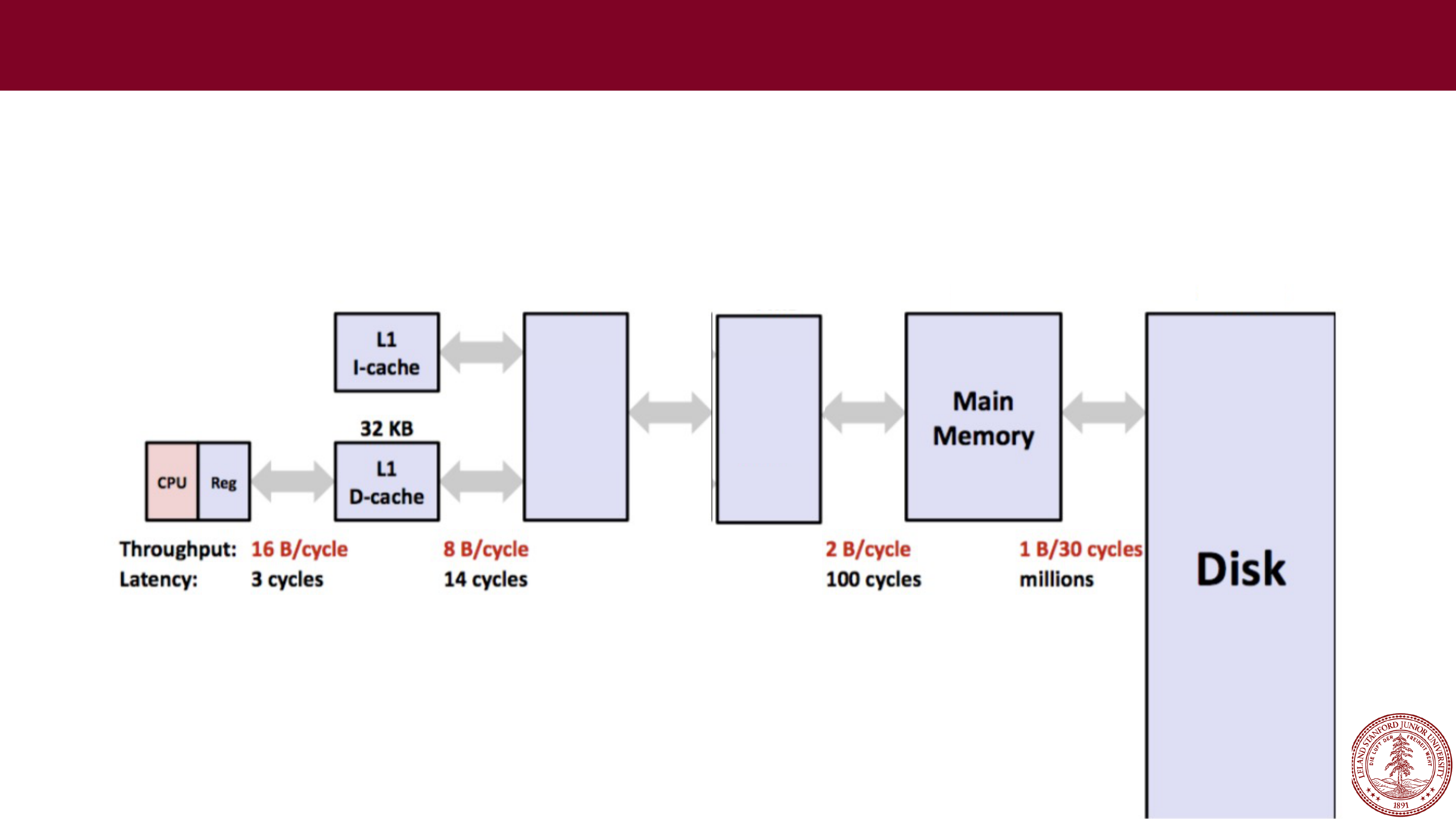
Computers these days have many
levels
of memory, from registers, to cache, to
main memory, to disk memory. The myth machines, with a Core i7 CPU have the
following memory structure (find out by typing
lscpu
)
L3
cache
L2
cache
256KB
8MB
32GB
1TB
4 B/cycle
40 cycles
Memory goes from
really fast
(registers) to
really slow
(disk),
and as data is more frequently used, it ends up in faster and
faster memory.
Page 34
Caching and Locality
All caching depends on locality.
Temporal locality
Repeat access to same data tends to be co
-located in TIME
Things I have used recently, I am likely to use again soon
Spatial locality
Related data tends to be co
-located in SPACE
Data that is near a used item is more likely to also be accessed
Realistic scenario:
97% cache hit rate
array.c
Page 35
Using Callgrind
Run program under callgrind, creates file callgrind.out.pid
valgrind --tool=callgrind ./array_opt
Process file to see source annotated with count per line
callgrind_annotate --auto=yes callgrind.out.<pid>