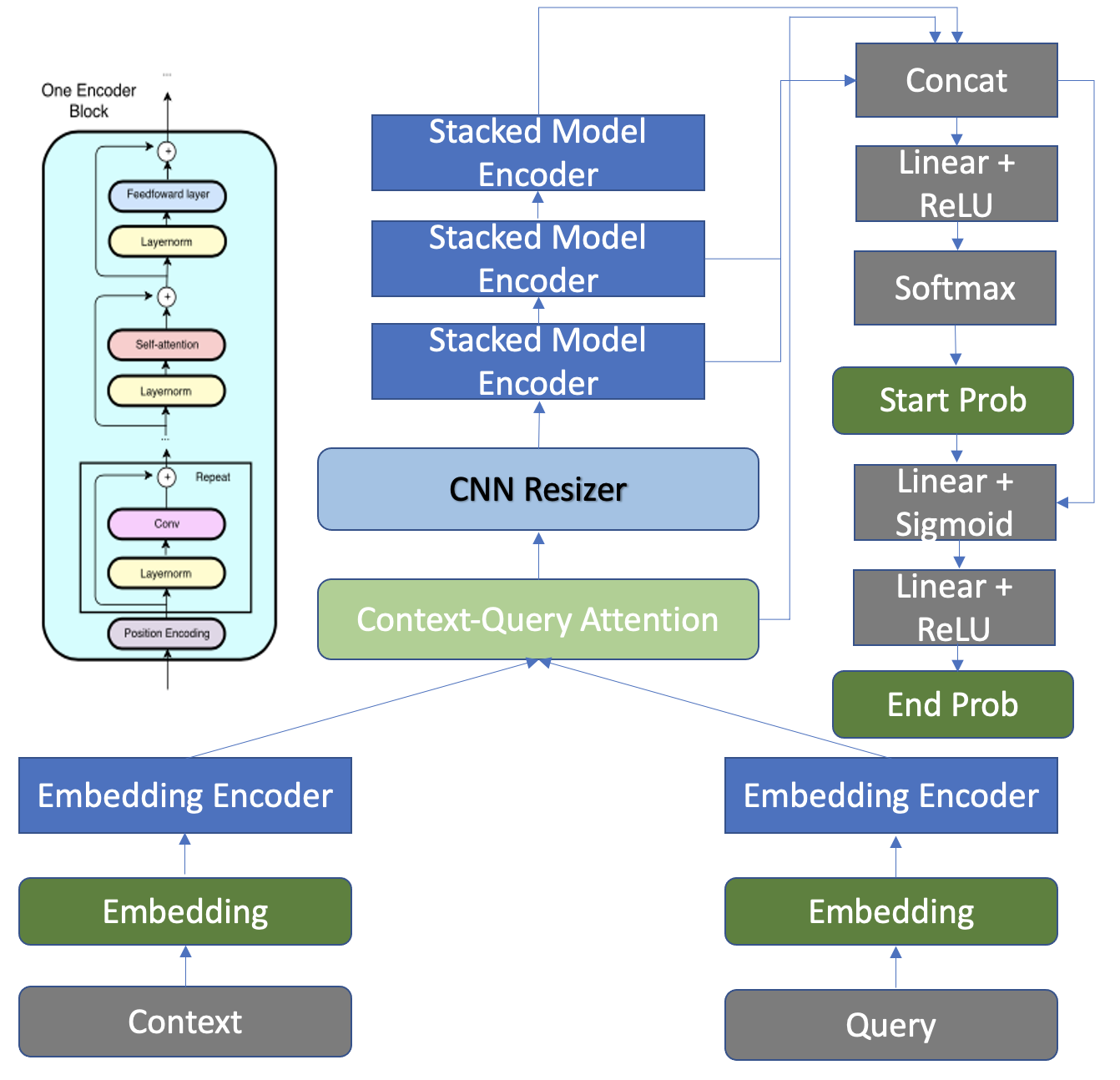
Before the advent of QANet, dominant question-answering models were based on recurrent neural networks. QANet shows that self-attention and convolutional neural networks can replace recurrent neural networks in question-answering models. We first implemented a version of QANet using the same architecture as that of the original QANet model, and then we conducted experiments on hyperparameters and model architecture. We incorporated attention re-use, gated self-attention, and conditional output into the QANet architecture. Our best QANet model obtained 59.3 EM and 62.82 F1 on the evaluation set. The ensemble of the two best QANet models and one BiDAF model with self-attention mechanism achieved 62.73 EM and 65.77 F1 on the evaluation set and 60.63 EM and 63.69 F1 on the test set.