The Built Environmental History of Chile
Query 2:
Estreo Marga Marga
Aaron Ligon and Kevin Boldt
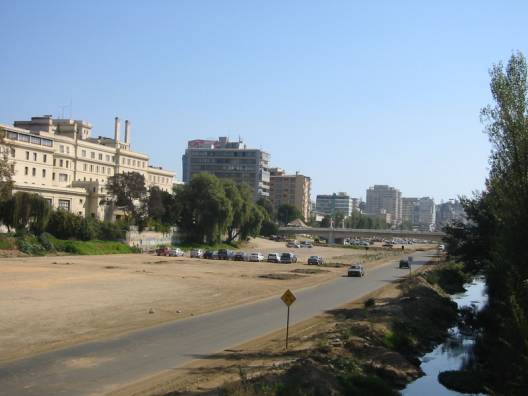
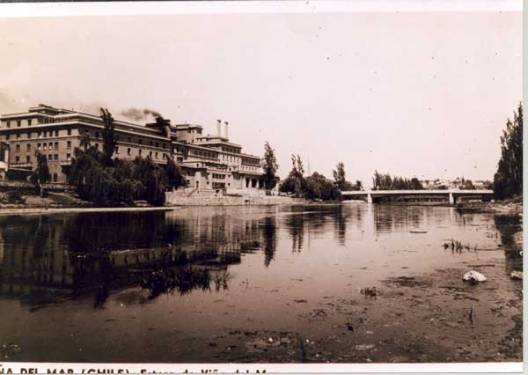
Found
in the beach resort of Vina del Mar, El Estreo Marga Marga is a
manmade canal which was originally designed to drain water into the
Pacific Ocean. The canal has become a city landmark and divides the city into
northern and southern portions. Any visitor to the city is guaranteed to make
several trips of El Marga Marga, as it cuts through the heart of
the city. These two photos of the Hotel O’Higgins overlooking the Marga
Marga (2005 and 1950) clearly show the changes over the past 55 years.
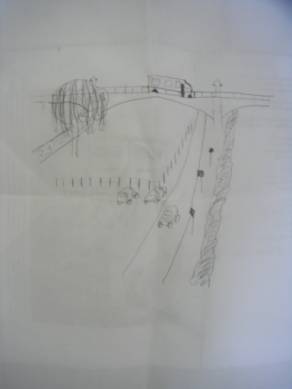
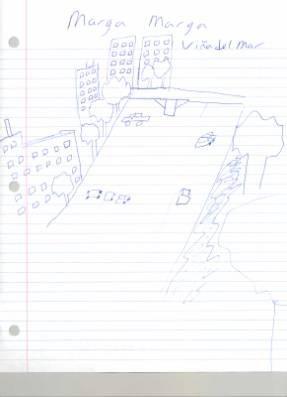
The
Estreo Marga Marga has been converted into a multiple use public space
and the water has confined to a small stream on the north side that runs
parallel to the dirt road. Around the Puente Quillota, the Marga Marga
is now used as a parking lot and the site for a circus.
Formal Symbolic Model
Functions |
Forms |
Behaviors |
|
Catch water |
Stream |
Cleaned by workers |
|
View |
Parking Lots |
Parking |
|
Beauty |
Road |
Transportation |
|
|
Circus |
Creative use |
|
|
|
|
Tour Guide Description
The Estreo Marga Marga canal is one of the visible features of Viña del Mar as it is practically impossible to walk around the city without crossing it. It runs east to west through Viña del Mar and divides the city into its older southern part and newer northern part. It is crossed by the main north-south avenues of the city in the form of white arched bridges. Much of the canal is presently dry and has been converted into multiple use space.
Personal Vignette
"Though we had walked over El Estreo Marga Marga numerous times during our escapades of Viña del Mar, Aaron and I felt we needed one more look at the río before we returned to Santiago. As the other five members of our group headed towards the bus terminal, Aaron and I broke off from the group and made our last dash to the river. Getting to Puente Quillota took only a few minutes, and upon the seeing the river, we were once again amazed by the diverse activity it contained: a circus, cars, and men cleaning out the waterway. After spending a few more minutes over the river, we received a phone call from Ben. Our bus was about to depart. We walked over the bridge one more time and then jogged to the bus station. Luckily, we made it in time for our bus back to Santiago."
Theoretical Interpretation (Brand)
Surroundings:
The biggest (or tallest) change in the surroundings of El Estreo Marga Marga has been the addition of numerous tall buildings to Viña del Mar. Today, many hotels and condominiums line the landscape of the beach resort. However, the Hotel O’Higgins still remains in its same site overlooking the canal.
Site: The canal originally filled with water has been mostly drained and converted into multiple use public space.
Structure: The bridges spanning the Estreo Marga Marga have remained unchanged over the past 55 years.
Services:
While it may seem strange for a river, one service that has been added to Marga Marga in the last fifty years is electricity.
Skin: The positions of the trees lining the river have changed as they have recently moved into the space that was once underwater.
Space plan:
The original canal filled with water has now been mostly drained with space given to a parking lot, road and circus. The water is now confined to a small stream on the north side.
Stuff: The water that previously was filled with weeds and algae has given way to cars, people and even permanent road signs.
Theoretical Interpretation (Alexander)
Alexander’s pattern of high places is present in the design of the canal in the form of bridges overlooking the space. The original intent of this was to give people a reflected view in the canal. However, this is not quite as effective today as there are only a few places in which the canal is full. The space created by the drained canal has come to be an activity node in Alexander’s language due to its central location in Viña del Mar. People have even become comfortable with the drained space of the canal as we noticed the pattern of people sleeping in public under the trees.