Query 4 Aaron
Ligon and Jenilee Deal
CEE33X May 4th, 2005
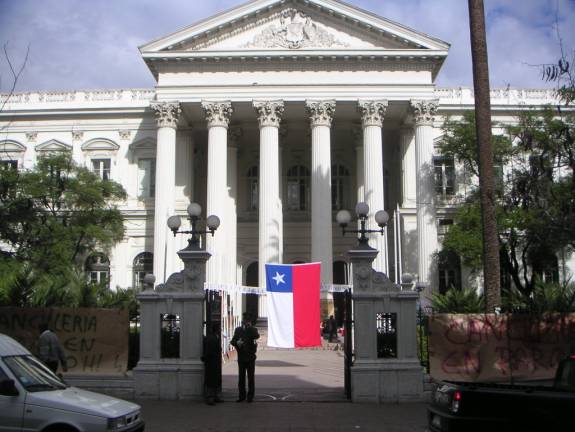
The Ex-Congreso Nacional was built near the Plaza de Armas in the 19th century as to house the new national congress. Its neoclassical architecture contrasts with the Spanish colonial style of previous government buildings. This is a key design intent as it stresses the Greco-Roman foundations of democracy and a rejection of the Spanish monarchy. During the Pinochet era, the national congress was moved to a modern building in Valparaiso. The Ex-Congreso Nacional now houses the Chilean equivalent of the State Department.
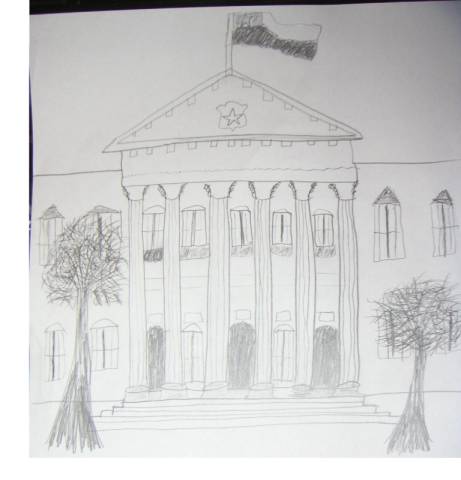

Aaron’s sketch highlights the attractive and imposing neoclassical style of the exterior of Ex-Congreso Nacional, while the two trees hint at the surrounding garden. This sketch is a view of a side entrance to the building, which only has one row of columns. The daunting size of the building, which takes up the whole square block, is implied by Aaron’s choice to allow the side of the building to occupy his sketch, from side to side. Conversely, Jenilee’s sketch focuses on a very small area of the building. She decided the capture her view of Ex-Congreso Nacional from the inside of the lobby, looking out. The center of attention is the main entrance, only from the inside, where one can see the checkered marble floor, one of the huge columns, and the fancy “CN” at the top that stands for “Congreso Nacional.”
FORMAL SYMBOLIC MODEL
|
FUNCTION |
FORM |
BEHAVIOR |
|||
|
|
Neoclassical design |
Well maintained |
|||
|
|
Imposing size |
Use has evolved over time to State Department |
|||
|
|
|
Public feels welcome in the gardens |
|||
|
|
Set back from street by gardens and gates |
Well guarded but not intimidating |
|||
|
Memorial to demonstrate empathy for their people
|
Monument to monastery fire |
Protesters use the building as a place for protest |
|||
|
|
Grand and stately meeting hall |
|










The Ex-Congreso Nacional fulfills its function of symbolizing the democratic republic and its independence from Spain through the imposing size of its neoclassical form with the two large rows of columns in front. These forms along with the building’s very well maintained look also contribute to the building’s impression of wealth and power. The function of symbolizing the democratic republic is also demonstrated in the behavior of the protestors who use the building as a place to put up signs and publicize their message. Their monument to the monastery fire fulfills the function of the congress’s empathy for the people.
PLUS AND DELTA
+ Well Maintained
We felt that the building was well maintained and this preserved the sense of grandeur that was the original intention.
D Use has evolved to from Congress to State Department
We were bothered by the fact that the building is not actually the congress anymore. For a building with so much meaning and symbolism to have its primary function removed takes a way from its character.
+ Public feels welcome in the gardens
+ Well guarded but not intimidating
Despite the fact that there are quite a few carabineros guarding the building, the outside is still a pleasant place where people are comfortable sitting to talk and even kiss. There is enough of a fence and trees to block out some of the noise from the street and make the gardens a more peaceful place.
+ Protesters use the building as a place for protest
For a place that is supposed to symbolize the Chile’s democratic republic, it seems very appropriate that the voice of the citizens in opposition to the government is visible and accepted.
ARCHITECTURAL CRITIC REVIEW
As I walk into the front façade of the Ex-Congreso Nacional, I’m struck by the imposing size of the two rows of columns that guard the entrance. These are the building’s most prevalent feature and the multiple rows create the feeling of a forest of enormous columns. Stepping back, we see that the building is a white neoclassical structure whose high ratio of height to width gives it a regal presence. Since the structure is forced to sit within one city block, buffered only by small gardens, it is only seen from up close. This succeeds in further accentuating the building’s vertical nature. On each side of the building there is an entrance with a large row of columns in front. This may seem a bit excessive at first, but in the end it succeeds by making the building has a front facing in each directions. Due position of the building and the gardens surrounding it, there aren’t many angles from which two façades can be seen at once. Proceeding inside, the buildings vertical nature is still apparent in the tall ceiling of the entrance room. A hallway branches off to either side, running around the entire inner perimeter of the building. This leads to the grand ceremonial hall whose sides are lined with rows of tall backed chairs. Overlooking the room from the far wall is a rather humorously contrived painting of the discovery of Chile. Overall, the building is grand and imposing, but in a way that leaves the viewer feeling rather empty. As a design it lacks the strong sense of originality necessary to make it architectural tour de force.
PERSONAL VIGNETTE
 The
whole class, the Director, and I were taking our weekly field trip. Today it
was the “Ex-Congreso Nacional.” The Director told us that this visit was
special because usually the public is not allowed inside the building;
apparently they were making an exception. Our guide was showing us the final
room of the tour, where the senate sits in their pompous chairs and makes
important decisions, and I had a plan. As we were filing out of the room, I
closely watched the guide, and waited for her to leave. As soon as she was out
of sight I dashed in front of the prestigious stage where the president of the
senate sits, and quickly yelled to Kevin to snap a photo. I was scared but
proud, and I even have proof:
The
whole class, the Director, and I were taking our weekly field trip. Today it
was the “Ex-Congreso Nacional.” The Director told us that this visit was
special because usually the public is not allowed inside the building;
apparently they were making an exception. Our guide was showing us the final
room of the tour, where the senate sits in their pompous chairs and makes
important decisions, and I had a plan. As we were filing out of the room, I
closely watched the guide, and waited for her to leave. As soon as she was out
of sight I dashed in front of the prestigious stage where the president of the
senate sits, and quickly yelled to Kevin to snap a photo. I was scared but
proud, and I even have proof:
THEORETICAL INTERPRETATION RYBCZYNSKI
The Ex-Congreso Nacional does a good job of capturing the European essence. Unlike “our cities” that “seem like unfinished building sites were each generation tries its hand,” the last major renovation of this building was in 1901, and only because of terrible earthquakes. Santiago has made a point out of not only having a neoclassical (i.e. Greco-roman) style in the beginning, but also in preserving the building. The building holds true to Rybczynski’s comments on symmetry, grand gesture and order. What would Rybczynski say? “Bravo!”
THEORETICAL INTERPRETATION ALEXANDER
(+) Pattern 67 – Common land: Although the inside of Ex-Congreso Nacional is not open to the public, anyone is allowed to pass time in the gardens. In an area filled with government buildings, busy streets, and loud micros, the gardens are one of the only nearby places to chill out.
(+) Pattern 66 – Holy ground: The Ex-Congreso Nacional is grandiose and well maintained. It was formerly the National Congress building and now functions as the meeting place for the Senate. Even protestors regard it as holy because they choose to put posters up on the gates in order to make a dramatic point. All these factors contribute to its holiness, which is clearly displayed through the high level of care given by the caretakers and the public.
(+) Pattern 163 – Outdoor room: Surprisingly the building meets all the requirements except for the suggestion, “…perhaps partially roof it…” The gate, combination of short/tall/bushy trees and columns at the entrance all contribute to the feeling of an outdoor room, at a subtle level.
(-) Pattern 62 – Stair seats: There definitely were not stair seats. The overall holiness of the building, combined with the beckoning benches and garden make it nearly impossible to use the stairs as chairs. In fact the absence of pattern 62 even though there are stairs on all sides just complements the presence of pattern 66, common land.
(-) Pattern 94 – Sleeping in public: Although there was not anyone sleeping in public, Alexander’s implicit goal is achieved: feeling comfortable. People were reading, resting and even kissing. Though this pattern does not directly apply, it can be applied when focusing on what mental state Alexander implies with “sleeping in public.”
FIELD NOTES
Memos: neoclassical; Greco-roman; gate surrounding premises; Greek-green-woman-statue lighting; huge columns at entrance; gravel paths inside; benches to sit; signs on all of trees identifying their type (e.g. Jorge Huneous, Belloto del Norte); large trees for shade; intricate gravel pathways; either ivy or grass covering a lot of the ground; grand- non operational-gray-antique fountain decorated with angels/cherubs; huge windows whose black bars match the gate; tall and short trees accompanied by Birds of Paradise; Chilean flag blowing in wind; monument “de fuego” (of fire) that memorializes many people who died in a burning Jesuit church; a lot of European influence; a few “carabineros” (policemen) around; some people sitting or walking; Supreme Court is on the other side of the street; Catholic church is across the street (the Director says, “It’s almost as if the Senate is saying ‘here the laws are made but there they’re watching.’”
Transcripts summary: The first interview I used the Fabia’s viewpoint of La Moneda which is an emotional subject for her in the sense that she’s sad it was bombed, but happy about its reconstruction. The second and third interviews were from Chileans walking on Luis Thayer Ojeda. The second person was an older man said that he spends a lot of time around Plaza de Armas and responded that it’s very important for the history of Santiago. The third person was a younger woman whom I asked specifically about Ex-Congreso Nacional; she does not spend any time in the gardens but thinks it’s a pretty building.
Coding: I was somewhat disappointed in the last two interviews because their opinions lie in the middle, I didn’t notice any extremes. I also need to be more forthright in asking them to repeat something or talk slower, because some stuff I didn’t understand. Maybe I should try a different atmosphere where people aren’t walking and instead sitting down at a café so I don’t get that “rushed” mentality. However, the mediocre responses are worth noting. In conclusion, the main parallel I would draw is that the historic district is appreciated because it represents the history and culture of its people; however its possible that it takes place on a somewhat subconscious level.