Carole Critchlow,
Leticia Rodriguez
CEE 33X, Prof. Kunz
5 de mayo, 2005
Query #4
La Catedral de Santiago, Plaza de
Armas
1.
Photo
|
|
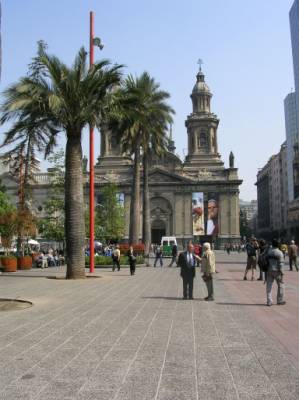
Caption La Catedral de Santiago, a historical symbol of Catholicism brought over by Spain during colonialism, still stands today on its own corner of Plaza de Armas. Such plazas were traditional in Spanish colonies, and were always anchored by a grand cathedral; this plaza is no exception. The Santiago cathedral is not the most extraordinary or aesthetically pleasing one in the world, but it is still majestic and proud. And though it is no longer the tallest or most impressive building in the area, la Catedral de Santiago remains an orientation and influence in the plaza and in Chilean life. The two towers have had to be restored several times after suffering structural damage from various earthquakes throughout the years. And yet the building still stands much as it did in the 1500s when it was first constructed. |
2.
Sketches
|
(Carole Critchlow) |
(Leticia Rodriguez) |
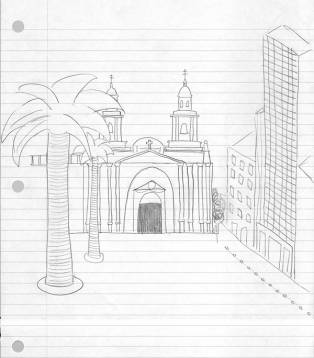
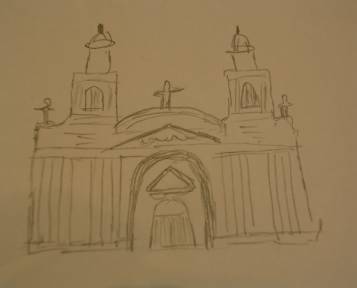
Shown here amid the bustling daytime crowd in Santiago’s Plaza de Armas, la Catedral de Santiago stands distinguished as the cornerstone of the plaza. These plazas were traditional in Spanish colonies, and were always anchored by a grand cathedral; this plaza is no exception. The Santiago cathedral, though not the most extraordinary in the world, is still majestic and proud. And though it is no longer the tallest or most impressive building in the area, la Catedral de Santiago remains an orientation and influence in the plaza and in Chilean life.
3.
Formal symbolic
model
|
Functions ·
Display power ·
Symbolism ·
Place of prayer ·
Neoclassical
style |
Forms ·
Classic columns ·
Arches ·
Twin spires ·
Ornate
sculptures, decorations |
Behaviors ·
People staring
in contemplation and prayer ·
People talking ·
Tourists taking
photos ·
Students on
field trips ·
Current
construction makes it noisy |
The forms of the
arches and classic columns are a reflection of the functional intent to create
the cathedral in a neoclassical style.
The ornate sculptures and decorations are traditionally found in places
of prayer. The impressiveness of the
forms of twin spires and sculptures add to the powerful display of this
cathedral, and motivates people to visit as religious followers, tourists and
students. (Further comments on
relationships are discussed below).
4.
Pluses/Deltas on
Behaviors
·
People staring in
contemplation and prayer +
o
We liked the fact
that people were taking time to think about what was in front of them and
kneeling in prayer. The interior of the
building does not have particularly marvelous architecture or paintings, but
the walls are still covered with symbols of Catholicism. The foot stools and
pews inside the cathedral provide a comfortable place for people to pray.
·
People talking D
o
We were upset
that some people were sitting on the pews talking to each other. The function of the pews is not for people
to sit and talk to one another. That
can be done outside the church.
·
Tourists taking
photos +/D
o
Tourists taking
photos is a reflection of their liking of the forms of the building, and they
were not disturbing mass at the time.
This marks the cathedral as a tourist attraction which is a compliment
for the building. However, the tourists
were a distraction to the people who were praying because their flash
photography was all over the place (and they were talking to each other).
·
Students on
fieldtrips +/D
o
Again this is
beneficial in the sense that it makes the students focus on the architecture
and significance of the cathedral, as opposed to attending a religious service
there. The students had notepads and
pencils in their hands, showing the educational intent of their being
there. However, this is again distracting
for people trying to pray.
·
Construction
makes it noisy D
o
The construction made
it almost impossible to concentrate or pray in the cathedral. The drilling was extremely loud and produced
a chemical odor throughout the cathedral.
5.
Architectural
critic review
 During
the period of Spanish colonization, cities in the New World were constructed
according to Spain’s Laws of the Indies. According to this decree, cities were
constructed around a central Plaza de Armas, a public square that earned its
name as the gathering place for the city’s military. Lining the square were the
important public edifices: royal courts, municipal buildings, residences of
local civic officers, and of course, a Catholic cathedral. Though all of Latin
America has since established its independence from the Spanish monarchy, and
many of the buildings in the Plaza de Armas have since modified their form or
function, the Plaza remains an important central location in many cities, and
is still anchored by a grand cathedral.
During
the period of Spanish colonization, cities in the New World were constructed
according to Spain’s Laws of the Indies. According to this decree, cities were
constructed around a central Plaza de Armas, a public square that earned its
name as the gathering place for the city’s military. Lining the square were the
important public edifices: royal courts, municipal buildings, residences of
local civic officers, and of course, a Catholic cathedral. Though all of Latin
America has since established its independence from the Spanish monarchy, and
many of the buildings in the Plaza de Armas have since modified their form or
function, the Plaza remains an important central location in many cities, and
is still anchored by a grand cathedral.
Santiago’s Plaza de Armas is no
exception. Founded in the 16th century as a small colonial town, the city has
now grown to be one of South America’s largest, and its Plaza still marks the
city center, with the official city cathedral still sitting prominently on one
axis. Due to its precarious location in an earthquake zone, none of the original
buildings from the Plaza remain standing today, but many of the current
incarnations remain quite true to the original design. The cathedral is no
exception; in fact, there were several churches built in its exact spot that
were all destroyed by either earthquakes or fires. The current cathedral was
begun in 1748, and was not finally finished until well into the 19th
century. Now, earthquake-proof and slightly bigger than the original building,
the cathedral remains a success in an architecturally diverse city.
Despite the more than 400 years
since the Plaza was originally built, it maintains its importance as a civic
center. Further, though church and state have been separated in Chile and
Catholicism is no longer the official religion, the cathedral has maintained
its importance as a cornerstone of the Plaza and a cultural landmark for many.
The cathedral has grown just enough with the times, slightly increasing its
size and equipping itself for a potential earthquake. Other than these changes,
it is stylistically true to its roots – it proudly recalls the European
influence that brought it here. And, though it is certainly grand and still the
focal point of the plaza, the design is respectful rather than imposing. It is
distinguished to the appropriate, obligatory level, and manages this without
being overly self-important (though this seems obvious, it is not true of all
churches). Though there are certainly grander and more majestic cathedrals in
the world, la catedral de Santiago does what it needs to do to fulfill its
role, and does so well.
6.
Personal vignette
When we went to visit the cathedral, we were hoping to be able to go
inside, sit back, and quietly observe, perhaps even engage in a little prayer.
However, when we entered the building, we were surprised at the high level of
noise from the construction being done for the renovation, and our noses were
struck by a strong chemical odor. It rudely interrupted the desired peaceful
environment and made it extremely hard to concentrate, observe, or pray.
7.
Theoretical
Interpretation: Rybczynski City
The Cathedral is situated on the
Plaza de Armas at the center of Santiago.
According to Rybczynski’s analysis, this is characteristic of a
“practical” city (43). Rybczynski’s
discussion of the Law of the Indies and the Spanish colonial style town with a
“standardized grid plan” (44) is directly seen in Plaza de Armas. He states that “The main public area in
these towns was a large central plaza surrounded by the chief colonizing
institutions: the royal council, the town hall, and the main church” (44). Plaza de Armas follows this pattern as it
once contained the government buildings and the cathedral. And as Rybczynski says, a practical city is
constantly changing, which is reflected here.
Though the cathedral still stands in the same place today, the royal
council and town hall are no longer there and instead are now the correo
central and the museo historico nacional.
8.
Theoretical
Interpretation: Alexander patterns
- Patterns we saw
- 66. Holy Ground: Both because of its
religious significance and symbolic value, and because of the rich
history of the site, the cathedral certainly represents holy ground.
- 110. Main entrance: Like many other
churches, the Santiago cathedral’s front entrance is grand and highly
visible. Framed by an arch,
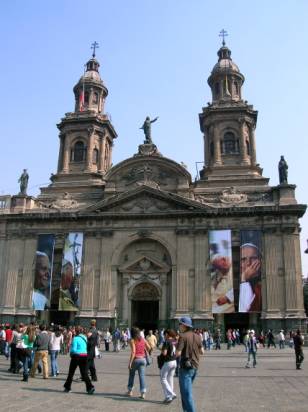
elaborate sculptures, columns, and a spire on either side (as well as
large pictures of Pope John Paul II at the moment), the main entrance is
impossible to miss from any location in the plaza.
- 21. Four story limit: The cathedral’s
height remains under four stories; thus, it is not overbearing while
still being prominent.
- Patterns we didn’t see
- 62. High places: The cathedral, though it
does possess two spires, would not be considered a tower, and there are
many buildings taller than it in the surrounding area. Because of the
traditional importance of the church, one might think that the cathedral
should be among the tallest buildings in the city, and perhaps at one
time it was. However, it no
longer holds that honor.
- 61. Small public squares: The cathedral
anchors a corner of the Plaza de Armas, which is a public square but
definitely not a small one.
However, despite Alexander’s predictions, the square has not felt
deserted any time we’ve been.
9.
Grounded theory
·
Questions for the
interviews:
1.
Have you ever gone to the cathedral?
Did you go inside? Have you
attended mass?
2.
What were your experiences like?
3.
Do you think this building is symbolic or influential for Chile?
·
Interview 1 (50
year old female)
1.
Yes, I’ve been to
the cathedral, I pass by there once in a while and have been to a few
masses.
2.
I find it
beautiful, gorgeous, antiguo,
colonial, typical of the era for Latin American countries. They maintain it very well, with much
care. It is the ‘mother church’ of
Chile. They do important masses there,
important political events, and events that are big or on a national
scale.
3.
But I don’t feel
like the cathedral has a particular symbolism for Chile or particular value;
it’s not important in the everyday lives of the Chilean people.
·
Interview 2 (30
year old male)
1.
Yes I have been,
both to see it as well as to attend Mass.
2.
I find it
beautiful but also somewhat cold; there are more beautiful ones out there.
3.
Yes, I believe it
has symbolic value for Chile and for its people – it signifies the power of the
church, and its own conflicts, by which I mean the types of Christian within
it.
4.
Other comments:
Two big things have happened at the cathedral very recently, just this year:
first, something very sad that affected the whole country. A priest was
murdered. One day after the priest gave mass, a young man approached him, and
killed him with a knife. They think that the young man was from a Satanic sect.
Whether you’re Catholic or not, it was an assassination, and it was a horrible
event to have happen, especially inside a church. It was a very sad event for
the whole society. And the second event: while they were doing renovations
inside the church they came across a mummified body, that of Diego Portales. He
was an important political figure in Chile in the late 1800s. His body had been
missing until now, but it was thought that he might be buried somewhere inside
the church.
·
Interview 3 (40
year old female)
1.
I have gone to visit it, usually with other people. I have not attended mass because I am not
Catholic. There are various reasons why
I have gone but they are strange reasons.
I wanted to see the structural reparation because the cathedral has
problems from earthquakes. Also to see
the statue of St. Teresa de los Andes, who is the only Chilean saint. […] I do
it because I need to know for me and for my students. It matters to me that I know Chile even though I am not
Catholic. I also went to the cathedral
when there was Peruvian immigration and I wanted to see the effect. They were lined up along the cathedral
looking for work. I wanted to see if
they went in for mass, as a sociological experiment. I also go almost always taking people
2.
I forgot to mention, I go to the cathedral when I can’t stand the noise
anymore. To me going into the cathedral
is a place of peace and quiet. This is
not one of my favorite cathedrals. I
don’t find it particularly aesthetically pleasant. My favorite part of the cathedral by far is the floor.
3.
Many important events happen there, as in many countries that are
majority Christian. I don’t know a lot
of people who go there on purpose. It’s
not an icon. People from the outskirts
of Santiago don’t come to visit it as they would in Mexico City. We don’t have anything in it. It’s not particularly big, fancy, or
impressive. Unlike some cathedrals,
this one isn’t even gilded. I may
exaggerate but I think the cathedral is more important to the Peruvians than to
Chileans because of the job market reason.
Except for major events, like when the former Pope died or when
Cardinals die. I suspect the Moneda
Palace is more visited than the cathedral but if it wouldn’t have been bombed
it wouldn’t be so. We basically don’t have
impressive buildings. The Church of San
Francisco is more historic, more impressive architecturally. It’s unique, it’s older, it’s been restored
rather than rebuilt, but the cathedral is the largest.
Coding
·
Ambiguity of
cathedral’s symbolism
·
Cathedral as host
for major events
·
Affect of
religious beliefs
·
Influence in
Catholic community
·
Architectural
style of Cathedral
Memos
·
The first and
second interviews were fairly short; the interviewees were agreeable and
answered the questions but were not overflowing with things to say. The second
did share the two extra comments though of events that happened there recently.
Both were conducted in Spanish and so the transcripts are not exact, but hit
all the main ideas.
·
The third
interview was quite lengthy in terms of time.
The interviewee had a lot of information and strong views about the
architectural style of the Cathedral.
The interview began in Spanish and ended in English.