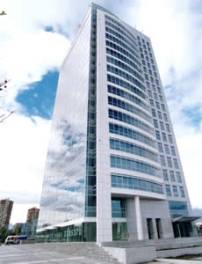
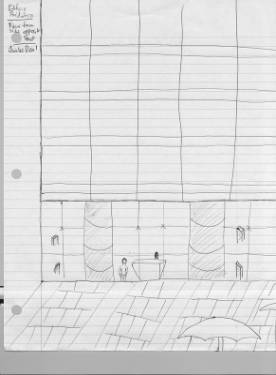
Description: The main relationships between function,
form, and behavior entail that of security, modernity, and multiculturalism: 1)
Security: the security measures are apparent and obvious to a casual viewer by
blatant display of security codepads, green lights, a security room with
windows so it’s easy to see into it, and a buffer between the building and the
street. All these measures contribute to the feeling of security and safety. 2)
Modernity: the architects/planners clearly had intention to build a
modern-style building, which is shown through the building’s exterior and interior
material, its windows, its shape, and its heavy clear glass entrance doors.
Once inside, the beautiful marble engulfs you as you’re greeted by eight
elevators and the receptionist’s desk. All these forms give successfully give
the impression of a modern building. 3) Multiculturalism: The multileveled
terraced grass, angles of the entrances and interior, and fountains are all
elements of feng-shui that would only be noticed by someone who had knowledge
of feng-shui, which is most anyone of Asian culture or anyone who has studied
feng-shui. In addition, the architects clearly wanted to show that the building
is named after the poet Huidobro, and as a consequence they etched his face
into all the entrance doors. This makes a statement of being well-cultured,
having pride in your country’s art, and shows a sense of intellectualism.
 Legend: each arrow ( ) represents a connection that says, “…‘x’ gives rise to ‘y’…”
IV.
PLUS/DELTA
+ Buffer between building and street
I really liked
the feeling of being away from the street and the consequent tranquility that
it brought. The well-done walkway/sidewalk that serves as the buffer adds to
the positive feeling as well. However, I think that the original function was
more for security than what I experienced.
+ Sign of wealth
It also felt
good to be in a place that generates success and productivity. Although my
attraction to this type of environment depends on my mood (sometimes I’d rather
be in a more relaxed environment), it’s always nice to see people working hard
and accomplishing something.
+ Well Maintained
Part
of the building’s “sign of wealth” is that it is well-maintained. Everything is
neatly trimmed, there is no trash, the windows and glass doors are clean, and
even the people are nicely groomed.
Δ Imposing size
I
did not like the building’s imposing size; it’s so high that it hurts my neck
to look at the top of it. I understand that the immense size is part of the
building’s modernity, wealth, and power, but for once I wish the architect
would go against the grain and achieve the same three objectives without making
a monster.
Δ Signs
I also did like
the feeling that LanChile just dominated the building by having its sign at the
top. I think this sole sign (besides a small Banco Chile sign on the lobby
level) gives the wrong impression that the building is LanChile’s, when if fact
many businesses have offices there. After talking to the Director of
Administration’s, I know that this was not a functional intent. The reality is
that LanChile owns 32% of the building and therefore has the ‘pull’ to put up
such a sign. I think that the majority of owners/planners/architects would
agree with me that the sign in both unappealing and misleading.
V.
ARCHITECTUAL CRITIC
REVIEW
Somebody Help Me…
It was just like someone painting
the image of a trampoline on the ground and then telling you to jump. Not only
is it not helpful, but it can kill you. This is just how I felt upon unveiling
the true character of Edificio Huidobro, located in the rich area of Nuevas Las
Condes in Santiago, Chile. The magnificent 21 floor steel construction praises
itself on having a state-of-the-art security system to shield and protect its
ever-so-important inhabitants. The official website for Huidobro Edificio brags
about such intricate systems and cutting edge technology. In reality, all the
building’s pretty gadgets, cameras, security guards, and security rooms are
ineffective, useless, futile, and a waste of time. Upon either entrance into
the building, two, four-foot tall stands meet each person who enters. Each
stand is fixed with a nine-digit keypad, much like a telephone. Each number is
a little bit more than 1” tall. When these first meet the eye, they look as
though they’re cracked up to be: modern, sleek, and effective. As I stroll to
the café for an overpriced salad, I take my seat facing towards the entrances,
and watch the people through the building’s clear glass doors. The first person
that I observe walks to the codepad and presses two digits, the first was on
the top row and the second I’m not sure. Another person walks in and presses
the same code, first a ‘3’ and then some digit on the third row. Eventually, I
worked out not just that passcode, but the passcode to a couple other floors as
well. As I sat there, proud of myself for feeling so intelligent and sneaky,
none other than a delivery guy walks in, presses a code, and goes in the
elevator! I couldn’t believe it. Here is LanChile, the country’s main airline,
and they’re supposed to be protected? We’re living in a time of global
terrorism and LanChile chooses…Huidobro? Even the Director of Administration
himself broke the cardinal rule, talking to me about the flaws of the security
system…I could have been anyone. I didn’t know whether to feel honored or
disturbed, but all I was thinking about was how easy it would be for someone
who really wanted to do harm. But this is not a security report, it’s an
architectural critique, so why am I talking about security faults…because part
of the building’s character lies in its intense feeling of security. If a building needs top notch security it’s
because it has something important to protect. Huidobro lies more than 30’ off
the street, you have to walk up stairs on all sides in order to enter, and the
inside is decorated with multiple security gadgets. But the truth is that
anyone can gain access into the building. In the United States, it is called
fraud when you advertise something for what it is not. I wonder how many
companies bought into Huidobro before it was actually built, and signing in on
Huidobro based on the presumption that it would have maximum security.
VI.
PERSONAL VIGNETTE
I get out of the taxi and stare
at this insanely huge building. The fountain in front tries and fails to
distract me from the building’s castle-like image. Nevertheless, I walk around
and I’m just completely in awe of how modern it looks and all the
important-looking people that are walking in and out. I’m busy exploring when I
see the old, blue, vacant building right next to Huidobro, and can’t help but
notice the stark contrast between the low-income housing and the multi-million
dollar modern building, Huidobro. It reminded me of the awful Cruz de III
Milenio from Coquimbo when a $25 million dollar, gigantic cross was placed in
the middle of a slum. The contrast was startling, but I tried not to allow it
to ruin my trip, or my interpretations of all the positive aspects of Huidobro…
like…umm…the fountains?
VII.
THEORETICAL
INTERPRETATION: Israel’s Some Place Like
Home and, Brand’s Ss
Israel stresses the intimate relationship between one’s
sense of self and one’s sense of environment. Huidobro is not a home, but a
workplace; compared to Israel’s description of ‘home’, Huidobro is cold.
Personally, I would hope that Huidobro did not
remind anyone of their home, but this also has to do with my own connections
from early childhood. My warm past experiences of place include summer days by
the pool, running around all crazy outside, and a relaxed but hyper
environment. I remember feeling completely content and happy to be able to rule
my house. I guess in some way, Huidobro can be a playground for adults.
However, it’s more difficult to take ownership of a huge castle like Huidobro.
I assume that one would take ownership over his/her office, but would not have
the freedom to play. According to Israel, one’s sense of self-place connection
evolves our lives. All of Brand’s Ss contribute to this sense of self-place
connection that evolves our lives through surroundings, site, setting,
structure, services, skin, space plan, and stuff. In terms of a single house or
building, I believe that the most influential parts are the structure and space
plan, because they most obviously resemble a reoccurring pattern. The next most
influential would be the surroundings and setting, and then finally the
services, skin, and space plan.
VIII.
THEORETICAL
INTERPRETATION: based on Alexander’s Patterns
My pattern language and
interpretation:
A workplace building should exude
wealth, power, and modernity without being too imposing or egotistical. The
most commonly forgotten attributes are windows that actually open and good
natural lighting. Too many times are employees stuck with re-circulating air
and artificial light, two sure ways to carry out an unproductive workday.
Include aspects such as:
Alexander Pattern 59:
Quiet backs – Huidobro takes advantage of its enormous height and creates a
quiet back on the side opposite the street. Combined with its fountain, all
visual and audio disturbances are blocked, and one can find peace of mind.
Alexander Pattern 88:
Street café – Huidobro makes an earnest effort by putting a café outside but
next to the building; it falls just short of a street café because it is a bit
off of the street. This not only provides comfort for the hardworking busy-bees
by assuring them that there is always something to eat right around the corner,
but it also breaks the sometimes draining tempo of a quick-paced working day.

Alexander
Pattern 110: Main entrance – Huidobro’s entrance “can be seen immediately
from the main approach”, and it has a “bold, visible shape that stands out in
front of the building.” This contributes to its image of wealth and power.
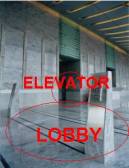
Alexander Pattern 127:
Intimacy gradient – Huidobro is a 21-floor building with countless employees.
Fortunately one is first greeted by the lobby, then goes to his/her appropriate
floor, then to his/her appropriate and private office. The architects took
special care to make sure they met this pattern.
 Alexander
Pattern 159: Light on at least two sides – Huidobro will have this
characteristic for a while, as long as their contract lasts with the park
across the street. This quality is so important to the building that they are
making sure they keep this attribute.
Alexander
Pattern 159: Light on at least two sides – Huidobro will have this
characteristic for a while, as long as their contract lasts with the park
across the street. This quality is so important to the building that they are
making sure they keep this attribute.
 My
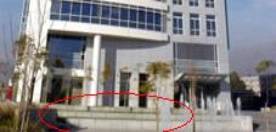
Pattern 1 (not referenced by Alexander): Terraced entrances – Huidobro’s
main entrance has Asian-style 3-step terracing, about 3’ high for each step. It
also has stairs on all sides that serve as a secondary and more subtle
terracing. This contributes to Huidobro’s powerful image and its feng-shui
approach as well.
My
Pattern 1 (not referenced by Alexander): Terraced entrances – Huidobro’s
main entrance has Asian-style 3-step terracing, about 3’ high for each step. It
also has stairs on all sides that serve as a secondary and more subtle
terracing. This contributes to Huidobro’s powerful image and its feng-shui
approach as well.
My Pattern 2
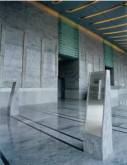
(not referenced by Alexander): Complementary angles – Huidobro’s exterior
and interior aspects are all connected, different, and complementary. For
example, the diamond-shaped fountain, circular cement benches, terraced grass,
square planting pots, and angular placement of the Huidobro itself all are at
different angles. However as a whole, all complementary angles work together
positively to create a connected whole.
IX.
GROUNDED THEORY
Field notes/Memos:
-
basically square building but rounded aspects
-
rounded cement seating outside
-
small skinny trees outside in front of building, 3x3 (9 total)
-
building sits across from park for a nice view
-
La Crème Café in back of building by rear entrance
-
the face of poet Huidobro etched in on all glass door
entrances
-
1’ address numbers outside by steps that say ‘5711’ but do not
say ‘Edificio Huidobro’
-
building is 30’ off from street separated by a sidewalk
o sidewalk
is composed of linear patterns of different sized square tiles of
white/grey/dark grey/cement
-
a beautiful fountain in front that has about 12 shooting
sprouts of water all slightly different heights
-
7-step fountain in the back by the café accompanied by short
bamboo trees – these serve to block out and both visual and audio cues from
surrounding low-income housing,
-
The building is neighbored on one side by these 3-story, old,
vacated, low-income housing; all the windows are broken as if someone threw
rocks at them
-
The building is also neighbored by another low-income 5-story
apartment that people live it (or I assume so because there’s clothes hanging
outside to dry)
-
A lot of construction on other side of building and in back of
it
Field notes/Interview I – Parking
attendant/Male/Middle-aged
-
Me: Excuse me, but, what are these buildings here [the vacated
blue buildings]?
-
Him: They used to be military housing for when Pinochet was in
power.
-
Me: So what are they now?
-
Him: Nothing. Nobody lives there. Before it was military
housing it was just open land.
-
Me: Is anybody going to do anything with them?
-
Him: Yes, the same people of this building [Edificio Huidobro]
bought the land.
-
Me: So does that mean they’re going to tear it down?
-
Him: Yes.
-
Me: What about that building over there [the other 5-story
low-income housing]?
-
Him: I don’t know. As of now they don’t have any plans.
-
Me: It only makes sense that they would buy up an old building
like that.
-
Him: I know, it’s amazing, the contrast.
-
Me: What do you mean?
-
Him: Well look for yourself. Here the windows are broken and
right next to me is this.
-
Me: Yea, I understand. What about over there [where all the
construction is]?
-
Him: That’s going to be more or less of the same.
-
Me: Is it the same people that built Edificio Huidobro?
-
Him: No, but it’s going to be just like this building.
Field notes/Interview II – Security
guard/Male/Middle-aged:
-
Me: Hi. I’m a student and I’m supposed to get a couple
interviews about people that use this building. I’m not looking for anything in
particular, just want to hear anything you want to say about it.
<<Silence>>
-
Me: It can be about anything. What you like about the
building, what you dislike, if there’s any particular part that comes to mind?
-
Him: Umm…let me see if I can get someone to talk to you.
-
Me: Do you have any opinion of the building?
<<He gets on his
walkie-talkie>>
<<He motions for me to
follow him>>
<<He leads me to the foot of
marble stairs at the side of the building>>
-
Go down one flight of stairs, turn right, and you’ll see the
camera room
-
Me: Where? Down there?
-
Him: Yes, just go down and turn right, the camera will see
you.
-
Me: Ok, thank you very much.
Field notes/Interview III – Building
administrator/Male/Middle-aged:
-
Me: Hi. My name is Jenilee and I’m a student from Stanford
University. I am doing a small project on this building and I was wondering if
we could talk for just a couple minutes.
<<Little did I know this
would last about two hours>>
-
Him: I’ve had architecture students come in before. The last
guy came in downloaded my presentation of the building onto a little drive.
-
Me: Oh I’m sorry; I don’t have one of those. But I’d like to
hear a little bit from you.
-
Him: What do you want to know?
-
Me: Anything. I’m more interested in hearing about any and
everything you have to say. If there are certain positive aspects, certain
negative aspects, things that jump out at you.
-
Him: Well we have a very unique transportation system. First
off, the building is in such a location that the businesspeople live 5 or 10
minutes away, and don’t have to worry about a long commute. And secondly, we
have a system that transports the people that work here from Metro Station
Escuela Militar to our building. This saves them a lot of traveling time, and
it’s free.
<<…abridged…>>
-
Him: You know everyone says that this building is intelligent,
but it’s not, it’s stupid (‘tonto’). The security system is stupid. We have a
‘micronic’ system where everyone needs to punch in a code before they go into
the elevators to access their floor. But the system is completely inefficient
because everyone has the same code
for every floor. There’s no way to tell who is coming in and out of the
building.
-
Me: Wow, it certainly looks like the security system is the
best though.
-
Him: It’s very easy to enter here. We don’t have anything like
individual magnetic strips on an id card…There are many cameras here but the
system is obsolete. They’re not digital and they don’t have a full view. It’s
like they take snapshots of every scene, so you can see what one person is
doing at one second, and you can see what they’re doing the next second, but
you can’t see what they’re doing in between.
-
Me: Wow, I had no idea.
-
Him: And the elevators also take a lot of time. There’s a lot
of waiting involved. It’s fine up on the lobby where they have eight elevators.
But for example when you’re down here [subterranean level] you have to wait
forever. And the reason is that the elevators aren’t programmed to make
multiple stops. They go to one level and then come back down to the lobby.
-
Me: That doesn’t make any sense.
<<…time passes…>>
-
Him: Well, there are other things that are positive about the
building.
<<As if trying to make up
for bashing his own building, his optimistic side surfaces.>>
-
Him: This building is only one of three in all of Chile that
is built so that it’s secure with steel construction, but that it doesn’t need
many pillars. The offices are huge and so are the offices. This is one of the
best parts about the buildings.
<<He then shows me the plans
from the building, and goes into to depth about the 4th floor.>
-
Him: Do you see here? There are one, two, three, four steel
constructions that give the floor its main support. And that way, the whole
floor is open space, it’s just beautiful.
<<…times passes…>>
-
Me: Why does it say LanChile at the top of the building?
-
Him: You see there are many people who own the building.
LanChile owns 32%.
-
Me: Oh I see, so is that the most?
-
Him: Yes! Most businesses own around 1%.
-
Me: Wow, who else is in this building.
-
Him: Companies like LanChile, Banco de Chile, MBI, and LG
Electronics.
<<…time passes…>>
-
Him: After all the construction was done the planners decided
that they didn’t want a 13th floor because it was bad luck. So all
the numbers were change, all the elevator systems were redone, everything was
rewired, and now there’s no 13th floor.
-
Me: Are a lot of buildings like this?
-
Him: No, maybe less than 5%.
-
Me: Really, that small?
-
Him: Yes
-
Me: Well I hope it’s worked!
-
Him: I don’t know we’ll see. Here, I’ll show you my
presentation of the building. It shows it built from the ground up.
<<I then watched about a 20
minute presentation of the building being constructed. I have to say most of
the pictures looked the same; the building was just a little bit taller. This
was kind of a boring part but I watched nonetheless and looked for anything
interesting.>>
-
Me: Ok, I have one last question. I know it’s probably
unlikely, but is there anything to the effect of childcare or anything like
that in this building?
-
Him: No. Very very few places have such a thing.
-
Me: I know, that’s the answer I expected but I just had to
ask.
-
Him: No, some supermarkets have a service, but it’s
inconvenient because it takes maybe 30 minutes each way on the Micro.
-
Me: Wow, that’s unfortunate. Does that mean that you have to
pay a private company if you need someone to watch your child?
-
Him: Yes. Alvear and Lavín are both calling for childcare in
buildings as a matter of fact.
-
Me: But why not Bachelet? I would think that out of all the
presidential candidates she would be the one pushing the hardest.
-
Him: Yes it would seem that way but she’s more of a realest.
Economically speaking, it’ll never happen.
Field notes/Coding:
-
Multiculturalism and intellectualism: Although no one
mentioned the feng-shui, Huidobro´s face etched onto the doors, or even the
building being named after a Chilean poet, these factors contribute to its
motivation and execution of being a multicultural and intellecutal building.
-
Wealth, success, and power: On the other hand Huidobro´s
modern style, intense effort to have a strong security system, and behavioral
aspects of the building (e.g. well maintained) and the people (e.g. hustling
and bustling, well-dressed) materialize in an overall theme of wealth, success,
and power, what is more interesting though are the underlying themes of
materialism and capitalism, both of which symbolize the quest for wealth and
power.
X.
ERIKSON’S EIGHT
TASKS OF LIFE
|
Task
|
Help, Hinder, or Irrelevant
|
|
Stage
|
Name
|
Description
|
|
|
1
|
Infancy
|
to develop trust
|
irrelevant
|
|
2
|
Young child
|
develop autonomy
|
|
3
|
Child
|
develop initiative
|
|
4
|
Youngster
|
develop industry
|
|
5
|
Youth
|
develop identity
independent of the family origin
|
|
6
|
Young adult
|
develop
non-narcissistic intimate relationships
|
helps
|
|
7
|
Adult
|
develop
generativity
|
helps and hinders
|
|
8
|
Old person
|
develop integrity
|
helps and hinders
|
I believe that
stages one through five do not apply to Huidobro because it is strictly an
office building without any sort of accommodation or thought to youngster. In
my time there, I am yet to see someone under the age of 18. However, if you
were to actually bring an infant, young child, child, youngster, youth, or
young adult into the environment, the building would not contribute to any of
the life tasks.
However I
believe that tasks six through eight do apply to Huidobro. For stage six, a
young adult that is placed in a mature and professional environment such as
Huidobro is going to act accordingly. Therefore Huidobro acts as a catalyst to
interactions between that young adult and his/her coworkers. In addition, the
young adult will spend a lot of time with coworkers while still being in a
non-narcissistic, non-sexual, but intimate environment nonetheless.
For stage seven
and eight, Huidobro’s environment can both help and hinder the person.
Developing generativity and integrity involves a certain degree of selflessness
and reflection, respectively. Huidobro gives the ‘Adult’ the opportunity to
teach other coworkers and really serve as a mentor. It also gives the ‘Old
person’ the chance to reflect on his days, on his career, and on the meaning of
his life. After all, some ‘Old people’ spend more time at work than at
home. However on the other hand, the
‘Adult’ can get so caught up in his/her own goals and trying to climb up the
corporate ladder that he/she forgets generativity and lacks the time for proper
development. This is also the case with the ‘Old person’ who is so wrapped up
in him/herself that there is not adequate time for reflection, and thus no
integrity. Huidobro breeds a
hard-working but competitive environment where some could easily get caught up
in the tide and forget him/herself.