Maria Chang
CEE 33X: Query 5
El Palacio de la Moneda
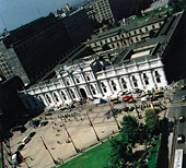
Photo
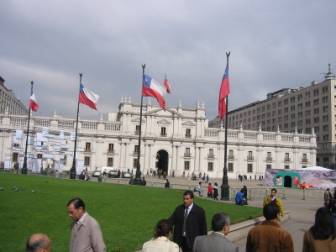
El Palacio de la Moneda is located between Plaza de la Constitución and Plaza de la Libertad in the center of Santiago. This photo is taken facing south in the Plaza de la Constitución. The building was designed by the Italian architect Joaquin Toesca and inaugurated in 1805. La Moneda was originally used as a mint, but it has housed the president’s offices and residence since the middle of the 19th century. In 1973, the building was bombed in a military coup that killed Salvador Allende and brought Augusto Pinochet to power. The building was restored according Toesca’s original plans after the attack.
Sketch
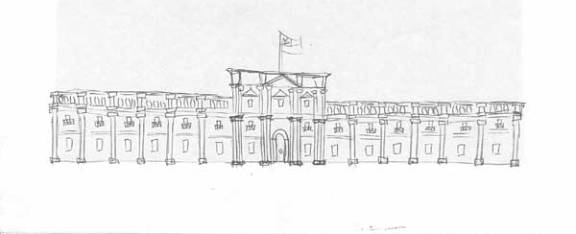
The sketch of Palacio de la Moneda, which currently houses the offices of the president, is from a direct view of the main façade which faces Plaza de la Constitución. Joaquin Toesca designed the building in the neoclassical style. La Moneda showcases a main archway and tall columns. The main façade is completely symmetrical and the same set of windows is repeated seven times on each side of the archway. Sketching the building made me realize just how wide the face of the building is. The width is about four times as long as the tallest part of the building.
Formal symbolic model
|
Functions |
Forms |
Behaviors |
|
National mint |
Courtyards |
Modern art displayed |
|
President’s offices |
Salons/ reception rooms |
Government workers passing
in and out |
|
President’s residence |
Columns |
Carabineros guarding
building |
|
National symbol of Chilean government |
Main archway |
Honor guards standing on
raised platforms outside main archway |
|
Historic artifact |
Grates covering windows |
Tourists visiting courtyard |
|
Express sense of importance |
Balustrade |
People sitting on benches
talking |
|
Convey dignity |
Chilean flag |
Visitors taking photos of
building |
|
Welcome visitors/public |
Fountain |
TV reporters and cameramen
broadcasting news |
|
Safety of
president/ministers |
Stairs in courtyard |
Building and site
maintained in pristine condition |
|
Serve the Chilean citizens |
Sets of identical windows |
Building is set apart (in
style) from those surrounding it |
- The Chilean flag serves the function of symbolizing Chile and its government. Reporters were using the courtyard as a backdrop due to this function.
- The columns, main archway, and honor guards express importance and give the building dignity.
- Grates covering windows and carabineros ensure safety.
- It is a historic building in the neoclassical style; the columns and archways employed visually separate the building from those around it.
Plus/ Delta
Plus: - Inviting: The archway in the main façade is open, allowing visitors to enter the spacious courtyard. The walls are low enough to let in lots of sunlight.
- Calm: The carabineros ensured that no disorderly conduct occurred, while the fountain added a sense of tranquility. This invited the public to visit and enjoy the courtyard. There were a few people sitting and enjoying the courtyard during lunch.
Delta: - Visually repetitive: The same columns, windows, and balustrade are repeated throughout the building.
Architectural critic
review
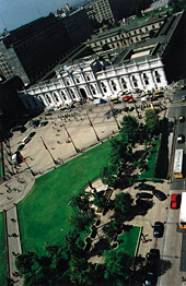
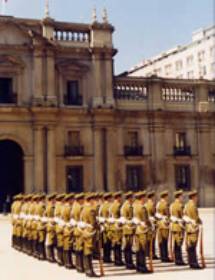
El Palacio de la Moneda is currently used as the offices of the president and several government ministers. However, the building was constructed as the mint of Chile. La Moneda was designed by the Italian architect, Joaquin Toesca, who was sent by the king of Spain. Toesca planned the building in the neoclassical style; unfortunately, he did not see the completion of La Moneda. Construction began in 1786 but the building was not inaugurated until 1805, and construction had not yet finished. Over the years, it has undergone several renovations and restorations. La Moneda is located in downtown Santiago between Plaza de la Constitución and Plaza de la Libertad and occupies an entire square block.
The first thing a visitor notices about the building is its width in relation to its height. The main façade is about three times longer than the height at the tallest point of the building. This proportion imparts a sense of stability, a condition fitting for the offices of the national government. Another feature of the design is the regularity of its elements. La Moneda is very symmetrical and repeats the same set of windows fourteen times in its main façade, with tall columns separating each set. The only thing breaking the symmetry was the solitary Chilean flag, on a pole in the center of the building, blowing in the wind. Though I found this to be visually uninteresting, I spoke with a few Chileans who admired its simplicity. One related the simple design of the building with the way Chileans would like their government to be: small and unpretentious. The building does not aspire to be a grand monument to the president. Instead, the building’s physical appearance suggests that it is a place where president occurs.
One of the best things about La Moneda has more to do with behavior than form: the main courtyard is accessible to the public. Any citizen or visitor can enter the courtyard and possibly glimpse government figures that represent the interests of the Chilean people. Even if a Chilean doesn’t get to see the president walking through the courtyard, he or she can admire the modern art sculptures on display. The exhibition of art is a thoughtful and welcoming gesture to visitors. The openness of La Moneda is surprising, especially when compared to the White House, which is behind a gate and set back from the street by a large lawn.
Even though Palacio de la Moneda is not a visually spectacular building, it serves its purpose well. It has housed the president’s offices for over a century, and gives them a sense of dignity without overexalting their position.
Personal vignette
The main courtyard of Palacio de la Moneda is open to the public, so I decided to go in during lunchtime on a weekday. To enter the courtyard, I had to let the carabineros guarding the main arch check my purse for prohibited items. Visitors were directed to carabineros of their gender, which was a thoughtful gesture. The carabinera checked my bag with a metal-detecting wand and waved me inside. However, when I tried to retrieve my purse, she said, “No.” I then turned to enter the courtyard, thinking that bags had to be left outside, but again said, “No.” She then handed me my bag and I entered the courtyard confused about what she had meant; to this moment, I still don’t know why she said, “No.”
Theoretical
interpretations:
-Israel and Brand
In fifth grade, my elementary school took us to the San Francisco Opera House to watch some tragic opera. I remember being excited because there were so many people and I was wearing one of my favorite dresses. I also remember that the Opera House was a big, grand building, not like the ones where I lived, and I associate my memories of the building with good emotions. Though La Moneda does not hold operas, it creates an impression in the minds of its visitors because of its size and its historical style. It is located in an important setting in downtown Santiago and is surrounded by several other government buildings. The site has been unchanged for two centuries, which imparts a sense of history.The structure includes courtyards, one of which is accessible to the public. Schoolchildren will most likely remember entering the archway into a large courtyard and playing around the fountain. Though visitors do not make use of the building’s services, the government officials use the water, electricity, and other modernizations that have been added to the building. Space plan applies mostly to people who work in the building. Skin and stuff are memorable because they give the building a pristine finish and visually interesting art.
-Alexander

- Pattern 110 – Main Entrance: A humongous arch is located in the main entrance; it is the only arch on that face.
- Pattern 115 – Courtyards that live: The main courtyard that is accessible to the public has a view of the Plaza de la Constitución through the main entry. There are at least four other doors in the building leading into the courtyard.
- Pattern 205 – Structure follows social spaces: The façade of La Moneda contains columns repeated at regular intervals.
- Pattern 159 – Light on at least two sides: Many of the rooms in La Moneda can only have light on one side; due to the design of the building, only the corner rooms can have light on two sides. This should have been applied to create a more conducive workspace.
- Pattern 55 – Raised walk: The sidewalk in front of the building is at the same level as the street. This is disconcerting for pedestrians.
- Maria’s pattern 1 – Fountain: A fountain, located in the courtyard of La Moneda provides a sense of tranquility.
- Maria’s pattern 2 – Width/height proportion: A high ratio of width to height gives a building a sense of stability.
Grounded theory
Field Notes
What do you think of el Palacio de la Moneda?
Fabia: I think it’s OK, not pretentious. I like the patios. I’m fond of the color: it’s white, unlike some other buildings that are pink. It’s impressive without being excessive. I like the symmetry and simplicity of the building. I’m glad it was restored, which they were able to do because they had Toesca’s original plans.
What do you think of el Palacio de la Moneda?
Store clerk: I think it’s pretty.
Do you like it or not like it?
I don’t think much about it; I don’t have any particular feelings toward it.
What do you think of el Palacio de la Moneda?
It’s a pretty building; they restored it after the military coup. It has many different salons and patios. President Lagos opened it up to the public; before people weren’t allowed in the patios. There are many things going on around there, like protests. Protesters often deliver letters to the building. Every morning they have the changing of the guard.
Coding
- analytical descriptions of La Moneda
- favorable emotional response
Memo
The subjects chosen were a store clerk, my host mom, and Fabia; they were selected due to convenience. The interview with the store clerk was about 1 minute, while the other two were 5 minutes long. It was hard to draw comments out of the store clerk; talking with Fabia and my host mom was easier. None of the three subjects interviewed had particularly strong feelings towards el Palacio de la Moneda. This may be because they were all relatively young when the palace was bombed during the military coup. All three liked the building as a physical structure, and two commented on the patios. Due to the brevity of the interviews, only a couple themes emerged and they may not be representative of views of La Moneda in general. Questions for a second round of interviews are listed below:
What do you think about La Moneda?
Does it have personal importance?
Does it reflect the Chilean identity?
Does it pertain to Chileans today?
Are the restorations worth the effort?
Is it important to preserve historic buildings?
-Erikson: host home
- The apartment provides shelter for the infant, so that he feels safe and can learn to trust.
- A young child can develop autonomy in the space provided; he can learn to climb the stairs
- A child develops initiative by exploring the apartment, opening doors, and playing in the park by the apartment.
- A youngster develops industry outside the apartment.
- A youth develops a family-independent identity by establishing relationships in schools (close by) and participating in social activities available in the city. The lack of bedrooms hinders this process, because the mom and child are sharing a room when guests come over (which is very often).
- Young adult: developing non-narcissistic romantic relationships would be hard given the lack of privacy in the apartment; this would probably occur outside the house. Platonic relationships would be able to form and grow in the adequate, living/dining room.
- An adult raising children would be able to provide food and obtain services necessary for their health and well-being.
- An old person can develop integrity in the apartment because it provides a sense of stability; one would not feel like a financial failure if he lived in that apartment.