Query-6: Homes. Please submit using
htm format before class (3 PM, May 19)
Please submit:
1. Photo of the inside of your host home.
Please add a brief (about 100 word) caption that comments on the name,
features, social and personal significance of the content of the photo.
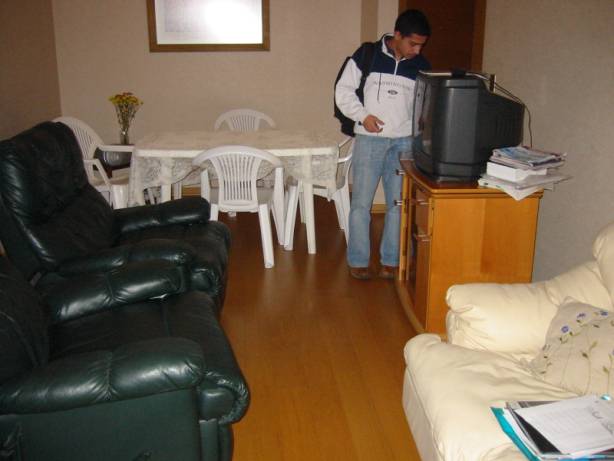
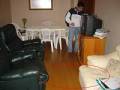
This photo captures Roberto del
Rio 1110 Depto 104 from the vantage point of the rectangular living/dining
room. The left of the photo shows two, dark green, overstuffed, “lazy-boy”
chairs (that give wonderful massages too). To the right are a full-sized cream
colored couch (that no one really sits on) and a television that faces towards
the green chairs. The living room quickly turns into a dining room with the
white plastic dining table and accompanying white plastic chairs. The wallpaper
is lightly textured, also a cream color, and complements the light hardwood
floor. After all are home from work or school, the family gathers here to eat
dinner and watch the nature channel.
2. Sketch of some aspect of the inside of
your host home. Please add a brief (about 100 word) caption that comments on
the name, features, historical and personal significance of the content of the
sketch. As appropriate, make the caption of your sketch more personal than that
of your photo.
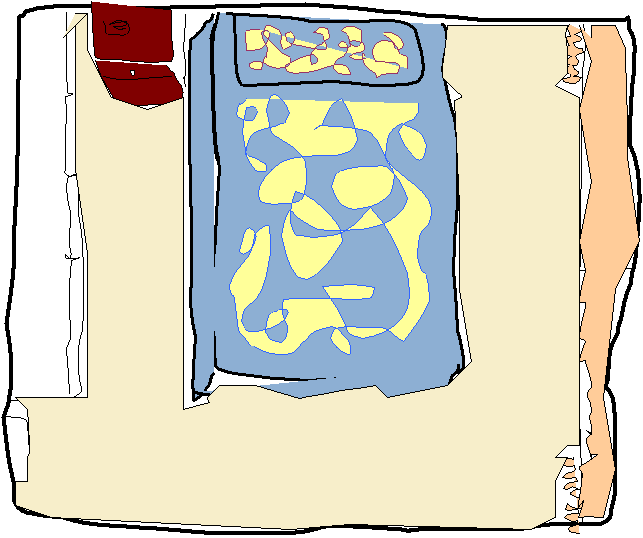
This is my room from a plane view. As you can see, there’s not much to
it, but in some way the lack of clutter is good for my mind. The bottom left hand corner is my door.
Because the closet is deep, there is a very very very small hallway, about a
foot long. The closet takes up the whole left side of my room and is very
spacious. Then the two pieces of furniture in my room are a dark wooden
nightstand and a twin bed. To the right of the sketch are sliding glass doors
with curtains that lead out to a small balcony. This is where I sleep and
study. Since I don’t have a desk or chair, it took me about a month to learn
how to study on my bed, but now I’m a pro.
3. Formal
symbolic model of at least five functions, forms and behaviors of your host
home. Using comments and arrows as appropriate, add brief description of
meaningful relationships you find among functions, related forms and related
behaviors. Add a legend that defines the semantic meaning of any arrows you use
in your diagram.
|
Function |
Form |
Behavior |
|
|
Living quarters for 1 to 4 people to live
|
|
Upper-middle class dwelling to be proud of. |
|
|
Upper-middle class
|
|||
|
|
Inviting and home-like. |
||
|
Inviting and
|
|||
|
Suitable to multiple tastes. |
|||
|
Suitable to multiple tastes. |
Interior design withstands test of time through its simple design even though has modern facilities. |
||
|
basic necessities. |
|
Users take basic necessities for granted. |
















Description: The main relationships between function, form, and
behavior entail the apartment being suitable to multiple tastes and being
inviting and home-like. It is both a function and a behavior for the apartment
being suitable to multiple tastes. Through the forms of: textured, cream colored, wallpaper, light wood
floor molding and white wood ceiling molding, cream comfy carpeting, bronze
coverings around electric plugs, and
simply engraved, white doors and closet doors with golden handles, the function
is achieved and its behavior materializes. These same forms also contribute the
inviting and home-like aspect, but additional forms include the dark green
chairs, cream couch, paintings on walls, and plants and flowers contribute the
function and behavior of the apartment being inviting and home-like. However,
the function for inviting and home-like is one of my host family, as opposed to
the apartment being suitable to multiple tastes, which is a function of the
architect.
 Legend: each
arrow ( ) represents a connection that says, “…‘x’ gives rise to
‘y’…”; each arrow that points to a brace
( { ) represents an individual arrow to each form, function, or behavior
that the brace hugs.
Legend: each
arrow ( ) represents a connection that says, “…‘x’ gives rise to
‘y’…”; each arrow that points to a brace
( { ) represents an individual arrow to each form, function, or behavior
that the brace hugs.
4. Summarize
things you liked and did not like (Plus/Delta) about behaviors you see; comment
explicitly on relationships to functions, forms and behaviors.
+ Inviting and home-like
The
cream motif, white doors, golden door handles, light hardwood flooring, and
even the bronze coverings around the electric plugs already make the apartment
feel like a home. The overstuffed chairs and couch also just invite you to make
yourself comfortable and either watch television or converse with other humans.
The conscious decision by the architects and family to create an inviting home
is apparent in all these forms.
Δ
Suitable to multiple tastes
Although
it is safe, economical, and expected for an architect to make an apartment
suitable to multiple tastes, I prefer more of an individual dwelling. It might
not always be possible, but a little cottage filled with character will win my
heart over a modern and plain house or apartment. This apartment definitely has
a cream motif, but it is slight and subtle enough where many people and
families would enjoy this apartment. Personally, a home being suitable to
multiple tastes is not sufficient, but it is for most people I assume that this
quality would be positive.
+ Users take basic necessities for granted
Usually
we are taught not to take things for granted. I agree with this on most counts
except for basic necessities. I enjoy not having to worry about if water is
going to come out of the sink when I turn it on to brush my teeth. I enjoy
being able to take a hot shower. I also enjoy turning the light switch on, and
knowing that I’m going to have sufficient light to do my homework. And yes, I
take these things for granted. I do all of these actions without thinking; and
if it weren’t this way, well, I would be disturbed.
+ Upper-middle class dwelling to be proud of
The
type of home you have says a lot about who you are. This apartment is a place
to be proud of because it is moderately new, well-kept, and is in a nice area.
All these aspects are important to me because it makes me feel safe, secure,
and happy to live where I do. This environment encourages me to invite friends
over and spend more time with my family.
5. Personal
vignette: describe an experience you had in your host home that was personally
meaningful and describe how that experience made the visit memorable for you.
On my night in Chile, I asked my host brother, Adrián,
where I could smoke. He led me to the half-indoor-half-outdoor laundry room.
After walking through the kitchen and into the laundry room, Adrián reached
above the tall washer-dryer machine, and grabbed his usual ashtray. Two hours later,
we were still in the laundry room having a heated discussion about life and
philosophy. Our communication was both in Spanish and English, as we both knew
a little bit of each. It was on this night that I knew that I would have a
great time in Chile, and that my host family would be a huge part of my
experience.
6. Theoretical Interpretation of the site for your host home based on
your interpretations of the perspective of Rybczynski in the Home reading.
We have come a long way since wooden benches for eating, gasoliers, and
the only subconscious gravitation towards comfort as an ‘idea.’ In my home it
does not matter where one sits in relation to the salt, but the men always sit
at the head of the table. My family always serves me first also, I assume a
lingering custom from the Medieval times. If it was not the Dutch, then it
probably would have been someone else who began to integrate the idea of a home
into the house. The master bedroom has a short hallway just inside the door
that turns to the left after about eight feet, leading to the actual bedroom.
This hallway accentuates the awareness of the architect of the importance of
privacy, especially for a couple. To this day, I am yet to see the master
bedroom.
7. Theoretical
Interpretation based on your interpretations of a Pattern language that you create to describe your host
home. Include at least five patterns of Alexander that we discussed in class up
to now. Describe and include at least two additional patterns that you find
relevant that Alexander does not mention. Annotate one or more photos of your
home and identify the relevant feature of each pattern. For any negative
examples of patterns, briefly comment on why you think that your pattern could
or should have applied.
My pattern language and interpretation: A home, whether it be big or small, one-story or
three-story, apartment or house, should be nothing less than a sanctuary and
both a place of gathering and privacy. However it is even more important for a
family to understand its needs more so than the architect who built the home.
For example, an architect always must always balance functionality with
aesthetics, but a family of three need not have a three-story house, as it will
create isolation instead of privacy.
Alexander Pattern 127 – Intimacy gradient, and
Alexander Pattern 205 – Structure follows social
spaces: When you enter my host home, you
are greeted by the living/dining room and the kitchen. There is a door with
four small windows that separates this area from the bedrooms. Once in through
this door, the bathroom first greets you; this way if a guest needs to use the
bathroom he/she does not need to go past any bedroom. Past the bathroom are two
bedrooms, and then finally the master bedroom. This is a perfect display of intimacy
gradient and how the structure of the home itself follows social spaces.
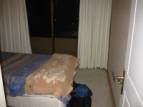
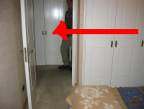

 Level of
Intimacy from lowest to highest
Level of
Intimacy from lowest to highest
Structure follows most social to most private
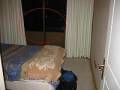
Alexander Pattern 179 – Light on two sides: Since my bedroom is on the east
side, I always have a second alarm when it’s not too overcast, the sun. And
during the afternoon, the sunshine enters through the living room. Whenever I
prefer natural light, I gravitate to either my bedroom or the living room.
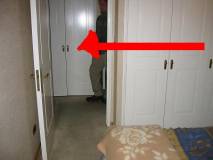 Alexander Pattern 136 – Couples realm: The master bedroom is set off by an
eight foot hallway so that even if the door is open, their privacy is in tact.
It also has a bathroom so that the couple (my host mom and dad) does not need
to leave the room in order to use the bathroom or shower. Unless invited, no
one ever has to go into their realm.
Alexander Pattern 136 – Couples realm: The master bedroom is set off by an
eight foot hallway so that even if the door is open, their privacy is in tact.
It also has a bathroom so that the couple (my host mom and dad) does not need
to leave the room in order to use the bathroom or shower. Unless invited, no
one ever has to go into their realm.
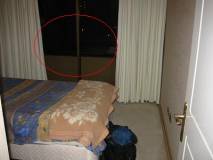 Alexander Pattern 192 – Windows overlook life: I absolutely positively love
the windows that overlook life! From the top to the bottom of the ceiling,
there are sliding glass doors that serve as huge windows and as the entrance to
balconies. Being on the seventh floor, you can look to the south and the east
(depending on which window) and observe the street activity and the playground.
Alexander Pattern 192 – Windows overlook life: I absolutely positively love
the windows that overlook life! From the top to the bottom of the ceiling,
there are sliding glass doors that serve as huge windows and as the entrance to
balconies. Being on the seventh floor, you can look to the south and the east
(depending on which window) and observe the street activity and the playground.
My Pattern 3 (not referenced by Alexander) – Multi-strength Lighting: A home serves as a place
of leisure and work. Sometimes, a dinner cannot achieve its brilliance if a
bright fluorescent light it blinding the guests, or the just the family. Just
the same, when it comes time to work, the golden light will strain the eyes,
and create a difficult working environment. Make sure that living rooms and
even bedroom have multi-strength lighting, as to serve all purposes of the
family.
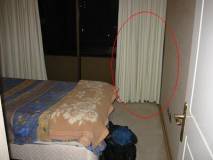 My Pattern 4 (not referenced by Alexander) – Double-layered window covers: There is nothing
better than being able to close the blinds or curtains after a long night of
work or play, knowing that the bright sunshine is not going to wake you in the
morning. Also, being able to open the heavy curtains/blinds, but still allowing
privacy with a sheer material is equally satisfying. Never underestimate the
importance of double-layered window covers.
My Pattern 4 (not referenced by Alexander) – Double-layered window covers: There is nothing
better than being able to close the blinds or curtains after a long night of
work or play, knowing that the bright sunshine is not going to wake you in the
morning. Also, being able to open the heavy curtains/blinds, but still allowing
privacy with a sheer material is equally satisfying. Never underestimate the
importance of double-layered window covers.
For your class project, show
8. Theoretical interpretation from the perspective of Flessig: how
well does the project support Smart Growth?
Flessig stresses the importance of a “Comprehensive Plan, Community Vision, and the Land Use map.” I am confident that Edificio Huidobro is a product of all of these themes. In fact Huidobro is a part of a larger plan called Nueva Las Condes that has a definite direction and track. Flessig addresses ten critical components. Edificio Huidobro scores positively on: proximity to existing/future development and infrastructure, site optimization and compactness, accessibility and mobility choices, community context and site design, fined-grained block pedestrian and park network, and process collaboration and predictability of decisions. However, Huidobro would not score well on: mix and balance of uses, environmental quality, and diversity. As far as re-use and redevelopment options, I believe that this is possible for Huidobro but will not happen any time soon.
9. Briefly
comment about
◦ Face(s)
of the patrimonio construido de Santiago
◦ Identity of the Chilean designers and
the project users that the views show
Edificio
Huidobro represents the modern face of the patrimonio construido of Santiago.
Although patrimonio construido is usually focused on the past and the roots of
Santiago, the modern face is Santiago’s patrimonio contruido in the making, its
most current face. However most of the modern works in Santiago are dedicated
to offices and the work environment. Santiago’s ‘need to succeed’ materializes
in their architectural efforts to work and prosper in buildings that are just
as modern as the United States, Japan, etc.
The American architectural firm Helmuth, Obata and Kassabaum Inc. USA (HOK) and Chilean architects Luis Corvatán Veliz Arquitectos Ltda collaborated to build Huidobro. HOK is a reputable firm based in Kansas City that has done projects all over the United States such as the Tampa Federal Court and the Raymond James Stadium. Unfortunately, I could not find any information on Luis Corvatán Veliz Arquitectos Ltda. However, from looking at the style of some of HOK’s work, I believe that their influence was mostly on the lighting and landscaping area of the building, where Veliz’s influence is more with the size and structure of the building. There is something to be said in a Chilean and American team working together. This says that the Chilean identity wants to be modern, developed, and on the same economic level as ‘the big guys’ (i.e. world powers).
10.
Comment on cultural, economic, global issues,
political science, psychology and sociology issues that the views suggest to
you, ideally with references to theoretical literature.
The dictatorship took the freedom and spirit out of Chile, and especially Santiago. Avenida de 11 de Septiembre still stands, the day that Pinochet and his dictatorship took over. Most of the modern buildings that are in Santiago today were built during the dictatorship as part of Pinochet’s plan to turn around the economy. In an economic sense, Pinochet saved Chile. But it was a dark victory because the heart of Chile was sacrificed. The government, until recently, censored everything. Now Chile has finally begun to flourish again, although its architecture has followed a slow trail of transformation. I believe that the modern movement is driven more by economics, politics, and global issues more than cultural issues. Since Santiago is the heart and capital of Chile, it only makes sense that the most modern city would have to be Santiago. But you do not see local Chileans hanging out at Huidobro like you do in Plaza de Armas because the modern movement is an economic movement. However, I believe that Chileans are proud to have modern buildings like Huidobro in their capital. Knowing that you’re country is economically successful, and growing at an incredible rate as well, is satisfying. Economic success creates pride and nationalism.