Query-7:
Final Project: Anticipando el bicentenario - las muchas caras del patrimonio
construido de Santiago.
La
Costanera del Norte
Aaron
Ligon
The Costanera del Norte is a brand new privately financed
tollway that passes underneath the center of the northern part of the city of
Santiago, connecting the west and east parts of the city. The tollway even
dives under the Mapocho river and has greatly reduced the time required to get
from the wealthy parts in the east of Santiago to the airport and coast in the
west. This has proved controversial because it is seen as a project
specifically designed for the rich that has deprived certain groups of their
river access that they previously enjoyed.
2. Formal symbolic model (corresponding pictures are numbered 1234 from top left going clockwise)
Functions |
Forms |
Behaviors |
|
1234 |
124 |
Traffic moves quickly 124 |
|
14 |
Dual tunnel bores 2 |
Landscaping above 1 |
|
1234 |
134 |
Urban sculpture 123 |
|
Reduce traffic 1234 |
Under river design 4 |
Someone drove the wrong way and caused and accident 2 |
|
24 |
13 |
Construction still ongoing 1 |
|
123 |
3 |
Doesn’t smell like exhaust 4 |
|
123 |
Automatic toll structures 2 |
Protests shut down the highway |
|
123 |
East to west route design 12 |
Overlooks the river 12 |
|
1234 |
4 |
Transitions between tunnels and outside are hard on the eyes. 1234 |
|
1234 |
Maintenance tunnels 4 |
Peaceful rides to the airport 124 |



















*Arrows from functions to forms mean that the function is fulfilled by the form
*Arrows from forms to behaviors mean that the forms facilitate the behaviors
*Arrows from functions to behaviors mean that behavior follows the function
3.
Summarize (Plus/Delta) of
behaviors.
+ Traffic moves quickly
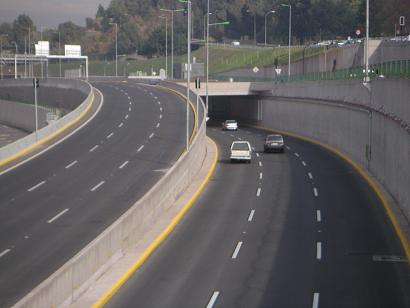
There never seems to be any traffic on the Costanera and its form has at least three lanes wide in each direction. This accomplished its function of bypassing the city so well that its hard to believe how quickly you can go underneath the congestion of people, cars and buses on the streets above.
+ Landscaping above
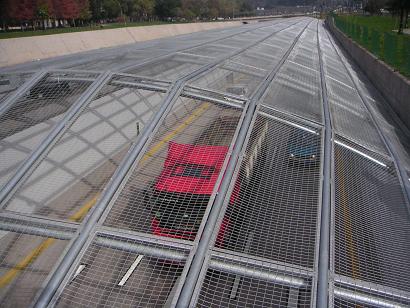
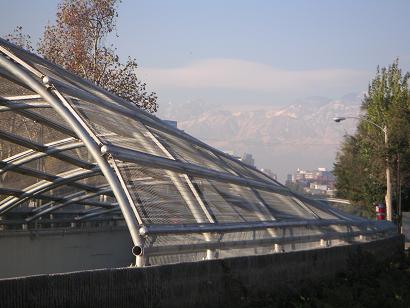
The landscaping above is not finished yet, but I like the way the builders try to integrate the Costanera into the landscape of the parks on the north side of the Mapocho to fulfill the function of beauty in a sort of urban sculpture. This is accomplished in the form of semi-covered “skylights” that run along the side of the river and let drivers look up and see the sky above while pedestrians in the park can look down onto the cars rushing by. This integration of the fast moving traffic fulfills the symbolic function by creating a living urban sculpture that represents the future and the increasing flow of information and goods across Chile and the globe.
Δ Protests by workers shuts it down
It bothered me that a the Costanera del Norte could not be built without having to deprive people of their livelihood. The workers that drag sand out of the Mapocho river were involved in a protest that blocked the highway because it prevents them from reaching the river to work. This behavior is also related to the function of symbolism as these people disagree with the intended symbolism of the project and find it a rather more negative symbol of oppression.
Δ Driver goes down the wrong lane and crashes.
I was also uncomfortable with the fact that this brand new piece of urban infrastructure has already been tarnished with tragedy. Even the form of separate tunnels for the opposing directions of traffic didn’t prevent this accident. This behavior also undermines the symbolism of a greater future by adding a sense of danger and fear.
+ Overlooks river
The Costanera del Norte overlooks and runs parallel to the Mapocho river. I really liked this since it brings out the symbolism of the costanera as a new flow of future through the city just like the Mapocho is a historical flow through the city. Although this parallel flow is striking and meaningful, it doesn’t quite fulfill the function of beauty since it’s quite impossible to describe the Mapocho as beautiful.
+ Urban Sculpture
The
positive behavior of the Costanera del Norte as a piece of urban sculpture is
intimately related to its function of symbolism. This is physically manifest in
its semi-covered form that protrudes from the ground.
Δ Construction still ongoing
The ongoing construction and landscaping going on above the costanera next to the Mapocho makes walking along it a rather unpleasant experience. This behavior is related to the function of making money because the remaining construction is purely for decoration and doesn’t actually add to profit making value of the project.
+ Doesn’t smell like exhaust
As a pleasant surprise, the tunnel doesn’t smell of exhaust even with the windows open. This is due to the forms of ventilation fans and semi-covered tunnels. These forms fulfill the function of showing off the technological prowess of the Chilean engineers.
Δ Transition between tunnel and outside are hard on the eyes
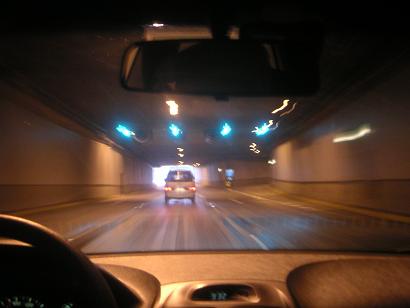
It is very hard to see during the inside to outside transitions on the costanera. This is due to the form of very dim lighting inside the tunnels. This is linked once again to the function of the project to make money. Most likely, allowing eyes to adjust to the low tunnel light rather than having it brightly lit can conserve power.
+ Peaceful rides to the airport
The Costanera del Norte provides
for a very peaceful ride to the airport with very little hassle or stress. This
is due to forms of multiple lanes and underground tunnels, which ease the flow
of traffic. This behavior also fulfills the functions of political image and
showing progress by making Santiago seem like a more modern city.
All over Santiago, we see the many faces of the patriomonio construido of Chile. In the very center of the city, the Plaza de Armas is a historical face that shows the Spanish colonial history of Chile At the corner of the plaza, the Cathedral presents another face of the patrimonion construido. La Moneda palace and the Congreso Nacional show a historical face of this patrimonio with their neoclassical design and symbolism of the republic. As we move away from the city center, the modern face of Providencia provides a strong contrast. Connecting the east and west sides of the city, the brand new Costanera del Norte also presents a modern and forward looking face of Santiago. Alongside the Mapocho River, the costanera rises out and descends into the ground like some sort of giant concrete and steel worm. The inside of the costanera is a rapidly moving stream of cars and trucks that gives a very strong sense of speed and progress in contrast to the gridlock in the city above.
The design of the Costanera del Norte gives insight into the modern identity of the Chileans who built it. The highway is an engineering feat that passes under the Mapocho River and the center of Santiago. The engineering was accomplished by Chileans and they show their pride in possessing advanced infrastructure like the costanera. The implementation of the costanera as a toll road also shows the capitalist identity of its builders. The highway was built with private funds and will be paid for by its users through the tolls. The identity of the users is also apparent from the path of the costanera, which transports drivers quickly from the rich eastern parts of Santiago to the international airport and ocean in the west. These rich users pass underneath the city and can leave the country or go to their beach homes without having to interface with the rest of Santiago at all, revealing their identity as the dominant and exclusive sector of society.
The view of the Costanera del Norte illuminates the growing problem of rapid development in Chile. The costanera was an expensive but necessary measure that was desperately needed to provide a means of rapid transportation through a city with a severe lack of modern urban planning. There is only one ring road to the city, Amerigo Vespucci, and otherwise there are no easy means of moving from disparate parts without going through the traffic clogged city center. This lack of urban planning is due to a strong centralized political system that is at the same time ineffective in moving forward. There is a very strong free market sentiment in this political system and most development and planning is left to the private sector, which does not necessarily have the public interest in mind. The Costanera del Norte was privately financed and built with the intention of its users paying tolls to recover the investment of the builders. It also highlights the economic inequality that permeates Chilean society. While it may be an engineering accomplishment, it is only used by a very small sector of Chileans who have cars and can afford the tolls.
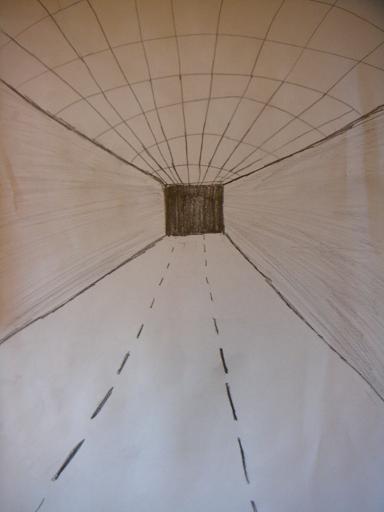
This sketch is a view from the inside of the semi-covered tunnel of the Costanera del Norte that runs parallel to the Mapocho river. Inside this section, one can see the tall buildings illuminated in the sunlight through the open top. This has the effect of hiding the shorter and older buildings and making Santiago seem like a city of the future. The whole project evokes the idea of a power cord filled with the energy of commerce and information running through Santiago that is plugged into the outside world at the airport. This flows through the city and eventually ends in the wealthy eastern neighborhoods, which are the center of economic power in Santiago.
On my way into Santiago for the first time, I took a taxi from the airport to Las Condes. The driver’s route went all the way up and down a small mountain, around the city to the north and finally down to Las Condes. This took nearly an hour reach my new Chilean home. Only a month later, I took a taxi from my home to the airport for our Bing trip to La Serena. From Las Condes we immediately got onto the Costanera del Norte and down into a canyon through Providencia. Looking up to either side I could see the tall buildings through the open roof. Eventually we entered the main tunnel and after a seemingly endless time underground we reappeared on the other side of the city and very quickly arrived at the airport. As I looked down at my watch, I was amazed to see that it had only been half an hour since we had left my house.
9. Architectural critic review
Along the Mapocho river in Providencia, parts of the Costanera del Norte are exposed to outside view through a series of semi-covered tunnels. These parts of the costanera are covered with a curved ceiling grid of metal that gives the impression of a glass roof. The sunlight flows into the tunnel providing a contrast with the darkness ahead and behind. From the inside, the drivers can only see the tall and modern buildings of Santiago, giving the impression of a futuristic city. From the outside, pedestrians walking along the river can see down into the tunnel and see the fast moving cars whizzing past. These parts of the tunnel seem like segments of a giant power cord that is barely breaking the surface. This image evokes the idea of the energy of information and commerce flowing through the city and providing it energy to grow. The fact that the viewer is only given glimpses emphasizes the enormity but subtlety of this flow. The tunnel also runs under and parallel to the Mapocho, as if the old and new flows of energy are intertwined. In this seemingly utilitarian highway and tunnel, the designers of the Costanera del Norte have created a symbol for the energy of the future flowing into the city of Santiago and electrifying it with its presence.
10. Summarize changes of Brand’s Seven Ss
Surroundings – Since the Costanera is brand new, its surroundings haven’t changed since it was built. However, new buildings are going up all the time in Providencia.
Site - The site of the Costanera del Norte seems fixed for a long way into the future, at least until its not useful or profitable anymore.
Setting – The setting along the Mapocho is interesting in its contrasts. The view changes with the seasons as the river fills and empties.
Structure – The metal grids were added to the original design to prevent vehicles from accidentally falling onto the costanera from above.
Services – There are huge fans for the circulation of air through the tunnel. They are brand new but will eventually be replaced with better ones that could be more efficient.
Skin – The skin of the costanera is changing because there is still landscaping occurring on top of it.
Space plan – The space plan of the costanera is fixed in solid concrete and it would be very hard to change any of the lane patterns.
Stuff – There usually isn’t much stuff on the costanera as it would block traffic, but there are sometimes temporary signs and road accessories. Also, river workers used their bodies to block off the costanera to protest their lack of access.
11. Theoretical Interpretation – Rybczynski: City
The Costanera del Norte represents a break in the tradition Spanish Colonial layout of Santiago. The center of Sanitago is full of straight streets intersecting in a grid that was laid out by Spanish law in the 16th century. This pattern still remains in the downtown area of Santiago even if none of the Spanish colonial buildings remain. The Costanera del Norte is a break with this tradition in that it adheres more to the American idea of a city where each generation adds its own unique parts. It is a very distinctive addition to the city built by the modern entrepreneurial class. Its winding and non-linear nature presents a contradiction with the traditional rigidity. However, from the traffic that clogs the center of the city, we see that in the age of the car, the traditional Spanish pattern is no longer properly functional.
12. Theoretical interpretation – Flessig: Smart Growth
The Costanera del Norte in itself is not necessarily a failure in smart growth, but its existence suggests a lack of effective urban planning. The reason that the costanera needs to exists is because Santiago has begun to take on the suburban sprawl development model of the United States. This means that people the people who live on the outskirts of town to the east must drive into town in order to go to work because they live in a purely residential area. Thus projects like the Costanera del Norte are necessitated because the crush of people trying to get into the center of the city creates traffic jams. The costanera discourages the creation of mixed used communities because it reinforces the car culture and allows smart development to be avoided.
13. Theoretical Interpretation – Alexander: Pattern Language
New Patterns
Underground highway
-This pattern of the underground highway is useful in designing efficient high-speed transport through the center of old cities that have no room for above ground construction. The older center of the city is thus linked to the highway network that has grown up on the outskirts. The Costanera del Norte fulfills this pattern but
Urban Sculpture
-The pattern of urban sculpture is when a utilitarian piece of infrastructure is turned into a piece of symbolic art by careful consideration of its design and placement.
The Costanera del Norte fulfills this pattern along the Mapocho river by breaking through the surface with skylights and diving under again as if it were a giant worm.
Alexander Patterns
Ring road
-This pattern is present in the Costanera del Norte because it connects disparate parts of the city in a way that avoids destruction of communities. The underground nature allows it to fulfill this pattern despite its constant traffic and high-speed nature.
Road Crossing
-This pattern is present in the Costanera del Norte because in the city it is only exposed in a few sections. This allows pedestrians to cross over the highway in most places. However, since it is a highways, if they are near one of the exposed sections, it may be a longer walk to a crossing than with a regular road.
Zen View
-This pattern is present in the Costanera del Norte because the ceiling of the tunnel is only open to the light at certain parts to allow the driver to get a view of the city above. However, the driver is always moving and will only get glimpses of the view. This fits with the transitional nature of the zen view.
Common Land
-This pattern is present in the gardens along the river that are placed right on top of the Costanera del Norte. The common land allows the sharing of space between the drivers who use the tunnel underground and people who can use the space above for recreation.
Absent Patterns
Access to water
-This pattern is absent in the Costanera del Norte because it blocks the access to the riverside at the parts where it is above ground. This led to protests from river workers that blocked the highway temporarily.
Promenade
-This pattern is not quite present in the park above the Costanera del Norte. Although there are with paths along the river, it is on the opposite side from most activity and there are no points of attraction along these paths.
14.
Grounded Theory – Field Notes
First Round of Interviews
Walter
-Has never used it before
-Its expensive
-It was built with private money
-People speed a lot in the tunnels
-Its controversial because its only accesses the rich part of town
Taxi Driver
-Uses it all the time
-Its extremely convenient
-Its expensive, but then again, he doesn’t have to pay for it
Chilean Student
-It works very well once you’re on it
-Access is limited and often it is hard to get on
-There’s the disconcerting feeling of not being able to see the city above you
Coding
-Effectiveness
-Access Issues
Memos
I seemed to miss out on the symbolic nature of the Costanera del Norte during these interviews as I hadn’t yet gotten enough of physical perspective of it to see any symbolism myself. I think I’ve got a lot more interesting ideas and questions for future interviews after visiting the central part today and I’d like to interview the Director at the beginning of next week to get his opinion. Here’s some new questions I want to ask.
*Have you ever WALKED along the Costanera del Norte near the river?
*If you did, how did you feel? (positive or negative?)
*What does the Costanera del Norte symbolize to you?
Second Round of Interviews
Chilean Engineering Students
-Political image was important in the construction
-People wanted to show off Chile’s development
-There are access problems with the on and off ramps since these are the only places with traffic on the costanera
-There is a conflict between old and new styles, especially where the costanera is above ground
-It is only actually useful for the rich to get to work and go to the beach and airport
-The symbolic nature affects many more people though.
Professor Fuenzalida
|
-Only time he’s actually used it was by accident because of bad signage
-The traffic moves very fast
-The grid on the open parts is to prevent cars from falling in and causing accidents
-It was a good thing that the road was built with private funds
-He has no problem with the costanera, but the problems is with the automobile based development model. However, the path is already taken and in this sense the costanera helps alleviate the problems.
-Symbolizes the entrepreneurial elite who sees it at no more than something they pay for and receive a service in return. This symbolism is also apparent in the costanera’s connection of the east of
Santiago with the airport and the coastal resorts.
Coding
-Image
-Elites
-Development
Memos
The first round of interviews really helped my get a better idea of what questions to ask. This made the second round of interviews much more effective
and let me learn more about what I really wanted to know in relation to the more symbolic nature of the Costanera del Norte.