Kevin Boldt
Prof Kunz
CEE33X
2 June 2005
Edificio Carrera
Future Home of the Ministry of Foreign
Relations
1.
Photos of three views of your class project, ideally a view of the largest
segment of the project that you can visualize, a view of an interior space and
a view of an internal or external detail that is symbolically or functionally
significant.
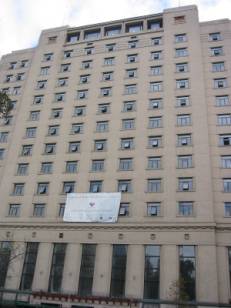
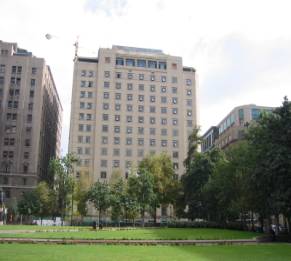
Picture’s Caption: El Edificio Jose Carrera is located in the heart of modern Santiago, surrounded by Palacio de La Moneda, numerous other government buildings, and Plaza de la Constitucion. Not only do the surroundings have symbolic importance, but the actual edifice has symbolic significance. Built in 1935 by architects Smith Solar and Smith Miller, El Edificio Carrera housed the luxurious Hotel Carrera almost 70 years. Numerous presidents and prime ministers have stayed in the hotel on state visits. However, with the purchase of the building by the Ministry of Foreign Relations, El Edificio Jose Carrera will soon become the new home of the ministry.
Sketch of some aspect of your
project. Please add a brief (about 100 word) caption that comments on the name,
features, historical and personal significance of the content of the sketch. As
appropriate, make the caption of your sketch more personal than that of your
photos.
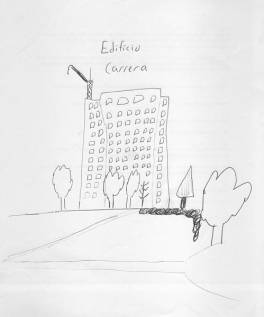
Sketch’s Caption: Located in the heart of modern Santiago, El Edificio Jose Carrera is surrounded by Palacio de La Moneda, numerous other government buildings, and Plaza de la Constitucion. . Built in 1935 by architects Smith Solar and Smith Miller, El Edificio Carrera housed Hotel Carrera almost 70 years. Numerous presidents and prime ministers have stayed in the hotel on state visits. With the purchase of the building by the Ministry of Foreign Relations, El Edificio Jose Carrera will soon become the new home of the ministry. While heads of states will continue to be entertained in El Edificio Carrera, the interior will undergo numerous changes to meet the needs of the Ministry of Foreign Relations.
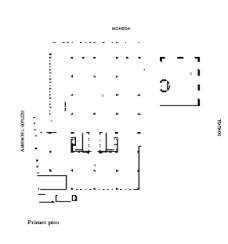
Primer
piso del Edificio Carrera
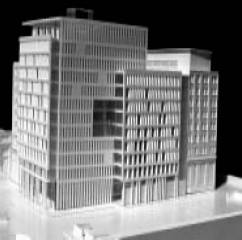
Side view
Immigration/ consular affairs Auditorium Entrance Entrance



2. Formal
symbolic model of at least five functions, forms and behaviors
visible in each view. Using comments and arrows as appropriate, add
brief description of meaningful relationships you find among functions, related
forms and related behaviors. Add a legend that defines the semantic meaning of
any arrows you use in your diagram.
Formal Symbolic
Model
|
Function |
Form |
Behavior |
|
|
|
Workplace for
Ministry of For. Rels. |
|
|
Simple design |
Visited by diplomats and head of states |
|
|
|
Atmosphere very business like |
|
Accessibility |
|
Well-maintained and accessible |
|
Grand |
Large doors |
High Security |
|
|
|
Receives high
volume of visitor |
|
|
|
Lots of foot and automotive traffic |
|
|
Building’s depth |
Though busy,
still can find quiet spots |
|
Hold Ministry of Foreign Relations |
Immigration/Consular affairs on first floor |
Blends in with neighboring buildings |
|
Hold large
events |
|
Historic and Modern Feel |
|
|
|
Hard to regulate temperature |
|
|
Lots of windows |
Easy to visit nearby ministries |
|
Hold library |
Large |
Tall and intimidating from street |
|
Accommodating to visitors |
Different levels of building |
Speakers common |
|
Blend in nearby buildings |
Hall |
View of city from office |



















|
Front of
Building
1st Floor Plan Side view |


3 Briefly
comment about:
o
Face(s) of the
patrimonio construido de Santiago
o
Identity of the Chilean
designers and the project users that the views show
El Patrimonio arquitectónico:
Edificio Carrera, originally designed in 1935 by American architect Solar Smith, provides both a historic and civic face to Santiago, Chile. In the historical sense, the building, which housed Hotel Carrera for almost 70 years, was one of the grand public works projects during the Great Depression under the government of Carlos Ibanez. Its placement in front of Palacio de la Moneda demonstrates the historically importance of the structure, and the relocation of the Ministry of Foreign Relations to Edificio Carrera not only reaffirms the building’s current importance but also the ministry’s importance in modern day Chile.
The Identity:
The renovation project on Edificio Carrera not only shows the complex needs of the Ministry of Foreign Relations (ballrooms, library, etc.), but it also shows how Chileans attempt to maintain historic buildings for modern purposes. In terms of the Ministry of Foreign Relations, their needs show the complex art of diplomacy; furthermore the size of the project shows how large the ministry has grown in the Republic of Chile’s 200 years of existence. In a city that has pushed forward more often than stepping back and embracing its history, it is intriguing that the government decided to maintain and restore a building from 1935 instead of building a brand new building for the ministry.
Comment on cultural, economic, global issues, political science, psychology and sociology issues that the views suggest to you, ideally with references to theoretical literature.
How it fits in to Chile:
The relocation of Chile’s Ministry of Foreign Relations to Plaza de la Constitucion demonstrates the ministry’s growth in actual size and significance in modern Chile. The ministry has played a vital role in negotiating free trade agreements with the United States, European Union, Korea, and works today for the free trade agreements of tomorrow. Furthermore, the recent election of Jose Insulza as Secretary General of the Organization of American States highlights the ministry’s ability to maneuver through complicated diplomacy. The Ministry will continue to play an important role as Chile becomes more integrated globally in both economics and politics.
Summarize things you liked and did
not like (Plus/Delta) about behaviors you see in your three views. Comment
explicitly on relationships to functions, forms and behaviors.
Behaviors
observed:
Plus: Very busy (businesslike) atmosphere at Edificio Carrera (caused from central location)
Plus: Ministry/government officials can more easily work with each other due to proximity (surrounded by numerous other government buildings)
Delta: Very government oriented business. No one relaxing (caused from concentration of governmentt buildings and lack of other types of buildings).
Delta: At night, area feels deserted, as all government buildings are closed.
Delta: Taking away Hotel Carrera leaves downtown area without a 5-star hotel (creates lack of non-government business activity).
Architectural critic review, in the manner of one we read, i.e., use about 500 words and 1-2 photos to summarize your project or another in Santiago that you admire. Acknowledge the limits of the project that you find, but identify its strengths. Include provocative commentary.
The recent election of Jose Miguel Insulza as Secretary General of the Organization of American States (OAS) demonstrates the rising stardom of Chile in the international arena. However, looking around Santiago, it has been hard to sense the importance of the Ministry of Foreign Relations. Recently, the ministry has not even had an adequate building to house all of its employees; instead it finds itself spread around Santiago. Its current home, ex-Congreso Nacional, is a symbol of Chile’s Republic, but it is too small for the ministry’s employees and is blocks away from the other buildings of the executive branch.
Fortunately, the purchase of Hotel Carrera, located in Plaza de la Constitucion, is a step in the right direction for recognizing the Ministry of Foreign Relations’ momentous role in modern Chile. The renovation of Edificio Carrera by architect Rodrigo de la Cruz is not only challenging due to the infrastructure of the 70 year old building, but also due to the ministry’s unique requirements, such as a dance hall and library. In July of this year, the Ministry of Foreign Relations will move into its new home.
The relocation of the Ministry of Foreign Relations back to Plaza de la Constitucion (the ministry had previous been located in the southern side of Palacio de la Moneda) from the former Congreso Nacional seems to be a logical choice. Not only will Edificio Carrera allow the whole ministry to be housed in the same building, but also it brings the ministry closer to the axis of government buildings, Palacio de la Moneda.
Furthermore, the placement of the Ministry of Foreign Relations has dual symbolic meaning, due to the structure and surroundings. Palacio de la Moneda has served as the President of Chile’s office and in the past also as his residence. Additionally, Hotel Carrera, designed by architects Smith Solar and Smith Miller, had served as one of Santiago’s premier hotels for much of the 20st Century and was a mark of the modernist movement.
The renovation of Edificio Carrera provides an opportunity to revitalize a business focused downtown. The arrival of thousands of new workers to an already busy part of town could produce jobs for even more Chileans. Plaza de la Constitucion currently lacks shops and restaurants, and planners should take advantage of this opportunity to create a vibrant life in downtown Santiago.
Personal vignette: describe an experience you had in or related to your project that was personally meaningful and describe how that experience made the visit memorable for you.
Personal Vignette:
On one Wednesday afternoon Director’s Seminar session with Professor Fuenzalida, we toured the former Congreso Nacional, which now serves as the Ministry of Foreign Relations. As an International Relations major, I found it interesting by both the past domestic politics and current foreign policy that have been going on the in that building. After an intriguing tour of the former capitol building, we headed off towards Palacio de la Moneda. Besides my innate interest in the President office, I was further interested in Plaza de la Constitucion when Professor Fuenzalida pointed out the future building of Ministry of Foreign Relations. Actually, I was surprised by the change of the ministry from such a dignified building to this more modern building. At that point I knew I had to learn more about the building Edificio Carrera.
Theoretical
Interpretation
Israel and Brand:
Since I grew up in small town, GA, I did not see many tall buildings around. However, I do remember many trips to Atlanta, where we would see numerous large skyscrapers. For me, going to Atlanta meant activity (Braves game, concert, special dinner, etc.), and so I began to attribute these large buildings to activity. Furthermore, I have always been interested by politics. Whether it was meeting the mayor, traveling to the State Capitol, or touring D.C., I have always been intrigued by the politics. Therefore, as I stand in front of Edificio Carrera it is both the actual structure of the building and the surroundings that I find so intriguing.
Summarize changes you can identify in
the amended list of Brand Ss for your project, i.e., Surroundings, Site,
Setting, Structure, Services, Skin, Space plan and Stuff.
Brand:
Surroundings: Located in the heart of Santiago and surrounded by numerous government buildings, including the Palacio de la Moneda. NO CHANGE
Site: At the corner to two main streets, making the building easily accessible. NO CHANGE
Setting:
Structure: Well maintained building that has been standing for 70 years. No change?
Services: Heating, air conditioning, water, electricity, internet, etc. UPDATED
Skin: New paint on the inside. NEW
Space plan: Changing from numerous hotel rooms to offices plus a library and ballroom CHANGED
Stuff: Computers, passports, pens, flags, etc. ALWAYS CHANGING!
Theoretical Interpretation of
the site for your project based on your interpretations of the perspective of
Rybczynski in the Home or City readings.
Rybczynski:
Santiago presents a more complex picture that Rybczynski describes in his chapter on city life. In Santiago de Chile, both European and American trends are found. On one hand, the city was designed by its Spanish founder, Pedro de Valdivia. He laid out the development of the city in 1541, when he first came to the city. Due to the Law of the Indies, the layout of the city followed the same pattern of the majority of cities in the Spanish Empire. Therefore Santiago maintains, even today, a central large public space – Plaza de Armas.
Furthermore, the area around Plaza de la Constitucion also seems European in many ways. While Rybczynski argues that many cities in the New World go from decade to decade changing their style, this area of Santiago has remained the same for around 70 years. While the occupants have changed and led to a centralization of government ministries, the actual building structures and styles have remained unchanged.
On the other hand, Rybczynski’s theory on the “suburbanization” of New World cities can been seen in Santiago. The downtown is no longer as vibrant, and over the last few years, more people have moved to the suburbs of Las Condes and Maipo.
Theoretical interpretation from the perspective of Flessig: how well does the project support Smart Growth?
Flessig Interpretation:
8. In many ways, the Hotel Carrera follows Flessig’s Smart Growth plan. In the ways that my project does follow the Smart Growth plan, I believe this is mainly due to its location in the historic center of town, in an area that has been occupied by numerous government buildings for decades.
On the other hand, the same location that gives the project many of its strengths also hinders the project’s flexibility and therefore ability to follow the Smart Growth plan. Several of the Chileans I talked to mentioned this disadvantage as one of their main reasons for opposing the project.
Measures followed excellently:
- - distance to road, water, and sewer services
- - walking distance to transit
- - Near food, entertainment
- - Street network is based on grid system
Measures not followed:
- - Parking lot?
- - Mixed-use
Theoretical Interpretation based on your interpretations of a
Pattern language that you create to describe your project. Include at
least five patterns of Alexander that we discussed in class up to now. Describe
and include at least two additional patterns that you find relevant that
Alexander does not mention. Annotate one or more photos of your project and
identify the relevant feature of each pattern. For any negative examples of
patterns, briefly comment on why you think that your pattern could or should
have applied.
Alexander’s Patterns:
Patterns Followed:
Pattern 61 (Small public squares):
- Though the pattern does not relate to the actual building, the public square (Plaza de la Constitucion) is still an important asset for Edificio Carrera and draws many people to the area.
Pattern 30: (Activity nodes):
- Government officials are concentrated together by the placement of their buildings. This creates lots of activity and exchanging of ideas.
Pattern 60 (Accessible green):
- Less than 30 feet from the front door of Edificio Carrera lies Plaza de la Constitucion.
Pattern 110 (Main Entrance):
- The main entrance of Edificio Carrera is on a main street in the center of downtown Santiago. The entrance will be easy for any diplomat or head of state to find.
Patterns not followed:
Pattern 95 (Building complex):
- Alexander argues that humans need a complex of smaller buildings that have their own social facts. Unfortunately, developers have not developed this concept around Plaza de la Constitucion. There remains a lack of shops and restaurants.
My Patterns:
KB Pattern 1 (Symbols should stick out):
- Buildings and places of symbolic national importance should attract the attention of visitors.
- If people can walk by without noticing significant national symbols, then these landmarks have failed.
KB Pattern 2 (Urban parks):
- Public green spaces should not bow down to buildings around them.
- People need green spaces for relaxation, especially if they work in large office buildings.
KB Pattern 3 (Placement of Govt Buildings):
- While the proximity of govt buildings is essential for an efficient govt, the buildings should not be so close that they exclude other establishments (like restaurants, shops, etc.) and create a “government zone.”
- Shops, restaurants, quiosks, etc. are important for visitors, tourists, and public servants.
Grounded Theory field
notes (transcript, coding and memos) that summarize interviews of 4 Chileans
with whom you discussed your photos and comments on your project
Grounded Theory
Transcript:
- Professor Umberto (Univ. de Chile and professional arichitect)
o Dislikes project
o Govt had design for new building for ministry
o Downtown loses 5-star hotel
o Not enough parking
o Destroys architectural landmark by American Solar Smith
o Controversy over how Carrera was selected
- Chilean student #1
o Unsure of effect on plaza
o Centralization of governmentt buildings interesting
- Chilean student #2
o Hadn’t heard of building before
o Knows the area
o Doesn’t think building will change area much
- Professor Fuenzalida
o Yes, Ministry of Foreign Relations needs new home.
o Process done in questionable manner
o Building and surroundings have symbolic importance
o Remembers when ministry was located in La Moneda
Coding:
- Older generation had stronger opinion over relocation of ministry to Carrera
- Possible connection between political activity and awareness and having opinion of Carrera
Memos:
- Dialogue with Professor Umberto and Chilean student was done after a short presentation on the project.
- Easy to get opinions of professors, while the students had less to say.