Modernity in
the Built Environment of Santiago
"Less is more only when more is too much” – Frank
Lloyd Wright (1867-1959)
Modern architecture and
beyond – defined
What is and is not modern tends to be formidably subjective. One’s classification
of modern depends on varying criteria such as time frame, function, form, and
behavior. Therefore, what does “modernity in the built environment of Santiago”
mean…exactly? To start, Wikipedia describes modern architecture as:
…first
appearing in the beginning of the 20th century, that rejected
historic precedent as a source of architectural inspiration and considered
function as the prime generator of form, employing materials and technology
directly, rather than softening with ornament or façade.
* * *
Some
historians see the evolution of modern architecture as closely tied to the
Project of Modernity and hence to the Enlightenment, the social and political
revolutions, general progress of mankind, and so on. Here the origin is placed
much earlier…
* * *
Others
see technological and engineering developments as key to the rise of Modern
architecture. Hence the usage of new materials such as iron, steel, concrete
and glass is ascribed as important place…
* * *
Some historians see the rise of
Modern architecture as a reaction to the Eclectism and what they see as the
poor taste of the Victorian Era fuelled by the possibilities of the Industrial
Revolution.
 The most influential school for modern
architecture was The Bauhaus architectural school in Germany, founded in 1919.
(Wik) It was not until the rise of the Nazi’s that leaders of Bauhaus and the
idea of modern architecture itself moved to the United States. (Wik) At this
point modern architecture can be seen as sprouting in two directions,
international style architecture and postmodern architecture.
The most influential school for modern
architecture was The Bauhaus architectural school in Germany, founded in 1919.
(Wik) It was not until the rise of the Nazi’s that leaders of Bauhaus and the
idea of modern architecture itself moved to the United States. (Wik) At this
point modern architecture can be seen as sprouting in two directions,
international style architecture and postmodern architecture.
 International
style architecture prospered around the 1920’s and 1930’s and is considered a
“primarily American offshoot of Bauhaus architecture” and also the “most minimal
form of modernism.” (Wik) More specifically, international style can be
characterized as the design of simple, unornamented buildings usually
constructed in glass for the facade, steel for exterior support, and concrete
for the floors and interior supports. (Wik) A classic example is the Seagram
building, a skyscraper, in New York City. It was built in 1958 as a 38-story
“icon of corporate International Modernism.”
International
style architecture prospered around the 1920’s and 1930’s and is considered a
“primarily American offshoot of Bauhaus architecture” and also the “most minimal
form of modernism.” (Wik) More specifically, international style can be
characterized as the design of simple, unornamented buildings usually
constructed in glass for the facade, steel for exterior support, and concrete
for the floors and interior supports. (Wik) A classic example is the Seagram
building, a skyscraper, in New York City. It was built in 1958 as a 38-story
“icon of corporate International Modernism.”
Finally, it was around the
1960’s that criticisms of modern architecture bloomed on the basis that it was
“universal, sterile, elitist, and lacked meaning.” (Wik) Postmodernity is seen
as a response to the formalism of the international style of modernism and
manifests itself by “replacing unapologetically diverse aesthetics; styles
collide, form is adopted for its own sake, and new ways of viewing familiar
styles and space abound.” (Wik) A classic example of postmodern architecture
can be seen in the Sony Building where it has modernist architecture
characteristics (i.e. skyscraper with steel beam and many windows) as well as
postmodern characteristics such as its “Chippendale style” and neo-eclecticism.
In conclusion, modernist
architects see postmodernism as “vulgar and loaded with ‘gee-gaws’” whereas
post modernist architects see modern architecture as “soulless and bland.”
(Wik) Modernism is rooted more in the amount of material and cost of a
structure whereas post-modernism “seeks exuberance in the use of building
techniques, angles, references.” (Wik)
So what does all this have
to do with Santiago?
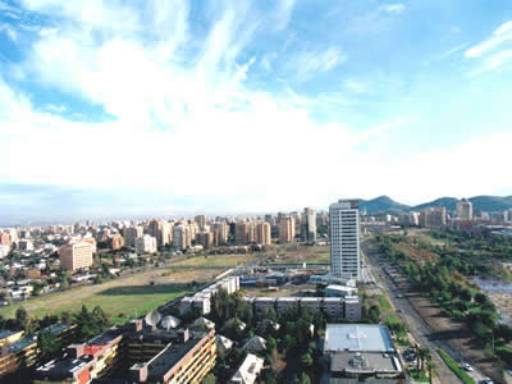
In the heart of Santiago,
namely in Providencia and Las Condes, one finds modern architecture,
international style architecture and postmodern architecture. For purposes of
this project, I will not focus on the postmodern aspect of Santiago as much as
the divergence and convergence of modern and international style architecture.
It seems to me that international style architecture, or what I like to call
pre-postmodern (in the theological sense), represents all the ideals of
postmodernism while still marching under the banner of modern architecture.
That is to say that international style architecture’s function represents more
than employing materials and technology directly. In a subtle way,
international style architecture actually represents the ideals of
postmodernism, namely by having unapologetically diverse aesthetics (subtly),
space abound, and form being adopted for its own sake. However, the difference
between  international style
  architecture and postmodern architecture is
that it keeps to the modern ideals just enough to declare that its main
objective is still minimalism, when in fact its not. Specific to Santiago, this
confusion of modern and postmodern can be seen in Edificio
Huidobro and Torre Telefónica.
Both are self-declared buildings of modern architecture, when in reality they
are more like budding postmodern works. In Edificio Huidobro, instead of having
the usual glass facade it has vertical and horizontal banding on one side that
emphasizes its height and cartoonizes its face. In addition, it has brilliant
fountains at both the front and back entrances. Needless to say, Edificio
Huidobro cannot be described as portraying minimalist virtues, it’s more than
just a box. Similarly, Torre Telefónica has all the aspects of a modern
building, except that it is in the shape of a cell phone, need I say more.
Another example is the Costanera
del Norte highway in Santiago that was just finished in April of
2005. The highway’s form seems to serve the basic function of transport until
architecture and postmodern architecture is
that it keeps to the modern ideals just enough to declare that its main
objective is still minimalism, when in fact its not. Specific to Santiago, this
confusion of modern and postmodern can be seen in Edificio
Huidobro and Torre Telefónica.
Both are self-declared buildings of modern architecture, when in reality they
are more like budding postmodern works. In Edificio Huidobro, instead of having
the usual glass facade it has vertical and horizontal banding on one side that
emphasizes its height and cartoonizes its face. In addition, it has brilliant
fountains at both the front and back entrances. Needless to say, Edificio
Huidobro cannot be described as portraying minimalist virtues, it’s more than
just a box. Similarly, Torre Telefónica has all the aspects of a modern
building, except that it is in the shape of a cell phone, need I say more.
Another example is the Costanera
del Norte highway in Santiago that was just finished in April of
2005. The highway’s form seems to serve the basic function of transport until 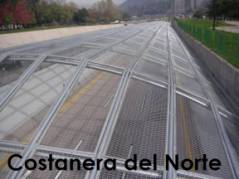 one continues into the underground section.
From inside the tunnel you can see the tall buildings above through the
half-open top. Stanford student Aaron Ligon describes this “semi-covered
tunnel” as a “power cord filled with the energy of commerce and information
running through Santiago that is plugged into the outside world at the
airport.”
one continues into the underground section.
From inside the tunnel you can see the tall buildings above through the
half-open top. Stanford student Aaron Ligon describes this “semi-covered
tunnel” as a “power cord filled with the energy of commerce and information
running through Santiago that is plugged into the outside world at the
airport.”
Whether one refers to this hybrid architectural style as international,
pre-postmodern or simply just part of Santiago’s gray area, one finds many
buildings that fall into this category.
Why?
Behind every form there is
a function, an intent, a reason. The genius of international style architecture
is that it keeps the seriousness of modernism while still being able to play
with the beauty of postmodernism. By the 1960’s everyone was “bored with the
box.” International style alleviates this boredom but also remains true to its
ideals of corporatism, capitalism, wealth, power and success.
(by Jenilee
Deal)