How did cooperation emerge?

Jared Moore and David Gottlieb

How can group benefit change the benefit for an individual?

Our aim: Develop an intuitive sense of cooperative and evolutionary game theory.

Divide the grade point

  • We will break half of you up into pairs.
  • The other half will also be paired, but anonymously.
  1. You are dividing up one grade (extra credit) point with another player.
  2. Each of you must place a decimal demand between 0 and 1 inclusive.
  3. You will get as many points as you bet so long as (your bet + their bet) <= 1.
    • Otherwise you get no points.
  4. We will go around the class collecting your bets and administering the points.
    • For those of you with partners, your partner will learn what bet you placed.

Why so nice?

Evolutionary game theory tries to provide the math to explain why we are nice to each other.

Evolution

Natural Selection

If […] organic beings vary at all in the several parts of their organisation, and I think this cannot be disputed; if there be, owing to the high geometrical powers of increase of each species, at some age, season, or year, a severe struggle for life, and this certainly cannot be disputed; then, considering the infinite complexity of the relations of all organic beings to each other and to their conditions of existence, causing an infinite diversity in structure, constitution, and habits, to be advantageous to them, I think it would be a most extraordinary fact if no variation ever had occurred useful to each being’s own welfare, in the same way as so many variations have occurred useful to man. But if variations useful to any organic being do occur, assuredly individuals thus characterised will have the best chance of being preserved in the struggle for life; and from the strong principle of inheritance they will tend to produce offspring similarly characterised. This principle of preservation, I have called, for the sake of brevity, Natural Selection. (Darwin 1859)

Nutshell

  1. variation

  2. differential fitness

  3. inheritance

Genetic Evolution

A diagram of Darwin’s finches’ beaks

Cultural Evolution

An image of two people in a skin kayak
  • What’s another example of something that could or has evolved culturally?

Game theory

Driving game

You wake up in a deserted (viz. lacking signs) landscape in a foreign country in the driver’s seat of a motorcycle. You are thirsty and decide to drive to find a source of water.

Which side of the road do you drive on?

Driving game

You live in a world where everone

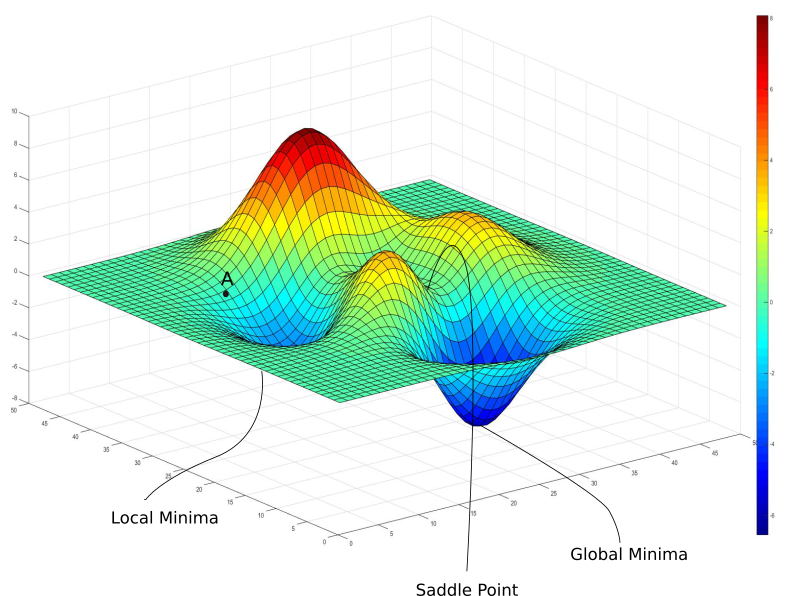
Equilibria qua minima

An example of a local and global minimum meant to explain equilibria

What are the equilibria?

cooperate defect
cooperate 2 0
defect 3 1

What are the equilibria?

cooperate defect
cooperate 4 0
defect 3 1

Haystack

cooperate defect
cooperate 2 0
defect 3 1

Founders Activity

cooperate defect
cooperate 4 0
defect 3 1

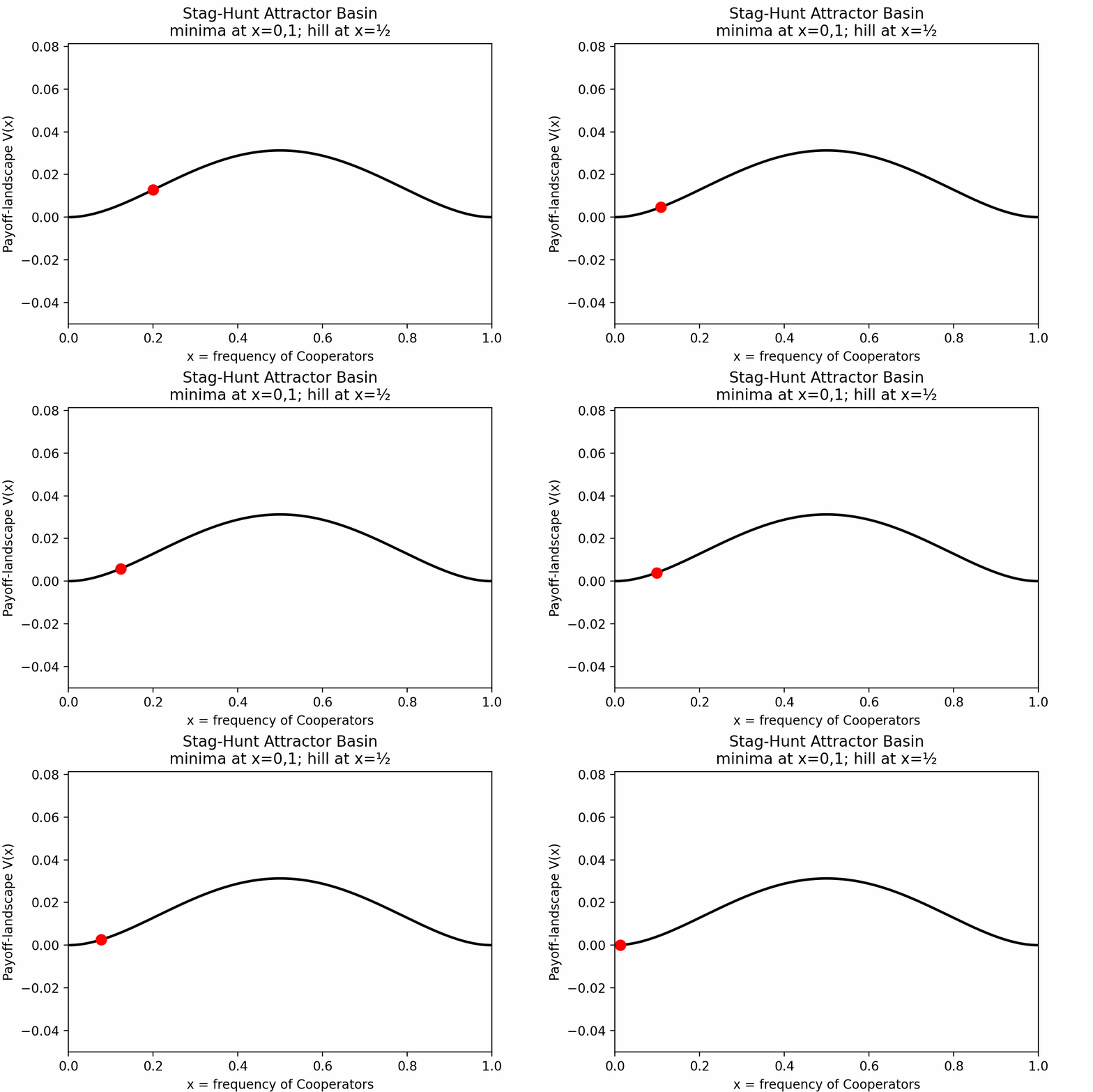
Equilibrium dyanmics

In the stag hunt randomly perturbing the population may eventually move the replicators to a different strategy, but it takes awhile. Such a gif is pictured.

Location

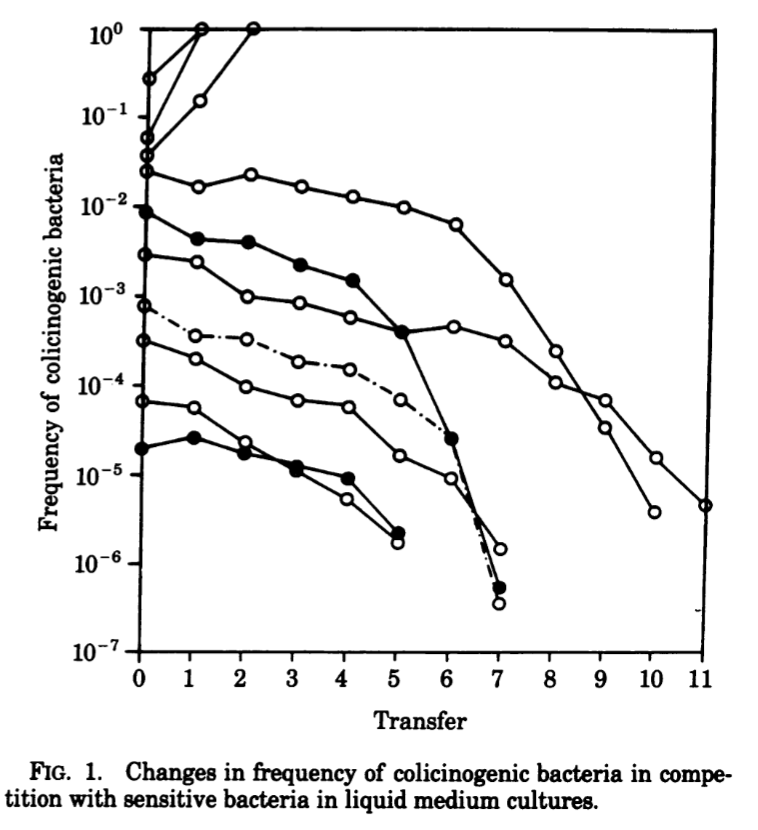
Bacteria poisoning in a stirred medium goes down.

Chao and Levin (1981)

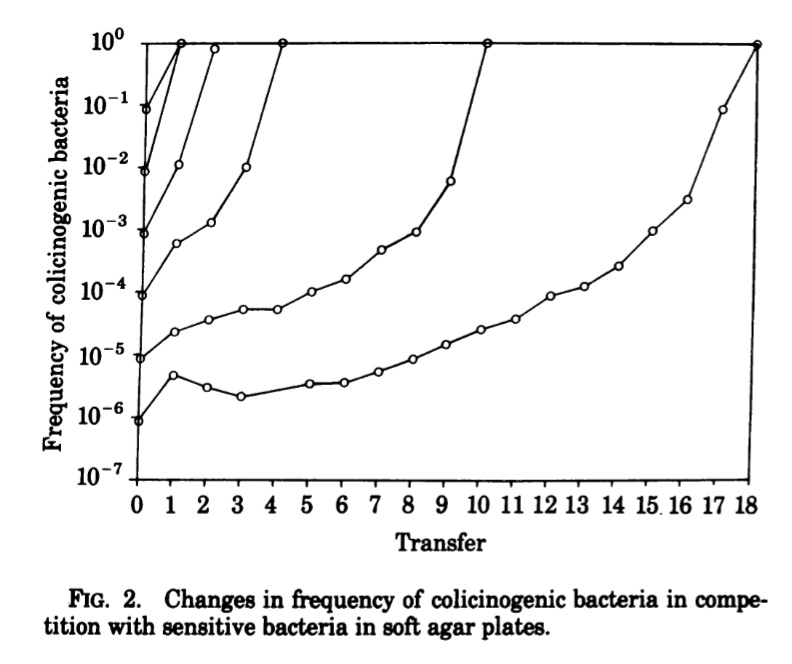
Bacteria poisoning in a still medium goes up.

Chao and Levin (1981)

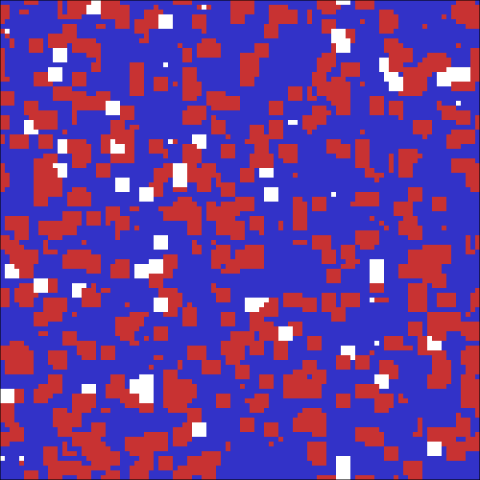
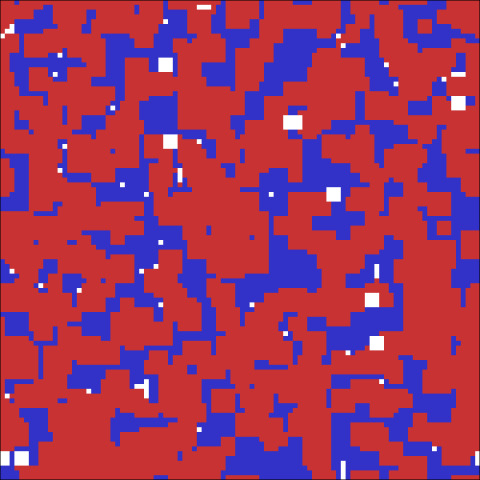
Divide-10, 10x10

NB: These time steps changes may be off.

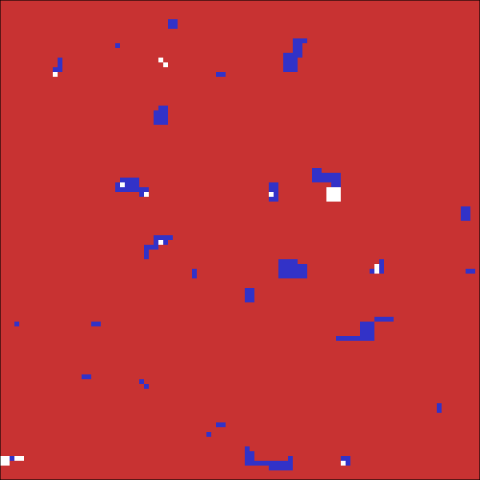
blue is demand-4; red: is demand-5; white is demand-6

Within five generations, demand five goes to fixation.

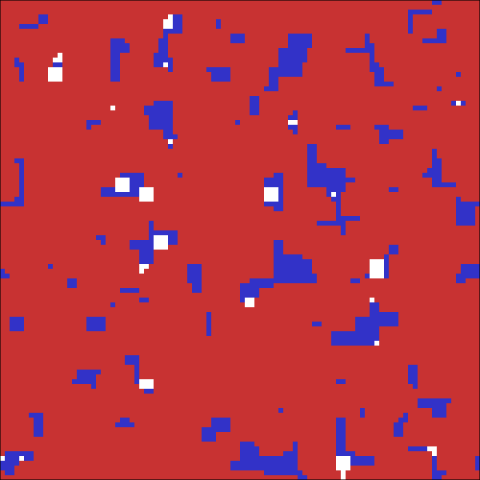
Divide-10, 100x100

blue is demand-4; red: is demand-5; white is demand-6

Within six generations, demand five goes to fixation.

Diagonal

SSSSSS
HHHSSS
HHHSSS
HHHSSS
SSSSSS
HHSSSS
HHHSSS
HHHSSS
SSSSSS
HSSSSS
HHSSSS
HHHSSS
SSSSSS
SSSSSS
HSSSSS
HHSSSS

Signaling

Signaling games

Act I Act 2 Act 3
S1 1,1 0,0 0,0
S2 0,0 1,1 0,0
S3 0,0 0,0 1,1

Sender’s Strategy

S1 -> M1

S2 -> M2

S3 -> M3

Receiver’s Strategy

M1 -> A1

M2 -> A2

M3 -> A3

What’s the point of signaling?

split steal
split 6.8, 6.8 0, 13.6
steal 13.6, 0 0

The only message you should send is that you’re going to split, but because it is the only message to send it’s “meaningless.”

golden balls - 1

golden balls - 2

Next class – how to explain this?

What do we need to model “morality”?

  • Repeated (iterated) games (reproduction)
  • Randomness of strategy
  • Location or proximity
  • Signaling (more next class)
    • Including punishments (reinforcement learning)

What else?

How sure can we be that our models are ‘seeing what we see’?

Project work time

Creative groups in the front left.

Video essays in the front right.

Philosophical essays in the back left.

Coding projects in the back right.

Exit ticket

What (if anything) are you going to change about your project?

References

Chao, L, and B R Levin. 1981. “Structured Habitats and the Evolution of Anticompetitor Toxins in Bacteria.” Proceedings of the National Academy of Sciences 78 (10): 6324–28. https://doi.org/10.1073/pnas.78.10.6324.
Darwin, Charles. 1859. On the Origin of Species By Means of Natural Selection Or, the Preservation of Favoured Races in the Struggle for Life. First. https://www.gutenberg.org/ebooks/1228.