Leaky bags of charged fluid

Jared Moore and David Gottlieb

Last Exit Ticket

Nutshell

Is there something in your brain that makes you moral?

and does this somehow “explain away” morality?

Constraint Satisfaction

Morality is just social rationality. It finds “good solutions to social problems” (Churchland 2018).

What’s right is what fits the circumstances.

Possible Claims

Stronger claim:

  • Neuroscience is the only layer we need to explain morality.

Weaker claim:

  • If we ignore neuroscience, we will not be able to fully explain morality.

Homeostasis

Social Mechanisms

Recall from last class

Cooperation
(in the context of competition)
Second-Personal Morality
(obligate collaborate foraging w/ partner choice)
“Objective” Morality
(life in a culture)
Prosociality Sympathy Concern Group Loyalty
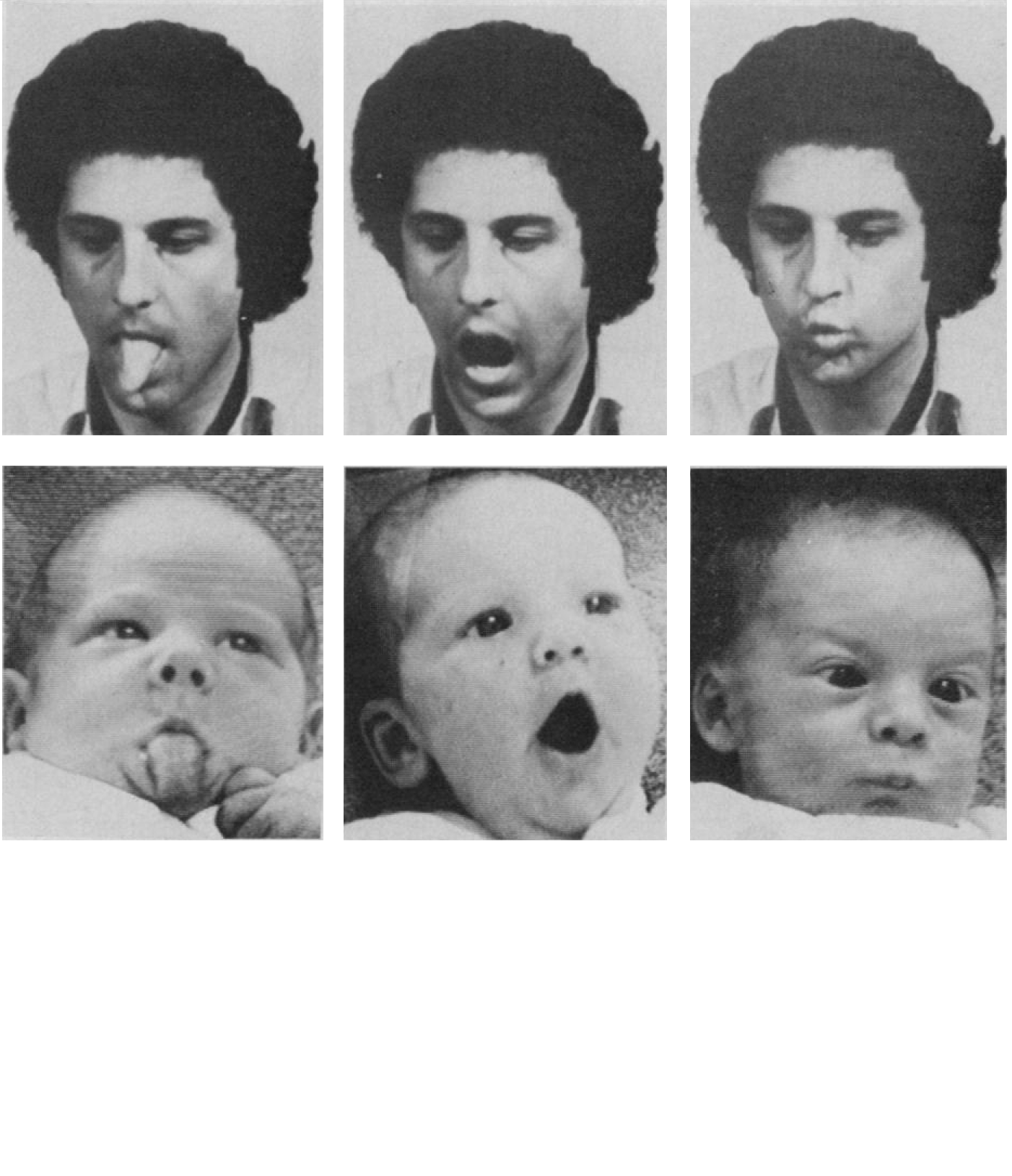
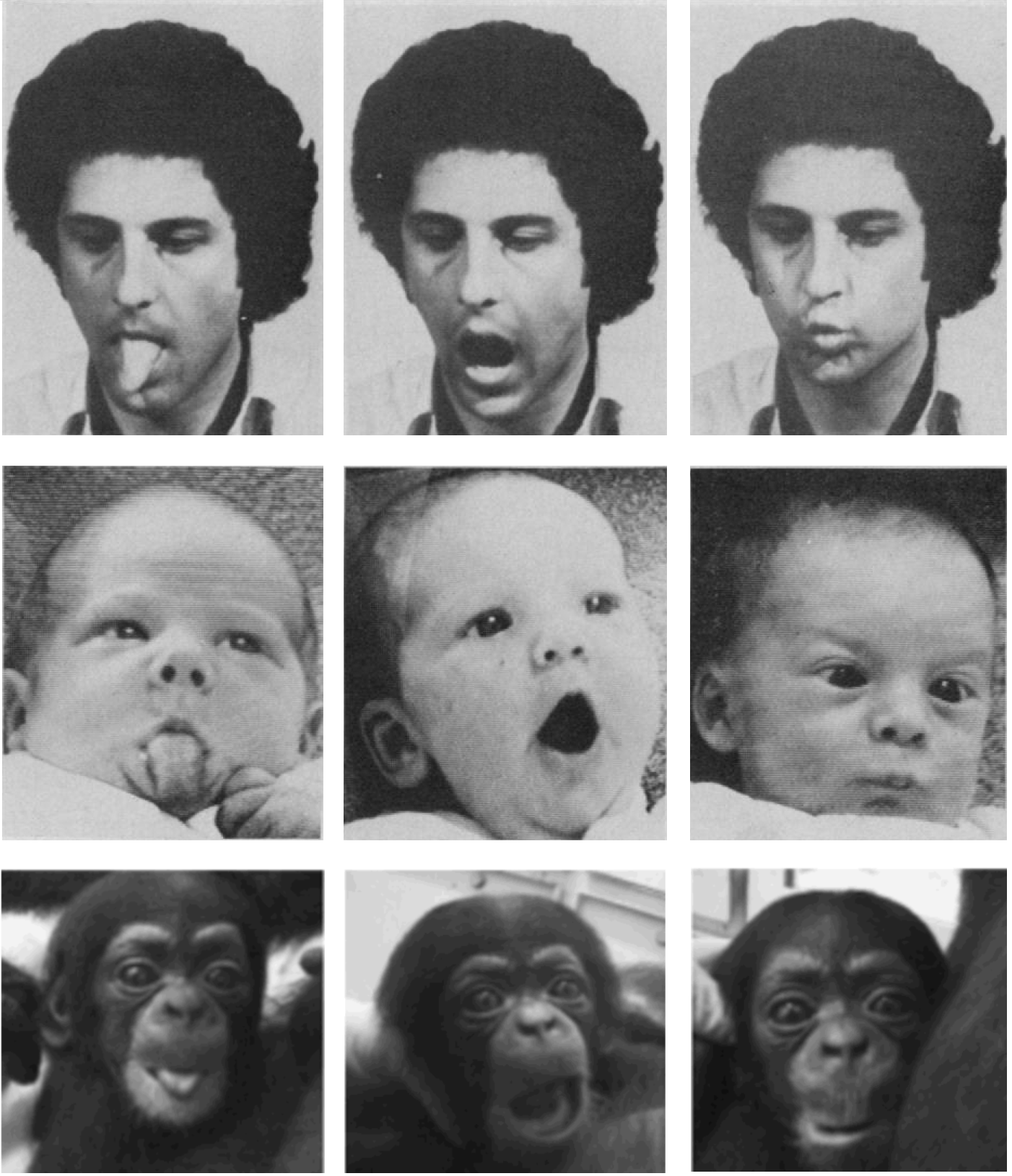
Cognition Individual Intentionality Joint Intentionality
- partner equivalence
- role-specific ideals
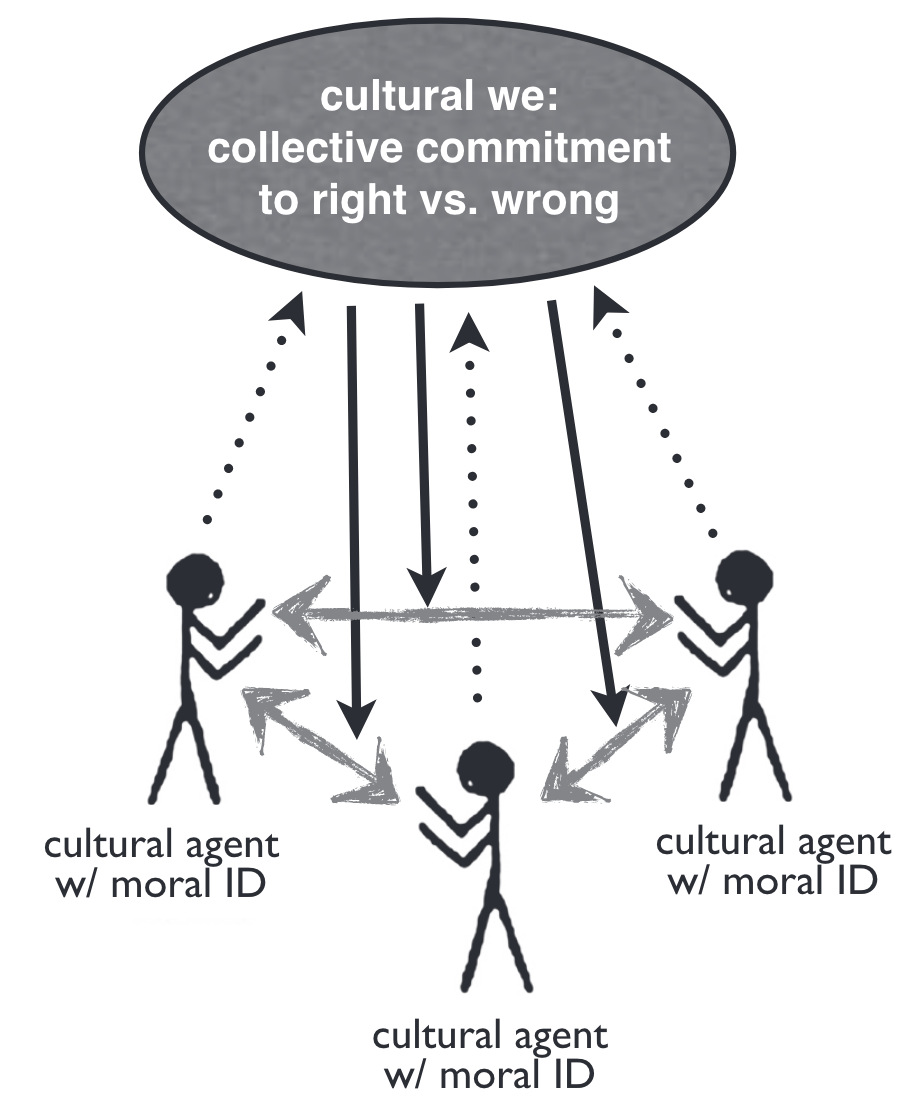
Collective Intentionality
- agent independence
- objective right & wrong
Social interaction Dominance Second-Personal Agency
- mutual respect & deservingness
- 2P (legitimate) protest
Cultural Agency
- justice & merit
- third-party norm enforcement
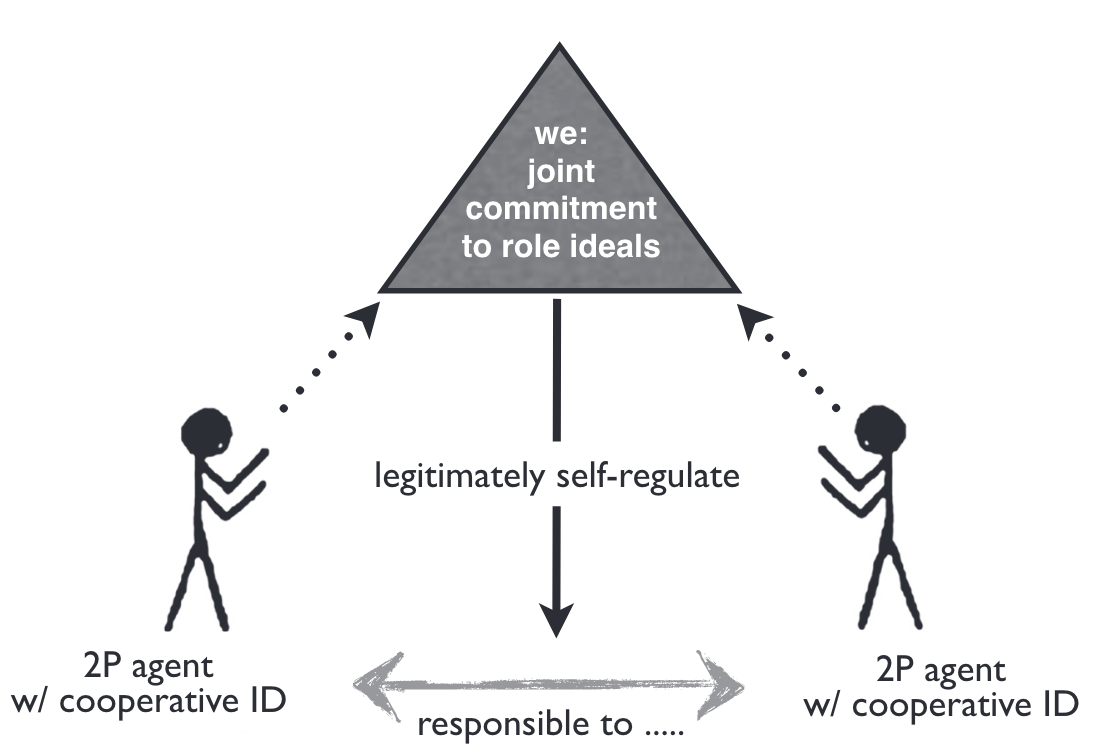
Self-Regulation Behavioral Self-Regulation Joint Commitment
- cooperative identity
- 2P responsibility
Moral Self-Governance
- moral identity
- obligation & guilt
Rationality Individual Rationality Cooperative Rationality Cultural Rationality

Tomasello (2016)

Churchland’s take

Morality—social behavior—emerges from

  1. caring
  2. recognition of others’ psychological states
  3. problem-solving in a social context
  4. learning social practices

We’ll mainly focus on the first two.

Churchland (2018)

Lost marbles

Photograph of cased-daguerreotype studio portrait of brain-injury survivor Phineas P. Gage (1823–1860) shown holding the tamping iron which injured him. Includes view of original embossed brass mat. From the collection of Jack and Beverly Wilgus. Like most daguerreotypes, the image seen in this artifact is laterally (left-right) reversed; therefore a second, compensating reversal has been applied to produce this image, so as to show Gage as he appeared in life. That this shows Gage correctly is confirmed by contemporaneous medical reports describing his injuries, as well as from the injuries visible in Gage’s skull and life mask, still preserved.

The equilibrium or balance, so to speak, between his intellectual faculties and animal propensities, seems to have been destroyed. He is fitful, irreverent, indulging at times in the grossest profanity (which was not previously his custom), manifesting but little deference for his fellows, impatient of restraint or advice when it conflicts with his desires, at times pertinaciously obstinate, yet capricious and vacillating [Harlow, John Martyn (1868).]

Pair bonding

(a,b) Monogamous prairie voles (a) have higher densities of OTR in the nucleus accumbens (NAcc) and caudate putamen (CP) than do nonmonogamous montane voles (b).

Lim, Murphy, and Young (2004)

Mammals whose circuitry outfitted them for offspring care had more of their offspring survive than those inclined to offspring neglect. (Churchland 2018)

My little OXT

Think of a time when you have felt attached. Perhaps you held an infant. You gave a hug. Sex.

First, what did it feel like?

Further consider:

You’re unwinding at home after your trip, tired from last night’s parties. One more year. What will your graduation be like? Will you continue with the well-heeled venture you’re interning at this summer? Your mother steps in. “Anything you don’t box up we’ll handle.” Take to the dump, she means. You hold up [Mr. Snufflekins]. You wonder: would it be wrong to throw him away?

(Swap [Mr. Snufflekins] with some replaceable childhood object you feel attached to.)

My little OXT

Rationally, it seems as if objects like Mr. S shouldn’t matter—you could just get another. And yet we feel attached to him.

Does this mean that our attachment system has gone awry?

Or, conversely, that rational ideas of what should matter fail to account for proper human morality?

Wire mother, cloth mother

Monkey clinging to the cloth mother surrogate in fear test

Social mechanisms

Lateral (side) and medial (interior) areas of the cerebral cortex associated with initiating joint attention and the anterior attention system. These include Brodmann areas 8 (frontal eye fields), 9 (prefrontal association cortex), 24 (dorsal anterior cingulate), and 11 and 47 (orbital prefrontal association cortex). Those regions associated with the Responding to Joint Attention and the posterior attention system include areas 7 (posterior parietal association area); 22, 41, and 42 (superior temporal cortex); and 39 and 40 (parietal, temporal, and occipital association cortices).

Mundy and Newell (2007)

Imagine we implant a baby bonobo with…

a device able to recognize successful and unsuccessful applications of the attentional apparatus to shared intentional frames […] If such a device can recognize what are effectively prosocial and antisocial behaviors, it could change the process of attending to those behaviors by piggybacking onto the extant learning mechanisms of the brain

We then rear that bonobo as we would a human child. The experiment works well enough; it results in behavior (along Tomasello’s dimensions) qualitatively similar to that of a five year old human child.

  1. Is this a conceivable experiment? (More on conceivability next week.)

  2. Would the experiment result in a moral agent?

  • What if it only resulted in agents who can establish joint commitments, but not proper culture (shared not collective intentionality)?

Moore (2023)

Social differences

People vary in their abilities to attend to social situations, to engage in the behavior putatively necessary for moral agency.

(Think of psycopathy, dementia, opiod addition, autism spectrum disorders, and hydroencephaly.)

Does that mean some people have more or less moral agency?

“Quasi” sociality

“Quasi” sociality

Moral Cicle

Can we draw a non-arbitrary behavioral boundary between what counts as a moral agent and what doesn’t?

(E.g. those sharks seem like they could access aspects of sociality and therefore could eventually yield recognizable moral agents.)

If not, should we use moral agency as a requirement for moral patiency?

What else would we use?

(We’ll talk about this more next week.)

Social AI

If we have a device able to recognize prosocial and antisocial stimuli, why bother with bonobos?

Say that we hook that device up to some actuators. (We embody it in a robot or simply use it as the reinforcer in RLHF.)

The low-level constraints this system faces would be very different than those humans face. (It doesn’t use oxytocin, e.g.)

  1. Does this matter?

  2. How close would we need to match the context (environment) of the AI and humans? (Would we need to raise it like a child?)

Social AI – functionalism

What “counts” as sociality? (e.g. as satisfying Tomasello’s criteria)

E.g. do you have to feel an emotion to be driven to act prosocially?

The mechanisms of attachment are very detailed and multilayered. Thus to describe them only as “attachment” may be to woefully reduce them and, one might argue, to mistake our model for reality.

Inspired by Ayana, Sneha, and Isabel’s comments

Does evolution debunk morality?

Motivations

Blatant benevolence and conspicuous consumption: Charity is just as “selfish” as self-indulgence. ... They divided a bunch of volunteers into two groups. Those in one were put into what the researchers hoped would be a “romantic mindset” by being shown pictures of attractive members of the opposite sex. They were each asked to write a description of a perfect date with one of these people. The unlucky members of the other group were shown pictures of buildings and told to write about the weather. The participants were then asked two things. The first was to imagine they had $5,000 in the bank. They could spend part or all of it on various luxury items such as a new car, a dinner party at a restaurant or a holiday in Europe. They were also asked what fraction of a hypothetical 60 hours of leisure time during the course of a month they would devote to volunteer work. The results were just what the researchers hoped for. In the romantically primed group, the men went wild with the Monopoly money. Conversely, the women volunteered their lives away. Those women continued, however, to be skinflints, and the men remained callously indifferent to those less fortunate than themselves. Meanwhile, in the other group there was little inclination either to profligate spending or to good works. Based on this result, it looks as though the sexes do, indeed, have different strategies for showing off. Moreover, they do not waste their resources by behaving like that all the time. Only when it counts sexually are men profligate and women helpful. From The Economist, https://www.economist.com/science-and-technology/2007/08/02/blatant-benevolence-and-conspicuous-consumption

(Griskevicius et al. 2007)

Why it might debunk

  1. Explaining away: We have our moral beliefs because we evolved to, not because they’re “true”
  2. Covert self-interest: When we care about others, we “really” do it because it serves our reproductive interests

Explaining away argument

If humans were bees

If … men were reared under … the same conditions as hive-bees, … our unmarried females would, like the worker-bees, think it a sacred duty to kill their brothers, and mothers would strive to kill their fertile daughters; and no one would think of interfering. (Darwin 1871)

Does this give a reason for moral skepticism?

Parfit’s explanation

Here’s Parfit making a parallel argument in a very different context:

[I]f some attitude has an evolutionary explanation, this fact is neutral. It neither supports nor undermines the claim that this attitude is justified. But there is one exception. This is the claim that, since we all have this attitude, this is a ground for thinking it justified. This claim is undermined by the evolutionary explanation. Since there is this explanation, we would all have this attitude even if it was not justified. (Parfit 1984, 308)

Parfit is saying: if we all think we have a self because of evolution, this undermines the explanation that we all think we have a self because we really have one.

Can we apply the same reasoning to morality?

By the same reasoning, if we all share certain moral attitudes because of evolution, this undermines the explanation that we share them because they are true or good.

A challenge to “moral realism”?

The challenge for realist theories of value is to explain the relation between … evolutionary influences on our evaluative attitudes, on the one hand, and the independent evaluative truths that [moral] realism posits, on the other. (Street 2006)

If morality evolved along with the human race, then asking how we ought to live makes as much sense as asking what animals ought to exist, or which language we ought to speak. [Binmore, 2005, p. 2] . . .

In schematic form:

  1. Morality consists of “independent evaluative truths” (“moral realism”).
  2. If our moral beliefs are the product of selection for reproductive success, it would be pure coincidence for them to line up with “independent evaluative truths.”

Therefore,

  1. They probably don’t.

Against substantive realism

Korsgaard criticizes the whole idea that morality is supposed to consist of “independent evaluative truths” (what she calls “substantive realism”). This turns out to be an example of the naturalistic fallacy: no independent truth by itself can decide for us what we should do.

The substantive realist assumes we have normative concepts because we are aware that the world contains normative phenomena, or is characterized by normative facts, and we are inspired by that awareness to construct theories about them. But that is not why we have normative concepts. … It is because we have to figure out what to believe and what to do. … even when we are inclined to believe that something is right and to some extent feel ourselves moved to do it we can still always ask: but is this really true? and must I really do this? (Korsgaard 1996, 46–47)

Even if there were “independent moral truths,” we would still face the question of what to do. Conversely, even though our inclinations reflect selective pressures rather than “independent moral truths,” we still face the question of what to do.

How do I know I’m not just doing what I was programmed to do?

Let’s ask Immanuel Kant:

In fact it is absolutely impossible to settle with complete certainty … whether there is even a single case where the maxim of an otherwise dutiful action has rested solely on moral grounds…. (Kant 2018, Ak. 4:407 / 21)

What’s the answer?

We can be fully suspicious of everyone’s actual motives in every dutiful action. Perhaps we will be right! But this does not affect the question of what we should do.

Tomasello’s rejoinder

The ultimate causation involved in evolutionary processes is independent of the actual decision making of individuals seeking to realize their personal goals and values. The textbook case is sex, whose evolutionary raison d’être is procreation but whose proximate motivation is most often other things. The fact that the early humans who were concerned for the welfare of others and who treated others fairly had the most offspring undermines nothing in my own personal moral decision making and identity. (Tomasello 2016, 7)

He says it doesn’t matter what the ultimate cause of our moral attitudes is – that’s just not relevant to deciding what to do.

What does he mean by saying “the textbook case is sex”?

Is morality really cloaked interest?

Plato

Thrasymachus: “Justice is nothing other than the advantage of the stronger.” (Plato, Republic I, 338c)

Callicles: “The makers of laws are the majority who are weak; and they make laws and distribute praises and censures with a view to themselves and to their own interests.” (Plato, Gorgias)

Popeye

Popeye cartoon. Popeye says, 'If ya does good deeds jus' to get yerself a swell seat in heaven yer selfish.'

Is altruism fake?

It is sometimes claimed that there is no such thing as altruism. Why?

The evolutionary version of this thought is that any stable altruistic behaviors can only exist because they provided selective advantages in the past.

What about self-sacrifice?

It is sometimes claimed that the most moral acts are utterly selfless. For example, Jesus is supposed to have sacrificed himself for the redemption of all humanity. Notably, Jesus did not have any offspring.

The most extreme forms of altruism and self-sacrifice are often associated with religious systems, where individuals are encouraged to emulate figures like Jesus, who are portrayed as embodying ultimate selflessness. Such emulation can lead individuals to act in ways that may reduce their own reproductive success, suggesting that these moral systems can promote behaviors that transcend individual genetic advantage. (Alexander 1987)

If altruism is cloaked interest, how do we explain self-sacrificing behaviors?

Summary

  • If we act the way we do because our dispositions made our lineage more reproductively successful, this makes it harder to see those acts as genuinely moral.
  • If someone does something outwardly altruistic, we might think to ourselves: that’s not really altruistic. You’re really indirectly pursuing your long-term reproductive interest.
  • Compare the Kantian thesis that only actions done from duty (not from interest) have moral worth.

Basically,

  • something is rationally self-interested if it promotes your long-term reproductive interest, and
  • if it is rationally self-interested, it is not genuinely moral.

Which lineage is the most reproductively successful?

Stylized picture showing one generation of reproductive outcomes of three different lineages.

Which lineage is the most reproductively successful?

Stylized picture showing two generations of reproductive outcomes of three different lineages.

Which lineage is the most reproductively successful?

Stylized picture showing three generations of reproductive outcomes of three different lineages.

Which lineage is the most reproductively successful now?

Stylized picture showing four generations of reproductive outcomes of three different lineages. Notably, in the final generation, all lineages have been wiped out and have zero surviving offspring.

A beautiful moment in time

New Yorker Cartoon, c 2012 Tom Toro. Shows a man in tattered business dress speaking to children around a fire. Caption: Yes, the planet got destroyed. But for a beautiful moment in time we created a lot of value for shareholders.

Long-term reproductive success

Suppose the Earth was struck by a meteor tomorrow, eliminating all animal life. All animals alive today would be complete failures in terms of reproductive success. Does anything you do today matter morally?

  • What if, because of a disaster like climate change, most humans alive die, so that in 1,000 years almost no current humans have living descendants?
  • What if, in 4 billion years, the Earth along with most of the solar system is physically swallowed by an expanding red giant sun, killing all life.
  • What if, in 10 billion years, all matter and energy concentrates in a “Big Crunch,” so hot and dense that no reproductive lineages can survive?
  • What if, in a quadrillion or so years (give or take), all matter and energy in the universe becomes so diffuse that no organized life is possible, so all life everywhere is extinct?

In the long run, we’re all dead

  • The skeptical argument suggested that the reason for moral behavior was long-run reproductive success.
  • However, long-run reproductive success seems to be impossible.
  • Accordingly, either:
    • there is no reason for moral behavior (nihilism), or
    • the reason is something other than long-run reproductive success.

Causation is different from motivation

If we don’t think nihilism is right, we can return to something Tomasello said earlier:

The ultimate causation involved in evolutionary processes is independent of the actual decision making of individuals seeking to realize their personal goals and values. (Tomasello 2016, 7)

I evolved to care about my friends because being disposed to care about my friends made animals in my lineage more likely to reproduce. But I care about my friends for their own sakes. My friends would never seriously say, “You only care about me because it increases your own reproductive chances.” Because it wouldn’t be true.

Sharks and humans can be friends

Signaling and deception

I can by no means will that lying should be a universal law. For with such a law there would be no promises at all. (Kant 2018)

Stanford faculty portrait of Prof. Brian Skyrms. On Thursday, we might be joined by Professor Brian Skyrms, author of The Stag Hunt and Signals and many other books and papers. Brian is the first philosopher to be inducted into the National Academy of Sciences and has made important contributions to evolution and game theory as well as classical philosophical questions like what is meaning?.

To make the most of his generous visit, we’d like everyone to come prepared with one question. It can be about Stag Hunt, or Signals, or an optional paper, or about how the game-theoretic approach relates to everything else we’ve been thinking about. Thank you!

Exit ticket

References

Alexander, Richard D. 1987. The Biology of Moral Systems. New York: Aldine de Gruyter.
Churchland, Patricia S. 2018. Braintrust: What Neuroscience Tells Us about Morality. Princeton University Press. https://research-ebsco-com.stanford.idm.oclc.org/c/qmsjx4/search/details/tqzh7ocgvj?db=nlebk.
Darwin, Charles. 1871. The Descent of Man, and Selection in Relation to Sex. 1st ed. London: John Murray.
Griskevicius, Vladas, Joshua M Tybur, Jill M Sundie, Robert B Cialdini, Geoffrey F Miller, and Douglas T Kenrick. 2007. “Blatant Benevolence and Conspicuous Consumption: When Romantic Motives Elicit Strategic Costly Signals.” Journal of Personality and Social Psychology 93 (1): 85–102. https://doi.org/10.1037/0022-3514.93.1.85.
Kant, Immanuel. 2018. Groundwork for the Metaphysics of Morals. Translated by Allen W. Wood. New Haven: Yale University Press. https://www-degruyter-com.stanford.idm.oclc.org/document/doi/10.12987/9780300235722/html#contents.
Korsgaard, Christine Marion. 1996. The Sources of Normativity. Edited by Onora O’Neill. New York: Cambridge University Press.
Lim, Miranda M., Anne Z. Murphy, and Larry J. Young. 2004. “Ventral Striatopallidal Oxytocin and Vasopressin V1a Receptors in the Monogamous Prairie Vole (Microtus Ochrogaster).” Journal of Comparative Neurology 468 (4): 555–70. https://doi.org/10.1002/cne.10973.
Moore, Jared. 2023. The Strength of the Illusion. Seattle, WA: Ergal Press.
Mundy, Peter, and Lisa Newell. 2007. “Attention, Joint Attention, and Social Cognition.” Current Directions in Psychological Science 16 (5): 269–74. https://doi.org/10.1111/j.1467-8721.2007.00518.x.
Parfit, Derek. 1984. Reasons and Persons. Oxford [Oxfordshire]: Clarendon Press. https://ebookcentral.proquest.com/lib/stanford-ebooks/detail.action?docID=728732.
Street, Sharon. 2006. “A Darwinian Dilemma for Realist Theories of Value.” Philosophical Studies 127 (1): 109–66. https://doi.org/10.1007/s11098-005-1726-6.
Tomasello, Michael. 2016. A Natural History of Human Morality. Harvard University Press. https://doi.org/10.4159/9780674915855.