Colombia:
Tomorrow’s Vietnam
By Jameel Johmson & Kristen Carothers
EDGE Spring, 2003
Securing economic opportunity,
domestic and abroad, has always been an integral aspect of U.S. foreign
policy. Dating back to the early 20th
century, when Teddy Roosevelt wielded his “Big Stick,” the United States first
began to establish a presence in Latin America. It assumed the role of “Big Brother,” with the primary objective
of creating an atmosphere viable to American economic growth in the
region. Roosevelt’s policy was
significant in that it developed the precedence for the United States to police
not only its neighbors, but the entire globe as well. This political stance was aimed to safeguard American interests,
ideological and material, but later set the stage for conflict as it was
challenged and even further propelled by the spread of communism. The United States became directly embroiled
in international conflicts, typified by American military presence in Vietnam
during the 1960s and in Latin America in the 1980s. However, with the end of the Cold War, the fear of the growth of
communism subsided and today, Latin American countries specifically struggle
with the perils of the drug trade. It
not only has etched a web of money laundering, violence, and corruption, but
has also emerged as a global epidemic, particularly as it finances the activities
of domestic guerilla groups and international terrorist forces. It presents a potential threat to American
security and peace; however, it is not the sole reason for the current U.S.
involvement in Latin America. The
United States government is still haunted by the shadows of American bloodshed
in Vietnam and predominantly, the backlash it has elicited from the general
public. In order to avoid further
scrutiny, the government is unwilling to admit their complete justification for
the escalation of military forces in Latin America, particularly in the nation
of Colombia. The existence of the drug
trade is emerging as a pretext for increased U.S. interference in Colombia that
is a detrimental force, fueling further violence and worsening human rights
conditions. It is clear that Colombia
is tomorrow’s Vietnam.
The devastating battle with drug
trafficking has wrought far-reaching effects in Colombia. However, to understand the severity of
turmoil and poverty that the drug trade perpetuates, it is necessary to also
address the nation’s additional economic, political, and social ills. Historically, Colombia has been one of Latin
America’s most stable countries, experiencing steady economic growth from the
1930s and onto the mid 1990s. Even through
Latin America’s troubled times of the 1980s, Colombia maintained its financial
fortitude with its economy growing at an average annual rate of 3.5
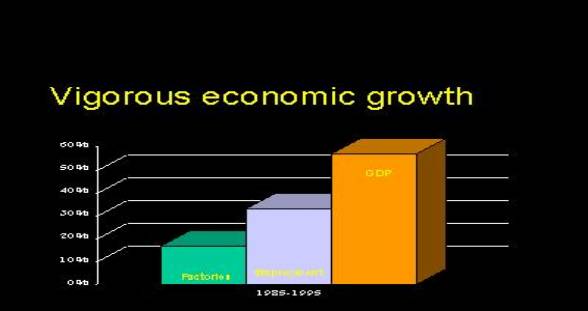
percent. The subsequent graph
demonstrates this period of vigor.
World Bank Group: http://www.worldbank.org/nipr/lacsem/columpres/sld003.htm
The
illustration shows the growth of the annual GDP (orange bar) along with the
contributions from the number of factories (green bar) and rate of employment
(blue bar) from the years of 1985 to 1995.
The Colombian GDP averaged 4.6% increase, while its manufacturing
establishments rose by almost 17% and employment grew by 33%. However, the prosperity that characterized
the Colombian economy began to end in the mid 1990s, reaching a severe low in
the 1999 recession. Harvesting of
Colombia’s key export, coffee, was depressed and its prices plunged, in which
this decline was one of the early and ominous signs of Colombia’s financial
fate. Its demise continued as the
annual GDP tumbled by 4%, while unemployment was stuck at a record high of 20%
and 55% of the population (40,349,388) were well below the poverty line (Wall
Street Journal, September 23, 1999).
This dismal state of Colombia’s financial market helped blanket the
nation in uncertainty, creating an atmosphere that embraced any prospect of
riches, further cementing the supremacy of the drug trade.
Distant from the country’s sagging
economy, narcotic growth and trafficking represents a $400 billion worldwide
industry with its roots implanted throughout Colombia. Unlike earlier years, when the cultivation
of coca (cocaine derived plant) remained low in the country, troubled economic
times have spurred increased coca growth in the 1990s that has thrust Colombia
forward as the world’s largest coca producer.
For instance, in 1998, Colombia had 93,000 hectares (232,500 square
acres) of land under coca and opium poppy cultivation, also generating 69,000
full-time jobs (The Colombian Economy after 25 Years of Drug Trafficking,
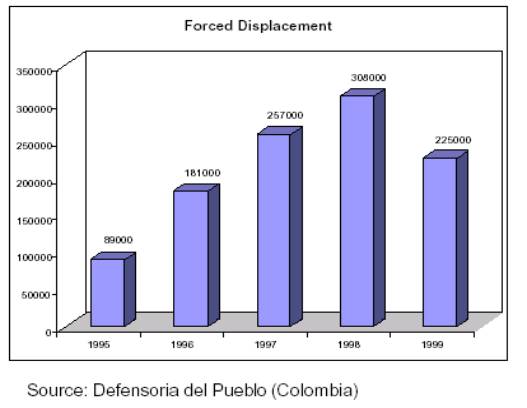
Ricardo Rocha). Coca growth has
attracted many laborers, primarily attributed to the agricultural decline that
forced the displacement of numerous workers as depicted in the following
graph.
http://www.mama.coca.org/feb2002/drugtrade.pdf
The graph shows the
number of unemployed workers for the years between 1995 and 1999. It highlights a severe facet of Colombia’s
economic struggles that has strengthened its foundation in narcotic growth and
trade. Another startling aspect of the
drug trade’s influence is that in comparison to the decline in coffee exports,
the drug trafficking has generated greater revenue as reflected in the
subsequent graph (1982-1996).

http://www.mamacoca.org/feb2002/drugtrade.pdf
As
seen in the graph, by 1986, the illegal narcotics trade had emerged as an
overwhelming source of income, nearly doubling the amount of finances brought
in by legal coffee exports. The trend
persists through the 1990s; a disturbing pattern demonstrating the considerable
extent that Colombia was entrenched in the drug trade. Equally alarming, Colombia’s share of the
cocaine market rose from 50% (1981) to 85% (1999), accounting today for about
$7.5 billion of yearly income (CIA World Fact book). This money profited from the narcotics trafficking is cleverly
interwoven into the Colombian economy, also providing the drug mafia with
additional security. It was said that,
“one could hardly go past a major development without being told that laundered
money financed it. This included hotels, nightclubs and shopping centers,
exclusive ranches and mansions” (Colombian Cartels, www.pbs.org).
The following graph demonstrates the Colombian drug trafficking income
as a percentage of the nation’s GDP ($250 billion).

“The
Colombian Economy after 25 Years of Drug Trafficking”, Ricardo Rocha
The
illustration points to the financial control that the drug trade has gained;
yet in 1998, their income of $7.5 billion was only 3% of Colombia’s total GDP
($250 billion). It reflects the
relatively diminutive effects that drug trafficking has directly on the fraught
Colombian economy. However, the
overwhelming and worldwide influence of the drug trade can never be overlooked
as “the estimated turnover of $400 billion has the power to corrupt almost
anyone” (World News, R.E. Kendall, Secretary-General of Interpol). Drug money’s vast influence in political
iniquity has become another symptom of the ills that afflict Columbia.
Notably,
positioned at the forefront of this “narco-democracy,” have been the crime
cartels: Medellin and Cali. The
Medellin cartel, led by Pablo Escobar, was the first of Colombia’s powerful
drug organizations that fed cocaine to the United States and abroad throughout
much of the 1980s. During that time,
the Medellin was also thought to be responsible for the murder of countless political
officials, police, prosecutors, judges, and journalists. Unfortunately, the Medellin demise in the
early 1990s only facilitated the rise to power of their rivals, the Cali
cartel, led by the Rodriguez Orejuelas brothers. After replacing the Medellin cartel, the Rodriguez brothers flooded
the markets and today, they now supply 80 percent of the cocaine flowing into
the United States and Europe (The Cali Connection, www.ccsf.edu). It
is a stark reflection of the power they possess.
In
addition, Colombia suffers from a lack of national cohesion and the political
fragmentation contributes to the inefficacy of their government to deal with
the drug trade. Each different state
fights to affirm its own regional independence, failing to form a united body that
effectively opposes the trade and growth of narcotics. At the same time, allegations continue to
mount, asserting that the Colombian government has been too lenient on the drug
cartels. For example, the Rodriguez brothers (Cali Cartel) received the near-maximum
penalty of 23 years when convicted, but are likely to be released after six (The
Cali Connection, www.ccsf.edu).
Many experts consider this a result of an arrangement between the
Colombian government and the brothers to avoid their extradition to the United
States, where they would face harsher penalties. More disturbing, DEA agents still believe that the Rodriguez
brothers continue to manage the Cali cartel right from their prison cells (Colombian
Cartels, www.pbs.org). The shortcomings of the Colombian
government’s ability and desire to more effectively confront drug trafficking
has created further uncertainty within the nation, particularly with its
condemnation by the United States in 1996.
It intensified Colombia’s loss of political legitimacy in domestic and
international forums. This has
furthered the staggering loss of public confidence that has now been compounded
with fear as the social atmosphere of Colombia has been enveloped by the
actions of guerrilla and paramilitary groups.
In earlier years, these
independently armed forces first appeared in response to their bitter
dissatisfaction with the government and burning desire for change. However, economic hardships had pressed them
to embrace the lure of riches and life of violence associated with the drug
trade. The most notable of the
guerrilla groups have been the Revolutionary Forces of Colombia (FARC) and the
National Liberation Army (ELN). In
opposition to the Colombian oligarchy of the 1960s, FARC was established in
1964, as the military wing of the Colombian Communist Party. It was comprised mainly of disenchanted
farmers and destitute laborers, aligned with the Soviet movement and
Moscow-line communists. On the other
hand, although ELN was also formed in 1964, it was greater influenced by the
Cuban revolution and was composed mostly of students and Colombian university
graduates (Colombian Labyrinth, Rabasa and Chalk). The divergence between the groups was
attributed to the tensions between Cuba and Moscow over strategy in Latin
America; though, the goals of both insurgents were to enact social change,
diminishing the unjust disparity in wealth among Colombian citizens. These aims were consistent for both groups
and involvement in drug trafficking was mostly carried out by paramilitaries,
who were privately armed “self-defense” groups. However, during the early 1980s, the cultivation of coca became a
dominant economic activity and in opposition to the paramilitaries and
government, the guerilla groups of FARC and ELN also began to promote and
protect the coca crops. In this period,
the vicious relationship among guerilla groups, paramilitaries, and the Colombian
government was developed that later would create much turmoil in the country.
Crowned
as the guardians of the narcotics trade, the guerilla and paramilitary
insurgents pierce and rip at the delicate social fabric of Colombia,
perpetuating violence and feelings of trepidation as they struggle for control
of the drug market. These groups offer
protection by overseeing each stage of drug trafficking from its cultivation on
the farm to its manufacture in the labs, and to its movement in the hands of
smugglers. It is a service that rewards
the insurgents with profitable gains in revenue. For instance, in 1998, guerillas and paramilitaries received 620
billion pesos ($551 million) solely from the drug trade. FARC specifically has a breakdown of fees (gramajes)
such as $5263 for protection per laboratory, $2631 for security of landing
strips, and $4210 for protection of coca fields per square acre (Colombian
Labyrinth, Rabasa and Chalk). In
turn, these groups used the derived money to finance armed conflicts and
primarily support the growth of their military forces.
Today,
the guerillas and paramilitaries are comprised of approximately 9,000 to 12,000
armed combatants, involved in numerous illegal activities. These include bombings, murders,
kidnappings, extortions, hijackings, as well as conventional military action
against Colombian political and economic targets. FARC and ELN are responsible for 20 to 30 percent of all of the
kidnappings that take place in the world.
For example, in March of 1999, the FARC executed three U.S. Indian
rights activists on Venezuelan territory after it kidnapped them from Colombia
(Colombian Labyrinth, Rabasa and Chalk). Foreign citizens are often the targets of FARC kidnappings, but
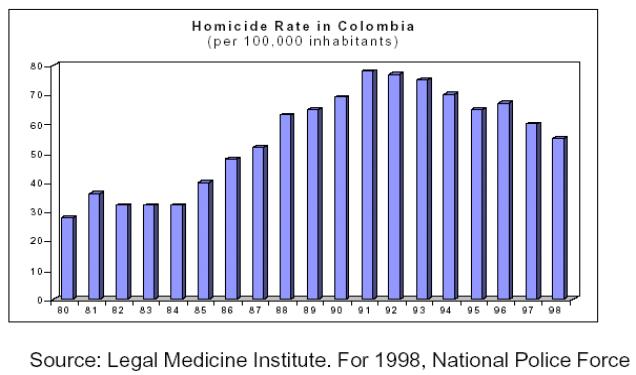
no local citizen is immune from the violence that the insurgents promote. For instance, the homicide rate in Colombia
has more than doubled over the past 20 years with the growing presence of
guerrillas and paramilitaries. These
groups, trying to gain control, commit “social cleansing” murders or limpiezas,
slaying those deemed misfits or suspected of cooperating with the opponent (Colombian
Labyrinth, Rabasa and Chalk).
http://www.mamacoca.org/feb2002/drugtrade.pdf
Bibliography
1. Klare,
M. “The Real Reason for U.S. Aid to
Colombia.” News Wire.
2. Wall
Street Journal, September 23, 1999.
3. Rocha,
Ricardo. The Colombian Economy after
25 Years of Drug Trafficking.
4. World
News
5. Flenker,
Cassandra. Colombia: To Save a
Democracy.
6. www.pbs.org.
Colombia’s Samper and the Drug Link.
7. www.ccsf.edu. The Cali Connection.
8. Rabasa
and Chalk. Colombian Labyrinth.
9. McManimon,
Shannon. Militarizing the Drug War.
10. Herman,
E. Globalization and Instability:
The Case of Colombia.
11. http://warpeace.org. The Folly of the U.S. Drug War.