Religion in the World Today:
Can the Conflict Be Solved?
By
Chris Lewis,
Jed Lowrie
&
John Mayberry Jr.
Taking a look at world religion, we will look at different countries from different parts of the world; analyzing the different religious problems and human rights violations. The overall question that we propose is: is there a simple solution to these problems and what can be done about them?
Throughout history, the lower class: those who are considered poor, minorities, and women, have been taken advantage of, denied their inalienable rights, and forced into unfavorable situations. Even in the United States within the last century, women have been denied the right to vote. Minorities, such as African Americans, were denied equal treatment. Blacks were legally obligated to separate themselves from places that were considered “white only.” Certain schools, restaurants, and other public places, were the locations for the cause of embarrassment and social inferiority. This discrimination and denial of inalienable rights, however, has not historically happened only in the United States. On the international level, many countries experience social animosity, specifically due to religious tensions.
In Mexico and Central America, there is a long tradition of the non-cooperation of human rights, “human rights activism in these countries can be traced back to the first Indian freedom- fighters against Spanish rule, over five- hundred years ago.” (www.amnesty.org) Even during the past history of civil conflict in countries such as Guatemala and El Salvador, people have demonstrated for basic human rights and personal and religious freedoms. Among the religious conflicts between the nations and its people, there is also a long tradition of persecution of the autonomy of individuals who defend human rights. Recent history has shown countless murders, abductions so they will “disappear”, torture and threats of death, detainment and harassment by state agents.
Civil rights activists suffer greatly in their pursuit to glorify civil rights but are often cut down by government and military officials who oppose the ideas represented by the minority. Lack of punishment prevails, as it has done for decades. The works of international human rights organizations would terminate were it not for the help, teamwork, and information which human rights defenders provide. In a nutshell, human rights defenders are the people in the lead of the struggle to understand the ideals proclaimed in the Universal Declaration of Human Rights, that all people should be free from “fear and want”. Defenders make every effort to gain the maximum amount of equality and human dignity without the exploitation of minority groups when oppressors are imposing unnecessary laws against minority groups. Combined with N.G.O.’s and other individuals or associations, trade unions, and religious organizations, the human rights community continues to fight for the advancement of the human race. Through the promotion of human rights education and denouncing violations, human rights defenders help to have power over the authoritarian tendencies that can appear in any government, no matter how much of a democracy it seems to be. Everyone in this battle to combat the denial of human rights, especially the freedom to practice any religion, lives an important life and is prepared to put their lives in danger for a legitimate cause.
Due to the religious altercations between Ireland and Northern Ireland both countries have suffered and the development of both nations has been affected. As a result of these quarrels, differences between Catholics and Protestants have developed into a huge, socio- political confrontation between people who favor British involvement and those who aspire for complete sovereignty of Irish people.
The reality of the conflict in Ireland started long before the current standoff between Northern Ireland and Ireland. It started in the 12th century because the English invaded the isle of present day Ireland under the command of King Henry II for the sole purpose of increasing the size of the already immense English Empire (http://members.fortunecity.com/walshdw/ire). The Catholics who inhabited the area fought courageously against several invasions for many centuries to come. Then, in the later 16th and 17th centuries, Scottish settlers immigrated to Northern Ireland, and brought with them their Protestant beliefs and virtues. Around the same time, William of Orange also found his way into Northern Ireland in 1690, with hopes of installing English influence to an even greater extent. Due to the immigration to Northern Ireland by Protestants, much religious tension was created between the Catholics and the newly incorporated religious group. Near the end of the 17th century only 38% of Ireland’s northern section was Catholic. Subsequently, the southern sections of Ireland remained Catholic, as they would not have their religious affiliation imposed upon. (http://members.fortunecity.com/walshdw/ire) The Protestant influence began to grow more and more prominent in the 18th century as the re-installation of The Edict of Nantes required Huguenots to get rid of their various societies. As a result, many disgruntled Huguenots decided to migrate to Ireland. (www.britannica.com). So it is safe to say that between the 12th and 18th centuries, most of the religious diversity increased as before that time, most of the country was dominated primarily by Catholics.
In 1801, the British Act of Union incorporated Ireland as part of the United Kingdom (www.britannica.com). This aggravated the Irish as they saw is as an attempt by Great Britain to be able to impose their power over the Ireland, and subsequently, it made Catholics a minority throughout the entire United Kingdom. Also, Catholics under British rule were extremely persecuted. Consequently, they were unable to acquire any political positions, and were deliberately forced into the urban areas, out of major cities. British control of Ireland continued to assert itself until 1916, when the Republican force in Ireland started the Easter Rebellion. There were nearly 16,000 Catholics in search of a combined, autonomous, sovereign Ireland. Their objective was to abolish British influence throughout Ireland. On Easter, their hard work began and they prevailed in freeing Ireland from British Rule. Toward the end of 1916, the Irish- Republicans had established an effective political government with distinguishable sects. The Sinn Fein party consisted of those who were determined to stop at nothing to form an independent Ireland. They showed undeniable support to the Irish Republican Army, which was credited for protecting Irish sovereignty from the danger of further British conquest. One of the most important leaders of the Sinn Fein was Eamon De Valera, who was an effective fighter in the Easter Uprising. De Valera would proceed to rally support from the rebellion to gain constituency for his political leadership of Ireland 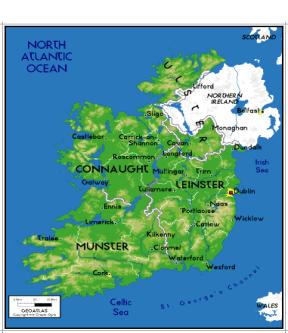 (www.britannica.com). In 1920, the governmental body of Ireland passed the Government of Ireland Act, which immediately divided Ireland into two parts.
Most of the Protestant’s of Northern Ireland longed for Great Britain to create a bond between the two countries. The picture above shows Ireland as a whole, then really distinguishes Northern Ireland from Ireland by coloring it white.
Protestants from both Northern Ireland and Great Britain wanted there to be a union created between the two nations. The Catholics on the other hand were in support of an independent Ireland, free from all foreign influence. The northern portion of the country made a pact and settled for the notion of British Home Rule. The whole idea of Home Rule was implemented in 1870. The rule was for the most part an attempt to establish Irish political clout working in accordance to the British Empire. (www.britannica.com) As a result of this rule, from 1920 until 1940, Northern Ireland acted as an openly sectarian state. Consequently, the Protestants were in a position of power in the political scene in Northern Ireland. This new situation favored Protestants and not Catholics. The Republic of Ireland was ultimately made a free state under the Anglo Irish Treaty. The treaty established the Republic of Ireland as a free state under the guidance of a British style parliament (www.britannic.com). Even with these changes, Northern Ireland remained a part of the United Kingdom. Starting with these developmental changes in Ireland’s then relatively young history, the split between Catholics and Protestants has been the cause of much hardship. The bulk of the confrontation has taken place in Northern Ireland due to the IRA campaigns against British supporters. All of the conflict appeared to have started when Protestants started to infringe upon the bounds of Irish society. Great Britain contributed to the continual dismay by trying to assert their hand in the political situation of the society.
The Irish Republican Army was at its roots developed from Irish volunteers that supported a sovereign Irish state free from all outside British intervention. The original intent for the IRA was to deter any further British action and influence after what became known as the Easter Rebellion. On a different note, the Sinn Fein the IRA was initially developed from the Irish Volunteers who supported a sovereign Irish state free from British intervention. The IRA was founded to deter against further British action after the Easter Rebellion. Although never officially paired together, the Sinn Fein allotted the IRA leverage to combat the British’s intervention by using guerilla-like military force (www.britannica.com).
The IRA began to make a definite impact in Ireland during the Irish War of Independence (1919-1921). This conflict was between the Irish Republicans and the British. In it the IRA used guerilla warfare and strategic bombing to combat their enemies. This war in time forced the British to recognize the Irish republic as a free state under the Anglo-Irish Treaty. The majority of the IRA’s soldiers accepted the treaty, but there were a definite group that did not approve of the compromise. A great deal of the IRA’s members would not support Northern Ireland becoming a part of the United Kingdom. This then forced the two sides to identify themselves as such. Those members that approved the treaty and supported it were named the Official Free State Army, and those who opposed the deal were named the Irregulars (www.britannica.com).
The attention throughout the early 1920’s turns to the Irish Republic’s Civil War. From 1922 through 1923 the Irish Republic was engaged in a civil war. The Official Army was able to defeat the “Irregulars.” In the time following their defeat, the Irregulars organized several campaigns that they believed could unify the Irish Republic (www.britannica.com). The Irish House of Representatives declared the IRA illegal in 1931. This further goes to show the level of unrest that was still present in Ireland. This shows the unrest and tension that was growing in Ireland. Although extreme, the IRA was once a large factor in freeing Ireland from British influence. By 1931, most of Ireland perceived the IRA as a brutal, unlawful group. Catholics, on the contrary, at this point most Catholics deemed the IRA malevolent. This caused the IRA to be labeled illegal in 1936 for the second time. The term “labeled” is used because this jurisdiction had a very small effect on IRA campaigns. The IRA took the focus of its attacks to England in 1939. Pending the years of World War II, the Free State Government had no control of the IRA. During the devastating world conflict, the IRA concentrated on attacking England. The Irish Free State withdrew from the British Commonwealth in 1948. At this time, the IRA devoted the majority of its attention to the unity of Northern Ireland with the Irish Republic (www.britannica.com).
Creating any influential uprising in Northern in the late 1960’s was very difficult. Catholics had started an uproar in the north consisting of civil rights protests against the Protestants that sparked a time of heavy persecution. The IRA was reinstated when Protestant activists began killing protestors to try and curtail such activity. The IRA began targeting British officials and Northern Ireland Protestants. In 1969, after a Sinn Fein political conference, the IRA dispersed again; this time into the Official and Provisional wings. The Official Wing represented a Marxist political and social order, while the Provisional Wing represented the Ulster (Northern Ireland) Catholics that wanted to exterminate Northern Ireland of British influence. (www.britannica.com) In the early 1970’s, the Provisional IRA went through with a series of attacks in Northern Ireland and England.
From 1970 up to 1996, the Provisional IRA was responsible for at least 3,000 deaths. Despite IRA persistence, the English refused to remove troops and continued to dominate Northern Ireland commerce. In 1994 the IRA and Great Britain engaged in secret peace talks that ended in a brief two- year ceasefire. By 1996 IRA attacks were once again underway (www.britannica.com)
Today, Northern Ireland is still a member of the British Empire; however, the conflict has remained. Two fifths (40%) of the population is Catholic. While the remaining three fifths (60%) are either Presbyterian or Episcopalian. The major cities of the Ulster counties are divided up differently. In Belfast, less than one third of the population is Catholic. In Londonderry there are more Catholics than Protestants.
Today, the conflict in Northern Ireland is a direct result of the history of events that have shaped the development of both, the Republic of Ireland and Northern Ireland. It began as a direct reaction to Religious difference, and now involves lasting political and social consequence. In present say Ireland there are three contrasting entities that contribute to the conflict. There are the civilized political parties of both Northern Ireland and the Republic of Ireland, and the illegal, uncivilized IRA. Although a united Ireland would be great, the compromise is too great to satisfy. The Protestants in the north favor being a part of the United Kingdom. Even though the extremist Catholics in Northern Ireland feel that the British are unjustly intervening, nothing can be done to appease both sides. A compromise has never been enough for the IRA. They simply want a completely free and united Ireland. Let’s hypothetically consider a united Ireland. Catholics would be a heavy majority, and the Protestants would be extremely disadvantaged in political and social situations. There would also be present the lasting effects for the events that have taken place this century. The problems will linger on no matter the circumstances due to the development of the conflict.
My great-grandmother, Anna Lowrie was involved in this conflict. She was a Catholic living in the Ulster town of Derry. Heavily persecuted, she decided to leave Ireland when she was in the eighth grade. She left her family after her mother died, and came to America alone, in search of freedom. If you understand my great- grandmother’s persecution, you can sympathize with the Catholics. They are definitely at a disadvantage in Northern Ireland. The Protestants rule almost every aspect of life. The IRA might be too extreme, but consider the conflict. The Protestants migrated to Northern Ireland, and fazed Catholics out of societal importance. In some respects they stole the lives of Catholics, and used British support to justify their conquest. My great-grandmother was a victim to this conquest. Look what she did; she escaped the persecution. Although it might be easy to blame the IRA, and label them unjustified, the British and persecuting Protestants are just as responsible for the turmoil.
Throughout the eighties and early nineties, civil war was rampant in El Salvador between the government and the Farabundo Marti National Liberation Front (FMLN), a group seeking religious equality. All through this war, anyone assumed to oppose the government became sufferers of human rights violations, including subjective arrest, torture, and execution. Human rights defenders paid a lofty a price for their genuine activities exploiting government abuse during the war. In addition to that, those directly accountable for these violations have gone unpunished for their unsightly crimes.
 Arguably the most well known advocate for the human rights cause is the Archbishop of San Salvador, Monsignor Oscar Arnulfo Romero y Galdamez. He was assassinated while attending mass in a chapel in San Salvador. During the conflicting times, he had developed into an outspoken opponent of human rights violations and an important human rights defender. In March of 1980, he wrote to Jimmy Carter, asking for the U.S. not to supply military assistance to El Salvador assuming that the aid would probably be used to commit human rights violations. As a result of this he was assassinated shortly after.
During Reagan’s presidency in the early 1980’s, comparable to Jimmy Carter’s plan, the U.S. was supplying military aid to El Salvador. This military equipment was seen as the U.S. “contributing instruments of death and violence” in contrast to aid that would help the existing state of affairs (http://members.aol.com). It was eminent that “there was an extremely high prospect that American military paraphernalia will be used primarily ‘against whole communities of Christians, and very likely against selected church employees’.” (http://members.aol.com) With regard to this situation in which apparent help is modified into having negative effects is controversial and wrong. While El Salvador occupies the smallest area in Latin America, it is also contains the highest population. More than half the inhabitants are farmers, and approximately a third of the students who begin in primary school end up graduating. Without sufficient income and education, the people of El Salvador were unable to rebel against a corrupt and suppressive government. More than ten thousand people died due to the existing conflict. Consequently, President Reagan’s advisors viewed El Salvador as a place of altercation between democratic ideals and communist revolution. The Archbishop John Quinn of San Francisco was quoted as saying: “The oligarchy as a whole has never acknowledged the social teachings of the church and resists any attempt at improving the situation of the impoverished of the country…All of this, in turn, only plays into the hands of the leftist groups who, with some justifiable grounds, can say that they have no other course and that they are the only resistance to the shocking and widespread violation of human dignity and civil rights”(http://member.aol.com). It is no surprise that civil war broke loose in El Salvador. Because certain religion was opposed, human choice was being challenged and the oppressed had grounds for revolt.
The murder of Archbishop Romero was investigated by the Commission of the Truth for El Salvador (Truth Commission), designed under the Peace Agreements of 1992 between El Salvador and the FMLN. In its report from 1993, the Commission decided that Former Major Roberto D’Aubuisson gave the command to assassinate the Archbishop and gave exact instructions to members of his defense service, posing as a “death squad”, to arrange and oversee the assassination
There is complete evidence that the Supreme Court had an extensive role in preventing the removal of former Captain Saravia who was involved in the assassination, from the United States and his succeeding imprisonment in El Salvador. By doing so, it ensured, interlaid, impunity for persons who designed the assassination. (www.amnesty.org/salvador.htm)
As of now, no one has been held responsible for the killing of the Archbishop. In 1992, the government and the FMLN signed a definite peace treaty in Mexico City after debate mediated by the UN. On December 15, 1992, the armed conflict was officially ended. Unfortunately, human rights defenders are still the targets of attacks for their efforts to protect and promote fundamental rights and freedoms.
One of the contributions to the effort left by Archbishop Romero was the Commission on Human Rights of El Salvador (CDHES), which he assisted to create. The CDHES was founded on April 1, 1978 by an assembly of university students and professionals with the plan of promoting and instilling respect for human rights. It has been an object of repression ever since and has suffered greatly for its efforts. Many of its members have been murdered or disappeared as a result of their loyalty and contributions on behalf of the victims of violations of human rights.
An additional human rights defender taken by force was the Press Coordinator of CDHES, Maria Magdalena Henriquez, who was kidnapped by police in civilian clothes in October of 1980. In March of 1983, the armed forces killed CDHES President Marianella Garcia Villas. There were dissimilar versions about the occurrences, which led to her death, ranging from a claim that she was amongst the fatalities in a massacre carried out by the “Atlacatl”, a Battalion of Rapid Reaction, in La Bermuda. There were differing allegations such as she was tortured for many hours and then murdered by the military as opposed to the government version in which she had been killed in an altercation with the military.
Even after the conclusion of the civil war in El Salvador, in spite of the reduction in the amount of human rights violations, defenders have persistently been targets of terrorization, attacks or intimidation. In May of 1994, the offices of the Salvadorean Women’s Movement (MSM) and Madeleine Lagadec Human Rights Centre were busted into. Undisclosed gunmen murdered Alexander Rodas Abarca the following day; he was an active member of the National Police and affiliate of the security group for the Revolutionary Party of Central American Workers (PRTC), while he was guarding the offices (www.britanica.com).
In spite of much resistance to human rights violations, there is still trouble for activists. Government involvement seems to be advancing the issue instead of thwarting it. Religious conflict with the Catholic Church developed into fundamental inalienable rights all humans are inclined to have. Human rights protectors became the main opponents in the fuss, instead of the church officials. Most of the interior conflicts in El Salvador basically revolved around the conflicting opinions of theology. However, in an effort to achieve worldwide justice, the common struggle for all human rights took over. Religion merely jump-started the fight in El Salvador. The poor people are not only struggling to survive another day, but they are furthermore in a battle against a government that should look after their best interests and safeguard the well being of the country. The citizens of El Salvador had their rights taken away from them. Peace accords and other allegedly helpful treaties have not aided much in the efforts of hoarding basic human rights and maintaining standards of human decor.
The conflict between Israel and Palestinian is described as a struggle between rival national movements. 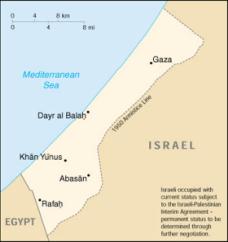 One being a Jewish led nation and the other an Arab, both fighting over a small strip of land between the Mediterranean Sea and the Jordan River. The fighting broke out in an eruption on September 29, 2000. A Palestinian intifada (Arabic for “uprising”) started in the light of a failed peace agreement at Camp David. According to Israeli leaders Yasir Arafat broke a series of pacts that were established in 1990. He resorted to terrorism after urging a generous Israeli proposal at Camp David and used violence as a political tool. The Palestinian leaders claim that Israel never made an attempt to make a legitimate peace offer. Palestine continues to illegally occupy the West Bank and the Gaza Strip.
As of late August 2002, the number of Israelis that have died is around 600 and the number of Palestinians is an outrageous 1,600. Of the 600 dead Israelis, 470 were noncombatants and 620 Palestinians were noncombatants. Israeli troops refuse to let up on the Palestinian targets. Entering West Bank cities and refugee camps, shelling targets that are linked to Arafat’s regime, and attempted to kill Palestinian militants that were described as 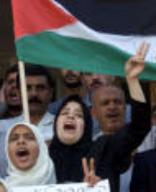 ticking time bombs. An Israeli human rights group called B’tselem says that more than 50 civilians have died in these attacks. The picture to the side shows Palestinian civilians rallying for peace.
The question now is peace an option. Literally thinking, there is no chance for real peace, the most reasonable option is a cease-fire. CIA director George Trent was sent to try and work out a cease-fire between the two nations, but nothing came of it.
In March of 2002 the Bush administration, which was cautious of assuming the mediate roll sent only Secretary of the State Colin Powel in April. His trip although failed. After two more suicide bombings in June 2002, President Sharon declared that Israel would take control of territory controlled by the Palestinians until further terrorist attacks stopped. President Bush also called for a leadership change, getting ride of Arafat, and creating a temporary democratic state. Even though the diplomacy between the two nations has stopped, neither country can agree on how the fighting started or how it should end.
The Israeli and Palestinian conflict can be dated back all the way to biblical times, but more recently it can be tracked to World War I when the Ottomans were defeated and Britain was given a League of Nations mandate to control Palestine. With World War II looming, the once British-controlled Palestine broke out into civil war. The war included the Jews, the Arabs, and the British; it lasted for the greater part of four years, 1936-1939.
It is obvious that there is no simple solution to this religious war. It seems funny that a war like this would start with religious intentions and now both sides have turned to cold-blooded killing to try and gain this small strip of land. It goes to show you that religion is such a powerful thing, that people are willing to kill others and sometimes even themselves for the cause.
Mexico and El Salvador also have problems that exist correlating between human rights and religion. Mexico’s problems, in addition to El Salvador’s have ignited a great deal of interest from alternative parties. As it seems, the tendency for Mexico’s tension has consistently been concerning religious struggles as opposed to human rights. Human rights correlates to religion in the sense that both signify the individual’s right to behave as they wish. The conflict as aforementioned illustrates the struggles of faith.
The Mexican Constitution by definition gives its citizens protection of their rights of religion, which the government respects with a few minor drawbacks. The Mexican government maintains an open relationship with all of the religions practiced on their grounds. One of the few exceptions to the government’s allotted freedom is the state of Chiapas. In parts of this region, the government has maintained strict political, cultural and religious stipulations to limit the practice of free religion.
The immediate situation with respect to religious freedom draws parallels between the historical tensions between the Roman Catholic Church and the modern state. The Roman Catholic Church has been an intricate part of the political scene for a good deal of its three hundred years as a Spanish colony. The Catholic Church has continued to be a part of the political scene throughout the post-separation period and through the end of the Mexican Revolution and the late nineteen hundreds. The post-revolution period brought with it severe restrictions on the flexibility of the Church and members of the clergy, which illustrated strong anti-clerical feelings. The ongoing tensions that existed between the Church and the State ended after 1940, but there were still present the Constitutional limits, as enforcement became gradually more withstanding in the coming decades. (www.britanica.com) In the more recent past, 1992, the government established a more friendly relationship with the Holy See and relinquished almost all of their then current restrictions on the Catholic Church. The lifting of such restrictions included granting religious groups a legal status, giving them property rights, and relinquishing the stipulations for how many priests could be present in the country. Despite this new status quo for how the Church and the State are to relate to one another, the law still holds a separation between the church and the state
Even though Mexico is a highly populated land, it has no dominant makeup as far as its religious population goes. As the government has reported, approximately forty five percent of the state of Chiapas, Mexico, identifies themselves as Protestant. This state makes up the densest concentration of Protestants in the country. Other evangelical Protestant groups contend that the number of Protestants in this region is actually closer to sixty percent. With this being considered the tension that exists between the religious groups is understandable.
A very modern case of religious conflict ending in violence happened in the city of Chiapas, Mexico. Affairs were not easy between the Catholic Diocese of San Cristobal de las Casas, and the Government during the term of Bishop Samuel Ruiz, which stopped in April 2000. The state of affairs in Chiapas is a result of an intricate mix of financial, cultural, political, and spiritual tension. The San Cristobal Diocese’s foreign clergy are unable to get their visa status extended or rectified and has complained as a result. The government barred French Catholic priest Michel Chanteau in February 1998, who had been the priest for 32 years of Chenalho, Chiapas, because of immigration charges. Chanteau had the Government held responsible in public for the December 1997 Acteal massacre. In 1995, the Government along with two other priests from Chiapas expelled Father Loren Riebe. In March 1999, the Inter-American Commission on Human Rights realized that the priests’ rights of religious freedom had been infringed upon and suggested that the expulsion order be overturned. The Commission also posed the idea that the officials implicated in the case be investigated and approved. The Government maintains that the only reason the priests were expelled was because of their political action and discarded the Commission’s recommendations. (www.state.gov/www/global/human_rights) This extensive list of banished Church officials makes presents ambiguity as to what is actually happening in Chiapas for the numerous amount of people to be removed.
In addition to the church officials being barred, much violence has broken out in Chiapas, Mexico. In certain parts of Chiapas, local leaders of native communities often consider outside evangelical groups, including Catholics, to be an unwelcome influence, and certainly a possible economic and political threat. Because of this, many leaders made the order to expel particular persons with affiliation to mostly the Protestant group. In many cases, the process by which one was expelled was either by crop or home burning, assault, and sometimes murder. On July 18, 1999, the Catholic and Protestant groups collided and several Catholics were expelled from their homes. Those people, who were left homeless, migrated temporarily to the city of San Cristobal with the shelter of the State Secretariat for Attention to Indigenous Affairs. As a result, the government finally allowed the Evangelists to return home and paid them for all of the damage that had been incurred. As the year came to an end, it took approximately 250 police officers, federal and state officials, and several representatives of the state human rights commission to safely escort the Evangelists to their respective homes. Unfortunately, violence still occurred on a regular occasion after the matter seemed to be solved.
Although Mexico’s religious conflicts seem to be similar to those of El Salvador, Mexico is not really fighting a civil liberties battle with its government, but the controversy is coming from within quarreling religious groups. However, both countries are seeing the same results of violence, poverty, and death. According to Alfred Hennelly, “It is an irreversible thrust in the Christian process of creating a new consciousness and maturity in our faith. Countless Christians have committed themselves to a fresh and radical interpretation of their faith, to a new re-experiencing of it in their real lives. And they have done this not only as isolated individuals but also as influential and sizeable groups within the church.” (Hennelly 2) It seems as though some sort of pride has been adopted in the country regarding religion and they have turned to violence and death to determine which religion should stand as the “correct” one.
In essence, the way to effectively remedy these seemingly hopeless situations is to instill messages of civil rights and religious freedom by the respective governments. Also, there should be a public display for those who have supported the battle for human rights and the turmoil they have overcome in order to get the message out. Similarly, they should show support to the teams of overseers from the United Nations (UN) who monitors the human rights protection. To promote the Declaration on Human Rights Defenders within the UN would allow for the worldwide recognition of the defenders and the extensive work they do, and show support from its adoption by the UN. The reason that there is any sort of tension between groups is because of the monopoly of power by the corrupt governments and the extent to which they abuse their power by taking advantage of their people. All in all, the solution entails several aspects. Because peace treaties have been unsuccessful over and over again, it is time that a new political organization becomes strong and helps bring their country back out of its backward ways. The only difficulty with this is that the military has so much power within the government that the military has to be in accord with the rising political party. If a new party can step in, their experience with the past can help guide them to an effective term, which can turn their country’s misfortune to a brighter future. It is time that religious tolerance was addressed more explicitly as the rest of the world becomes more diverse and, hopefully, more open-minded about past conflicts that have historically lead to death.
It doesn’t seem to matter what country we looked at if they there was a problem that had to due with religion, there was no simple solution to it. Religion is a very touchy subject because people of the same religion can range from the occasional church go-er to the radical thinker. If there were a simple solution to religious problems the world would be a better place, but this is not the case; and because religion is held so deeply by so many people it is hard to change the views already ingrained in someone’s mind. The best solution to a problem like this is too educated the future generations. Children learn to be intolerant; they are not born that way. Literally thinking, there is no way to fix any of these problems within the next 10-20 years, but gradual steps toward a common goal would be a start that no one involved in these conflicts is willing to take.
Bibliography
“Catholics and Protestants in the Northern Ireland Labor Market.” 3/1/2003. www.ccsr.ac.uk/publications/newsletters/12/
catholicsandprotestantsinthe.htm.
“Central America and Mexico: Human Rights defenders on the Front Line.” 3/4/2003. http://web.amnesty.org/ai.nsf/Index/ AMR020011996?OpenDocument&of=COUNTRIES\EL+SALVADOR
“Central America and Mexico: Human Rights defenders on the Line: Update.” 3/4/2003. http://web.amnesty.org/ai.nsf/Index/AMR020041996?OpenDocument&of=COUNTRIES\EL+SALVADOR 10/12/1996
“Center for Reduction of Religious-based conflict.”3/3/2003 aps.naples.net/community/NFNWebpages/storyboard.cfm?StoryBoardNum=142&PageNum=140
“Defining human rights: The nature of Human Rights: Commonly Accepted Postulates.” 2/24/2003. www.britanica.com
“Human Right Violations-It's Happening Now and Most People Don't know about it or Don't Want To Know About It, But People Are Suffering So A Few People at the Top Can Have A Lot More Money Than They Deserve.” 3/5/2003. http://hometown.aol.com/violin39/opinions/index.htm
“United States Policies in Support of Religious Freedom: Focus on Christians.” 2/16/2003. http://www.state.gov/www/global/human_rights/970722_relig_rpt_christian.htm.