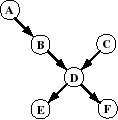
A Bayes belief net consisting of six nodes and its associated conditional probability tables are shown below.


 P(a1)

 P(a2)

 P(a3)

 0.5

 0.3

 0.2


 P(b1|ai)

 P(b2|ai)

 a1

 0.4

 0.6

 a2

 0.3

 0.7

 a3

 0.5

 0.5


 P(c1)

 P(c2)

 P(c3)

 0.2

 0.4

 0.4


 P(d1|bi,cj)

  P(d2|bi,cj)

 b1,c1

 0.3

 0.7

 b1,c2

 0.5

 0.5

 b1,c3

 0.9

 0.1

 b2,c1

 1.0

 0.0

 b2,c2

 0.4

 0.6

 b2,c3

 0.7

 0.3


 P(e1|di)

 P(e2|di)

 d1

 0.1

 0.9

 d2

 0.8

 0.2


 P(f1|di)

 P(f2|di)

 P(f3|di)

 d1

 0.1

 0.5

 0.4

 d2

 0.8

 0.0

 0.2

Problem:

a) Compute the probability P(a3,b2,c3,d1,e2,f1).
 
b) Compute the probability P(a2,b2,c2,d2,e1,f2).
 
c) Suppose we know the net is in the following (partial) state of evidence e: a3,b1,c2. What is the probability P(f1|e)? What is the probability P(e2|e)?
 
d) Suppose we know the net is in the following (partial) state of evidence e: f1,e2,a2. What is the probability P(d1|e)? What is the probability P(e2|e)?
 
e) Suppose we know the net is in the following (partial) state of evidence e: a2,c3,e1,f2. What is the probability P(d2|e)? What is the probability P(d2|e)?