|  Charlie’s
Angels and Crouching Tiger, Hidden Dragon both present
female characters that are empowered by their physical strength,
self-reliance, and power to protect themselves. The two films
treat the sexuality of their heroines differently, however:
in Charlie’s Angels, the Angels use their sexuality
to empower themselves by performing typically patriarchal
stereotypes of women, thus denying the female characters
agency over their own sexual expression; in Crouching Tiger,
the young female fighter’s
agency allows her to express both her physical and mental
power Charlie’s
Angels and Crouching Tiger, Hidden Dragon both present
female characters that are empowered by their physical strength,
self-reliance, and power to protect themselves. The two films
treat the sexuality of their heroines differently, however:
in Charlie’s Angels, the Angels use their sexuality
to empower themselves by performing typically patriarchal
stereotypes of women, thus denying the female characters
agency over their own sexual expression; in Crouching Tiger,
the young female fighter’s
agency allows her to express both her physical and mental
power 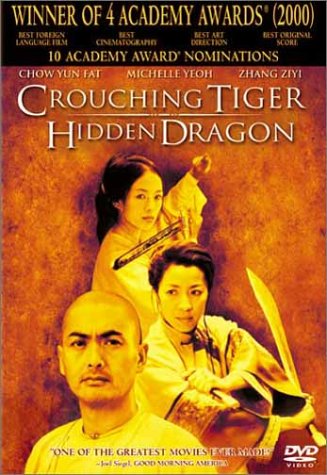 and
her sexuality on her own terms, and shows her empowerment
to be the source of her sexual agency. and
her sexuality on her own terms, and shows her empowerment
to be the source of her sexual agency.
These
observations might lead one to conclude that the feminist messages in
Crouching Tiger are more complete and authentic than those
in Charlie’s Angels. That conclusion would be premature without
an examination of the factors that could be attributed to
the different portrayals of women’s sexuality in the films.
In this paper, I will first describe in more detail each
film’s treatment of its heroines sexuality and sexual agency;
then, I will analyze the differences in genre and in cultural
that might explain this disparity between the two films'
representations of their characters. This analysis will reveal
that although these two factors can explain some of the differences,
ultimately the representations of the Angels give them less
sexual agency than do the representations of Jen in Crouching
Tiger.
|