| A
Cinderella Story, Still a Tale of Male Hegemony |
| Stephanie
Myers |
|
Film is a commercial industry, there is no doubt about that. So, while Andy Tennant, writer and director of Ever After, says he created the strong willed and independent lead character of Danielle with his daughter in mind, we must question his true motivation for making the film. Were his good intentions complicated by a capitalistic drive to be successful at the box office, because if they were he probably would not create a radically feminist interpretation of a story that, in its traditional form was Disney’s most successful project. The same issues are relevant when examining the Rodgers and Hammerstein text since few social norms and stereotypes seem to be challenged besides the fact that the cast is drawn from a “rainbow” of races. We say we want to see more transgressive representations of women in the media, bit are yet to reshape the social mold because filmmakers with the potential to do so are too afraid to take a loss on their investment. We, as an audience, need to take some responsibility for this situation and take it upon ourselves to demand strong female characters. The time has come to put our money where our mouth is and make a real difference, or generations of little girls after us will still watch these movies thinking, “Someday, my prince will come.” |
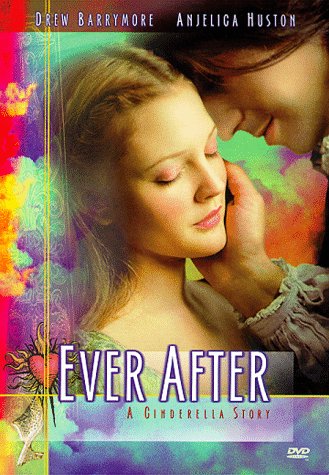 At
first reading you might, as I certainly did, embrace and celebrate contemporary
film adaptations of Cinderella as groundbreaking feminist retellings
of what was a tragically oppressive fairy tale when Disney presented
it in 1950. But upon further investigation, we find only more of the
same patriarchy perpetuating symbols and messages that saturated old
versions. Ever After and Rodgers and Hammerstein’s Cinderella
of 1997 still lack real, strong, positive female mentors for Cinderella.
The fairy godmother, who may be analyzed as the catalyst to Cinderella’s
improved self-image could also be seen as encouraging Cinderella to
deny her true self in an attempt to impress a man who’s resources
could erase all her problems. The only living model of female maturity,
the stepmother is one that rejects traditional notions of femininity,
but this statement is problematic because it is this woman who provides
the source of conflict. And in the end, conventional romantic narrative
is preserved as Cinderella’s ultimate happiness is realized not
when she finds and accepts her true, but in her union with a man.
At
first reading you might, as I certainly did, embrace and celebrate contemporary
film adaptations of Cinderella as groundbreaking feminist retellings
of what was a tragically oppressive fairy tale when Disney presented
it in 1950. But upon further investigation, we find only more of the
same patriarchy perpetuating symbols and messages that saturated old
versions. Ever After and Rodgers and Hammerstein’s Cinderella
of 1997 still lack real, strong, positive female mentors for Cinderella.
The fairy godmother, who may be analyzed as the catalyst to Cinderella’s
improved self-image could also be seen as encouraging Cinderella to
deny her true self in an attempt to impress a man who’s resources
could erase all her problems. The only living model of female maturity,
the stepmother is one that rejects traditional notions of femininity,
but this statement is problematic because it is this woman who provides
the source of conflict. And in the end, conventional romantic narrative
is preserved as Cinderella’s ultimate happiness is realized not
when she finds and accepts her true, but in her union with a man.