| Be
Angry! Fight Back! (But don’t really…): The Contained Reality of Jim
McKay’s Girls Town |
| Ara
Kim |
|
The mid-90’s were witness to a crop of new feminist filmmakers willing
to depict girls in “real” and socially unexpected ways. One of them,
Jim McKay, wanted to make an empowering film for young
Some critics feel the
answer is very successfully, hailing Girls Town as one of the most realistic
films about young women ever made. Others are of the opposite opinion,
calling the movie a work of pure fantasy, criticizing it for the girls’
absolutely consequence-free spree of vengeance. I argue that the film
is neither completely realistic nor completely fantastical, but rather
a movie with a contained reality. Girls Town recognizes the real and
valid existence of girls’ anger, yet in its overt avoidance of consequences,
it seems to suggest that this anger is socially acceptable only in the
context of filmic fantasy. Though it loudly produces a rallying cry
for girls to fight back, it fails to address how girls can do so in
a culture that will punish them for it. It is fine for the characters
of Girls Town to be violently angry—they live in a world without consequences—but
how are real girls supposed to do the same and navigate through the
social rules that tell them they cannot? The question is one McKay was
apparently unwilling to face. By situating his characters’ anger in
a fantasy world, McKay reveals that he too is unwilling to challenge
the real world social unacceptability of anger in girls, thereby weakening
his film’s rallying cry. In the end, Girls Town, in its eventual surrender
and containment of its gritty realism, is emblematic of the extent to
which the social unacceptability of anger in girls is ingrained within
our cultural conscience. |
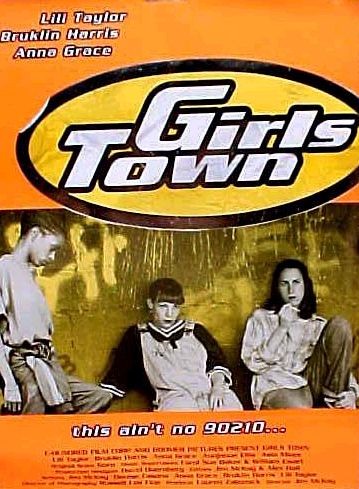 women
that defied the deep-rooted convention that girls never express anger.
Revolving around three girls who choose to fight back against the men
who have wronged them, his film Girls Town is a celebration of anger
in girls as a means to confidence, agency, and resistance. Where society
traditionally constructs angry girls as the mythic “bitch” or “shrew,”
Girls Town attempts to portray them as nothing more than just honest
girls who express an anger that is real and natural. Yet the question
remains, how successfully does McKay’s depiction of girls defy traditional
convention?
women
that defied the deep-rooted convention that girls never express anger.
Revolving around three girls who choose to fight back against the men
who have wronged them, his film Girls Town is a celebration of anger
in girls as a means to confidence, agency, and resistance. Where society
traditionally constructs angry girls as the mythic “bitch” or “shrew,”
Girls Town attempts to portray them as nothing more than just honest
girls who express an anger that is real and natural. Yet the question
remains, how successfully does McKay’s depiction of girls defy traditional
convention?