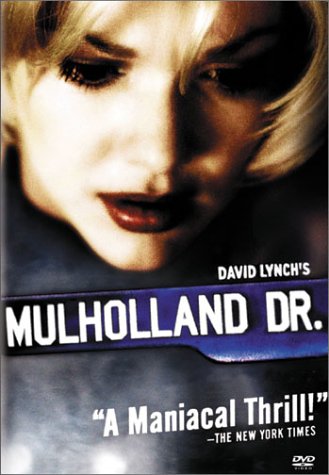
 David
Lynch’s Mulholland Drive creates a vivid world of illusion through the dreams
of a dysphoric and ultimately tragic aspiring actress whose failed hopes
become the core of an elaborate fantasy designed by the director to
convey Diane’s ideal of a glamorous and exciting Hollywood life while
modernizing and satirizing both the genre of film
noir and the film industry itself along the way.
In her dream, Diane retains some semblance of self as Betty –
still blond, still an aspiring actress – but she is also a perky, idealistic,
and naive young woman who manages to get the adventure, get the part,
and, in a clever twist on classic noir
romance, get the girl. This
dream is presented to the audience for the first two-thirds of the film,
and while viewers are captivated by the vivid imagery and the atmosphere
of suspense, they are also confused by the seemingly random events,
people, and objects that weave their way in and out of the story.
Even when reality is revealed, and we see that Betty is actually
Diane, whose Hollywood experience is the nightmare of a dead-end acting
career and a disastrous relationship with the popular and successful
Camilla, the viewer is still lost amidst the confusion of the nonlinear
narrative and blurs between illusion and truth.
The differences between Diane and Betty are so stark that the
audience has difficulty believing they were even portrayed by the same
actress, Naomi Watts. Incidentally, Watts’ career offers an interesting real-life example
of the struggle to “make it big” that is depicted in the film, though
the difference is that she was strong enough to deal successfully with
the setbacks and frustrations inherent in acting, while her character’s
final act is grabbing a gun a shooting herself in the head. What factors drive Diane to such levels of desperation and psychosis?
Is the tragedy solely caused by the guilt she felt after realizing
she had essentially murdered the woman she claimed to love, or is it
more a result of an overall feeling of isolation and loneliness created
by the ruthlessly competitive nature of Hollywood – the loneliness that
perhaps drove Diane to become so unhealthily dependent on Camilla in
the first place. David
Lynch’s Mulholland Drive creates a vivid world of illusion through the dreams
of a dysphoric and ultimately tragic aspiring actress whose failed hopes
become the core of an elaborate fantasy designed by the director to
convey Diane’s ideal of a glamorous and exciting Hollywood life while
modernizing and satirizing both the genre of film
noir and the film industry itself along the way.
In her dream, Diane retains some semblance of self as Betty –
still blond, still an aspiring actress – but she is also a perky, idealistic,
and naive young woman who manages to get the adventure, get the part,
and, in a clever twist on classic noir
romance, get the girl. This
dream is presented to the audience for the first two-thirds of the film,
and while viewers are captivated by the vivid imagery and the atmosphere
of suspense, they are also confused by the seemingly random events,
people, and objects that weave their way in and out of the story.
Even when reality is revealed, and we see that Betty is actually
Diane, whose Hollywood experience is the nightmare of a dead-end acting
career and a disastrous relationship with the popular and successful
Camilla, the viewer is still lost amidst the confusion of the nonlinear
narrative and blurs between illusion and truth.
The differences between Diane and Betty are so stark that the
audience has difficulty believing they were even portrayed by the same
actress, Naomi Watts. Incidentally, Watts’ career offers an interesting real-life example
of the struggle to “make it big” that is depicted in the film, though
the difference is that she was strong enough to deal successfully with
the setbacks and frustrations inherent in acting, while her character’s
final act is grabbing a gun a shooting herself in the head. What factors drive Diane to such levels of desperation and psychosis?
Is the tragedy solely caused by the guilt she felt after realizing
she had essentially murdered the woman she claimed to love, or is it
more a result of an overall feeling of isolation and loneliness created
by the ruthlessly competitive nature of Hollywood – the loneliness that
perhaps drove Diane to become so unhealthily dependent on Camilla in
the first place.
Through this film, David Lynch seems
to be making a powerful statement about the corrupting forces people
must struggle against when trying to succeed in the film industry.
By focusing on an extreme example of one woman’s Hollywood dreams
gone awry, the film brings attention to the harsh reality of the industry’s
treatment of women and society’s expectations for what the “ideal” woman
is. In the case of Mulholland Drive, these pressures create the irreconcilable
conflict between Diane’s dreams and her reality which drives the entire
film; by examining Diane’s intense self-loathing
in conjunction with the idealism of her alter-ego Betty, I aim to extract
a social and psychological explanation for Diane’s downfall that could
give insight into the struggle all women have to reconcile the reality
of the limitations placed on them by society with the dreams whose actualization
depends upon breaking free from those limitations. |