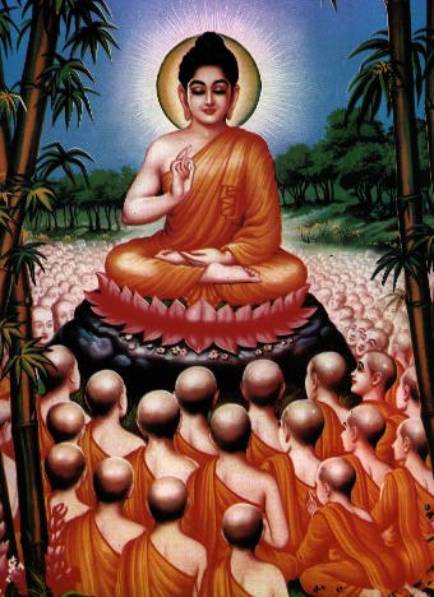
"How is a Buddhist?"
Sophomore College
Stanford University
2003
Syllabus
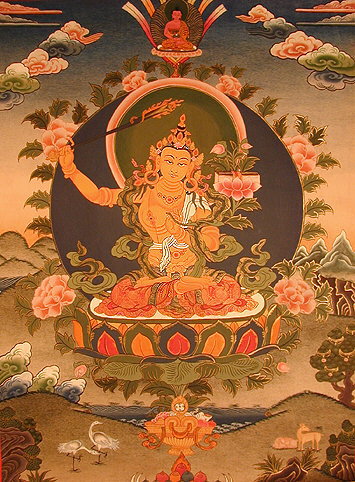
Manjushri is the Bodhisattva of Transcendent Wisdom.
The youthful prince carries with his right hand the double--edged sword able to
cut through illusion and with his left hand a blooming lotus that supports a
volume of the Prajna-paramita Sutra. He is depicted as a youth of sixteen years
in order to convey the Buddhist insight that wisdom is not a matter of mere
experience or years, but results from the cultivation of intellectual genius,
which can penetrate directly to the bedrock of reality. Wisdom is the most
honored virtue in Buddhism, called the Mother of all Buddhas, since only wisdom
makes possible the great bliss of total freedom from all suffering that is the
goal of all living beings. Thus, Manjushri is one of the most important of all
Buddhist deities, the veritable god of wisdom and herald of emancipation.
I solemnly prostrate to the Lama
and the Protector Manjusri whose knowledge, devoid of the clouds of the two
obscurations, is very pure and clear as the sun. He holds the book before his
mind so that all beings may see exactly all subtle meanings, for those person
imprisoned in the darkness of ignorance, confused and troubled in suffering.
From compassion for all, he
expounds in sixty kinds of eloquent speech.
His thundering Dharma voice
awakens all from sleepiness, releasing them from the iron chains of passion.
Holding the sword of wisdom, he clears away the suffering and obscurations.
From the first pure, after passing through the ten stages, all become the body
of the victorious son clearing away 112 kinds of mental obscurations.
To Manjusri I pay
homage.
(repeat this prayer as many
times as you are able)
Om Ah Ra Pa Tsa Na
Dhi
(repeat the mantra as many rimes as you are
able, then sit silently; then pray as follows:)
By the rays of your kind, supreme
knowledge, clear the darkened ignorance of my mind.
In order to understand the
teachings and the commentaries as in traditional canon, I beseech you to grant
the luminosity of confident wisdom.
An introduction by
way of a forethought
This Sophomore College, "How
is a Buddhist?", is not a Buddhist teaching. It is “about Buddhism”. What that means will be up to you to decide. Perhaps it is more like a Chemistry lab
than anything else.
However, it is, I think, strongly
influenced by Buddhist ideas. It
is an experiment in the same sense that the Buddha instructed his disciples not
to accept anything on the basis of what he had taught or what they read; they
were to accept only what they themselves experienced. Our purpose is to explore how a Buddhist views the universe,
understanding the concept 'universe' itself in Buddhist terms. To the extent that we believe that
education means not just the acquisition of more information but a real change
in the way we think or perceive, this Sophomore College belongs both to
Buddhist education and to education about Buddhism.
The Daily Schedule
September 4, 2002
Wednesday
10:00 a.m.
– 12:00 noon Introduction
Preliminary questions and basic
concepts; preconceptions, conceptions, first questions; “mental culture” and
“religion”; cosmology; the problem with different assumptions concerning the
nature of the “sentient being”
The problem of the “history of
Buddhism” and of “Buddhist History”
5:00 p.m. BBQ
7:00 p.m. Film: “The Little Buddha”
(at
Mark Mancall’s house)
September 5, 2002
Thursday
10:00 a.m.
– 12:00 noon The
Buddhist narrative. The Three
Jewels. “The Wheel of Life”
2:30 p.m. Film: “The Harp of Burma”
“Friends
in High Places”
7:00 p.m. Film: “The Jew in the Lotus”
September 6, 2002
Friday
9:30 a.m. –
12:00 noon The
Theravada Buddhist Tradition and the Thai Experience
Film: “I am a monk”
1:15 p.m. –
3:05 p.m. Sophomore
College Workshop:
Passion
vs. Pragmatism: Integrating Majors and Careers
September 8, 2002
Sunday
9:00 a.m. –
2:00 p.m. Visit
to Thai Buddhist temple, Fremont
September 9, 2002
Monday
9:30 a.m. –
12:00 noon Buddhist
aesthetics and the function of “art” in Buddhism;
tankas,mandalas,
and other instruments of mental culture
Film: mandala
1:15 p.m. –
3:00 p.m. Sophomore
College Workshop:
Overseas Studies Programs
3:15 p.m –
5:00 Sophomore
College Workshop:
Undergraduate
Research Opportunities
7:00 p.m. Faculty
Night
September 10, 2002
Tuesday
10:00 a.m.
– 12:00 noon The
concept and practice of practice
2:30 p.m. Film: “Lord of the Dance”
September 11, 2002
Wednesday
10:00 a.m.
– 12:00 noon Monastic
traditions
12:30 p.m. Departure
for the City of 10,000 Buddhas
mid/late
afternoon Arrival
6:00 p.m. –
7:00 p.m. Buddha
Hall: Worship
7:30 p.m. Dinner
September 12, 2002
Thursday
3:30 a.m. Wake-up
4:00 a.m. –
6:00 a.m. Buddha
Hall: Ritual, Meditation
to 10:30
a.m. Breakfast/Discussion,
followed by
mid-day
ritual
12:00 lunch
2:00 p.m. Discussion/Meditation
4:30 p.m. –
5:00 p.m. dinner
6:30 p.m. Buddha
Hall: ritual
Evening Lecture/Discussion
September 13, 2002
Friday
3:30 a.m. Wake-up
4:00 a.m. –
6:00 a.m. Buddha
Hall: Ritual, Meditation
to 10:30
a.m. Breakfast/Discussion,
followed by
mid-day
ritual
11:30 a.m. Departure
for Stanford
September 16, 2002
Monday
10:00 a.m.
– 12:00 noon Divine
Madness and Enlightenment
2:30 p.m. Film: “King of Masks”
September 17, 2002
Tuesday
10:00 a.m.
– 12:00 noon Introduction
2:30 p.m. Film: “Why has Bodhi-Dharma left for the
East?”
7:00 p.m. Departure
for Kannan Do in
Mountain
View
10:00 p.m.
(or before) Return
to campus
September 18, 2002
Wednesday
9:30 a.m. –
12:00 noon Tibetan
Buddhism: The Intellectual
Tradition
Film: “”Debate in the Tibetan Tradition”
2:30 p.m.
7:00 p.m. Tibetan
Buddhism: The tradition of
practice
Film: “The Medicine Buddha”
September 20, 2002
Friday
4:00 p.m. Departure
for San Francisco to see “Enlightenment Guaranteed” and attend reception
beforehand; perhaps final dinner, perhaps another time
10:00 p.m. Return
to campus
Stanford University
Sophomore College
2002
"How is a
Buddhist?"
Buddhism: Some Memory Aids
(but not for
attachment)
Just as no sweet smell is found in a latrine,
No happiness is found within the five types of being.
Lord
Maitrepa
I. Dimensions
for the comparison of religions
1. Practical
and ritual
2. Experiential
and emotional
3. Narrative
and mythic
4. Doctrinal
and philosophical
5. Ethical
and legal
6. Social
and institutional
7. Material
See: Smart, Ninian, Dimensions of the Sacred
(London: HarperCollins, 1996).
II. Major
Buddhisms
1. Theravada
(Hinayana): South and Southeast
Asia
2. Mahayana: Vietnam, China, Japan, Korea
3. Vajrayana
(a sub-set of Mahayana): Himalayas, Tibet,
Mongolia,
Buryatia,
Tuva, Kalmykia...
III. Buddhist Scriptures
1. The
Discourses: Sutra (Sutta)
2. The
Monastic Rules: Vinaya
3. The Scholastic Treatises: Abhidharma (Abhidhamma)
IV. The Wheel of Life
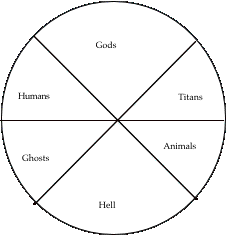
V. The Buddhist
Universe
Level Meditation
Level
(jhana)
|
31 |
Neither perception nor
non-perception |
8 |
ü
Sphere of |
|
30 |
Nothingness |
7 |
ý
formlessness |
|
29 |
Infinite consciousness |
|
ï |
|
28 |
Infinite space |
5 |
þ (arupavacara) |
|
27 |
|
4 |
ü |
|
- |
|
|
ï
Sphere of pure |
|
- |
|
3 |
ï form |
|
- |
Higher Gods |
|
ý |
|
- |
|
2 |
ï |
|
- |
|
1 |
ï (rupavacara) |
|
12 |
|
|
þ |
|
11 |
|
|
ü |
|
- |
Lower Gods |
|
ï
Sphere of |
|
6 |
|
|
ï Sense-desires |
|
5 |
Humans |
|
ï |
|
4 |
Titans |
|
ý |
|
3 |
Ghosts |
|
ï
(kamavacara) |
|
2 |
Animals |
|
ï |
|
1 |
Hell |
|
þ |
VI. The Four Noble Truths
1.
The Truth of Suffering:
Suffering exists
2.
The Truth of Arising:
Suffering arises from attachment to desires
3. The Truth of Cessation: Suffering ceases when attachment to
desire
0ceases
4. The
Truth of the Path: Freedom from suffering
is possible by practicing
the eightfold
path
VII. The
Eight-fold Path
1. Right Understanding ü
2. Right Resolve (thought) ý Wisdom
þ
3. Right
Speech ü
4. Right
Action ý Morality
5. Right
Livelihood þ
6. Right
Effort ü
7. Right
Mindfulness ý Meditation
(samadhi)
8. Right
Meditation þ
VIII. The Three Characteristics of Existence
1.
Transciency
2.
Sorrow
3.
Selflessness
IX. The
Five Hindrances
1.
Sensuous lust
2.
Aversion and ill will
3.
Sloth and torpor
4.
Restlessness and worry
5.
Skeptical doubt
X. The
Seven Factors of Enlightenment
1.
Mindfulness
2.
Investigation
3.
Energy
4.
Rapture
5.
Tranquility
6.
Concentration
7.
Equanimity
XI. The
Ten Perfections
1.
Generosity
2.
Morality
3.
Renunciation
4.
Wisdom
5.
Energy
6.
Patience
7.
Truthfulness
8.
Resolution
9.
Loving-kindness
10.
Equanimity
XII. The
Four Boundless States
These are considered
'friends' on the way to Nirvana, i.e., they help in dissolving
the idea of a separate self
1.
Loving kindness
2.
Compassion
3.
Sympathetic joy
4.
Equanimity
A 'near enemy' is a
quality that may masquarade as the original but is not,
while a 'far enemy'
is clearly the opposite quality
Quality Description Near
Enemy Far
Enemy of, or
loving-kindness good-will,
friendship, selfish love, hatred
unconditional
love self love
for
all sentient
beings
compassion empathy;
to feel pity cruelty
with,
instead of
for,
someone
sympathetic
joy spontaneous
joy hypocrisy envy
in
response to the
success
of others
equanimity even-mindedness indifference anxiety
based
on insight
into
the nature of
things
XIII. The Ten Fetter of Existence
1.
Self-delusion
2.
Doubt
3.
Clinging to ritual
4.
Sensuous lust
5.
Ill-will
6.
Greed for fine material existence
7.
Greed for immaterial existence
8.
Conceit
9.
Restlessness
10.
Ignorance
XIV. The Five Types of Beings
1.
buddhas
2.
disciples
3.
bodhisattvas
4.
the undetermined (who have the potential to become disciples or bodhisattvas
5.
those with no potential for enlightenment at all
XV. The Buddha's Three Bodies
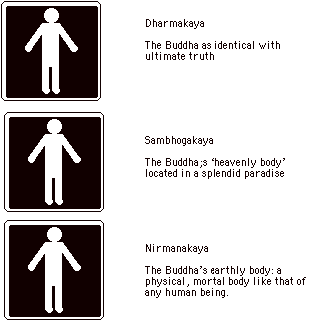
1. The Dharmakaya, the 'Dharma Body,' is the
Buddha's body that is one with the eternal dharma, the ultimate truth, which
lies beyond all dualities and conceptions, the fundamental buddha, the original
state of all things.
2. The Sambhogakaya, the 'Bliss Body' or 'Enjoyment
Body,' is the body that appears to the bodhisattvas in the celestial realm,
where they commune with the truth of the Mahayana. It may also be the body through which we are able to
understand and enjoy the bliss of enlightenment.
3. The Nirmanakaya, the 'Transformation Body,'
'Appearance Body,' or 'Manifest Body,' is the body in which the buddha appears
in the world for the benefit of suffering beings. It is not a real, physical body but rather something like a
phantom appearance assumed by the dharmakaya.
XVI. The
Five Aggregates (Skandhas)
1. Form is made up of
earth
water
fire
wind
2. Feeling is
pleasant
unpleasant
neutral
Feelings
arise when there is contact between the six internal organs faculties)
and the six external objects:
Internal
Organs External
objects
eye sight
ear sound
nose odor
tongue taste
body touch
mind thought
(mental objects)
3. Perception is related to the six external objects
4. Volition is the response of the will to the six external objects
5. Consciousness grasps the characteristics of the six external objects
Visual consciousness
Auditory consciousness
Olfactory consciousness
Gustatory consciousness
Tactile consciousness
Mental consciousness