A History of The Eye
Introduction
During antiquity, there was a focus on understanding the eye, which suggests that it was viewed as a very important part of the body. For example, Galen devoted an entire book to the eyes. Later during the Renaissance, writers wrote about dissections and the functional anatomy of the eyes, including the lids, lashes, cornea, and retina. For instance, Leonardo Da Vinci focused on the eye's structural anatomy. Interestingly, he observations often paralleled Galen's discussion and in some cases, could be read exactly word for word. Although Renaissance descriptions of the eyes often echoed those of antiquity and the Middle Ages, as time went on the eye did not get as much attention as it had during the earlier periods. The focus shifted to other parts of the body as seen in the work of William Harvey who only lightly mentioned the eye. The eyes became less important as new parts of the body were discovered and discussed.
Questions to consider: Why did Da Vinci describe the eye in similar terms as the ancient physicians even though anatomy was better understood? Why did the focus shift to other parts of the body that were thought to be more important?
A Collection of Quotations from Original Sources and Images of the Eye:
Antiquity
Galen, 200 A.D.
Referring to eye disorders: "The sight is injured when too much liquid escapes in couching (cataracts)"
Referring to natural eye protection: "He (the Creator) set the eyelashes in front like a palisade, so that small bodies, warded off by these hairs, might not readily fall into the open eyes and He established the eyelids themselves to be folded together and close the eyes if a larger body is encountered... Having been made small, the lower eyelid very clearly no longer needs to move at all."
Referring to tear ducts: "To give ease and lightness of movement, two glands (lacriminal glands) were also formed in each eye, one in the lower and other in the upper part and these pour forth moisture into the eyes from perceptible openings."
Referring to binocular vision: "For if he stands near a pillar and then closes each eye in turn, some of the things seen by the right eye on the right side of the pillar will not be visible to the other side."
The Middle Ages
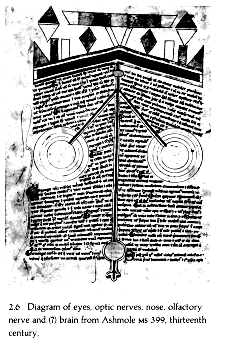
Master Nicolaus, ca. 1150-1200
"Two nerves arise from the cellula phantastica and cross in the middle of the forehead, one of them passing to the pupil of the right eye, the other to the left. Through these nerves visual spirits are conveyed to the pupils... The nerve in question is called the optic nerve, from the Greek word 'optos' which signifies visus in Latin."
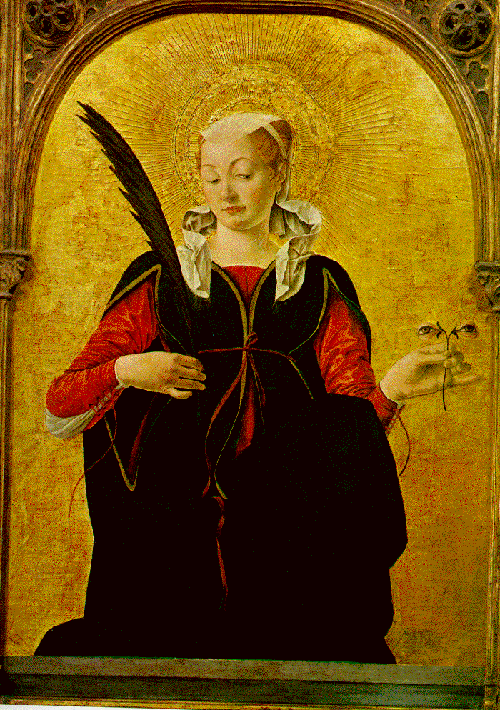
Lucy, saint of the eyes
The Renaissance
Pre-Vesalian Anatomists
Referring to natural eye protection: "The hairs are fixed at the ends of the eyelids to guard the eyes from external and very small things, such as dust. The eyelids are continued in this manner: the upper lid is united with the pericranium, the lower lid is united with the membrane which covers the lower part of the face." Niccolo Massa,
Referring to tear ducts: "...glandular, caruncula which retains humidity." Niccolo Massa,
Leonardo da Vinci, 1452-1519
Referring to the description of the eye: "The eye, the instrument of vision, is hidden in the cavity above, and in that below is the humor which nourishes the roots of the teeth."
"The optic foramer is where the visual power passes to the sensorium and the nasolacrimal is where the tears well up from the heart to the eye, passing through the canal of the nose."
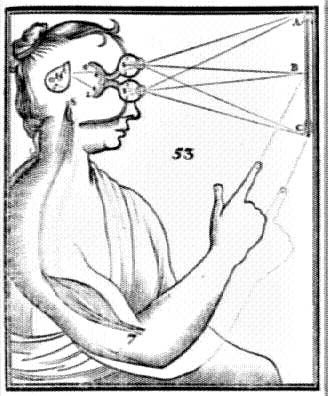
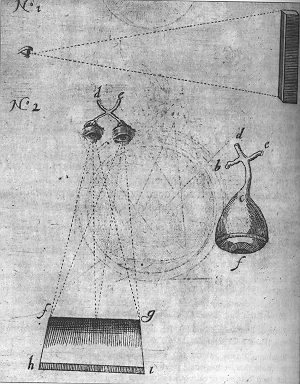
Descartes, 17th century developments
Conclusion