
A HISTORY OF THE HEART
Introduction
Ancient physicians, such as Galen, focused a great deal of attention on the heart and its central role in the body. In his treatise On the Usefulness of the Parts of the Body, Galen reaffirmed common ideas about the heart as the source of the body's innate heat and as the organ most closely related to the soul. However, he was not afraid to contradict others in matters of detailed anatomy, such as Aristotle's claim that the heart is the origin of the nerves. Although Galen urged his followers to continue in the same spirit of scientific observation and endeavor, his ideas would remain largely unchallenged for several centuries. During the Middle Ages, Avicenna attempted to identify the heart's function although he did not have a comprehensive understanding of its anatomy. He believed that the heart controlled all the other organs, and quoted Aristotle by saying that the heart is the "source of all [the] functions [of the body] though they are manifested in several principle organs." He also believed that the heart produced breath, the "vital power or innate heat" within the body, which was pumped through the body with blood by means of the expansion and contraction of the heart and arteries.
Even as late as the sixteenth century, the heart was still seen much as the ancients had viewed it. Complexion theory and other ancient physiological theories were present in the texts of writers such as Gabriel Zerbi and Andres De Laguna. But opinions about some long-existing theories were starting to change. For example, Leonardo da Vinci's view of the heart was definitely influenced by traditional Galenic physiological beliefs, although he did begin to understand the heart based on mechanical principles. Later William Harvey still supported the Aristotelian notion of the heart as the origin of all things, specifically the origin of all the heat of the body. Known to be situated at the fourth and fifth ribs and therefore at the center of the necessary body, it was also regarded as the place of perfection of the blood.
By the end of 17th century, the anatomical knowledge of the heart was surprisingly accurate. For example, they were aware that the heart was divided into four parts with two ventricles and two auricles as they called them. It was also known that the heart was surrounded by a pericardium with a humor like serum or urine to prevent the heart from becoming dry (pericardial fluid). Because the heart was regarded as the principal organ, it was believed that as long as the heart was running, a person could never die. Thus, throughout time, the heart has been placed at the center of life.
Questions to consider: Why was the heart very as such a significant organ? Why did medical writers begin to see the heart in terms of mechanical principle (e.g. as a pump)?
A Collection of Quotations from Original Sources and Images of the Heart:
Antiquity
Galen, 200 A.D.
"The heart is, as it were, the hearthstone and source of the innate heat by which the animal is governed."
"Nature established the heart in the very center of the cavity of the thorax because she found the place to be most suitable for protection and for uniform refrigeration from the whole body of the lung."
"The heart is a hard flesh, not easily injured. In hardness, tension, general strength, and resistance to injury, the fibers of the heart far surpass all others, for no other instrument performs such continuous, hard work as the heart."
"The complexity of [the heart's] fibers... was prepared by Nature to perform a variety of functions... enlarging when it desires to attract what is useful, clasping its contents when it is time to enjoy what has been attracted, and contracting when it desires to expel residues."
The Middle Ages
Avicenna, 980-1037
"[The heart is the] root of all faculties and gives the faculties of nutrition, life, apprehension, and movement to several other members."
"The pulse is a movement in the heart and arteries which takes the form of alternate expansion and contraction, whereby the breath becomes subjected to the influence of the air inspired."
"The heart [is] the source or starting-point of the vital power, or innate heat."
"The heart and the breath are the root of life, and they are both very "hot"--- indeed to excess. For life itself depends on the innate heat, and growth depends on the innate moisture. Indeed the heat is present in and maintained or "nourished" by moisture."
Renaissance
Pre-Vesalian Anatomists
"The heart is among all the viscera and members of the body the first root of the innate and vital heat of life."--Gabriel Zerbi, 1502
"The heart has only two ventricles, a right and a left. I do not know what is the meaning of the riddle proposed by the people who add a third ventricle to the heart unless perhaps they intend by it those pores which are found in the septum." --Andreas De Laguna, 1535
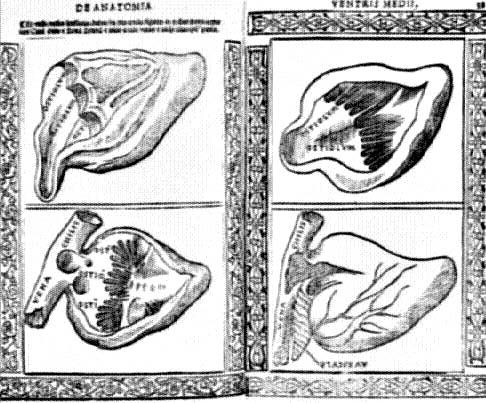
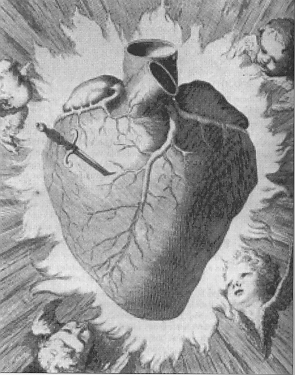
"If indeed from the heart alone rise anger or passion, fear, terror, and sadness; if from it alone spring shame, delight, and joy, why should I say more?"--Andreas De Laguna, 1535
Leonardo da Vinci, 1452-1519 (illustrations from Da Vinci's text)
"At one and the same time, in one and the same subject, two opposite motions cannot take place, that is, repentance and desire. Therefore, if the right upper [auricle] and lower ventricles are one and the same, it is necessary that the whole should cause at the same time one and the same effect and not two effects arising from diametrically opposite purposes as one sees in the case of the right ventricle with the lower, for whenever the lower contracts, the upper dilates to accommodate the blood which has been driven out of the lower ventricle."
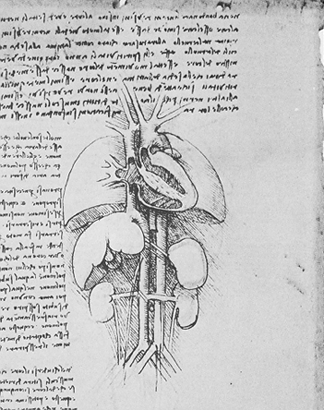
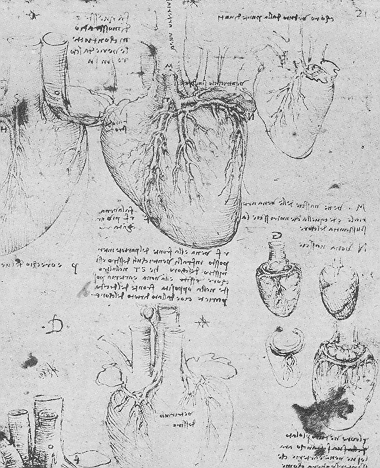
"The heat is generated through the motion of the heart and this is shown because the more rapidly the heart moves, the more the heat is increased, as the pulse of the febrile, moved by the beating of the heart, teaches us."
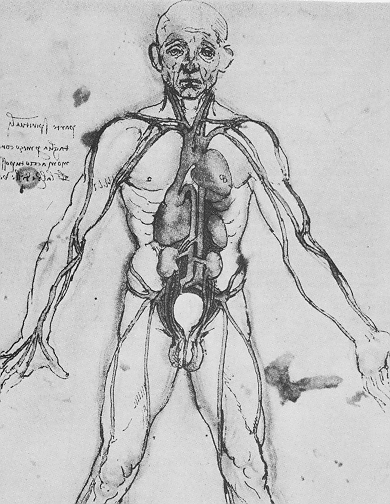
"The heart of itself is not the beginning of life but is a vessel made of dense muscle vivified and nourished by an artery and a vein as are the other muscles. The heart is of such density that fire can scarcely damage it. Nature has made this great resistance to heat so that it can resist the great heat which is generated in the left side of the heart by means of the arterial blood which is subtilized in this ventricle."
William Harvey, 1653
"The heart [is] an essential constituent of the body... that it may lodge the central source of heat. This part must be well protected, seeing that it is, as it were, the citadel of the body."
"The heart is very white, the auricles reddish and filled with blood."
"The heart is situated at the 4th and 5th ribs. Therefore [it is] the principal part because [it is in] the principal place, as in the center of a circle, the middle of the necessary body."
"Vigor results from the heat of blood; therefore [we have] the irascible [person]; on the contrary, [those] slow to fear, do not fear to become angry, for in them the bubbling of the blood [is] as a bubbling lake, but with great repose they swiftly cool down.. A hard heart [indicates blunt] sensibility, and a softer one, keen sensibility."
Conclusion
Return to History of the Body Home page