
A HISTORY OF THE NERVOUS SYSTEM
Introduction
During antiquity and the Middle Ages, common ideas prevailed about the function of nerves in the body. These ideas were heavily influenced by Galen. Galen believed that the brain was the source of the nerves. He attributed the spinal cord as an extension of the brain which carried sensation to the limbs. He believed that the nerves controlled the actions of muscles in the limbs, and the two functions, sensation and motion, were governed by two different types of nerves; hard and soft. Early medieval physicians, in agreement with Galen, believed nerves were offshoots of, and controlled by, the brain. Master Nicholas, however, becomes more precise than "hard" and "soft," calling those nerves involved in perception the sensory nerves, and nerves involved with motion, motor. Nicholas also blends Aristotle's belief that the nerves emanate with the heart with Galen's view of the body by describing how nerves create emotion in the heart. Avicenna also seems to understand the relationship between nerves and the senses. The association he makes between the "dryness of the nerves" and anger suggests that he believes that nerves are also responsible for emotions.understood the nerves' intimate connection with the brain, as well as with the rest of the body.
The writings of the Renaissance physicians reflect a mixture of ancient and medieval beliefs about the nervous system as well as new knowledge from anatomical dissections. Leonardo Da Vinci's treatment of the central nervous system is a good example of how physicians relied upon both the ancient tradition and current anatomical observations. In his earlier figures, Da Vinci drew upon physicians such as Avicenna and Albertus Magnus. Later, he used an injection technique to obtain casts of the cerebral ventricles and used frogs for physiological experiments on the nervous system. From his studies he concluded that the spinal cord was the center of life. Alessandro Benedetti was also able to break from the traditional interpretation of the nerves to objectively observe them by means of dissection. Although Benedetti still subscribed to the theory of 'spirit' he did infer that it was blood and nerves that were responsible for the sustenance of the body.
Harvey continued the Renaissance tradition of using anatomical observations as the basis for knowledge about the body. Harvey seemed to have a good sense about the relationship between the brain and nerves; he understood that nerves from the brain caused a distant limb or organ to both feel sensations and initiate movement. Through extensive anatomical studies, he identified many of the major nerves such as the optic, auditory, and olfactory nerves. He also studied many of the ancient texts, and contradicted some of the older accepted models of the nervous system. Yet still there is no sense that Harvey understood how nerves work or that they carry electric signals back and forth between the periphery limbs and organs and the brain.
Questions to consider: How did the Renaissance physicians incorporate ancient views of the nervous system into the knowledge gained from anatomical observations?
A Collection of Quotations from Original Sources and Images of the Nerves:
Antiquity
Galen, 200 A.D.
"Now, if the heart were the source of the nerves, as some who know nothing of what is to be seen in dissection, it would readily move these six muscles."
"I have shown in my book On the Teachings of Hippocrates and Plato that the source of the nerves, of all sensation, and of voluntary motion is the encephalon [the brain] and that the source of the arteries and of the innate heat is the heart."
"Hence, all the instruments of the senses--if we are to believe our eyes that see and our hands that touch them--communicate with the encephalon."
"The spinal medulla grows out from the encephalon as a trunk... and supplies nerves to all parts below the head."
"Since sensation consists in receiving impressions and since the motion which the nerves produce in muscles consists in acting, the soft nerve has properly been inserted in the eye, and the hard nerve into the muscles moving it."
The Middle Ages
Avicenna, 980-1037
"Sensation and movement are sometimes conveyed to a member through one single nerve, sometimes through several nerves. In each case the nerve is the source of the power."
"These are structures arising from the brain of spinal cord. They are white, soft, pliant, difficult to tear, and were created to subserve a) sensation, b) movement of the limbs."
"Nerves are one of the 'simple members' -- homogeneous, indivisible, the 'elementary tissues' (others include the bone, cartilage, tendons, ligaments, arteries, veins, membranes, and flesh)"
"Dryness in the nerves is the state which follows anger."
Master Nicolaus, ca. 1150-1200
"The optic nerve, which descends from the brain to the eyes, passes through the center of the eye as far as the crystalline humor, through it comes the visible spirit, and as it emerges through the uveal tonic and the cornea it is mingled with clean air and transports its rays to the body, and thus sight is brought about."
"All the nerves arise directly or indirectly from the brain."
"The brain also has subservient members, namely the nerves; for the animal spirits are carried by the nerves to all the members, endowing them with sensation, motion, and what not."
"Of [the nerves], some are sensory, others motor. The sensory nerves are those which serve sensation chiefly, serving motion only secondarily. The motor nerves act conversely. According to some authorities, all the sensory nerves originate from the cellula phantastica, the motor from the cellula memorialis. There are also five kinds of sensory nerves, which are classified according to the operations of the five senses, namely, sight, hearing, smell, taste, and touch. Two nerves arise from the cellula phantastica and cross in the middle of the forehead, one of them passing to the pupil of the right eye, the other to the left. Through these nerves visual spirits are conveyed to the pupils."
"Likewise, certain other nerves arise from the same commissure and pass through the whole length of the neck to the heart and surround the sides of the heart; by means of these, animal spirits are carried to the heart to produce the emotions, such as anger, joy, sadness, and the like, for all the operations of the mind and should originate in the brain and terminate in the heart. Still other nerves begin in the same commissure and pass through the whole length of the neck to the upper orifice of the stomach, where they terminate; by these, animal spirits are borne to produce appetite, for appetite is composed of two forces, namely, animal force and simple natural or appetitive force, which flourishes by the action of warmth and dryness."
"Also, other nerves arise from the same vertebra and go to the sternum, where they become superficial and connect the sternum with the spine, in order to bring about inspiration and respiration."
The Renaissance
Pre-Vesalian Anatomists
"In the Anatomy of the Living (Pseudo-Galen, De Anotomia Vivorum, fol. 53 ) the nerves are light to receive the spirit and thin in order to offer swift and easy passage to the spirit and flexible to serve the members."-- Alessandro Achillini, 1520
"There are seven pairs of nerves. Galen, however, says that anatomists do not count the two branches which pass to the nostrils. These provide the sense of smell; they are softer than the others and differ little from the substance of the brain. The second pair of nerves moves the eyes voluntarily through the forarnina which exist in the eye sockets. The third pair give sensation to the face. The fourth pair gives sensation to the diaphragm, viscera, and stomach. The fifth pair comes to the petrous bone to weave a panniculus with its fibers; by means of one part of this pair the sense of hearing is created. The sixth pair which is slender carries sensation to the palate and brings motion to the muscles of the throat. The seventh pair carries sensation and motion to the tongue." -- Alessandro Achillini, 1520
"By means of nerves, the pathways of the senses are distributed like the roots and fibers of a tree. The bones of the arms and legs and the ribs arise from the spine, hard, stable, heavy, as the firm foundation of the entire body. For this reason they are still and dry, without sensation, since otherwise they would be continually subject to pain. Their ends cohere to each other, one with a hollow end, another with a round end, or each one hollow as in the middle of a bone of the heel." --Alessandro Benedetti, 1497
"Two nerves go forth from each vertebrae. From them power is furnished to the hands, feet, and other parts of the body by which necessarily and fitly life is maintained since nerves provide the ability to feel and move." --Alessandro Benedetti, 1497
Leonardo Da Vinci, 1452-1519 (illustrations from Da Vinci's text)
"The entire body has its origin from the heart insofar as the first creation is concerned. Therefore the blood, the veins and the nerves do likewise, although nerves are clearly seen to arise entirely from the medulla (nucha), remote from the heart, and that substance of the medulla is the same as that of the brain from which it is derived."
"The nerves arise from the last membrane (pia) which clothes the brain and medulla."
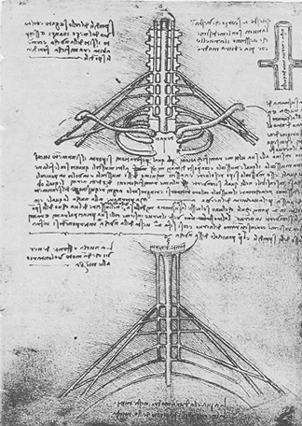
"The medulla is the source of the nerves which give voluntary motion to the members."
"There are as many branchings of the nerves as there are muscles, and there cannot be more nor less since these muscles are shortened or enlarged only because of the nerves from which the muscles receive their sensibility. And there are as many cords, the movers of the limbs, as there are muscles."
Helkiah Crooke, Microcosmographia, 1631
"The Nerves are nothing else but productions of the marrowy and slimy substance of the Brain, through which the Animal spirits do rather beam than are transported. And this substance is indeed more fit for irradiation then a conspicuous or open cavity, which would have made our motions and sensations more sudden, commotive, violent and disturbed, whereas now the members receiving a gentle and successive illumination are better commanded by our will and moderated by our reason."
William Harvey, 1643
"Since there is an organ of sensation, different sensible objects and images of the brain are distributed into the nerves."
"According to Avicenna, the nerves are like plantings of the brain, and provide ready intelligence for the organs of sensation; like the fingers of the hand; wherefore the brain neither sees or hears, yet knows all things."
"The anatomy of the nerves teaches that sense occurs in the brain."
"For the nerves only carry down, they do not act, move, nor are they sentient by a faculty, but are organs."
"Nerves from the brain carry sensation and motion to the muscles and organs."
Conclusion
Return to History of the Body Home Page