 Introduction
A History of the Arteries and Veins
Introduction
The veins and arteries of the human body have been objects of study as long as there has been interest in anatomy. Their significance, while not always understood, has been realized throughout history. The various analogies and descriptions of veins and arteries provide interesting insight into how our understanding of the circulatory system has evolved. As the quotations in this paper indicate, Galen established a foundation upon which the arteries and veins could be understood.
In the Galenic tradition, the venous and arterial systems were entirely distinct. Except for the small amount of blood that allegedly crossed through the pores in the central septum from one side of the heart to the other to mix with the spirits, the content of the two types of vessels was believed to be different . The veins contained blood, the arteries a mixture of spiritus and blood. They were associated with different principle organs as well, namely, the liver with the veins and the heart with the arteries. Their purposes were also distinct: the liver dealt with nutrition while the arteries were important for the dissemination of spiritus conveying vital virtue throughout the body.
Although several beliefs such as the idea that the arterial and venous systems are distinct elements has persisted to modern day thinking, there were several other viewpoints that helped transform Galenic views on arteries and veins. Conspicuous by its absence from this short collection of quotations is the recognition of the venous and arterial networks as belonging to a single sys em that works cooperatively to provide for the entire body with blood.
Questions to consider: Why did physicians believe that the arterial and venous systems were distinct and separate? Why did the Galenic model persist so long?
A Collection of Quotations from Original Sources and Images of the Arteries and Veins:
Antiquity
Galen, 200 A.D.
"One very large artery [the aorta] has been produced from the heart like a trunk divided into many branches and twigs."
"Nature seems to use the largest of the vessels like aqueducts, sending out to all the parts nearby in every region through which they go side-channels or conduits, as it were, which differ in size according to the worth and usefulness of the parts receiving them."
"Throughout the body the animal arteries are mingled with veins and veins with arteries, and both veins and arteries are mingled with nerves and the nerves with these...And of course the usefulness of such a complete interweaving is very evident, if, that is to say, it is a useful thing for all parts of the animal to be nourished."
The Middle Ages
Master Nicolaus, ca. 1150-1200
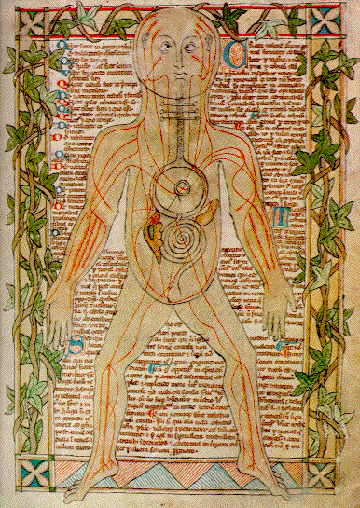
"The members derived from the principals are the nerves, veins, arteries, and seminal ducts. All the nerves arise directly or indirectly from the brain, all the arteries from the heart, all the veins from the liver."
"The animal spirits are carried by the nerves to the hand...the vital force is carried by the arteries to confer vitality, and so forth."
"As subservient members the liver has the veins, which provide it with nutrient blood."
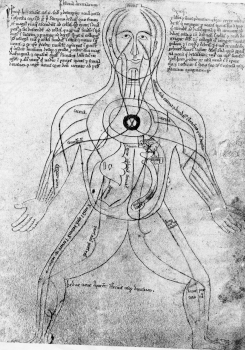
Medieval illustrations of the venous system
The Renaissance
Berengario da Carpi, ca. 1460-1530 (illustrations from Da Carpi's text)
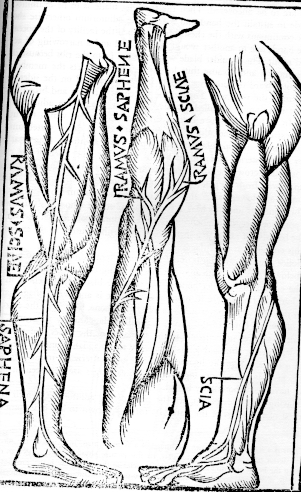 "There are many arteries and veins imperceptible
to the senses, such as those which go to the bones, the skin, and to the
extremities of the members."
"There are many arteries and veins imperceptible
to the senses, such as those which go to the bones, the skin, and to the
extremities of the members."
"There are more veins than arteries...The reason is that there are many cold members which by their nature do not require relief of secretions, for which also a little spirit is sufficient. Thus they do not have many arteries."
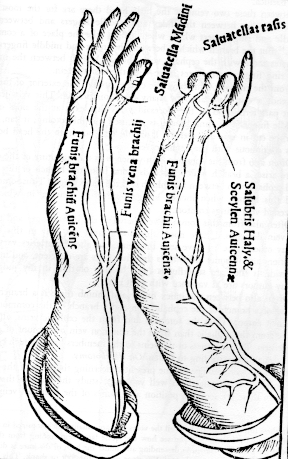
"There is no artery without its vein to accompany it. Thus the artery may keep the vein alive, and the vein may give blood to the artery in its needs, the blood by which the vital spirit is made and the artery itself is nourished."
"The aorta artery leads the vital spirit to the entire body of the living creature and maintains it during life."
Leonardo da Vinci, 1452-1519 (illustrations from Da Vinci's text)
"The plant never arises from the branchings, for the plant first exists before the branches, and the heart exist before the veins. The heart is the seed which engenders the tree of veins."
"All the veins and arteries arise from the heart. The reason for
this is that the maximum thickness found in the veins 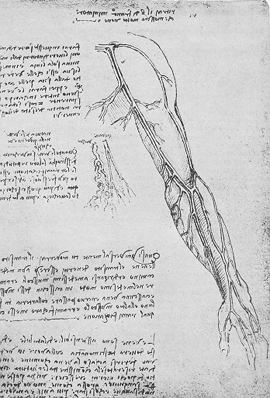 and arteries
occurs at the junction which they make with the heart. The more removed
they are from the heart, the thinner they become and divide into smaller
branches."
and arteries
occurs at the junction which they make with the heart. The more removed
they are from the heart, the thinner they become and divide into smaller
branches."
"When the veins become old they lose the straightness of their branchings and become more folded or foruous and the covering thicker as old age increases with the years."
"You will find almost universally that the course of the veins, and the course of the nerves occupy a common path, are directed to the same muscles, and ramify in the same manner in each of these muscles, and that each vein and nerve pass with the artery between one or other muscle and ramify in them with equal branchings."
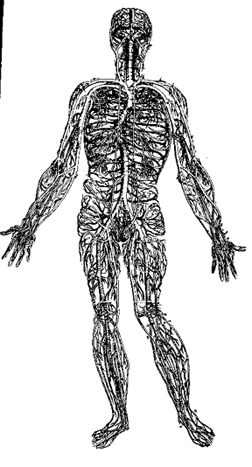
Helkiah Crooke, 1631 (illustration from Crooke's text)
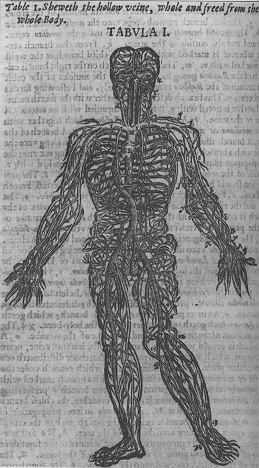
"The veins because their guest is not so subtle but a more cloudy and thick spirit, generated immediately out of the purer substance of the blood, have but a single coat, as being sufficient to contain a more quiet spirit. The arteries because their spirits are more sprightful and impetuous, moving always with the subsultation, and perpetually playing up and down, are made (so some think) sixfold as thick as the veins."
Andreas Vesalius, 1543 (illustration from Vesalius' text)
William Harvey, 1653 (illustrations from Harvey's text)
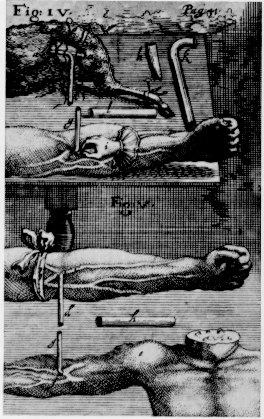 "Wherefore there are many valves in the veins opposed to the heart:
the arteries have none except at the exit from the heart. Hence the first
veins are pulsating, the latter are non-pulsating."
"Wherefore there are many valves in the veins opposed to the heart:
the arteries have none except at the exit from the heart. Hence the first
veins are pulsating, the latter are non-pulsating."
"The artery, like the vein, sends a branch into the liver and the vein divides and is continuous to the ventricles of the heart"
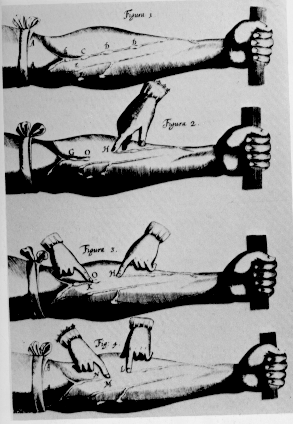
"The heart is perforated by the pulmonary artery, pulmonary vein, great artery, and great vein."
"The pulmonary artery, because of its duty and covering in the lungs has a double trunk with a thicker covering lest the thinner part of the blood, which is the nourishment of the lungs, transpire."
"The spirit passes hence into the great artery and thence into all."
"Blood is moved from the vena cave into the lungs through the pulmonary artery, and from the lungs through the pulmonary vein into the aorta."
Conclusion
Return to the History of the Body Home Page