|
1
|
- Andrew Wood and Dave Ryan
|
|
2
|
- May, 1962: Khrushchev makes veiled references to a plot (How would the
U.S. feel to have missiles pointing at them, as they have missiles
pointed at us?)
- September: JFK and Congress issue warnings to USSR that US will deal
harshly with any threats to national security
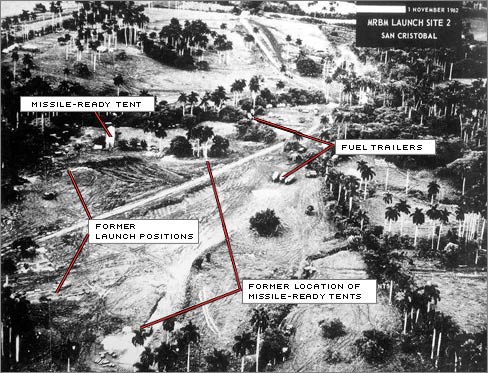
- October 14: U2 recon. flight over Cuba spots sites installing nuclear
missiles
- October 15: Presence of missiles is confirmed
|
|
3
|
|
|
4
|
- October 16: President Kennedy notified
- October 16-22: Secret deliberations on what should be done
- October 22: Kennedy tells nation his plan for blockade and quarantine
- October 23: OAS endorses naval quarantine
- October 24: Naval quarantine begins and successfully changes course of
many Soviet ships
|
|
5
|
- October 25: One Soviet ship challenges naval quarantine; Kennedy lets it
pass
- October 25: At the UN, Adlai Stevenson directly challenges the Soviet
ambassador to admit to the existence of missiles, when the ambassador
refuses, Stevenson wheels out pictures of the missile sites
- October 26: Soviets raise possibility for a deal: if we withdraw
missiles will America promise not to invade Cuba?
|
|
6
|
- October 27: Soviets demand that Americans also withdraw missiles from
Turkey; Major Anderson’s plane is missing over Cuba, presumably shot
down; U.S. recon plane strays over Soviet airspace…high tensions
- Kennedy tells Khrushchev that he will accept the proposal of the 26th,
Kennedy tells his brother to tell the Soviet Ambassador that though the
Turkey missiles would not be part of the bargain, they would be removed
in time
- October 28: USSR agrees to withdraw missiles
|
|
7
|
- Motivations
- Close the missile gap—Currently far behind U.S. in terms of number of
missiles
- Verbal threats no longer effective with overwhelming evidence of U.S.
superiority
- Protect Cuba
- Reciprocity: The U.S. has missiles pointing at us, let’s see how they
feel now
|
|
8
|
- Inability to use the missiles
- If fired a missile, repercussions would be severe
|
|
9
|
- Effectiveness of naval quarantine
- Conventional inferiority in the Caribbean
- No possible countermove
- Overwhelming world support for the U.S.
- Other possible reasons
- Got what he wanted?
- No U.S. invasion of Cuba
- U.S. missiles withdrawn from Turkey
|
|
10
|
- In September Kennedy had stated and Congress had passed a resolution
saying that if the Soviet Union placed offensive weapons in Cuba we
would not tolerate it.
- Could we then rely solely on diplomacy? Kennedys thought John could be
“impeached” if he didn’t act in accordance with his prior warnings
- Determined in first 48 hours of crisis that the removal of missiles was
the primary objective
- This objective effectively ruled out isolated diplomacy, and left two
options…
|
|
11
|
- Option 1 - Air Strike
- On October 17th, President Kennedy “made the flat statement
that there would definitely be an air strike, at least against the
missile sites, and perhaps against wider targets” (Bundy 394)
- Reservations from others, airstrike may be using a “sledgehammer” to
kill a “fly
- Later that day Robert McNamara suggests policy in between diplomacy and
an air strike
|
|
12
|
- Option 2 – Blockade
- Advocated early on by McNamara and Robert Kennedy, blockade would not
require instant killing, but critics feared it would not remove the
missiles and would allow Soviets time to complete what they already had
in Cuba
- Douglas Dillon strengthened blockade argument by suggesting that it
would only be a first step, that if Khrushchev did not remove the
missiles to lift it, then more could be done
- By Friday the 19th, the committee working on the blockade
adapted it into a quarantine, on Sunday Kennedy accepted their plan as
the course of action
|
|
13
|
- Could we have used the crisis to remove Castro?
- Our warnings all along had been against offensive weapons so once that
warning is tested if we use it to attack Castro are we sticking to our
word?
- Could we have tried diplomacy before resorting to the quarantine?
- If we didn’t keep secrecy, Khrushchev could have proclaimed defiance,
or denounced quarantine…then both countries would be in positions where
they’re heading straight for each other and can’t just turn back
|
|
14
|
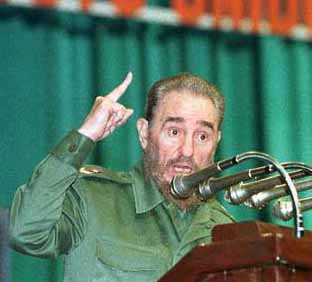
- No real role in decision making
- Apparently out of touch with the situation
- Oct. 26: “Aggression imminent/imperialists disregarding world
opinion”—Clearly not the case
- Khrushchev plays along to some extent but it is clear he disagrees with
him (“your suggestion would have started a thermonuclear world war”)
|
|
15
|
- Do you feel Major Anderson’s death justified more aggressive action?
- Seeing as how our options in the crisis were somewhat dictated by the
warnings we issued in September…should we have issued those warnings?
- Robert Kennedy likened an air strike to Pearl Harbor (Bundy 394), was
that a fair analogy?
- If the missiles in Cuba were conventional, and neither the Soviet Union
nor the U.S. possessed any nuclear weapons, would the crisis have been
avoided?
|
|
16
|
|

 Notes
Notes