|
1
|
- The official order states:
- "The 509 Composite Group, 20th Air Force will deliver its first
special bomb as soon as the weather will permit visual bombing after
about 3 August 1945 on one of the targets: Hiroshima, Kokura, Niigata,
and Nagasaki."
|
|
2
|
- March 25
- At the urging of Leo Szilard, Albert Einstein signs a letter of
introduction of Szilard to President Roosevelt. Szilard wishes to warn Roosevelt of
the post-war dangers of a nuclear arms race if the atomic bomb is used
against Japan. The letter states:
“The terms of secrecy under which Dr. Szilard is working at present do
not permit him to give me information about his work; however, I
understand that he now is greatly concerned about the lack of adequate
contact between scientists who are doing this work and those members of
your Cabinet who are responsible for formulating policy.” In the memorandum accompanying the
letter, Szilard wrote: “our ‘demonstration’ of atomic bombs will
precipitate a race in the production of these devices between the United
States and Russia and that if we continue to pursue the present course,
our initial advantage may be lost very quickly in such a race.”
|
|
3
|
- April 12
- Franklin Roosevelt dies, and Harry Truman becomes the 33rd President of
the United States.
- April 25
- Secretary of War Stimson and General Groves brief President Truman on
the bomb. In this briefing,
Groves insists that Japan had always been the target of the bomb’s use.
- April 25
- Joint Chief Planners advise Joint Chiefs of Staff that “unless a
definition of unconditional surrender can be given which is acceptable
to the Japanese, there is no alternative to annihilation and no prospect
that the threat of absolute defeat will bring about capitulation.”
|
|
4
|
- April 27
- The Target Committee meets for the first time to decide which Japanese
cities to target with the atomic bomb.
By the end of May the following cities are selected: Kyoto,
Hiroshima, Kokura and Niigata.
[See minutes of the second meeting of the Target Committee in
Related Sites.] Eventually Kyoto
is replaced by Nagasaki and the listed cities are spared further
conventional bombing by the American Army Air Force.
- April 29
- In a report entitled Unconditional Surrender, the Joint Intelligence
Committee informs the Joint Chiefs of Staff that “numbers of informed
Japanese, both military and civilian, already realize the inevitability
of absolute defeat.”
- May 8
- War in Europe ends.
|
|
5
|
- May 9
- The Interim Committee meets for the first time. Its purpose is “to study and report on
the whole problem of temporary war controls and later publicity, and to
survey and make recommendations on post war research, development and
controls, as well as legislation necessary to effectuate them.” The Interim Committee appoints a
Scientific Panel, which included Oppenheimer, Lawrence, Fermi and
Compton.
- May 25
- Leo Szilard visits White House with letter of introduction from Albert
Einstein to warn President Truman of the dangers atomic weapons pose for
the post-War world and to urge him not to authorize use of atomic
weapons against Japan. Szilard is
referred Matthew J. Connelly, Truman’s appointments secretary, to James
Byrnes in Spartanburg, South Carolina.
|
|
6
|
- May 28
- Assistant Secretary of War John J. McCloy argues to Secretary of War
Stimson that the term “unconditional surrender” should be dropped: “Unconditional
surrender is a phrase which means loss of face and I wonder whether we
cannot accomplish everything we want to accomplish in regard to Japan
without the use of that term.”
- May 28
- In a State Department Memorandum of Conversation, Acting Secretary of
State Joseph Grew describes a meeting with President Truman that
day. Grew writes: “The greatest
obstacle to unconditional surrender by the Japanese is their belief that
this would entail the destruction or permanent removal of the Emperor
and the institution of the Throne.
If some indication can now be given the Japanese that they
themselves, when once thoroughly defeated and rendered impotent to wage
war in the future will be permitted to determine their own future
political structure, they will be afforded a method of saving face
without which surrender will be highly unlikely.”
|
|
7
|
- May 31
- The Interim Committee agrees that “the most desirable target would be a
vital war plant employing a large number of workers and closely
surrounded by workers’ houses.”
Among those agreeing is James Conant, the president of Harvard
University.
- May 31
- The Office of Strategic Services (OSS) reports on receiving a Japanese
peace feeler through a Japanese diplomat stationed in Portugal. The Japanese diplomat says that the
actual terms are unimportant so long as the term “unconditional
surrender” is not used.
- June 1
- Interim Committee makes formal decision decides not to warn the civilian
populations of the targeted cities.
|
|
8
|
- June 11
- The Franck Committee on the social and political implications of the
atomic bomb, headed by Nobel Laureate James Franck, issues a report
advising against a surprise atomic bombing of Japan. The report states, “If we consider
international agreement on total prevention of nuclear warfare as the
paramount objective…this kind of introduction of atomic weapons to the
world may easily destroy all our chances of success.” The report correctly predicts that
dropping an atomic bomb “will mean a flying start toward an unlimited
armaments race.”
- June 14
- The Franck Committee Report – with its recommendation that bomb be
demonstrated to Japan before being used on civilians – is taken by
Compton to Los Alamos, and copies were given to Fermi, Lawrence and
Oppenheimer. June 16
- Compton, Fermi, Lawrence and Oppenheimer conclude: “We can propose no
technical demonstration likely to bring an end to the war; we see no
acceptable alternative to direct military use.”
|
|
9
|
- June 17
- McCloy tells Stimson that “there were no more cities to bomb, no more
carriers to sink or battleships to shell; we had difficulty finding
targets.”
- June 18
- Admiral Leahy makes diary entry noting, “It is my opinion at the present
time that a surrender of Japan can be arranged with terms that can be
accepted by Japan and that will make fully satisfactory provision for
America’s defense against future trans-Pacific aggression.” He also notes that General Marshall
believes that an invasion of Kyushu, the southern-most Japanese island, “will
not cost us in casualties more than 63,000 of the 190,000 combatant
troops estimated as necessary for the operation.” This may be compared to later
estimates, after the atomic bombings, of 500,000 to 1,000,000 American
lives saved.
|
|
10
|
- June 20
- A meeting of the Supreme War Direction Council before Emperor Hirohito
is held on the subject of ending the war. According to the U.S. Strategic
Bombing Survey, “the Emperor, supported by the premier, foreign minister
and Navy minister, declared for peace; the army minister and the two
chiefs of staff did not concur.”
- June 26
- Stimson, Forrestal and Grew agree that a clarification of surrender
terms should be issued well before an invasion and with “ample time to
permit a national reaction to set in.”
The three agreed that “Japan is susceptible to reason.”
- July 10
- At a meeting of the Supreme War Direction Council, Emperor Hirohito
urges haste in moves to mediate the peace through Russia.
|
|
11
|
- July 13
- Washington intercepts and decodes
a cable from Japanese Foreign Minister Shigenori Togo to his Ambassador
in Moscow that states, “Unconditional surrender is the only obstacle to
peace….”
- July 15
- President Truman lands at Antwerp on his way to Potsdam meeting. Byrnes has convinced him to drop
Article 12 of the Potsdam Declaration, which had provided assurance that
the Emperor would be allowed to retain his throne as a constitutional
monarch.
- July 16
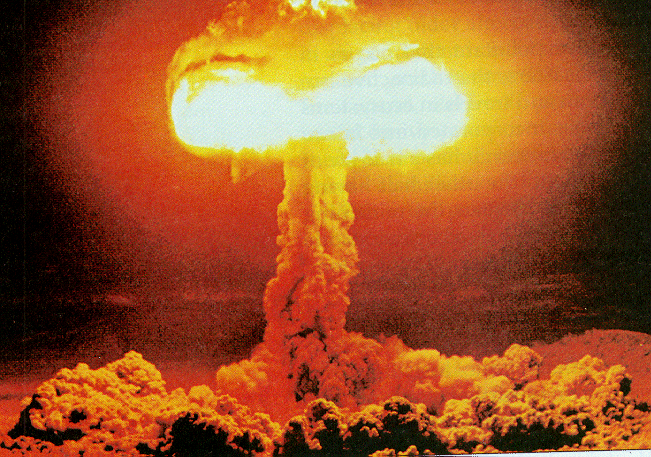
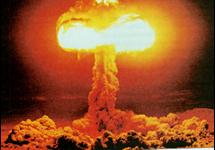
- Trinity test, a plutonium implosion device, takes place at 5:29:45 a.m.
mountain war time at Alamogordo, New Mexico. It is the world’s first atomic
detonation.
|
|
12
|
- July 17
- President Truman at Potsdam writes in his diary, “Just spend [sic] a
couple of hours with Stalin…. He’ll
be in the Jap War on August 15th.
Fini Japs when that comes about.”
- July 21
- President Truman approves order for atomic bombs to be used
- July 23
- UK Prime Minister Winston Churchill remarks, “[I]t is quite clear that
the United States do not at the present time desire Russian
participation in the war against Japan.”
- July 24
- Walter Brown, special assistant to Secretary of State Byrnes, writes in
his journal that Byrnes was now “hoping for time, believing after atomic
bomb Japan will surrender and Russia will not get in so much on the
kill, thereby being in a position to press claims against China.”
|
|
13
|
- July 24
- Secretary of War Henry Stimson passes on orders for atomic attack.
- July 25
- General Carl Spatz, commander of the United States Army Strategic Air
Forces, receives the only written order on the use of atomic weapons
from acting Chief of Staff, General Thomas Handy.
- July 26
- Potsdam Declaration calls upon Japanese government “to proclaim now the
unconditional surrender of all Japanese armed forces.” The alternative, the Declaration
states, is “prompt and utter destruction.”
- July 26
- Forrestal secret diary states, “In the past days Sato in Moscow has been
sending the strongest language to the Foreign Office at Tokyo his urgent
advice for Japan to surrender unconditionally. Each time the Foreign Minister, Togo,
responds by saying that they want Sato to arrange for the Russians to
receive Prince Konoye as a special representative of the Emperor to
Moscow. Sato’s persistent reply
to these messages was that this is a futile hope, that there is no
possibility of splitting the concert of action now existing between
Great Britain, the United States and Russia.”
|
|
14
|
- July 28 |
- Japan rejects Potsdam Declaration.
- August 6
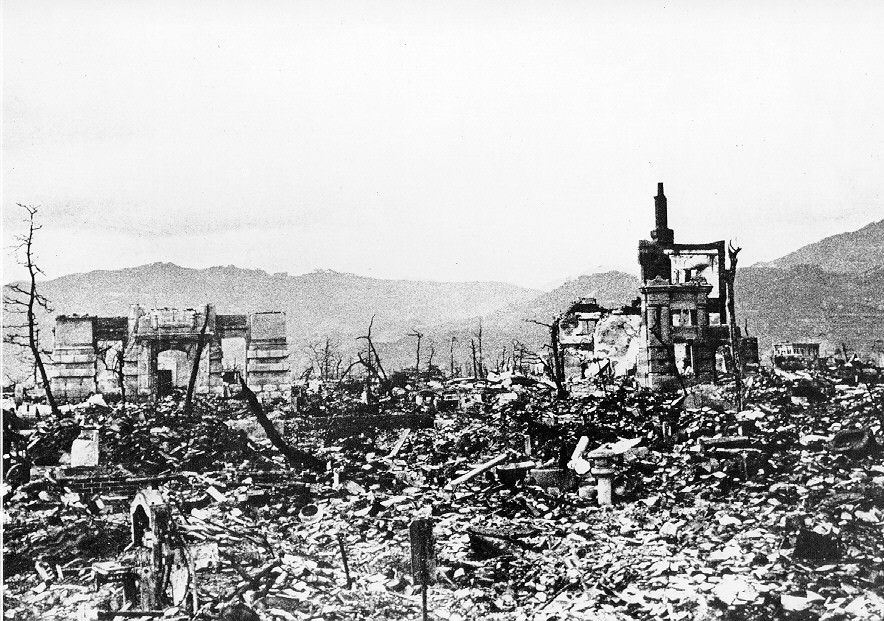
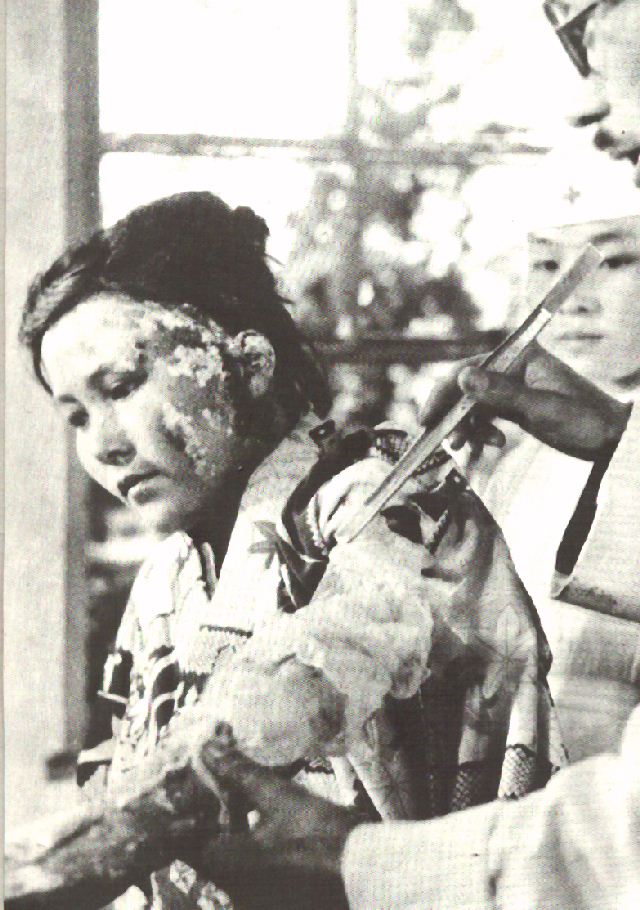
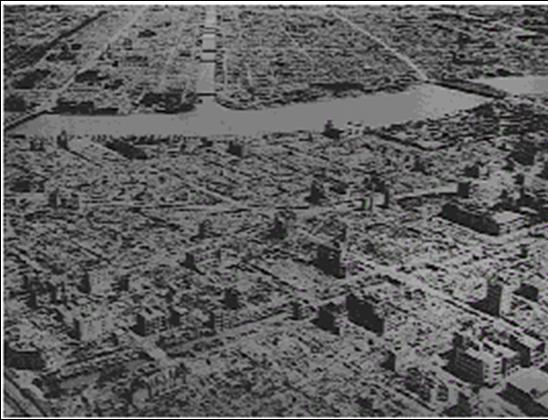
- The world's second atomic bomb, Little Boy, a gun-type uranium bomb, is
detonated 1,900 feet above Hiroshima, Japan. It has a yield of
approximately 15 kilotons TNT. Some 90,000 to 100,000 persons are killed
immediately; about 145,000 persons will perish from the bombing by the
end of 1945.
- August 8
- Soviet Union informs Japan that it is entering the war.
|
|
15
|
- August 9
- At 9:44 a.m. Bockscar, a B-29 carrying Fat Man, the world's third atomic
bomb, arrives at its primary target, Kokura. The city is covered in haze
and smoke from an American bombing raid on a nearby city. Bockscar turns
to its secondary target Nagasaki.
At 11:02 a.m. the world's third atomic bomb explosion devastates
Nagasaki, the intense heat and blast indiscriminately slaughters its
inhabitants
|
|
16
|
- August 9
- President Truman speaks to the American people via radio broadcast He states, “The world will note that
the first atomic bomb was dropped on Hiroshima, a military base. That was because we wished in the
first instance to avoid, in so far as possible, the killing of
civilians.” [The official Bombing
Survey Report stated: “Hiroshima and Nagasaki were chosen as targets
because of their concentration of activities and population.” More than 95 percent of those killed
at Hiroshima and Nagasaki were civilians.]
- August 9
- Atomic bomb dropped on Nagasaki.
- August 9
- Soviet Union begins its offensive against Japan in Manchuria.
- August 14
- Japan surrenders.
|
|
17
|
- Bibliography:
- http://www.trumanlibrary.org/teacher/abomb.htm
- www.willamette.edu/cla/wviews/hiroshima.html
- www.socialstudieshelp.com/Lesson_95_Notes.htm
- www.colorado.edu/AmStudies/lewis/2010/atomic.htm
- History 5N readings, April 12: McGeorge, Berstein, Walzer.
|
|
18
|
|

 Notes
Notes