 v
v
 The
Peace Agreement
The
Peace Agreement
The terms of the peace agreement included compensation payments to Kuwait, inspections to guarantee that
Iraq was no longer making or storing weapons of
mass destruction, and the establishment of "no-fly zones" to protect
the Shiites and Kurds from government air attacks. Unless these demands
were met by Iraq, the sanctions wold remain
in place. Hussein remained in power, despite revolts among the Kurds in the
north and the Shiites in the south and his isolation from almost all other Arab
nations.
During the Iran-Iraq war, oil shipments were limited to trucks or
pipeline. The boycott after the invasion of Kuwait and the damage to the oil
fields during the Gulf War cut deeply into Iraq's oil revenues. The
UN Security Council seized all Iraqi assets abroad to compensate the victims of
the war and to pay for UN inspection expenses in Iraq. The debts incurred
during the Iran-Iraq war, along with the boycott, the loss of assets and the
cost of reparations, have left the Iraqi economy in shambles.
The Problem of
Disarming Iraq
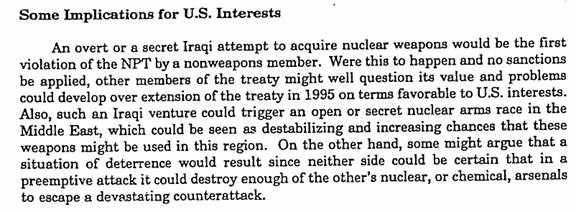
After the Gulf War, the UN Special Commission (UNSCOM) was charged with
disarming Iraq, using
intelligence-gathering methods to destroy Iraq's nuclear, biological, and chemical weapons programs. Because Iraq was so weakened, inspectors
from around the world thought the job would be complete in a year or so.
Eight years later, UNSOM inspectors left Iraq, and the job is still not
done. In 1995, two of Hussein's sons-in-law (with their bodyguards and a
group of insiders) defected to Jordan. They provided
evidence of the existence of biological weapons, many made and stored in
private residences, and easily huttled around the
country under the noses of the UN inspectors.
Iraq's many deceptions and
barriers to inspections, in order to hide their weapons production and storage
sites, caused the US to employ some of its latest
communications spy technology at UNSCOM's
request. The sophisticated technology and the information the technology
yields are customarily not shared, and as UNSCOM's
work became more secretive, it became less open with the member states.
Tensions among them built. At the same time that Iraq refused to allow
inspections of suspected weaons sites, the US was accused of using
information from the "spy technology" for its own ends, and the team
was recalled. The four-day aerial attack by the US and Great Britain in December 1998 dealt the
final blow to UNSCOM.
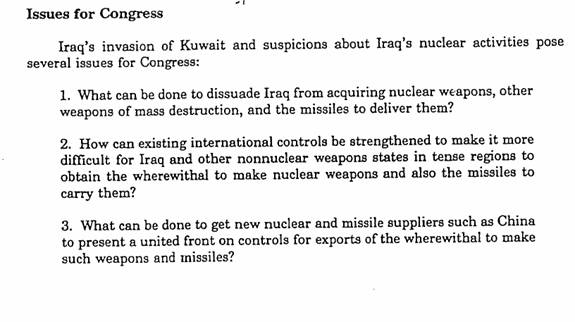
At the end of 1998, the UN was faced with some tough choices. What could
the UN do that would have the support of UN member nations to check Hussein's
threat to the stability of the Middle East? Military attacks
have had little international support and do not provide any long-term
solution. Doing nothing or invading and occupying Baghdad were both considered
unacceptable. In the first case, Iraq would continue to produce
weapons of mass destruction and pose a continued threat to the whole Middle East. In the second case,
the costs of occupying an Arab capital, financially and politically, would be
disastrous.